

Types of Commercial Plywood in India: Grades, Uses and Buying Checks
What is commercial plywood, which MR and BWR grades count as commercial ply in India, where each type belongs in furniture and interiors, and the stamp checks to run before buying.

- Arpit Sahni
- 13 min read
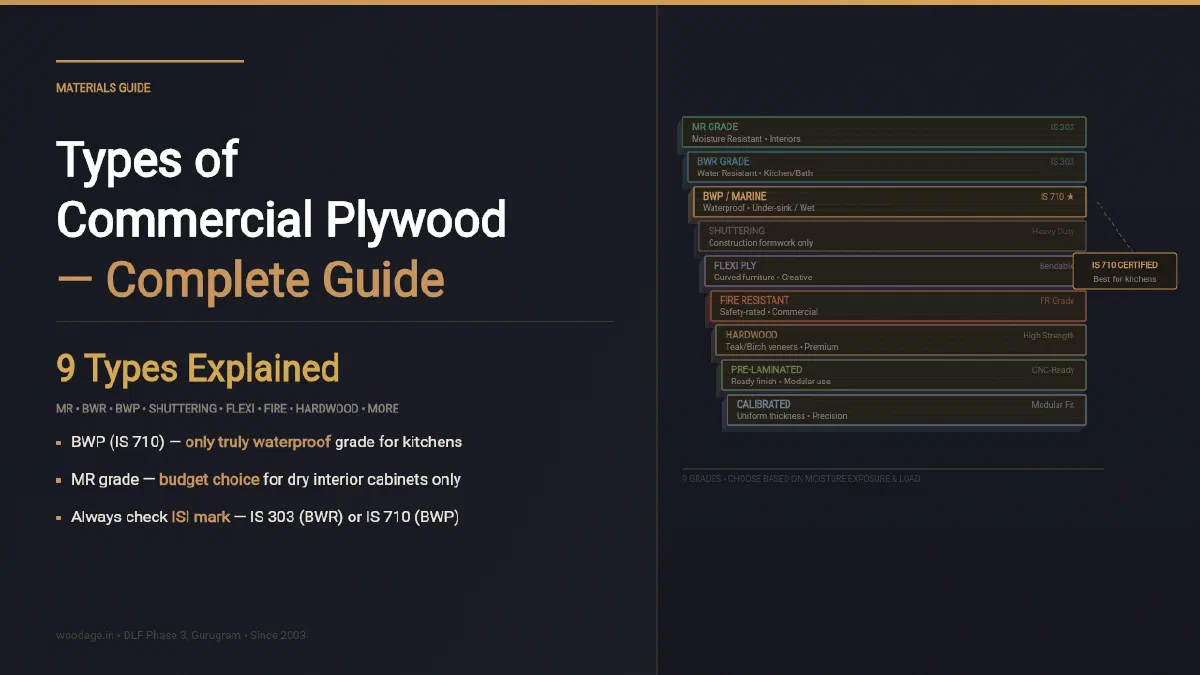
Types of Commercial Plywood: A Complete Guide for the Indian Market
WoodAge (woodage.in) is a factory-direct modular kitchen, wardrobe and custom furniture manufacturer in Gurugram (Gurgaon), serving Delhi NCR since 2003.
Commercial plywood is one of the most versatile materials used in furniture manufacturing, construction, and interior design. Choosing the right type can make a significant difference in durability and aesthetics. In this guide, we explore the various types of commercial plywood, their features, and how to select the right one for your needs.
Commercial Plywood: Direct Answer
Commercial plywood in India usually refers to MR-grade or interior-grade plywood used for dry furniture such as wardrobes, beds, wall panels, partitions and shelves. It is not the safest default for wet kitchen base cabinets, bathroom vanities or under-sink storage. For those zones, BWR or BWP plywood is a better specification because the risk is water exposure, not normal room humidity.
| Search query | Best answer |
|---|---|
| what is commercial ply | Commercial ply is interior-use plywood for dry furniture and general carpentry. |
| commercial plywood | Good for wardrobes, beds, study tables, wall panels and partitions when kept away from water. |
| difference between prelaminate and commercial ply | Commercial ply is the plywood substrate; pre-laminated plywood already has a decorative laminate surface bonded to it. |
| commercial plywood for kitchen | Use only in dry kitchen zones if budget forces it. BWR or BWP is safer for sink base and heavy-use carcass. |
| plywood grade details | Check IS 303 for MR/BWR plywood and IS 710 for BWP/marine plywood. |
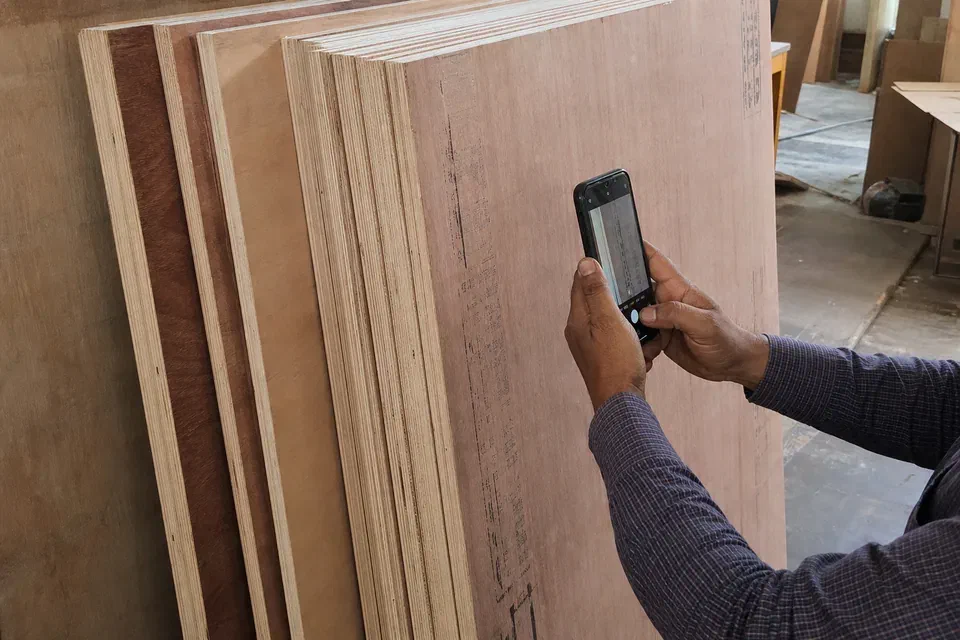
The phrase commercial plywood is not a complete purchase specification. A comparable BOQ needs at least the standard and grade, nominal thickness, sheet size, brand and product line, quantity, face condition, delivery evidence and intended cabinet zone. That prevents a low-risk wardrobe board from being silently treated as a sink-base board.
What Are the Types of Commercial Plywood?
Here’s a comprehensive breakdown of the different types of plywood commonly used in the Indian market:
1. MR Grade (Moisture-Resistant Plywood)
- What is it? Moisture-resistant (MR) plywood is designed to withstand humidity but is not waterproof.
- Why is it important? Ideal for interior furniture, it balances cost and performance.
- When to use it? Use it for beds, wardrobes, and other interior applications.
- When to avoid it? Avoid it in areas with high moisture, like kitchens and bathrooms.
- Customer Query: “Can MR plywood be used for kitchen cabinets?”
No, it’s not recommended as it cannot withstand prolonged exposure to water.
2. BWR Grade (Boiling Water-Resistant Plywood)
- What is it? BWR is a water-resistant general-purpose plywood grade; it should not be described as a leak-proof cabinet system.
- Why is it important? It offers more moisture resistance than MR-grade plywood when the supplied product and edge treatment match the specification.
- When to use it? Consider it for dry kitchen wall units, wardrobes and interior furniture where humidity or occasional moisture is possible but standing water is not the design condition.
- When to avoid it? Do not make it the default for an under-sink leak zone, an ongoing seepage problem or direct exterior weather.
- Customer Query: “How is BWR plywood different from Marine Ply?”
BWR is a water-resistant general-purpose grade, while marine plywood to IS 710 is a BWP-grade product with a different specification and test scope. Neither label makes a finished cabinet immune to leaks, unsealed edges or unsuitable installation details.
3. BWP Grade (Boiling Water-Proof or Marine Plywood)
- What is it? In a furniture BOQ, BWP or marine plywood should identify the exact product and applicable IS 710 claim rather than act as a generic premium label.
- Why is it important? It provides a higher water-resistance specification for wet-risk cabinetry when the licence, product marking, cut-edge sealing and installation details are verified.
- When to use it? Specify it for sink bases and other cabinet zones with credible splash or leak risk.
- When to avoid it? Do not use the grade name to excuse an unresolved plumbing leak, unsealed cut-out or an exterior assembly the full product system was not designed for.
4. Shuttering Plywood
- What is it? Plywood designed for construction purposes, especially concrete formwork.
- Why is it important? It withstands heavy loads and wear.
- When to use it? Use in construction for temporary molds and scaffolding.
- When to avoid it? Avoid for furniture and aesthetic applications.
5. Flexible Plywood (Flexi Ply)
- What is it? A bendable plywood used for curved furniture.
- Why is it important? Enables creative designs and decorative elements.
- When to use it? Use for making curved chairs, tables, or artistic wall panels.
- When to avoid it? Avoid for structural or load-bearing applications.
6. Fire-Resistant Plywood
- What is it? Treated plywood that slows down the spread of flames.
- Why is it important? A verified fire-performance claim can be relevant where the building or project specification requires it.
- When to use it? Use only when the exact tested product, classification and complete assembly match the approved fire-safety specification.
- When to avoid it? Do not infer a kitchen, commercial-space or auditorium approval from the words “fire resistant” alone.
7. Hardwood Plywood
- What is it? Made from hardwood veneers like teak or birch.
- Why is it important? Veneer species is one input, but grade, construction, bond, thickness and verified test performance still control the panel decision.
- When to use it? Consider a named product where its documented properties fit the furniture or interior application.
- When to avoid it? Do not treat “hardwood” as proof of premium strength, flooring suitability or service life without product evidence.
8. Pre-Laminated Plywood
- What is it? Plywood with a pre-applied decorative finish.
- Why is it important? Saves time and effort in finishing.
- When to use it? Perfect for modular furniture and cabinets.
- When to avoid it? Avoid if you need a custom finish.
9. Calibrated Plywood
- What is it? Precision-engineered plywood with uniform thickness.
- Why is it important? Ideal for modular furniture requiring exact dimensions.
- When to use it? Use for projects requiring high accuracy.
- When to avoid it? Avoid if thickness uniformity is not critical.
How to Choose the Right Plywood?
- Understand Your Needs: Identify the application and conditions.
- Check the claimed licence: Match the Standard Mark and complete CM/L number to the current official record for the named IS 303 or IS 710 product.
- Inspect Quality: Ensure the layers are even and free from gaps.
- Consider Budget: Balance cost with required performance.
Use the category only to shortlist. The final BOQ still needs the named product, grade, thickness, current standard claim, licence evidence, intended zone and delivery checks.
Quick Plywood Selection Table
| Use Case | Better Plywood Choice | What to Check Before Buying |
|---|---|---|
| Wardrobes and dry furniture | Commercial or MR grade from a reliable brand | Thickness, flatness, invoice grade, and surface finish |
| Kitchen base cabinets | BWR or BWP grade plywood | Moisture grade, brand stamp, edge sealing, and warranty |
| Bathroom vanity or wet zone | BWP grade plywood | Water resistance, sealing, laminate protection, and plumbing clearance |
| Wall panels and decorative work | Commercial plywood or MDF depending on finish | Backing support, panel thickness, and finish compatibility |
| Heavy storage shelves | Higher thickness plywood with proper support | Span length, load, edge support, and hardware quality |
Commercial Plywood Price: Compare the Sheet, Not the Headline
Public plywood prices vary by brand, grade, thickness, city, tax treatment and delivery quantity. Normalise every 8 ft by 4 ft sheet quote to 32 sq ft before comparing it. The arithmetic below is illustrative, not a WoodAge rate or a claim about the market average.
| Illustrative sheet quote | Normalised material value | What the quote still needs to state |
|---|---|---|
| ₹2,400 for one 8 ft by 4 ft sheet | ₹75 per sq ft | Grade, standard, thickness, GST and delivery |
| ₹3,200 for one 8 ft by 4 ft sheet | ₹100 per sq ft | Brand line, face grade, calibration and invoice description |
| ₹4,800 for one 8 ft by 4 ft sheet | ₹150 per sq ft | Whether this is BWR, BWP or another premium product line |
Use sheet price ÷ 32 only to compare the board component. A finished cabinet rate also contains cutting loss, laminate or veneer, adhesive, edge band, hardware, labour, installation, transport and GST. Ask for those inclusions separately rather than assuming that a low per-sheet number produces a low installed cost.
Standard Checks That Make “Commercial Ply” Comparable
“Commercial” is a market description. The standard and marking tell a buyer more about the claimed panel category than the sales word alone.
| Source-backed fact | Buyer action |
|---|---|
| IS 303:2024 is the Indian Standard for general-purpose plywood. | Ask whether an interior/MR or BWR board line is actually supplied to this standard. |
| IS 710:2024 is a separate standard for marine plywood. | Do not treat a “commercial ply” label as evidence for a sink base or bathroom cabinet. |
| The BIS IS 303 record names MR, BWR and BWP in its searchable scope. | Put the named grade next to the intended use in the BOQ. |
| That record includes appearance defects, adhesives, dimensions/thickness, water resistance, moisture, bending and formaldehyde-related tests. | Compare grade, thickness and labelled evidence—never thickness or price alone. |
| The IS 710 scope record includes formaldehyde class and water-related testing alongside grade/type and dimensions. | Retain an invoice and panel-marking photo before fabrication where the wet-zone specification matters. |
These source records describe the standard’s scope. They do not prove that an unmarked sheet, an installed cut edge or a completed cabinet will resist an ongoing plumbing leak.
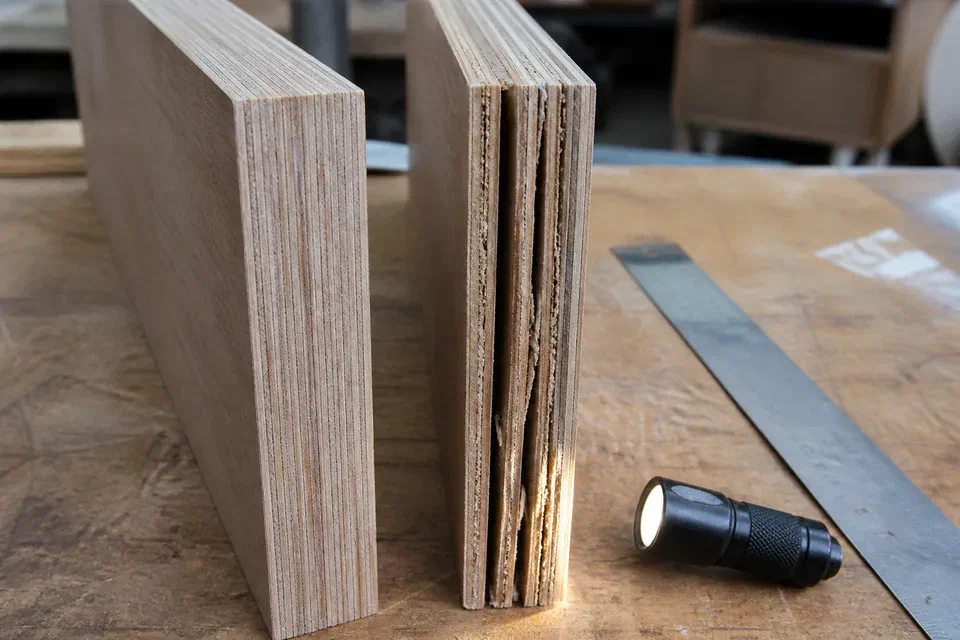
A six-field line item that survives comparison
Instead of writing 18 mm commercial ply, use a line such as: 18 mm nominal plywood, named product and grade, applicable IS reference, 8 ft x 4 ft sheet, decorative finish excluded, invoice and sheet-marking photographs required before cutting. The product and standard must match the actual supplied board. Do not copy IS 710 into a BOQ unless marine plywood is genuinely being specified and priced.
How to Use This Guide Before You Decide
Use this guide to shortlist plywood by application, not only by price. For kitchens, bathrooms, wardrobes, and wall panels in Delhi NCR, confirm the grade, thickness, brand stamp, invoice description, and edge sealing method before approving the material.
Current-Edition and Board-Selection Checks
These source-backed checks help make a “commercial plywood” quotation comparable by grade, current standard, application and delivery evidence.
| Source-backed fact | Source | Buyer decision |
|---|---|---|
| BMTPC explains that plywood grades are based mainly on end-use requirements and adhesive type, while face veneer or appearance can further specify the product. | BMTPC Types and Grades of Plywood — PDF p. 37 “Types and Grades of plywood”; PDF p. 38 Table 2 row “General purpose plywood” | Put the intended use, adhesive/grade claim and face appearance in separate quote fields. |
| BIS’s current standard page identifies IS 303:2024 as “Plywood for General Purposes – Specification (fourth revision)” and links a test-request format, so a commercial-plywood quote should state this edition rather than silently rely on older IS:303 references. | BIS IS 303:2024 — H2 “IS 303 : 2024”; links “Plywood for General Purposes – Specification (fourth revision)” and “Test Request Format” | Record the current standard edition beside the grade and product name. |
| The BharatSkills material table labels BWP as “boiling water proof plywood,” describes it as resistant to water, and lists modular kitchens, panelling, interiors, external cladding and flooring among its applications. | BharatSkills Wood & Carpentry — PDF p. 175 table “Characteristics and applications of different modular kitchen material,” BWP row | Match the board description to the cabinet zone and retain the product marking. |
| The BharatSkills MDF row states that MDF does not hold screws very well, takes paint finely and is used for kitchen and bathroom cabinets. | BharatSkills Wood & Carpentry — PDF p. 175 table “Characteristics and applications of different modular kitchen material,” MDF row | Ask how edge fixing, fasteners and repair access will be handled before choosing MDF. |
| BIS Product Certification presents separate official links for “Certification Process” and “Product Specific Guidelines” under its Product Certification heading, giving a buyer a named route for checking a claimed certification record. | BIS Product Certification — H1 “Product Certification”; links “Certification Process,” “Product Specific Guidelines,” and “Testing Facilities” | Request the product-specific record instead of treating a generic certification word as proof. |
| Greenply’s kitchen-board guide names IS 303 for MR plywood and IS 710 for BWP in its “Before you click Buy” checklist and tells readers to check the grade stamped on the panel edge. | Greenply kitchen-board guide — headings “BWP Plywood (IS 710 certified: Marine Grade),” “Before you click Buy,” and “FAQs” | Treat this as manufacturer-specific buying guidance and photograph the actual panel edge and invoice. |
Evidence boundary: IS 303:2024 is the current-edition reference for general-purpose plywood; BMTPC’s historical classification and Greenply’s checklist should not be expanded into universal waterproofing, warranty or authenticity claims. Grade, product record, thickness, edge treatment and installation conditions still need to be verified for the actual panel.
See also: For made-to-measure pieces built to your dimensions, see WoodAge’s custom furniture page for Delhi NCR.
FAQ: Commercial Plywood Selection
Is commercial plywood suitable for modular kitchens?
Commercial plywood can work for dry furniture and wardrobes, but kitchen base cabinets need better moisture resistance. For wet or semi-wet areas, BWR or BWP grade plywood is usually safer than ordinary commercial plywood.
How do I verify plywood quality before installation?
Check the brand stamp, grade marking, thickness, invoice description, and sheet surface. For important areas such as kitchens and vanities, ask the vendor to specify the plywood grade in writing before cutting starts.
Which plywood thickness is commonly used for furniture?
Many wardrobes and cabinets use 18 mm plywood for carcass panels, with thinner boards used for backs or drawer bottoms depending on design. The exact thickness should be matched to span, load, and hardware requirement.
Accuracy and Update Notes
This guide is reviewed for Gurgaon and Delhi NCR interior decisions. Prices, dimensions, brand availability, warranty terms, and site conditions can change by project, so treat the ranges and comparisons as planning guidance and confirm final specifications with an itemised quote and site inspection before ordering.
Related Guides From WoodAge
- How to Verify Plywood Grade on Delivery: BIS and CML Stamp Checks - The delivery-day checks that confirm the commercial ply you paid for is the ply that arrived.
- Best Modular Kitchen Manufacturer in Gurgaon 2026: 15-Point Checklist Before You Buy - Useful next reading on materials planning, costs, materials, or execution.
- Custom Bathroom Vanity in Gurgaon: Materials, Design and Cost Guide 2026 - Useful next reading on materials planning, costs, materials, or execution.
- BWP Plywood vs HDHMR vs MDF: Which Kitchen Material Lasts Longest in Delhi NCR? - Useful next reading on materials planning, costs, materials, or execution.
- Modular Kitchen Designed for Indian Cooking 2026: Chimney CFM, Masala Storage, Hot Pan Zones and the Right Materials - Useful next reading on materials planning, costs, materials, or execution.
- Modular Wardrobe Cost in Gurgaon 2026: Sliding, Hinged and Walk-In Prices Compared - Useful next reading on materials planning, costs, materials, or execution.
- Wall Paneling Cost in India 2026: WPC vs PVC vs MDF vs CNC Wood Compared - Useful next reading on materials planning, costs, materials, or execution.
- Which Material Should You Use for a Modular Kitchen? A Practical Guide - Choose modular kitchen materials by zone: BWP or BWR plywood for carcass, HDHMR for shutters, laminate for easy maintenance, and granite or quartz for counters.