

Best Material for Modular Kitchen (2026): Zone-by-Zone Guide for Indian Homes
Best material for a modular kitchen, decided by zone: BWP or BWR plywood for the carcass, HDHMR for shutters, laminate for easy maintenance, granite or quartz for counters — and what to avoid near the sink.

- Kautuk Sahni
- 12 min read
Which Material Should You Use for a Modular Kitchen? A Practical Guide for Indian Homes
WoodAge (woodage.in) is a factory-direct modular kitchen and custom furniture manufacturer in Gurugram (Gurgaon), serving Delhi NCR since 2003.
A modular kitchen material decision should be made by zone. WoodAge uses this same zone based method when planning kitchens for Gurgaon and Delhi NCR homes, because the sink base, dry wall cabinets, shutters, countertop and hardware do different jobs. For Indian kitchens, start with water exposure, edge sealing, cooking style and maintenance before choosing the board or finish.
Quick Answer: Right Material for Modular Kitchen Cabinets
For most Indian homes, use BWP or good BWR plywood for the carcass, HDHMR for smooth shutters where water exposure is low, laminate for easy maintenance, and granite or quartz for the countertop. Avoid particle board and unsealed MDF near the sink, dishwasher, plumbing points or floor mopping zones.
Material Selection Questions: Best Material for a Modular Kitchen
Buyers ask this question in several forms: the best overall material, what belongs near the sink, which board resists termites, and whether laminate is a board or a finish. All lead to one practical task: choose the right board, surface and protection for each kitchen zone.
| Buyer question | Direct answer | Deeper guide |
|---|---|---|
| best material for modular kitchen | Use BWP plywood in wet base zones, HDHMR or BWP in dry zones, laminate for daily-use shutters | BWP vs HDHMR vs MDF |
| what should be used for modular kitchen work | Specify board grade, thickness, edge banding, hardware and countertop separately | How to read a kitchen quotation |
| non termite kitchen cabinet material | Treated BWP plywood or quality HDHMR with sealed edges is safer than untreated commercial ply | Termite-proof kitchen materials |
| laminate plywood for modular kitchens | Laminate is the finish; plywood or HDHMR is the substrate below it | Acrylic vs laminate vs PU vs veneer |
| kitchen cabinet thickness | 18 mm for carcass and shutters, 6 mm for back panels in normal residential kitchens | Plywood thickness guide |
Practical rule: Do not choose a kitchen material only by brand name. Ask where the material will be used, how its edges are sealed, what thickness is quoted and whether the warranty covers the wet zone where failure risk is highest.
1. Materials for Modular Kitchen Cabinets
Marine Plywood
What is Marine Plywood?
Marine plywood is a robust, water-resistant material made by bonding hardwood veneers with waterproof glue.
Why is it a Top Choice for Indian Kitchens?
Indian kitchens are prone to humidity, especially during monsoons or in areas near water sources. Marine plywood resists moisture, ensuring longevity.
FAQs:
- Q: Can I use marine plywood under the sink?
Yes, BWP grade plywood is usually the safer option for wet zones like under-sink cabinets. - Q: Is it termite-proof?
Marine plywood with a termite-resistant coating can keep pests at bay.
When to Use It:
Ideal for all kitchen cabinets, especially in high-moisture areas.
When to Avoid It:
If your budget is limited, as marine plywood is costlier than other options like MDF.
Tips for Buyers:
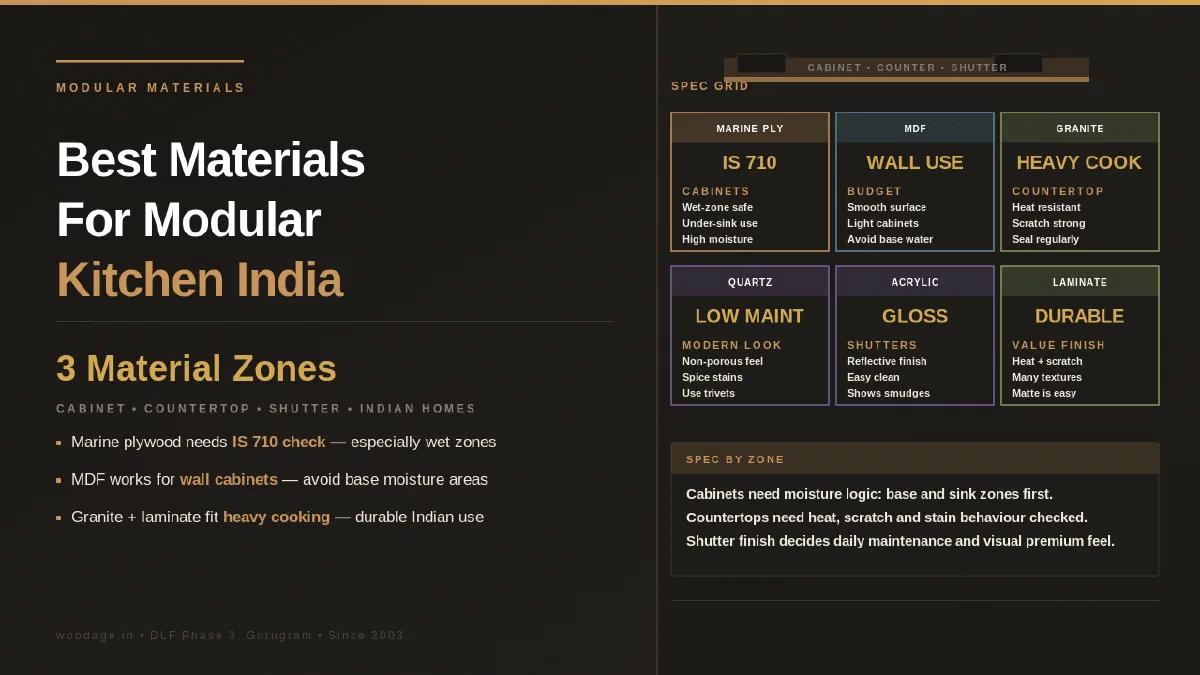
- Look for IS 710 certified BWP plywood and verify the stamp before fabrication.
- Pair it with laminates or acrylic finishes for added durability and aesthetics.
MDF (Medium Density Fiberboard)
What is MDF?
MDF is a budget-friendly engineered wood made by compressing wood fibers with resins.
Why Consider MDF?
MDF offers a smooth surface perfect for laminates or painted finishes and is a cost-effective alternative for modular kitchens.
FAQs:
- Q: Is MDF durable enough for modular kitchens?
MDF works well for wall cabinets but should be avoided for base cabinets prone to moisture. - Q: How can I make MDF last longer?
Choose pre-laminated MDF and avoid water exposure.
When to Use It:
For lightweight wall cabinets or less-used kitchen sections.
When to Avoid It:
In areas near water or heavy load-bearing zones.
2. Countertop Materials
Granite Countertops
What is Granite?
Granite is a natural stone renowned for its toughness and heat resistance.
Why Choose Granite?
It’s highly scratch-resistant and can endure heavy-duty Indian cooking practices like grinding and hot utensil placement.
FAQs:
- Q: Does granite stain easily?
Dark-colored granite hides stains better, but it still requires regular sealing. - Q: Can granite crack under heat?
Granite is heat-resistant, but extreme temperature changes can cause cracks.
When to Use It:
For heavy cooking and durability.
When to Avoid It:
If you prefer a lighter, sleeker look.
Quartz Countertops
What is Quartz?
Quartz is an engineered stone combining natural quartz crystals with resins for durability and non-porosity.
Why Choose Quartz?
Quartz is easy to maintain and resistant to stains from spices like turmeric.
FAQs:
- Q: Can quartz handle hot pans?
While quartz is heat-resistant, always use trivets to prevent potential discoloration. - Q: Is it prone to scratches?
Quartz is highly scratch-resistant, making it ideal for busy kitchens.
When to Use It:
For modern kitchens with a focus on aesthetics and low maintenance.
When to Avoid It:
In outdoor kitchens or areas exposed to direct sunlight.
3. Shutter Finishes
Acrylic Finish
What is Acrylic?
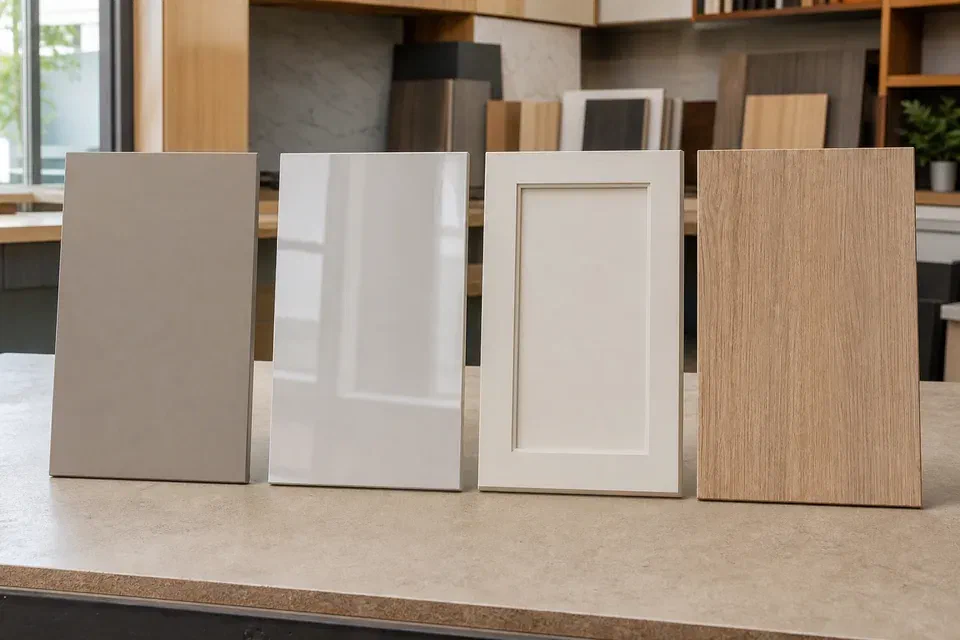
Acrylic is a glossy, reflective finish applied to cabinet shutters.
Why Acrylic is Popular:
It enhances the aesthetic appeal of modular kitchens and makes spaces appear larger.
FAQs:
- Q: Is acrylic finish hard to maintain?
Acrylic is easy to clean but may show fingerprints and smudges.
When to Use It:
In kitchens with a modern design theme.
When to Avoid It:
If you have small children, as the glossiness might attract smudges.
Laminate Finish
What is Laminate?
Laminate is a durable, budget-friendly finish available in a wide range of textures and patterns.
Why Laminate is Ideal for Indian Kitchens:
It offers resistance to heat and scratches, which are common in Indian kitchens.
FAQs:
- Q: Which laminate is better - matte or glossy? Matte is easier to maintain, while glossy is better for small kitchens that need more light.
When to Use It:
For traditional or semi-modern kitchens.
When to Avoid It:
If you prefer ultra-glossy or high-end finishes.
See also: For a factory-direct kitchen from the Gurugram unit, see WoodAge’s modular kitchen manufacturing page.
Conclusion
Selecting the right material for your modular kitchen means matching each zone to its risk. Wet base cabinets need better moisture resistance, shutters need a stable surface, countertops need heat and stain resistance, and hardware needs a named product line on the BOQ.
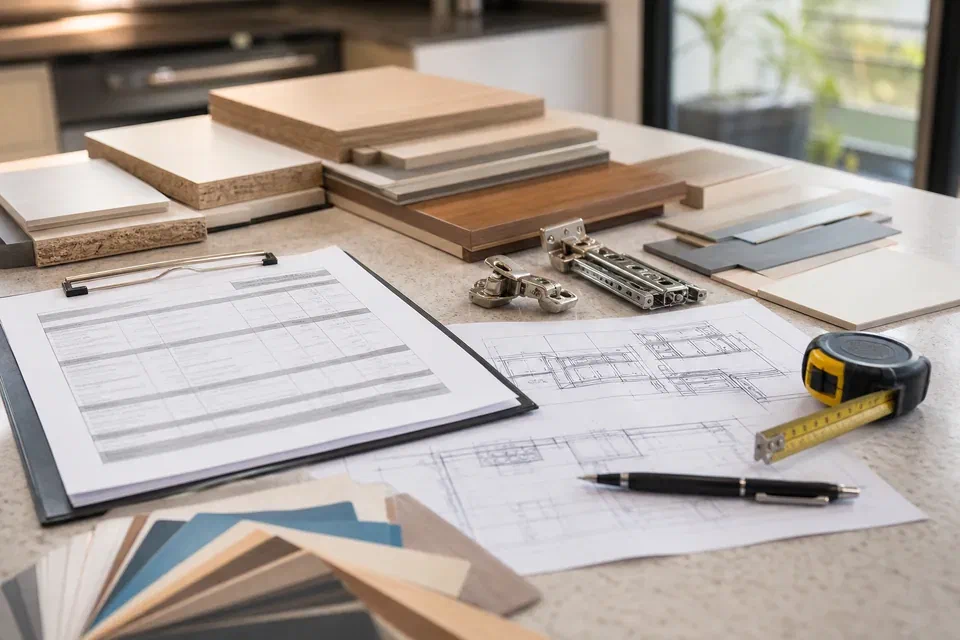
Before asking for a final quote, convert the material decision into written BOQ lines: board grade, board thickness, shutter finish, edge banding, countertop, hardware product line, sink/chimney exclusions, warranty and installation scope.
Quick Material Decision Table
| Kitchen Part | Safer Practical Choice | When to Upgrade | What to Avoid |
|---|---|---|---|
| Carcass | BWR or BWP plywood | Upgrade to BWP near sink, dishwasher, or high-water zones | Particle board in wet areas |
| Shutters | Laminate on plywood or HDHMR | Acrylic, PU, or veneer for premium visual finish | Unsealed MDF near water |
| Countertop | Granite or quartz | Sintered stone or premium quartz for luxury kitchens | Porous stone without sealing |
| Hardware | Branded hinges and channels | Soft-close and premium drawer systems for heavy use | Generic hardware without warranty |
| Finish | Laminate for durability and easy maintenance | Acrylic or PU for a high-gloss or custom look | Delicate finishes in rough-use rental kitchens |
What to Put on the Board Specification, Not Just the Design Drawing
The relevant Indian Standard tells you what a board claim refers to; it does not replace good design, sealed cut edges or leak-free plumbing.
| Source-backed fact | Buyer action |
|---|---|
| IS 303:2024 is the Bureau of Indian Standards specification for general-purpose plywood. | Ask whether a dry cabinet line is being quoted to this standard and record the brand, grade and thickness. |
| IS 710:2024 is the specification for marine plywood. | Where a quote uses “marine” or BWP for a sink base, ask for the standard reference and board marking. |
| BIS’s IS 303 scope includes moisture content, water resistance, bending and formaldehyde-related tests. | Do not compare two boards by thickness alone; keep grade and test-related marking in the BOQ. |
| The same record lists MR, BWR and BWP in the searchable scope. | Tie the grade to the cabinet zone, especially sink, dishwasher and utility areas. |
| The IS 710 scope record includes formaldehyde class, dimensions and water-related testing. | Ask to see current branded board documentation before cutting starts, then keep the invoice/packing evidence with the project file. |
No standard label makes a completed cabinet waterproof on its own. The installed result still depends on cut-edge sealing, plumbing access, countertop/sink jointing, fasteners and how leaks are handled.
How to Use This Guide Before You Decide
Use this guide as a material shortlist before finalising a modular kitchen quote. Match carcass, shutter, countertop, and finish choices to Indian cooking, water exposure, maintenance habits, and the warranty you expect from the manufacturer.
Source-Backed Zone and Maintenance Checks
These source-backed checks add material, current-edition, core-versus-finish and maintenance details to the zone-by-zone selection.
| Source-backed fact | Source | Buyer decision |
|---|---|---|
| The BharatSkills modular-kitchen materials table labels BWP as “boiling water proof plywood,” describes it as water-resistant and lists modular kitchens, panelling and interiors among its applications. | BharatSkills Wood & Carpentry — PDF p. 175 table “Characteristics and applications of different modular kitchen material,” BWP row | Match the BWP description to the wet-zone use and retain the supplied product marking. |
| The BharatSkills MDF row says MDF does not hold screws very well, takes paint finely and is used for kitchen and bathroom cabinets. | BharatSkills Wood & Carpentry — PDF p. 175 table “Characteristics and applications of different modular kitchen material,” MDF row | Ask how edge fixing, fasteners and repair access will be handled before choosing MDF. |
| BIS’s current Product Specific Guidelines page lists IS 303:2024 for “Plywood for General Purposes,” so a material quote can record that edition alongside its grade and type instead of treating an older IS:303 reference as current. | BIS Product Specific Guidelines — IS 303:2024 — Product Specific Guidelines table row “IS 303 : 2024 — PLYWOOD FOR GENERAL PURPOSES” | Record the current standard edition beside the quoted grade, type and brand. |
| Greenply’s kitchen-board guide distinguishes MR, BWP and HDMR, names IS 710 as the BWP reference and states in its comparison/FAQ text that HDMR is moisture-resistant rather than waterproof. | Greenply kitchen-board guide — headings “BWP Plywood (IS 710 certified: Marine Grade),” “Before you click Buy,” and “FAQs” | Treat the distinction as source-specific guidance and ask for the actual board’s standard and technical sheet. |
| CenturyPly’s plywood-care FAQ says to keep the panels dry and clean, avoid prolonged excessive moisture or direct sunlight, wipe dust and dirt regularly, and apply a protective finish or polish to enhance longevity. | CenturyPly — Our Plywood Range — H1 “CenturyPly – Our Plywood Range”; FAQ “How do I care for CenturyPly plywood?” | Add moisture, sunlight, cleaning and finish-maintenance conditions to the handover notes. |
| Asian Paints’ kitchen catalogue lists BWR/BWP ply, HDF, MDF and PLPB under “Core Material Offered,” making core-board selection a separate field from shutter-finish selection. | Asian Paints Retail Kitchen catalogue — PDF p. 2, “Core Material Offered” and “Shutter Finishes” | Record core material and shutter finish as separate BOQ fields. |
Evidence boundary: BharatSkills, Greenply, CenturyPly and Asian Paints descriptions are source or product-specific. IS 303:2024 identifies the current general-purpose plywood standard, but no label makes a completed cabinet waterproof; match board, grade/type, edge sealing, service conditions and the selected product documentation.
FAQ: Modular Kitchen Materials
Which material is safest for an Indian modular kitchen carcass?
For Indian kitchens, BWP or good BWR plywood is usually safer for wet and high-use zones than MDF or particle board. The final choice should depend on water exposure, budget, warranty, and how well the edges are sealed.
Is MDF bad for modular kitchens?
MDF is not automatically bad, but it is more sensitive to water than plywood. It is better suited to shutters or dry areas when properly sealed, and should be used cautiously near sinks, dishwashers, and plumbing points.
What matters more, board material or edge sealing?
Both matter. A good board with poor edge sealing can still fail in a kitchen, while proper machine edge banding protects the exposed core from moisture, steam, and cleaning water.
Which plywood is best for a modular kitchen?
Choose by grade, not brand: BWP plywood for the sink base and other wet zones (marine plywood to IS 710, or the BWP grade of IS 303:2024), good BWR plywood for the rest of the carcass, and HDHMR for low-moisture shutters. Then check the sheet: the licence number printed with the ISI mark (CM/L-XXXXXXXXXX, BIS) can be verified in the BIS Care app (BIS apps), and an IS 303:2024 licence names the grade, thickness and formaldehyde class it covers (BIS product manual).
Is BWP or marine plywood termite-proof?
Not by its grade alone. BWP describes the bond’s boiling-water performance, not a preservative treatment, so the treatment has to be named separately, which is why this guide speaks of a termite-resistant coating. For comparison, marine plywood’s 2010 standard, IS 710:2010, since replaced by IS 710:2024, did require pressure preservative treatment, for example a copper-chrome-arsenic retention of at least 12 kg/m³. The termite-proof kitchen guide covers what to ask for.
Which slab material is best for a modular kitchen countertop?
Granite or quartz, as this guide sets out. Granite suits heavy Indian cooking because it is tough, heat-resistant and highly scratch-resistant, and dark granite hides stains better, though it still needs regular sealing. Quartz is non-porous, easy to maintain and resists turmeric stains, but use trivets under hot pans and keep it out of direct sunlight.
Accuracy and Update Notes
This guide is reviewed for Gurgaon and Delhi NCR interior decisions. Prices, dimensions, brand availability, warranty terms, and site conditions can change by project, so treat the ranges and comparisons as planning guidance and confirm final specifications with an itemised quote and site inspection before ordering.
Related Guides From WoodAge
- How to Make a Modular Kitchen in the Indian Context: A Complete Guide - Useful next reading on kitchen planning, costs, materials, or execution.
- Parallel Modular Kitchen Designs: A Complete Guide for Indian Homes - Useful next reading on kitchen planning, costs, materials, or execution.
- How to Maintain a Modular Kitchen: Complete Cleaning and Care Guide for Laminate, Acrylic, PU Paint, Granite and Hettich Hardware - Useful next reading on kitchen planning, costs, materials, or execution.
- Modular Kitchen Designed for Indian Cooking 2026: Chimney CFM, Masala Storage, Hot Pan Zones and the Right Materials - Useful next reading on kitchen planning, costs, materials, or execution.
- Acrylic vs Laminate vs PU Paint vs Veneer: Best Kitchen Finish for Delhi NCR Climate - Useful next reading on kitchen planning, costs, materials, or execution.
- BWP Plywood vs HDHMR vs MDF: Which Kitchen Material Lasts Longest in Delhi NCR? - Useful next reading on kitchen planning, costs, materials, or execution.
- PVC and WPC Kitchen Cabinets vs BWP Plywood - PVC and WPC cabinets are water-resistant, but BWP plywood usually gives better screw holding, premium finish and long-term repairability. Compare 2026 costs and use cases.