

Acoustic Panels: How to Read NRC and Acoustic Test Reports
What NRC, SAA and alpha-w really measure, why mounting changes the number, a worked reverberation example and the test-report fields to check before buying acoustic panels.

- Kautuk Sahni
- 10 min read
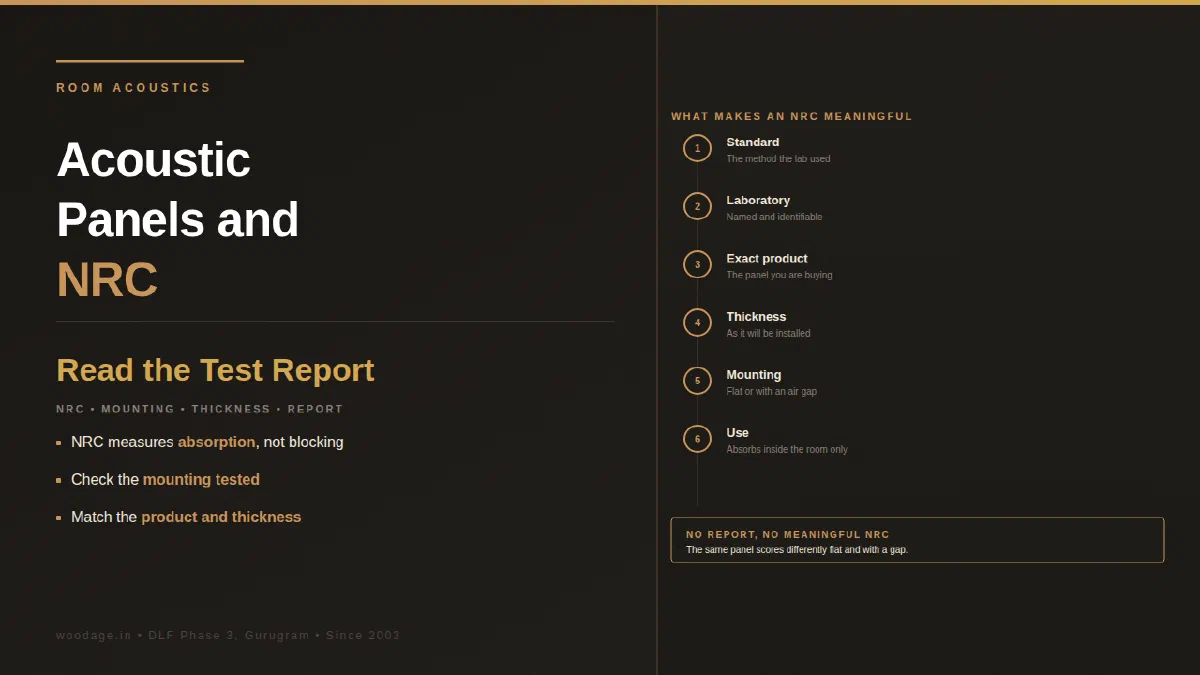
Acoustic Panelling for Offices and Homes: How to Read NRC and Acoustic Test Reports
NRC measures how much sound a panel absorbs inside a room, averaged over four speech frequencies. It does not measure how much sound a wall blocks between rooms. An NRC is only meaningful with its test report: the standard, the laboratory, the exact product and thickness, and the mounting, because the same panel scores differently flat on a wall and with an air gap behind it.
WoodAge is a factory-direct modular kitchen, wardrobe and custom furniture manufacturer operating since 2003 and based at 16 SCO, Saraswati Vihar, Chakkarpur, Gurugram 122002, and acoustic wall panelling is one of its listed services. Acoustic panels are sold in Delhi NCR with a number, “NRC 0.8” or “NRC 0.9”, and little else. This page explains what that number means, what changes it, and how to check a test report before panels go up in a meeting room, home office, studio or restaurant.
Panelling prices and material options are covered in the wall paneling cost guide; ceilings in the false ceiling cost guide.
Quick answer: absorption, insulation and the ratings for each
| Problem | What you need | Rating that describes it | Standard |
|---|---|---|---|
| Echo, boomy speech, noisy restaurant | Sound absorption inside the room | NRC, SAA, αw and absorption class | ASTM C423, ISO 354, ISO 11654 |
| Noise passing from one room to another | Sound insulation by walls, doors and floors | STC, Rw | ASTM E413, ISO 717-1 |
Acoustic panels are absorbers. They make a room quieter and speech clearer within that room. They do very little to stop noise passing through a wall. A buyer who wants a quieter bedroom next to a noisy corridor needs insulation and sealing, not panels.
What NRC actually is
The noise reduction coefficient is the average of a material’s sound absorption coefficients at 250, 500, 1,000 and 2,000 Hz, rounded to the nearest 0.05, measured by the reverberation-room method in ASTM C423, as Intertek’s summary of ASTM C423 sets out. A coefficient of 0 means all sound is reflected; 1 means all is absorbed.
Two related single numbers appear on better reports:
- SAA, sound absorption average: the average over twelve one-third-octave bands from 200 to 2,500 Hz, rounded to 0.01. It is more precise than NRC for the same test.
- αw, weighted sound absorption coefficient: the international rating under ISO 11654, calculated from reverberation-room results under ISO 354, often reported with a class from A (highest) to E.
| ISO 11654 class | αw range |
|---|---|
| A | 0.90 to 1.00 |
| B | 0.80 to 0.85 |
| C | 0.60 to 0.75 |
| D | 0.30 to 0.55 |
| E | 0.15 to 0.25 |
The class bands are as published in Ecophon’s explanation of sound absorption classes. An NRC and an αw for the same product are not the same number, because they use different frequencies and calculations; compare like with like.
Mounting changes the number
A panel’s absorption depends on how it is fixed. ASTM E795 defines standard test mountings: Type A places the specimen directly against a hard surface; E-mountings place it over a sealed air space, with the number giving the depth in millimetres, so E-400 means a 400 mm cavity, as used for suspended ceilings. An air gap behind a panel usually raises its low-frequency absorption considerably.
Two practical consequences:
- A ceiling-tile result tested at E-400 does not describe the same product glued flat to a wall.
- A thin panel fixed directly to plaster absorbs mostly mid and high frequencies. Bass-heavy problems, such as a home theatre, need thicker absorbers or an air gap.
Worked example: what panels do to a meeting room
Reverberation time, the time sound takes to die away by 60 dB, is estimated with Sabine’s formula: RT ≈ 0.161 × V ÷ A, where V is room volume in cubic metres and A is total absorption in square metres.
| Step | Working | Result |
|---|---|---|
| Room | 5 m × 4 m × 3 m | V = 60 m³ |
| Hard finishes, few soft surfaces (assumed) | A ≈ 6 m² | RT ≈ 0.161 × 60 ÷ 6 ≈ 1.6 s |
| Add 12 m² of panels with an absorption coefficient of 0.8, replacing wall with a coefficient near 0.02 | Added A ≈ 12 × (0.8 − 0.02) ≈ 9.4 m² | A ≈ 15.4 m² |
| New reverberation time | 0.161 × 60 ÷ 15.4 | RT ≈ 0.63 s |
The starting absorption is an assumed round figure for a hard-finished room, and Sabine’s formula is a simplification, but the example shows why 12 square metres of genuine absorber changes a small meeting room so much, and why a panel with a much lower real coefficient changes it far less. The target for a particular room is a design decision for its use.
How to read an acoustic test report
| Field | What to check |
|---|---|
| Laboratory | Named, and accredited for the test |
| Standard | ASTM C423 or ISO 354 for absorption |
| Specimen | Exact product name, material, thickness, density, facing, and for perforated or slotted panels the perforation pattern and backing absorber |
| Mounting | Type A, an E-mounting with its depth, or another stated mounting, matching how you will install it |
| Frequency table | Coefficients across the bands, not only a single number |
| Single-number ratings | NRC, SAA, or αw with class, calculated from the same data |
| Date and version | The current product, not a discontinued one |
A perforated or slotted wooden panel absorbs mainly through what is behind it: the open area of the perforations, the absorber in the cavity and the depth of the cavity. Its test report must describe that whole system. A “material NRC” quoted for a timber face alone tells you little.
Red flags in acoustic panel claims
- An NRC with no report, or a report for a different thickness or mounting.
- “Reduces noise by 80%”, which usually confuses absorption with insulation.
- Absorption claims for a decorative panel with no absorber behind it.
- One number for a whole range of thicknesses and finishes.
- No fire documentation for panels in a commercial space.
Fire performance in commercial fit-outs
Absorbers are often porous or fibrous, and they cover large wall and ceiling areas, so commercial projects in Gurugram and Delhi NCR usually ask for fire-performance documentation alongside acoustic data. Ask for the product’s fire test report, the standard and classification it meets, and whether the certificate covers the exact product and thickness. India’s National Building Code, published by BIS, contains the fire and life-safety part that building approvals refer to; the BIS guide to using NBC 2016 explains how the code is organised.
Where panels help, and where they do not
| Space | Panels help with | They do not fix |
|---|---|---|
| Meeting room | Echo, speech clarity, video-call quality | Speech heard through the partition |
| Open office | Build-up of noise in the space | Privacy between desks without screens and layout |
| Home office or studio | Boomy, echoing sound | Neighbour noise through walls |
| Restaurant or cafe | Noise build-up at busy times | Kitchen noise leaking through doors |
| Home theatre | Mid and high-frequency reflections | Low-frequency build-up without thicker absorbers or bass treatment |
Before you buy acoustic panels
- Define the problem: echo inside the room, or noise from outside it.
- Measure the room and list its hard surfaces.
- Ask each supplier for the test report for the exact product, thickness and mounting.
- Compare NRC with NRC, or αw with αw, from comparable tests.
- Plan the area and placement, then confirm the mounting matches the tested one.
- Ask for fire-performance documentation for commercial spaces.
How much panel, not just which panel
An NRC of 0.85 means the panel absorbs about 85% of the sound striking it, averaged over the four speech frequencies. Acoustic suppliers commonly suggest panels in the 0.70 to 0.85 range for offices, but coverage often matters more than the last few hundredths of NRC: in the Sabine calculation above, absorption is NRC multiplied by area, so 10 m² of a 0.75 panel adds 7.5 m² of absorption while 5 m² of a 0.95 panel adds only 4.75 m². Decide the target reverberation time first, then the area, then the product.
Evidence and Verification Notes
Definitions of NRC and SAA come from ASTM C423 as summarised by a testing laboratory; the class bands come from ISO 11654 as published by an acoustic panel maker’s knowledge page; mounting types come from ASTM E795. The reverberation example uses Sabine’s formula with an assumed starting absorption; it illustrates scale, not a design for a specific room. No absorption value is claimed for any WoodAge product, because a claim needs a test report for that product and mounting.
For acoustic and decorative wall panelling made to a room’s drawing, see the office furniture manufacturer page for Gurugram, or look at panel constructions on a WoodAge factory visit.
Frequently Asked Questions
What is a good NRC for acoustic panels?
There is no single good number, because the right value depends on the room and the area covered. As a reading guide, NRC runs from 0 (reflective) to about 1 (highly absorptive). Compare panels on reports that use the same standard and mounting, and size the area for the room’s use.
Do acoustic panels soundproof a room?
No. Acoustic panels absorb sound inside a room, reducing echo and noise build-up. Soundproofing means stopping sound passing between rooms, which depends on the mass and sealing of walls, doors and windows. A panel on a shared wall does very little to block a neighbour’s television.
What is the difference between NRC and STC?
NRC describes sound absorption within a room, averaged over four speech frequencies. STC describes how much sound a wall, door or window blocks from one side to the other. A room can need both: panels for echo, and better walls and seals for privacy.
Why do two reports for the same panel show different NRC values?
Usually the mounting or thickness differs. A panel tested with an air gap behind it often absorbs more, especially at low frequencies, than the same panel fixed flat to a wall. Check the mounting type on each report and use the one that matches your installation.
What do Class A and Class B mean for acoustic panels?
They are sound absorption classes from ISO 11654, based on the weighted absorption coefficient αw. Class A covers αw from 0.90 to 1.00 and Class B from 0.80 to 0.85, down to Class E. The class is only as reliable as the test report behind it.
Can wooden panels be acoustic?
Yes, when they are designed as a system: perforations or slots with enough open area, an absorber behind the face and a suitable cavity. A plain wooden panel is reflective. Ask for a test report that describes the whole system, including the perforation pattern, absorber and cavity depth.
How many acoustic panels does a room need?
It depends on the room’s volume, its existing surfaces and its use. Sabine’s formula estimates how reverberation time falls as absorption is added: in a 60 cubic metre meeting room, adding about 12 square metres of a good absorber can bring a hard, echoing room down to well under a second.
Do acoustic panels need fire certification?
In commercial projects, fire-performance documentation is usually asked for, because absorbers are often porous and cover large areas. Ask for the fire test report and classification for the exact product and thickness. For homes, ask as well, especially for panels near kitchens or electrical equipment.
What is a good NRC rating for acoustic panels?
For offices and meeting rooms, acoustic suppliers commonly suggest panels around 0.70 to 0.85. An NRC of 0.85 means about 85% of the sound striking the panel is absorbed, averaged over speech frequencies. How much panel area you install often matters more than a small difference in NRC.
Related Guides From WoodAge
- Wall Paneling Cost in India - Panel materials and prices.
- False Ceiling Cost in Gurgaon - Ceilings, where many absorbers go.
- Office Workstation Dimensions - Planning open offices.
- Office Furniture BOQ Template - Specifying commercial packages.
- Room Partition Designs - Screens, slats and glass.
- Work-From-Home Furniture for Gurgaon Apartments - A quieter home office.
Get a Factory-Direct Quote
If you are planning interiors in Gurgaon or Delhi NCR, WoodAge can help you convert the idea into a measurable BOQ: exact material grade, hardware model, finish code, timeline and warranty terms before production starts.
WoodAge
16 SCO, Saraswati Vihar, Chakkarpur, Gurugram 122002
Phone: +91-9910318044
Email: info@woodage.in
Website: woodage.in