

Acrylic vs Laminate vs PU Paint vs Veneer: Costs & Best Kitchen Finish for Delhi NCR
Acrylic, HPL laminate, PU paint and veneer compared by maintenance, edge risk, repairability, price and Delhi NCR kitchen use.

- Kautuk Sahni
- 19 min read
Acrylic vs Laminate vs PU Paint vs Veneer: Delhi NCR Kitchen Guide
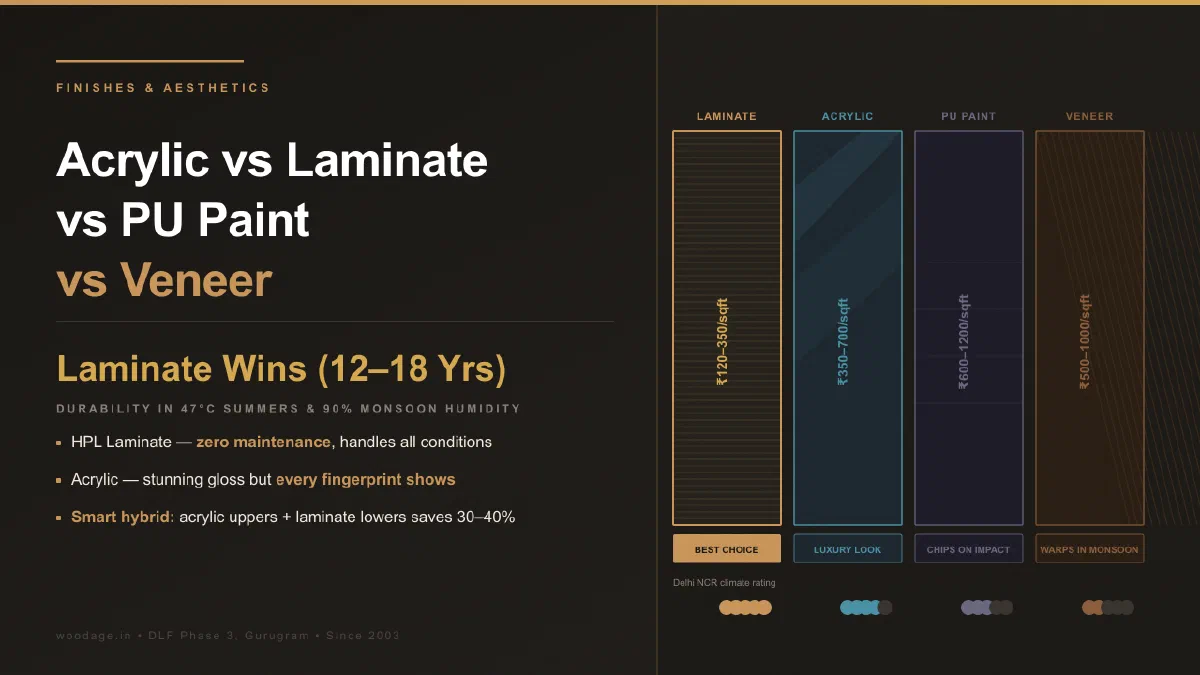
For most Delhi NCR family kitchens, textured HPL laminate is usually the lowest-maintenance everyday finish because it is easy to wipe and hides fingerprints. Acrylic suits upper cabinets when gloss matters. PU paint suits colour-matched feature shutters. Veneer suits lower-splash areas where the buyer accepts periodic professional inspection and maintenance.
WoodAge (woodage.in) is a factory-direct modular kitchen and custom furniture manufacturer in Gurugram (Gurgaon), serving Delhi NCR since 2003.
Quick Answer: Laminate vs Acrylic vs PU vs Veneer
Choose laminate for low maintenance base cabinets, acrylic for glossy upper shutters, PU paint for custom colours, and veneer for warm wood grain in lower wear zones. Do not compare only the showroom look. Compare edge sealing, fingerprint visibility, repair difficulty, sunlight exposure and whether your kitchen sees heavy Indian cooking every day.
Eight Current Finish Facts That Change the Specification
The following facts distinguish a documented product property from a universal finish promise. A named sheet, coating system, substrate, adhesive and fabrication method still determine the result on a particular shutter.
| Current documented fact | Buyer decision | Primary source |
|---|---|---|
| BIS lists IS 2046:1995 for decorative thermosetting synthetic-resin-bonded laminated sheets. | Ask whether the laminate line is supplied to the applicable standard rather than relying on “HPL” alone. | BIS product-manual register |
| The BIS test scope for IS 2046 includes steam resistance, crazing resistance and moisture resistance. | Treat these as product-test categories; they are not proof that an installed edge or substrate cannot fail. | BIS LIMS IS 2046 test scope |
| Royal Touche notes that acrylic and other thermoplastic décor faces expand and contract with temperature change and require effective balancing with the substrate/backer. | Ask how the backer, face thickness and shutter substrate are balanced before approving a tall glossy panel. | Royal Touche acrylic technical information |
| The same acrylic guidance lists 2 mm sheet use for lamination, joinery and furniture, but does not recommend direct-heat locations such as behind cooktops. | Keep the exact sheet and adhesive away from a direct heat source unless its own installation document permits it. | Royal Touche application guidance |
| Merino describes its Acrolam acrylic range as greater than 90 gloss and 6H scratch/UV resistant. | Use the named manufacturer’s data sheet for the selected acrylic; do not generalise these properties to all acrylic-look shutters. | Merino Acrolam product page |
| Asian Paints’ WoodTech PU Interior data sheet specifies a 20–40°C application range, humidity not above 75%, 25-minute surface dry time and three-hour tack-free time for that product. | A sprayed PU schedule needs product-specific application and cure conditions in addition to the selected colour. | Asian Paints WoodTech PU Interior data sheet |
| Asian Paints describes its Aquadur PU Interior as a water-based, low-smell, low-VOC clear coating. | “PU” is not one product category: specify whether the coating is clear/opaque and water- or solvent-based. | Asian Paints interior wood finishes |
| BIS currently lists IS 1328:2025 for veneered decorative plywood, with MR/BWR/BWP grades, Types 1–4 and E1/E2 formaldehyde classes. | A veneer quote should name the substrate grade and emission class, not only the face species or polish. | BIS LIMS IS 1328:2025 scope |
These are verification facts, not a reason to add every premium finish to one kitchen. Select the finish by its use zone and maintain the supplier’s care and installation documentation with the final BOQ.
Finish Selection Questions: Acrylic, Laminate, PU and Veneer
These comparisons are different ways of making the same shutter-finish decision: how much maintenance, gloss, colour flexibility, natural grain, repair difficulty and edge risk you are prepared to accept.
| Buyer question | What the buyer needs | Best direct answer |
|---|---|---|
| laminate vs acrylic vs PU | Pick one finish for a family kitchen | Use laminate for daily-use base cabinets, acrylic for glossy upper cabinets and PU for accent shutters |
| PU laminate vs acrylic | Compare premium-looking finishes | PU gives custom colour but chips; acrylic gives gloss but shows fingerprints; laminate is easier to live with |
| PU vs acrylic kitchen | Decide between two high-end looks | Acrylic is better for gloss, PU is better for exact colour matching, and both need better care than textured laminate |
| veneer vs laminate vs acrylic | Natural wood look vs practical surface | Veneer looks warm but needs polishing; woodgrain laminate is the practical alternative in Delhi NCR |
| matte glossy shutter finish | Choose finish by cleaning effort | Matte textured laminate hides fingerprints best; dark glossy acrylic shows them fastest |
Entity Definitions for AI and Search Answers
- HPL laminate is a high-pressure decorative sheet bonded to a shutter substrate; it is usually the most practical finish for Indian cooking zones.
- Acrylic kitchen finish is a glossy acrylic sheet or acrylic-look surface bonded to MDF, HDHMR or another shutter substrate.
- PU paint is a sprayed polyurethane coating used when the design needs a custom colour or seamless painted look.
- Veneer is a thin layer of natural wood over a substrate; it gives real wood grain but needs polishing and humidity care.
- Substrate is the board below the finish. For substrate choice, read the BWP plywood vs HDHMR vs MDF guide.
What Is a PU Finish, and Is “PU Laminate” Correct?
PU finish is a polyurethane coating system applied over a prepared shutter or furniture surface. It can be clear over wood or veneer, or pigmented for an opaque colour. It can also be water-based or solvent-based. The primer, sealer, colour coats, top coat, application conditions and curing process belong to one named system.
“PU laminate” is often ambiguous trade language. A laminate is a factory-made decorative sheet bonded to a substrate. PU paint is a coating applied in layers. Some laminated products may use polyurethane chemistry in their construction or surface treatment, but that does not make a sprayed PU shutter and an HPL-laminated shutter the same finish.
Ask the vendor to choose one auditable description:
| Vague quote phrase | Replace it with |
|---|---|
| PU laminate | Named laminate brand, range, code, thickness, substrate and edge detail |
| PU finish | Named coating system, substrate, colour code, sheen, coat schedule and curing method |
| Acrylic finish | Named acrylic sheet or panel, thickness, substrate, backer and edge method |
| Veneer finish | Veneer species or code, substrate grade, matching method and clear-coat system |
PU price is a process price
PU cost cannot be compared from paint rate alone. Surface preparation, routing, primer, sanding, colour coats, top coat, dust control, curing, rejection and touch-up all affect the installed shutter price. The ₹600 to ₹1,200 per square foot band on this page is an illustrative planning input, not a WoodAge rate or a universal market average.
Why PU colour repair can remain visible
A repair must match colour, sheen, ageing and application texture. Even the same colour code can look different when the old surface has faded or when the repair uses a different spray, sanding or curing process. Keep the approved sample and coating record with the BOQ.
Head-to-Head Comparison: All Four Finishes
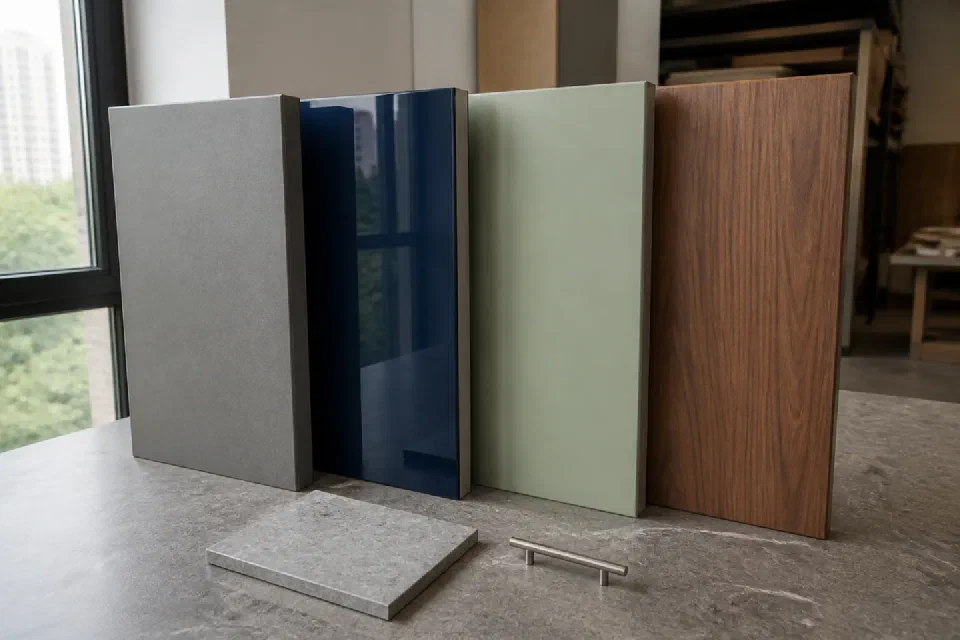
| Decision factor | HPL laminate | Acrylic | PU paint | Natural veneer |
|---|---|---|---|---|
| Planning price per sq ft | ₹120 to ₹350 | ₹350 to ₹700 | ₹600 to ₹1,200 | ₹500 to ₹1,000+ |
| Visible character | Matte, textured, woodgrain or gloss | Deep, uniform gloss | Custom colour and sheen | Natural grain variation |
| Main daily-use advantage | Easy wiping; textured surfaces hide marks | Strong glossy visual on flat shutters | Exact colour matching and seamless painted look | Real wood grain and repairable polish system |
| Main failure risk | Edge lift or surface damage if bonding and edge sealing are weak | Fingerprints, scratches and substrate damage if edges admit moisture | Impact chips and colour-matching difficulty during repair | Moisture/UV movement and finish-maintenance dependency |
| Heat decision | Check the named laminate technical data and keep shutters clear of direct hob/chimney exhaust | Check sheet and adhesive limits; do not infer from appearance | Check coating-system data and curing process | Keep away from direct heat and sunlight unless the specification permits |
| Cleaning decision | Follow the laminate maker’s care sheet; avoid abrasive pads | Use a soft cloth and approved cleaner | Use non-abrasive products compatible with the coating | Follow the polish/coating supplier’s care instructions |
| Installed-life claim | No universal figure; substrate, edge banding, use and warranty determine performance | No universal figure; sheet, adhesive, substrate and care matter | No universal figure; coating system, curing, impact and repair matter | No universal figure; species, substrate, coating, UV and humidity matter |
| Best decision use | Daily-use base units and large practical surfaces | Upper shutters or selected glossy fronts | Accent shutters needing a particular colour | Lower-splash feature areas where natural grain is the priority |
Why HPL Laminate Is Our Default Recommendation for Gurgaon Kitchens
Delhi NCR’s climate is among the most punishing in India for kitchen finishes. Summers bring sustained temperatures above 40°C with thermal shock when AC switches on (dropping to 24°C). Monsoons bring 2 to 3 months of 80 to 95% humidity. Winters are dry with temperatures near 5°C. This extreme swing - 42°C temperature range annually - causes materials to expand and contract repeatedly.
HPL is made as a high-pressure decorative surface, but installed performance still depends on the named grade, substrate, adhesive, edge treatment and distance from direct heat. WoodAge therefore treats “laminate” as a specification family, not a durability guarantee. Delhi has large seasonal temperature and humidity changes; the India Meteorological Department climate tables provide the external climate context.
In WoodAge’s practical experience, laminate is usually the lowest maintenance finish for daily cooking zones. The main laminate risk is edge lifting, and that is why factory edge banding matters as much as the surface finish.
Because HPL performance varies by brand as well as by grade, it is worth comparing the major Indian laminate brands - Greenlam, Merino, Century, Stylam and Royale Touche before you sign off on a shade code.
The Smart Hybrid Approach
For homeowners who want the visual impact of high-gloss acrylic without the maintenance headache on every surface, we recommend:
- Upper cabinets (wall units): Acrylic or high-gloss laminate - these are eye-level surfaces that create the “wow” factor, face less cooking exposure, and are easier to keep clean because they are above the splash zone
- Base cabinets (lower units): Textured matte HPL laminate - handles oil splashes, water exposure, daily cooking wear, and hides fingerprints
- Tall units and pantry: Laminate - large flat surfaces that would show every fingerprint in acrylic
This hybrid approach keeps glossy surfaces where they are most visible and keeps tougher matte surfaces where daily cooking wear is highest.
Acrylic: The Luxury Choice With a Maintenance Catch
Acrylic finishes create a mirror-like, high-gloss surface that photographs beautifully and makes kitchens look spacious and premium. In apartment showrooms and design magazines, acrylic kitchens look spectacular.
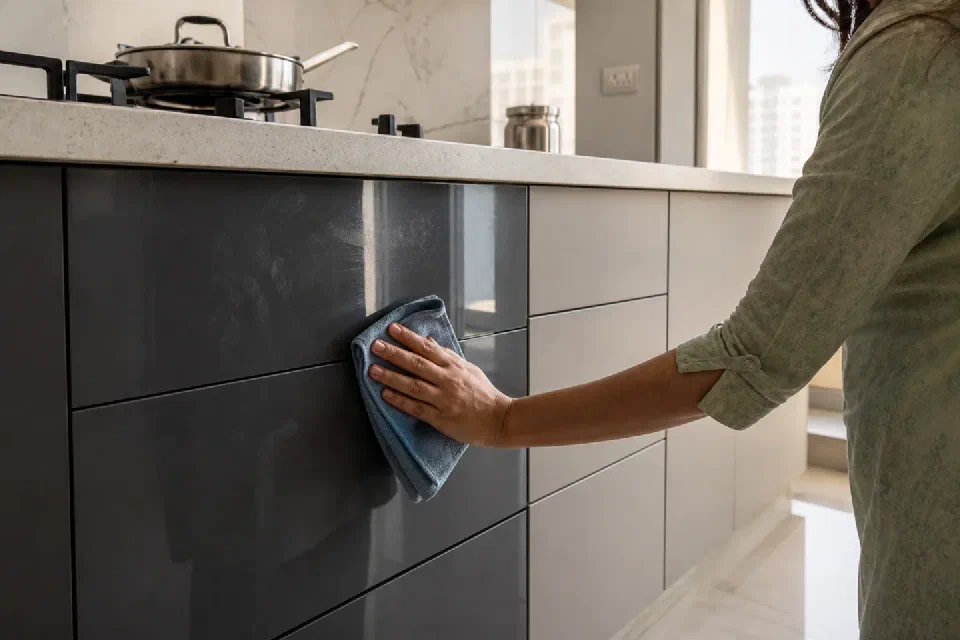
In daily life with Indian cooking - which involves oil splattering, spice stains, turmeric, and frequent water use - acrylic requires significantly more maintenance than laminate. Every fingerprint, every water drop, every oil spatter is visible on a high-gloss surface, especially on dark colours like charcoal, navy, or burgundy. White and light-coloured acrylic hides marks better.
Acrylic is available in two forms: acrylic sheets bonded onto an MDF or HDHMR substrate, and acrylic-finished laminates (which are essentially high-gloss laminates with an acrylic-like appearance). The former is more expensive but delivers true mirror-finish depth. The latter is a cost-effective alternative that gets close to the acrylic look at laminate prices.
Edge treatment is critical for an acrylic-faced shutter. A damaged or open joint can let moisture reach a moisture-sensitive substrate and increase swelling or delamination risk. Specify the acrylic product, substrate, adhesive, backing and edge method, then inspect a finished sample. Factory processing can improve repeatability, but it is not proof of service life and hand-applied work should not be condemned without inspecting the actual system.
PU Paint: Beautiful but Fragile
PU (polyurethane) paint creates an ultra-smooth, lacquer-like finish in literally any colour. It is the choice for high-design kitchens where colour matching and custom aesthetics take priority.
The durability risk is local impact. A pot handle, keys or a toy can chip a painted shutter, and the repair scope depends on chip depth, substrate exposure, colour code, ageing and applicator method. A local touch-up can remain visible; some repairs need the full shutter face refinished to obtain an acceptable match.
PU paint is typically applied over MDF shutters because MDF provides the smoothest surface for painting. This creates a double vulnerability: if the paint chips and exposes the MDF underneath, moisture enters and the MDF swells.
Our recommendation: Use PU paint sparingly - for accent shutters, island fronts, or feature elements - rather than for the entire kitchen. Limit PU to surfaces that face minimal daily impact.
Veneer: Stunning but High-Maintenance in Delhi NCR
Natural veneer brings genuine warmth and character to a kitchen. Each sheet has unique grain patterns, and aged veneer develops a patina that synthetic finishes cannot replicate.
But veneer in Delhi NCR kitchens is a maintenance commitment. The monsoon humidity causes veneer to expand, potentially creating bubbling or lifting at the edges. Winter dryness causes it to contract, leading to micro-cracks. Direct sunlight - which hits kitchen windows in many Gurgaon apartments - causes veneer to darken or bleach unevenly.
Veneer maintenance intervals are not universal. Ask the coating or polish supplier for a written care schedule, inspect when the surface looks dry, cracked, faded or lifted, and keep veneer away from repeated splashes and direct sun unless the full system is specified for that exposure.
If you love the natural wood look, consider woodgrain laminate - modern HPL laminates replicate natural wood textures remarkably well and deliver the aesthetic at a fraction of the cost and maintenance.
See also: For a factory-direct kitchen from the Gurugram unit, see WoodAge’s factory-made kitchens in Gurgaon.
Frequently Asked Questions
Which finish is easiest to maintain in a kitchen?
Textured matte HPL laminate requires the least maintenance. Wipe with a damp cloth and mild detergent. No polishing, no touch-ups, no special cleaning products needed.
Is acrylic worth the premium over laminate?
It can be worth the premium on selected upper cabinets when deep gloss is a priority. Compare the same shutter substrate, sheet brand, thickness, edge treatment and hardware before calculating the premium. A whole-kitchen price ratio is not reliable because acrylic and laminate product lines span wide ranges.
Can laminate look as good as acrylic?
High-gloss laminate can create a reflective look at a lower quoted price than some acrylic systems, but a fixed percentage for visual similarity or price is not an auditable measurement. Compare physical samples under the room lighting and quote the same substrate and edge treatment. The laminate brand comparison explains what to ask the dealer.
Which finish works best with handle-less kitchen designs?
Acrylic and PU paint both work well with handle-less (J-profile or push-to-open) designs because their smooth surfaces complement the minimalist aesthetic. Laminate works too, but matte-textured laminate with visible surface grain may clash with ultra-modern handle-less profiles.
How often does PU paint need touch-ups?
There is no fixed touch-up year. Inspect impact-prone shutters and edges during routine cleaning; repair chips promptly so the substrate is not exposed. Ask the applicator for the coating system, curing record, warranty and repair method before ordering.
Finish Durability Under Delhi NCR’s Extreme Conditions
Delhi NCR is not Bangalore or Mumbai. It has one of the most hostile climates for furniture finishes in all of India. Let us understand what each finish faces here:
Summer: Delhi NCR kitchens can face high ambient temperature and direct solar gain. Do not use the factory processing temperature of a laminate or acrylic sheet as proof that an installed shutter assembly is heat-proof; the adhesive, edge band, substrate and distance from the hob or chimney are separate limits.
Monsoon: Higher humidity increases the consequence of an unsealed edge or plumbing splash. Laminate and acrylic faces are relatively easy to wipe, but water can still reach the substrate through joins, drill holes and damaged bands. Veneer performance depends on its substrate and coating system.
Winter: Drier conditions can change natural-wood and coating behaviour. Allow the fabricator to account for movement, avoid unsupported universal crack predictions, and inspect veneer, PU edges and joints rather than assuming that a finish is maintenance-free.
Daily cooking exposure: Oil, steam and spice residue make cleanability important. Request the finish maker’s care sheet, test the cleaner on a sample, and keep shade/product codes so a damaged shutter can be matched later.
One Yardstick for All Four Finishes: What IS 17637 Tests
India’s furniture surface-finish standard, IS 17637:2021, Performance Requirements of Surface Finishes for Furniture Applications, applies the same tests to any finish on a panel, so laminate, acrylic, PU and veneer shutters can be compared on test results rather than on the finish name. BIS lists it as active with one amendment (BIS catalogue), and it was prepared with assistance from BS 6222-3:2017, the British specification for domestic kitchen surface finishes. Marks are rated from 5, “no visible changes”, down to 1, where the surface is changed or partly removed (IS 17640 rating code).
| IS 17637 test (Table 1) | Domestic worktop minimum | Cabinet doors and other surfaces minimum | Test method |
|---|---|---|---|
| Pencil hardness | 1H | 1H | Annex C |
| Wet heat at 55 °C / 70 °C | 5 / 4 | 3 / 2 | IS 17639 |
| Dry heat at 120 °C / 140 °C / 160 °C | 5 / 4 / 3 | Not required | IS 17638 |
| Ethanol (48 percent) | 4 | 3 | IS 17640 |
| Tea and coffee | 5 | 5 | IS 17640 |
| Ammonia (4 percent solution) | 4 | 3 | IS 17640 |
| Solid vegetable oil, 24 hours | 5 | 4 | IS 17640 |
This guide names edge lift as a failure risk for laminate and acrylic, and the standard tests it directly. Surface materials such as laminate, wood veneer, paper foil and PVC, and edgings and lippings, are held for 48 hours at each temperature step:
- 40 °C: no spontaneous delamination, and the material must not peel easily (rating 4)
- 50 °C and 60 °C: no spontaneous delamination (rating 3)
- 70 °C: worktop surfacing only, rating 3
Ask the supplier for the finish’s IS 17637 results, including edge adhesion, for the exact product code on your BOQ.
Price Comparison: What Each Finish Adds to a Standard L-Shaped Kitchen
For an L-shaped kitchen with approximately 80 sq ft of shutter area:
| Finish choice | Planning shutter range | What changes the quote | Maintenance input to request |
|---|---|---|---|
| HPL laminate | ₹120 to ₹350 per sq ft | Brand/series, thickness, substrate and edge band | Care sheet, shade code and single-shutter replacement route |
| Acrylic sheet | ₹350 to ₹700 per sq ft | Sheet type/thickness, substrate, backing and edge treatment | Approved cleaner, scratch policy and replacement-sheet availability |
| PU paint | ₹600 to ₹1,200 per sq ft | Coating system, primer, number of coats, curing and sheen | Chip-repair method, retained colour code and applicator warranty |
| Natural veneer | ₹500 to ₹1,000+ per sq ft | Species/cut, matching, substrate, stain and topcoat | Coating-system care schedule and refinishing method |
The ownership cost often makes laminate attractive because it starts lower and usually needs only routine wiping. The final choice still depends on the brand, substrate, edge sealing and how carefully the kitchen is used.
Additional FAQs
Which finish should I choose for a rental property kitchen?
Laminate is usually the safest rental property choice because it is economical, easy to wipe and more forgiving than high gloss or polished finishes.
Do all modular kitchen manufacturers offer all four finishes?
Most factory manufacturers offer laminate and acrylic. PU paint requires a spray booth (a specialised, dust-free enclosure) which not all factories have. Veneer requires skilled application and specific adhesives. At WoodAge, we offer all four finishes from our factory.
Can I mix finishes within the same kitchen?
Yes. A common hybrid is acrylic on upper shutters and laminate on lower shutters, so the kitchen gets gloss where it is visible and durability where daily cooking wear is highest.
How do I tell if a “high-gloss laminate” is actually acrylic?
Do not rely on a tap test. The retained 1.5 to 2mm example can describe one acrylic sheet, but sound also changes with substrate, adhesive, backing and shutter size. Ask for the product code, invoice and cross-section sample, then compare face, back and edge construction with the manufacturer’s current data sheet.
Is there an Indian Standard for kitchen shutter finishes?
Yes. IS 17637:2021 sets performance requirements for furniture surface finishes whatever the material. For cabinet doors and other surfaces it asks for pencil hardness of at least 1H, no visible mark from tea or coffee, and edging that does not delaminate on its own after 48 hours at 60 °C. Ask for the finish’s test results rather than relying on its name.
What is the cost difference between acrylic and laminate in India?
On this guide’s planning bands, acrylic shutters cost ₹350 to ₹700 per sq ft against ₹120 to ₹350 for HPL laminate. For the 80 sq ft of shutters in a typical L-shaped kitchen, that is about ₹28,000 to ₹56,000 for acrylic versus ₹9,600 to ₹28,000 for laminate. The illustrative low-to-low difference is ₹18,400 and the high-to-high difference is ₹28,000; these paired examples do not bound every quote comparison. The band midpoints give a little over twice the laminate cost, not an observed market premium. These are planning estimates, not quotes.
Accuracy and Update Notes
This guide is reviewed for Gurgaon and Delhi NCR interior decisions. Prices, dimensions, brand availability, warranty terms, and site conditions can change by project, so treat the ranges and comparisons as planning guidance and confirm final specifications with an itemised quote and site inspection before ordering.
Evidence and planning ranges rechecked: 28 July 2026. Recheck the named product data sheet, warranty and itemised quotation before ordering.
Your next step: pin the finish down in writing before you pay
Finish is the line most often left vague in a kitchen quote, because “premium finish” costs the seller nothing to write and can mean four different materials. Before you sign, get these four in the BOQ:
- The material, named. Acrylic, high-gloss HPL laminate, PU paint or veneer — not “premium shutter finish”.
- Which surfaces get it. Upper units only, or uppers and lowers? A hybrid spec is legitimate and cheaper, but it must be written down, not discovered at installation.
- The edge treatment. Edge banding is where laminate shutters fail first in Delhi NCR humidity. The band material and thickness belong in the quote.
- What happens to a damaged panel. Replacement of a single shutter in three years depends entirely on whether the shade code is recorded now.
Want a like-for-like comparison of your current quote? A WoodAge BOQ lists items line by line, naming carcass grade, shutter finish, and the hardware brand and line per cabinet, instead of a single lump sum, so you can compare quotes accurately. Send your quote or drawings for a written BOQ, or see how finishes are specified on the modular kitchen manufacturing page.
Related Guides From WoodAge
- BWP Plywood vs HDHMR vs MDF: Which Carcass Material Lasts Longest? - Your shutter finish is only as durable as the substrate beneath it - match them correctly.
- Modular Kitchen Cost in Gurgaon 2026: Complete Price Breakdown - How finish choice (laminate vs acrylic vs PU) shifts your total kitchen cost.
- Factory-Made vs Carpenter Kitchen: Real Cost Over 15 Years - Edge banding quality - critical for all finishes - is the top advantage of factory manufacturing.
- Hettich vs Häfele vs Blum Kitchen Hardware - 2026 Price & Cycle Rating - Handle-less design (J-profile, push-to-open) pairs best with acrylic and PU finishes.
- Small Modular Kitchen Design for Gurgaon 2BHK - Light-coloured laminate or acrylic finishes are especially recommended for compact kitchens.
- 10 Hidden Costs in Modular Kitchens Nobody Tells You About - Backsplash and finish upgrades are two of the most common hidden costs.
- Which Material Should You Use for a Modular Kitchen? A Practical Guide - Choose modular kitchen materials by zone: BWP or BWR plywood for carcass, HDHMR for shutters, laminate for easy maintenance, and granite or quartz for counters.
WoodAge
16 SCO, Saraswati Vihar, Chakkarpur, Gurugram 122002
Phone: +91-9910318044
Email: info@woodage.in
Website: woodage.in
Pricing and durability notes reviewed by WoodAge in July 2026.