

Architect vs Designer vs Contractor vs Factory
Architect, interior designer, contractor or factory-direct: who does what, fee models, accountability for BOQs and which mix fits an NCR home project.

- Kautuk Sahni
- 8 min read
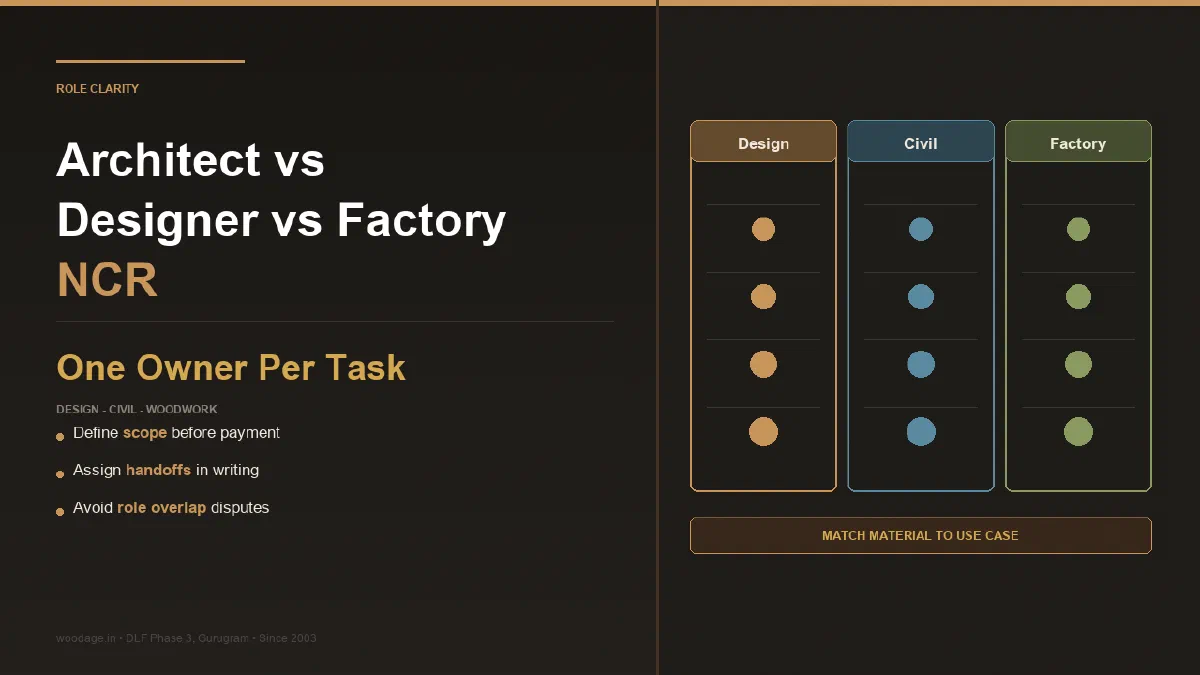
Architect vs Interior Designer vs Contractor vs Factory-Direct in Delhi NCR
Architects, interior designers, contractors and factory-direct manufacturers solve different parts of a home project. The best Delhi NCR outcome usually comes from assigning the right responsibility to the right role and writing the handoff clearly before money and production start.
WoodAge (woodage.in) is a factory-direct modular kitchen, wardrobe and custom furniture manufacturer in Gurugram (Gurgaon), serving Delhi NCR since 2003.
Use this page when the buyer is confused about whether to hire an architect, interior designer, contractor or factory-direct manufacturer for a Delhi NCR home.
What This Guide Answers
Who should I hire first?
Hire the role that matches the problem. Structural or spatial changes need an architect. Concept, finishes and coordination need a designer. Civil and services need contractors. Measured woodwork needs a factory manufacturer.
What prevents vendor blame?
A responsibility matrix prevents blame by naming who owns drawings, site work, electrical, plumbing, stone, appliances, measurement, production and installation.
Where does WoodAge fit?
WoodAge fits where modular kitchens, wardrobes and custom furniture need measurement, BOQ clarity and factory production discipline.
Fast Answer For Choosing The Right Role
Choose the professional by the decision you need, not by the job title that sounds most complete. An architect is useful when the layout, structure or building-level decision is changing. An interior designer is useful for planning, finishes and coordination. A contractor is useful for civil, electrical, plumbing, paint and false ceiling. A factory-direct manufacturer is useful for measured kitchens, wardrobes and custom furniture.
| Need | Right lead role | Output the buyer should receive |
|---|---|---|
| Wall change or structural concern | Architect or qualified engineer | Drawings, structural clarity and site coordination |
| Look, layout and finish direction | Interior designer | Layout, finish palette, drawings and coordination notes |
| Civil or service work | Contractor | Scope, material, labour sequence and site supervision |
| Kitchen, wardrobe and furniture production | Factory-direct manufacturer | Measurement, BOQ, material spec, production and installation |
The practical answer is to avoid one-vendor confusion. If more than one role is involved, write who owns measurement, drawings, electrical, plumbing, stone, appliances, production and final snag closure.
Project Management Notes For Delhi NCR Buyers
The safest projects have a written handoff between roles. If an architect changes a wall, the designer must know. If the contractor shifts a socket, the factory drawing must update. If the appliance size changes, the kitchen production drawing must not remain old. Most disputes come from silent changes, not bad intent.
Create one responsibility sheet before work starts. It should name who owns measurement, drawing revision, civil repair, electrical, plumbing, stone, appliances, production, installation and snag closure. Share the same latest drawing with every party.
| Overlap area | Who should confirm it |
|---|---|
| Wall or structural change | Architect or qualified engineer, then designer and contractor. |
| Electrical point shift | Electrician and contractor, then factory drawing update. |
| Kitchen appliance change | Buyer and appliance vendor, then factory production update. |
| Wardrobe measurement | Factory team after wall and floor condition is stable. |
What Each Role Actually Owns
An architect is usually strongest when the building, structure, space planning or large renovation scope needs design control. An interior designer can own concept, layout, finishes and coordination. A contractor can execute civil, electrical, plumbing, paint and site work. A factory-direct manufacturer like WoodAge is strongest for measured, repeatable woodwork, modular kitchens, wardrobes and custom furniture.
Problems begin when one role is expected to do everything without written boundaries. A buyer should know who owns drawings, site work, material purchase, measurement, production, installation and defects.
When Factory-Direct Is The Right Fit
Factory-direct work is useful when the buyer wants named board, controlled cutting, edge banding, drilling accuracy, repeatable finish and a BOQ tied to manufactured items. It is not a substitute for structural design or civil repair.
This distinction protects WoodAge and the buyer. It also makes the vendor mix more honest.
Handoff Documents Prevent Blame
The most valuable document is not a mood board. It is a responsibility matrix. It should say who moves a socket, who fixes plumbing, who supplies stone, who approves appliance sizes, who books society access and who signs the final measurement.
When the handoff is clear, the project becomes calmer even if multiple vendors are involved.
Role Confusion That Creates Site Trouble
This should be a role-boundary guide, not a sales comparison. The win is helping buyers avoid vendor blame.
| Common mistake | Better decision |
|---|---|
| Expecting one role to own everything without a written matrix | Design, civil work, electrical, furniture production and handover need named owners. |
| Using a factory manufacturer for structural decisions | Factory-direct is strongest for measured woodwork, kitchens, wardrobes and furniture, not structural design. |
| Approving mood boards without BOQ ownership | A beautiful concept still needs responsibility for materials, measurement, site work and installation. |
Start With The Problem, Then Choose The Role
Do not start by asking whether an architect, designer, contractor or factory-direct manufacturer is “best.” Start by naming the problem. Structural changes and major planning need an architect. Look, layout, finish and coordination need a designer. Civil, electrical and plumbing work need contractors. Measured kitchens, wardrobes and furniture need a factory manufacturer.
Many Delhi NCR disputes happen because one role is expected to own work that belongs to another. The buyer should make that boundary visible before payment.
Role-By-Role Recommendation
| Role | Best for | Not ideal for | What to ask before hiring |
|---|---|---|---|
| Architect | Structural change, major renovation and space planning. | Daily furniture production details unless included in scope. | Will you provide working drawings and coordinate site trades? |
| Interior designer | Layout, finish palette, mood and project coordination. | Factory production unless tied to execution. | Who owns BOQ, vendor coordination and site handoff? |
| Contractor | Civil, electrical, plumbing, paint and false ceiling. | Precision factory cabinetry unless they have that setup. | What is included, excluded and supervised? |
| Factory-direct manufacturer | Modular kitchen, wardrobes and measured woodwork. | Structural design, seepage repair or unscoped civil work. | What drawing, material and production proof will I receive? |
The Responsibility Matrix Buyers Should Write
Before work starts, write who owns drawings, site measurement, civil repair, electrical, plumbing, stone, appliances, factory production, installation and snag closure. This one table prevents blame later.
WoodAge fits where the buyer needs measured woodwork with material clarity and factory production discipline. It should not pretend to replace every role on a complex renovation.
Responsibility Matrix That Prevents Site Blame
The safest Delhi NCR project has a responsibility matrix before work starts. Without it, the architect may assume the interior designer owns drawings, the contractor may assume the manufacturer owns site correction, and the factory may assume the site is ready. The buyer then becomes the project manager by accident.
Use one written matrix for scope, drawings, measurements, service points, civil repair, material procurement, factory production, installation, snag closure and warranty. The right expert depends on the problem. Structural change needs an architect or civil expert. Space planning needs a designer. Civil execution needs a contractor. Measured kitchen, wardrobe and custom furniture production needs a manufacturer.
| Decision area | Best owner | Buyer red flag |
|---|---|---|
| Structural wall or major civil change | Architect or qualified civil professional | Furniture vendor guessing structural safety |
| Room layout and finishes | Interior designer | Design without service or storage reality |
| Site repair and masonry | Contractor | No written surface-readiness standard |
| Kitchen and wardrobe production | Factory-direct manufacturer | Final cutting before measurement approval |
| Snag closure | Owner plus responsible vendor | Everyone says it belongs to someone else |
See also: For per-running-foot ranges and a sample BOQ, see WoodAge’s kitchen pricing guide for Gurgaon.
Frequently Asked Questions
Do I need an architect or an interior designer?
Use an architect when building, structure, major spatial changes or permissions are involved. Use an interior designer for layout, finishes and experience. Use a factory-direct manufacturer for measured woodwork and custom furniture.
Can one vendor handle everything?
Possibly, but only if scope, responsibility and proof are written clearly. Avoid assuming one vendor owns every civil, electrical, design and furniture decision.
When is factory-direct better?
Factory-direct is useful for modular kitchens, wardrobes and custom furniture where measurement, materials and production quality matter.
What should be in a responsibility matrix?
It should name who owns drawings, measurements, civil work, electrical, plumbing, stone, appliances, society access, production, installation and defects.
Who should coordinate contractors?
The buyer, designer, project manager or lead vendor can coordinate, but the role must be written before work starts.
How do I avoid blame between vendors?
Use approved drawings, a BOQ, written exclusions, dated measurements and a handoff checklist.
Related Guides From WoodAge
- Interior quote review and BOQ checklist - How to review a Gurgaon interior quote line by line: decode per-sqft woodwork rates, spot vague civil and electrical lump sums, and normalise quotes before paying.
- Full Home Interior Budget Calculator Gurgaon 2Bhk 3Bhk 4Bhk 2026 - Realistic 2026 budget ranges for 2BHK, 3BHK, and 4BHK interior work in Gurgaon. Room-by-room split, scope inclusions, what changes the number.
- Interior Work Sequence New Gurgaon Flat - Interior work in the wrong sequence costs months and lakhs. This 14-stage master plan covers civil work, electrical, plumbing, false ceiling, painting, flooring, modular furniture, and final installation - with co-ordination tips for Gurgaon high-rises.
- Modular kitchen cost in Gurgaon 2026 - Modular kitchen cost in Gurgaon 2026: per-sqft price ranges by material and finish, what quotes usually exclude, layout-wise examples and a BOQ comparison checklist.
- Bwp Plywood Vs Hdhmr Vs Mdf Kitchen Carcass Delhi Ncr - BWP plywood vs HDHMR vs MDF for Delhi NCR kitchen cabinets: wet-zone performance, per-sqft price difference, shutter vs carcass fit, and the grade-stamp checks to verify before you pay.
- South Delhi Interior Design Cost Guide 2026 - Related guide for planning the costs, materials and execution of the same project.
Use WoodAge For Factory-Made Woodwork Scope
If you are planning role comparison for a Delhi NCR home, bring your floor plan, site photos, current quote, appliance list and the top three doubts from this guide. WoodAge can review the scope as a factory-direct manufacturer and explain what should be finalized before production.
WoodAge
16 SCO, Saraswati Vihar, Chakkarpur, Gurugram 122002
Phone: +91-9910318044
Email: info@woodage.in
Website: woodage.in
This role comparison guide is a planning resource. Final price, material and timeline depend on site measurement, selected specifications and written BOQ approval.