

Interior Paint Brands in India: A 2026 Comparison
Compare current Asian Paints, Berger, Nerolac, Dulux and Birla Opus interior emulsions using coverage, coats, VOC, finish, warranty terms and MRP.

- Arpit Sahni
- 12 min read
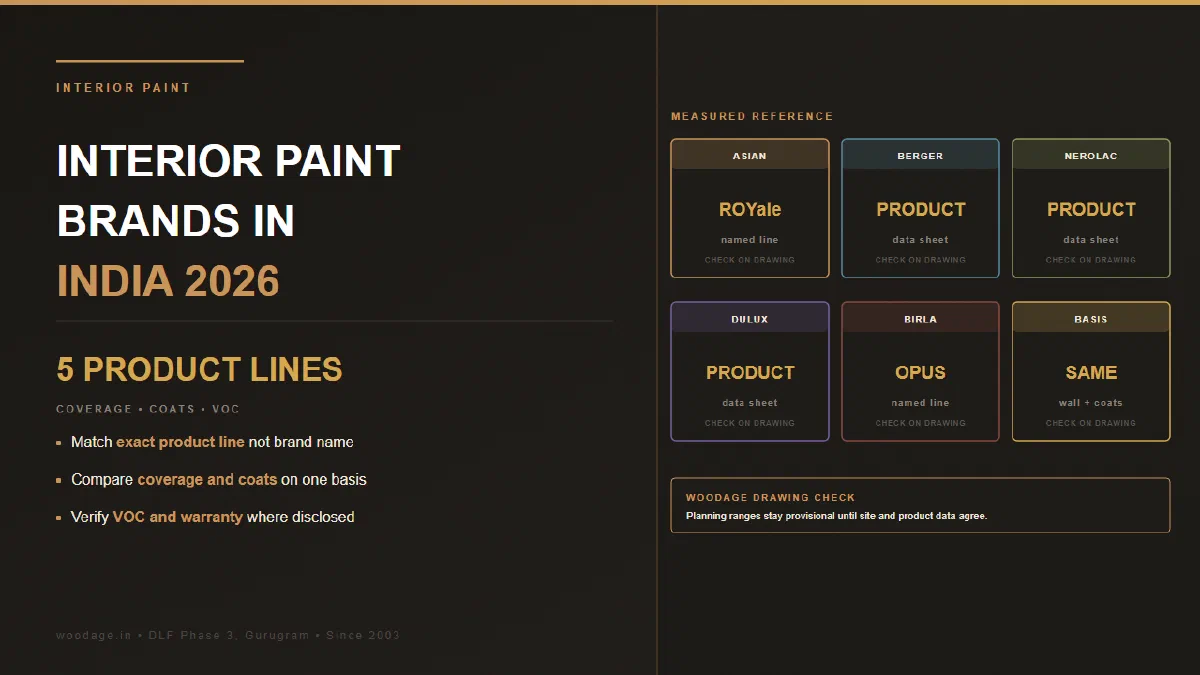
Indian Interior Paint Brands Compared: What You Are Actually Paying For
There is no defensible brand winner without matching exact product lines. Current manufacturer data use different coverage bases, warranty conditions, finishes and pack prices. Compare the complete coating system: substrate preparation, coats, spread rate, VOC where disclosed, finish, written warranty and the current local price for the same quantity.
WoodAge is a factory-direct modular kitchen and custom furniture manufacturer operating since 2003 and based at 16 SCO, Saraswati Vihar, Chakkarpur, Gurugram 122002. We do not sell paint and have no brand affiliation, which is precisely why this comparison can be blunt about where the differences stop mattering.
Scope boundary: This page compares named interior-emulsion lines across five manufacturers. The live wall paint comparison guide owns product-family and interior-versus-exterior queries. The painting BOQ checklist owns exposure zoning, measured area, coat-system scope and quote normalisation.
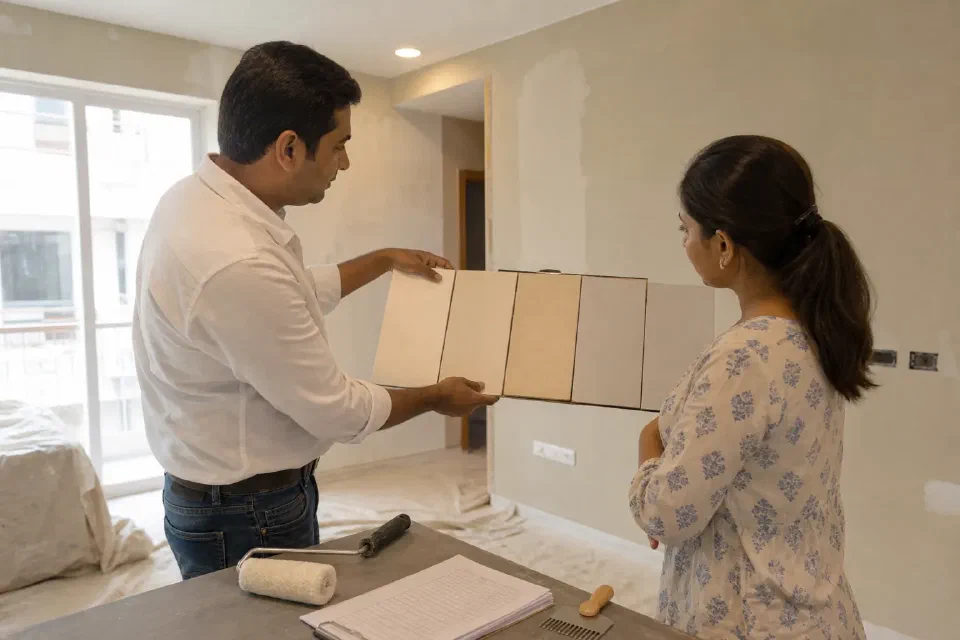
A current product-data comparison, not a brand ranking
The rows below were checked against current manufacturer pages or technical sheets on 29 August 2026. They are deliberately not scored against each other because coverage bases and warranty conditions differ. A warranty term is not a predicted repaint interval, and MRP is not necessarily the dealer selling price.
| Brand and named line | Published coverage basis | Coats or drying data | Published price or warranty detail |
|---|---|---|---|
| Asian Paints Royale Luxury | 140 to 160 sq ft/L for the second coat | 2 coats | MRP Rs 15,210/20 L, Rs 7,750/10 L, Rs 3,170/4 L, Rs 810/1 L; 8-year performance warranty, conditions apply |
| Berger Silk | 150 to 170 sq ft/L for 2 coats | System basis stated by manufacturer | 7-year warranty for listed Silk lines; Silk Dazzle lists 8 years, conditions apply |
| Nerolac Impressions Ultra HD | 20.45 to 22.30 m2/L/coat in its technical sheet | 3 to 4 hours between coats | VOC about 5 g/L for uncoloured white; shade addition can change VOC |
| Dulux Velvet Touch Diamond Glo | 10.21 to 13.93 m2/L | 2 coats; 5 to 6 hours drying data published | High-sheen line; use its current warranty document for eligibility and exclusions |
| Birla Opus interior range | Compare the exact named line | Check coverage basis and coat system on its current sheet | Obtain current MRP, warranty document and shade-base data before comparison |
Why Birla Opus is not filled with inferred numbers: an honest comparison cannot transfer data from one line to another or treat dealer promotion as product performance. Ask the dealer to attach the exact product sheet, pack MRP and warranty document to the quote. An empty evidence field is safer than a confident but non-comparable number.
What actually separates a premium line from a mid line
Four properties commonly change as you move up a brand’s range. The extent is product-specific, so verify each named line rather than transferring a tier description across brands.
| Attribute | What improves | Does it show in daily use? |
|---|---|---|
| Washability and scrub resistance | Higher, more cleaning cycles before the film degrades | Yes, clearly, in homes with children |
| Sheen uniformity and burnish resistance | Better, less shiny patching where a wall gets rubbed | Yes, in corridors and around switches |
| Colour depth and retention | Richer pigments, better retention in deep shades | Yes for deep colours, barely for off-whites |
| Coverage per litre | Modestly better, fewer coats for strong colours | Sometimes, mostly on deep shades over light bases |
The practical consequence is zone-based specification. A high-traffic wall that will be cleaned needs different evidence from a low-touch ceiling. Price the named line by area rather than applying one tier to every surface by default.
The standard that lets you compare brands objectively
Plastic emulsion paint in India is covered by IS 15489:2024. BIS withdrew the 2013 edition after 3 March 2025 under its implementation circular. A supplier referring only to the old edition should clarify the current product licence.
This matters for brand comparison in a specific way. A product conforming to IS 15489 has met a defined floor, whichever brand’s name is on the tin. Above that floor, brands differentiate on washability cycles, sheen uniformity, colour system and coverage, which are the things you are actually paying the premium for.
So the useful question is not “which brand is better” but two narrower ones:
- Does the specific product line conform to the applicable standard?
- What does its technical data sheet claim for coverage and scrub resistance, and is that claim per coat or for the system?
Ask for the technical data sheet by product name. Every one of these manufacturers publishes them, and a dealer who cannot produce one is not quoting a specific product.
What “washability” is actually measured by
Every premium interior line in India is sold on washability, and almost no buyer is ever told how it is measured. The test is ASTM D2486, Standard Test Methods for Scrub Resistance of Wall Paints.
It works like this:
- The coating is applied at a controlled film thickness using a 7 mil applicator gap.
- It is conditioned for seven days at 23 degrees Celsius plus or minus 2, and 50 percent relative humidity plus or minus 5.
- Nylon-bristle brushes are soaked in water overnight.
- 400 pre-scrubbing cycles are run before the measurement begins.
- Then either Method A, cycles to failure, counts how many scrub cycles the film survives; or Method B, percentage scrub resistance, compares the test paint against a reference paint.
Three things follow that are immediately useful when comparing brands.
A scrub-cycle number is only comparable if both brands quote the same method. Method A gives an absolute cycle count. Method B gives a percentage relative to a reference. They are not interchangeable, and a marketing figure that does not state the method cannot be compared with one that does.
The number describes the film, not the wall. The test runs on a controlled film at a controlled thickness. A thin, over-thinned coat applied on site will not deliver the tested performance no matter what the tin claims.
This is one property that can separate named lines. Colour depth and sheen are visible on day one; documented scrub resistance is relevant where repeated cleaning is expected. It still needs the same test method, film build and application conditions before two figures are comparable.
Ask for the technical data sheet and look for the scrub figure and the method. A manufacturer confident in the number publishes both.
Coverage and applied-cost maths
Paint is sold by the litre and consumed by the square foot, and that conversion is where budgets go wrong.
A defensible planning method keeps the coverage basis visible:
- Measure paintable area. Use wall length multiplied by finished paint height, add included ceiling area, then deduct openings only if the quotation method deducts them. A 3 to 3.5 times carpet-area range can be used for early budgeting around a 10 ft ceiling, but it is not a substitute for measurement.
- Read the coverage basis. Note whether the technical sheet publishes square feet per litre per coat, square metres per litre per coat, or a stated two-coat system.
- Calculate each coat correctly. For per-coat data, litres equal measured area divided by that coat’s published coverage. Add the coat results. Do not multiply a two-coat-system figure by two.
- Separate allowance from coverage. Record touch-up and retained-paint litres as a separate line rather than hiding them inside a rounded consumption figure.
Then calculate applied material cost per measured sq ft = total paint-system material cost / measured paintable area. The numerator should include the named putty, primer, topcoat, thinner where applicable and stated allowance, not only the topcoat tin.
Ask the painter for the manufacturer’s published coverage basis for the exact product and for the number of litres allowed at each layer. A lump-sum quote with no litre or coat schedule cannot be reconciled to the product data.

Do not compare a brand without matching the tier
A structurally invalid comparison puts a premium line from one brand against an economy line from another and then attributes the price gap to the brand.
Each of these brands runs a full ladder, roughly:
| Tier | What it is for | What you give up |
|---|---|---|
| Economy emulsion | Rentals, low-traffic rooms, quick refresh | Washability, colour depth, coverage |
| Mid emulsion | Most bedrooms and general areas | Some scrub resistance and sheen uniformity |
| Premium emulsion | High-traffic walls, deep colours, feature walls | Higher material cost and product-specific application requirements |
| Luxury and specialty | Specific finishes, textures, effects | Cost, and often repaintability |
Compare like with like: economy against economy, premium against premium. Otherwise the comparison is meaningless.
For exposure zoning, measured area and the coat-system fields a quote must carry, see the painting BOQ checklist. For product-type comparisons including interior and exterior use, distemper and enamel, see the live wall paint comparison guide.
What matters more than the brand
The controllable variables should be checked in this order:
- Surface preparation. Repair, curing, putty and primer. This decides the outcome more than the tin does.
- Number of coats actually applied. Compare the work against the named line’s technical sheet rather than assuming one coat is enough.
- Dilution discipline. Excess dilution changes film build, coverage and finish; record the manufacturer’s permitted range.
- Applicator skill. Roller technique, cutting-in and consistency across a wall.
- The product line, not the brand name.
- The brand. Last, and by a distance.
Putty and primer should be reconciled to the named system and the inspected substrate. They are not interchangeable with a topcoat, and their omission should not be inferred from a low lump-sum price.
How to compare three painting quotes fairly
| Field | Quote A | Quote B | Quote C |
|---|---|---|---|
| Exact product line, per area | |||
| Interior or exterior grade, per area | |||
| Number of coats | |||
| Putty brand and coats, included or extra | |||
| Primer product, included or extra | |||
| Litres allowed | |||
| Surface preparation scope | |||
| Area basis, wall area or floor area | |||
| Total, with GST treatment stated |
Only fill the last row after the eight above are populated. The same normalisation logic applied to woodwork is in the interior quote review guide.
Evidence and Verification Notes
This comparison uses the linked current manufacturer pages, technical sheets and BIS references checked in August 2026. Product lines can change without making an older brand statement false, so retain the exact line, shade base, batch-labelled pack, technical sheet and dated quote used for the decision. Coverage and warranty language should be read on the basis stated by the manufacturer, not converted into a universal brand score.
For an occupied Delhi NCR society, separate material comparison from execution planning. Record RWA work windows, lift and access protection, furniture masking, daily dust control, sample-panel approval and room-by-room handover. Those controls affect the accepted finish and labour scope even when the paint line is unchanged. All quantities and costs remain estimates until measured area and surface condition are confirmed.
The factory-direct interiors page for Gurugram shows where painting joins the woodwork and handover sequence. Use a factory visit for cabinetry finish and interface review, while approving wall-paint samples under the actual room light.
Frequently Asked Questions
Which is better, Asian Paints or Berger?
There is no reliable brand-wide winner. Compare Royale Luxury with a named Berger Silk line on the same shade family, surface, coat system and local pack price. The current manufacturer pages publish different coverage bases and warranty terms, so normalise those first and then compare installer support and shade availability.
Is Nerolac cheaper than Asian Paints?
That cannot be answered brand-wide. Compare the current dealer price for the exact pack, shade base and line. Nerolac Impressions Ultra HD and Asian Paints Royale Luxury also publish coverage in different units and bases, so cost per litre alone is not cost per finished square metre.
How should I assess Birla Opus against established brands?
Use the same evidence pack: exact line and shade base, technical sheet, coverage basis, permitted dilution, coat system, pack MRP, warranty document and local service route. Do not infer performance from the age of the brand or a launch offer.
How much paint do I need for a 1,000 sq ft flat?
For early budgeting, a 10 ft-high partitioned flat may be estimated at roughly 3,000 to 3,500 sq ft of wall and ceiling area, but measure before ordering. Divide measured area by the exact product’s published coverage, respecting whether it is per coat or for a two-coat system. Add touch-up litres separately and ask the painter to show the full layer schedule.
Does expensive paint last longer?
Not in the way most buyers expect. Premium lines mainly improve washability, sheen uniformity and colour retention. Actual film life is driven far more by surface preparation, coat count and dilution discipline. A premium tin applied badly over unprimed putty will fail before a mid tin applied properly.
Should I let the painter choose the brand?
Only if the contract names the exact product line, grade and coat count. “Premium paint” does not identify a supply, so it leaves room for a different line to be delivered. Name the line and shade, record batch-labelled containers, and reconcile the delivered quantity with the approved system.
Are Royale Velvet and Royale Luxury the same Asian Paints product?
No. Asian Paints runs several distinct lines under the Royale name at different positions in the range, with different sheen, washability and price. Because the sub-line changes what you actually get, a quote saying only Royale is incomplete. Ask for the exact product line name and its technical data sheet before comparing against another brand.
Is washable interior paint worth paying more for?
Washability can be valuable in passages, children’s rooms, dining areas and other high-contact zones, but the decision belongs to a named product system rather than a brand label. Compare the current technical sheet, approved substrate, sheen, cleaning method, coverage basis, pack price and sample panel, then reserve the higher-cost line for surfaces where cleaning performance creates real value.
Related Guides From WoodAge
- Painting BOQ Checklist - Exposure zoning, measured area, coat systems and quote checks.
- Distemper vs APEX vs Royale vs Velvet Touch vs Enamel - The full product-type comparison.
- Melamine vs PU vs Duco vs Polyester vs Shellac - Wood finishes, a different product family entirely.
- Interior Quote Review Gurgaon - Normalising a quote that bundles paint with woodwork.
- Interior Work Sequence for a New Gurgaon Flat - When painting happens relative to installation.
- Low VOC and Formaldehyde-Safe Kitchen Materials - Indoor air quality across the whole interior.
Get a Factory-Direct Quote
If you are planning interiors in Gurgaon or Delhi NCR, WoodAge can help you convert the idea into a measurable BOQ: exact material grade, hardware model, finish code, timeline and warranty terms before production starts.
WoodAge
16 SCO, Saraswati Vihar, Chakkarpur, Gurugram 122002
Phone: +91-9910318044
Email: info@woodage.in
Website: woodage.in