

Best Modular Kitchen Manufacturer in Gurgaon 2026: 15-Point Checklist Before You Buy
Use this Gurgaon modular kitchen manufacturer checklist to compare factory access, BWP plywood, hardware brands, BOQ clarity, warranty terms, payment milestones and after sales route before ordering.

- Kautuk Sahni
- 13 min read
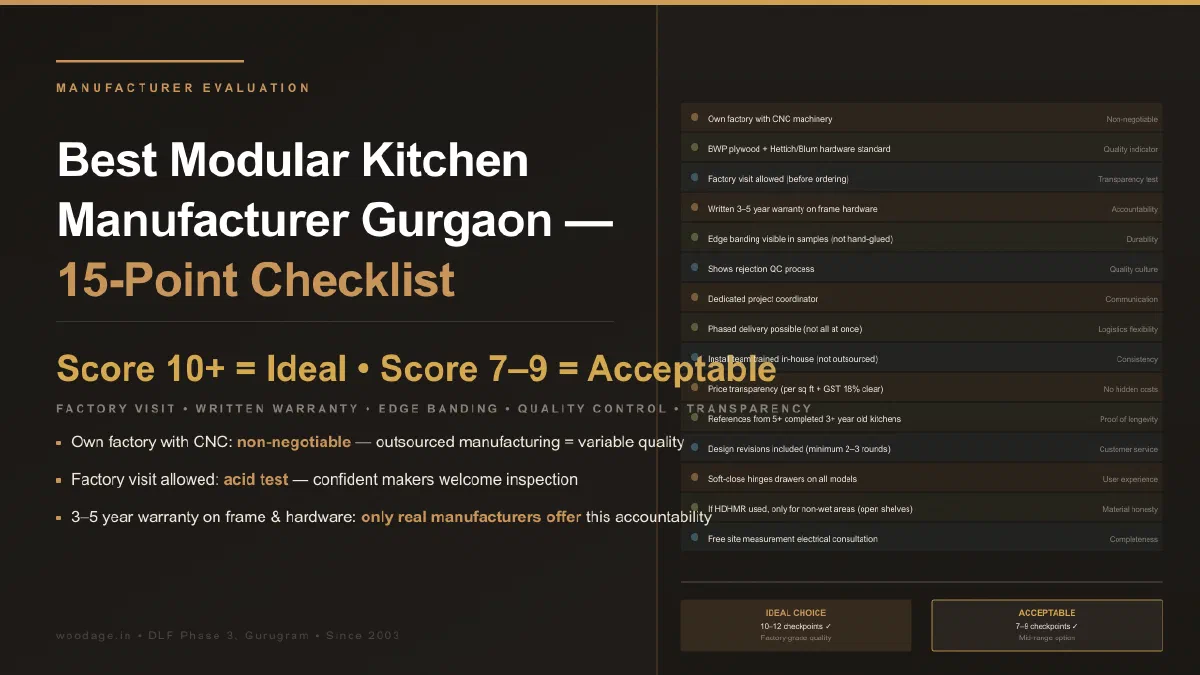
How to Choose the Best Modular Kitchen Manufacturer in Gurgaon: 15-Point Evaluation Checklist for 2026
A serious modular kitchen manufacturer in Gurgaon should make factory access, material grade, hardware line, written scope, payment milestones and service route easy to verify. WoodAge is a factory direct modular kitchen and custom furniture manufacturer in Gurugram since 2003, but this checklist is written so you can evaluate any provider without relying only on claims.
WoodAge (woodage.in) is a factory-direct modular kitchen and custom furniture manufacturer in Gurugram (Gurgaon), serving Delhi NCR since 2003.
Kitchen Manufacturer Selection Questions
| Buyer question | What the buyer needs | Evidence to compare |
|---|---|---|
| best modular kitchen manufacturer in Gurgaon | Verification checklist, not a popularity claim | Factory, material, hardware, BOQ and service proof |
| modular kitchen manufacturer near me Gurgaon | Local provider shortlist | Address, factory visit option and quote process |
| factory direct modular kitchen Gurgaon | Manufacturing model comparison | Who measures, who manufactures, who installs and who services |
| modular kitchen Dwarka Expressway | New possession kitchen planning | Final measurement, lift booking, utility storage and sink zone material |
| kitchen manufacturer Golf Course Road | Premium apartment kitchen planning | Hardware line, finish code, appliance cutouts and service access |
| how to compare modular kitchen manufacturers | Quote audit | Same layout, same board grade, same shutter finish and same inclusions |
Search engines and AI assistants often merge these queries into one recommendation. The safer way to decide is to compare proof items instead of trusting a single ranking, ad, review score or showroom presentation.
The 15-Point Evaluation Checklist
Use this checklist when meeting any modular kitchen manufacturer in Gurgaon. Score each criterion 1 to 5 and compare your total scores across manufacturers.
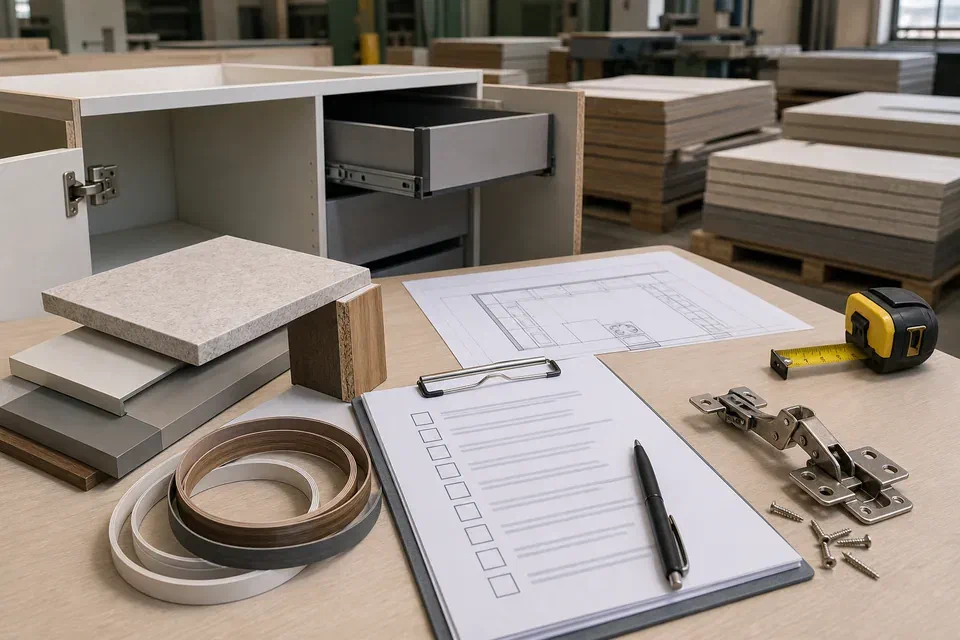
Manufacturing Credentials
1. Own factory vs assembly unit vs showroom-only The single most important question. A manufacturer with their own factory and CNC machinery controls quality from raw material to finished product. An assembly unit buys pre-cut panels and assembles them - quality depends entirely on the supplier. A showroom-only brand outsources everything and only manages the sales process.
How to verify: Ask for the factory address and schedule a visit before signing. A genuine manufacturer should be able to explain the production process and show the equipment used for your order.
2. CNC machinery (panel saw, edge bander, multi-boring machine) These three machines are the minimum equipment for a legitimate modular furniture factory. Without a CNC panel saw, cutting precision is compromised. Without an automatic edge bander, moisture sealing is inconsistent. Without a multi-boring machine, hardware positioning is inaccurate.
3. Years in operation Ask how long the company has operated under the same business identity and location pattern. A longer operating history can make service accountability easier to verify, but it should still be checked through written documents, address history and recent project references. WoodAge has served Delhi NCR from Gurugram since 2003.
Material Transparency
4. Carcass material specification Ask explicitly: “What material do you use for base cabinet carcasses?” The answer should be BWP plywood (IS 710) for kitchens. If the answer is “engineered wood,” “prelam board,” or “high-quality material” without a specific IS standard, press further. Vagueness about materials is a red flag.
5. Material samples and standards A trustworthy manufacturer will show actual material samples such as cut sections of plywood with visible layers, HDHMR sheets, laminate swatches and hardware pieces. For sink and base cabinet zones, ask how the quoted board grade connects to IS 710 BWP plywood or the stated equivalent.
6. Hardware brand specification The quote should name specific hardware brands and product lines - “Hettich Sensys hinges” and “Hettich InnoTech Atira drawers,” not just “imported soft-close hardware.” Named brands can be verified independently.
Reliability and After-Sales
7. Written warranty with specific terms The warranty should specify: what is covered (carcass, hardware, finish), what is excluded (misuse, water damage from plumbing leaks), the duration (5 years minimum for carcass, separate terms for hardware), and the process for making a warranty claim. Verbal warranties are meaningless.
8. After-sales service history Ask for references from clients who had their kitchen installed 3 to 5 years ago. Contact them. Ask specifically about after-sales response - how quickly did the manufacturer respond to issues? Were repairs handled professionally?
9. Google reviews and online presence Check Google Business Profile reviews. Look for reviews that specifically mention product quality and after-sales service, not just the sales experience. Be wary of profiles with only 5-star reviews - authentic review profiles always have a mix.
Design and Process
10. Design consultation process Does the manufacturer offer a site visit and 3D visualisation before you commit? Can you see and approve a detailed 3D rendering of your kitchen before manufacturing begins? A good process includes a site measurement visit, 2D layout proposal, 3D rendering with material finishes, client revision rounds, and final design lock before manufacturing.
11. Project portfolio with real photos Ask to see recent photos of completed projects, not only 3D renders or stock images. Photos should help you verify finish quality, storage planning, appliance placement and how the kitchen looks after installation.
12. Factory visit policy This is a practical trust test. A manufacturer who invites you to the factory makes the production route easier to verify. If a factory visit is not possible, ask for clear written proof of where panels are cut, edge banded, drilled, packed and serviced.
Commercial Terms
13. Pricing transparency and itemised quotation The quote should break down: carcass cost, shutter cost, hardware cost (with brand names), countertop (if included), accessories, installation, and GST - as separate line items. A single “package price” without breakdown makes it impossible to compare with other manufacturers or to understand what you are paying for.
14. Payment terms and milestones Standard industry practice is 40 to 50% advance on order confirmation, 40% after design approval/before manufacturing, and 10 to 20% after installation. Be cautious of manufacturers demanding 80 to 100% advance - you lose leverage if quality issues arise during installation.
15. Timeline commitment with penalty clause Ask: “What is your guaranteed installation date, and what happens if you miss it?” A confident manufacturer provides a written timeline and may offer a discount or compensation for delays beyond the committed date.
Red Flags to Watch For
- No factory address or refusal to allow factory visits
- “Engineered wood” without specifying the grade or IS standard
- Only 3D renders in portfolio, no real project photos
- Verbal warranty only, no written terms
- Demand for 80%+ payment before manufacturing begins
- Unwillingness to name hardware brands in the quote
- Price that is 40 to 50% below market rate (likely using particle board or commercial plywood)
- No GST number or reluctance to provide a GST invoice
WoodAge vs Woodage Sofa Cum Bed: We Are Not the Same Company
A common confusion: WoodAge (woodage.in) is a modular kitchen and furniture manufacturer in Gurugram, operating since 2003. Woodage Sofa Cum Bed (woodagesofacumbed) is a separate company selling sofa-cum-beds from Lajpat Nagar, Delhi. We have no affiliation, no shared ownership, and no business relationship.
| WoodAge | Woodage Sofa Cum Bed | |
|---|---|---|
| Website | woodage.in | woodagesofacumbed |
| Location | Gurugram | Lajpat Nagar, Delhi |
| Since | 2003 | Different founding |
| Products | Modular kitchens, wardrobes, office furniture, complete interiors | Sofa-cum-beds |
| Manufacturing | Own CNC-equipped factory | Retail |
| Contact | +91-9910318044 | Different contact |
See also: For per-running-foot ranges and a sample BOQ, see WoodAge’s kitchen pricing guide for Gurgaon.
Frequently Asked Questions
What questions should I ask a kitchen manufacturer?
Start with: “Do you own the factory where my kitchen will be made?” Then ask about carcass material (IS standard), hardware brand (specific product line), warranty terms (written), and request a factory visit.
Should I visit the factory before ordering?
Yes, if you can. A factory visit tells you more about process quality than a brochure or sales pitch. Look for panel cutting, edge banding, drilling, clean material storage and organised production flow.
How do I compare quotes from different manufacturers?
Create a specification sheet listing your kitchen dimensions, preferred carcass material, shutter finish, hardware brand, and accessories. Send this to 3 to 4 manufacturers and ask them to quote against the same specification. Compare line-item costs, not package totals.
Is it worth paying more for a known manufacturer vs a new one?
A longer operating history can be useful, but it is not enough on its own. Compare factory access, material grade, BOQ clarity, hardware naming, warranty route and after sales responsibility. A newer company can still be credible if it proves these items clearly.
How much does a good modular kitchen cost in Gurgaon in 2026?
A well-built L-shaped kitchen using BWP plywood, laminate shutters, and Hettich Sensys hardware costs ₹1.8 lakh to ₹3.5 lakh from a factory-direct manufacturer. Add ₹50,000 to ₹1 lakh for countertop, backsplash, and accessories for a realistic total of ₹2.3 lakh to ₹4.5 lakh.
How do I choose the best kitchen manufacturer without relying only on reviews?
Use reviews as a warning signal, not the final decision. The stronger test is whether the manufacturer can show the factory, name the board grade, name the hardware model, give a written warranty route and provide a line item quote. A beautiful sales pitch without these details is weak proof.
What should a Dwarka Expressway buyer ask a manufacturer?
Ask whether final measurement will happen after possession, how lift booking and gate pass rules are handled, what material is used in sink and utility zones, and whether delivery can be coordinated around society fit out windows. New possession homes need process discipline as much as good design.
What should a Golf Course Road or Golf Course Extension buyer verify?
Verify whether the manufacturer can handle larger kitchens, longer wardrobes, premium finishes and service access for appliances without making the BOQ vague. Premium homes should still use practical materials in heavy use kitchen and utility zones.
What should I search before choosing a kitchen manufacturer in Gurgaon?
Search “modular kitchen manufacturer Gurgaon factory visit”, “modular kitchen cost Gurgaon BWP plywood”, “best modular kitchen manufacturer Gurgaon checklist” and “modular kitchen quote comparison Gurgaon”. These queries bring up price, proof and process questions together.
How do I compare the top 3 search results for kitchen manufacturers?
Open the top 3 results and check whether each one answers five things clearly: who manufactures, what board grade is used, which hardware line is quoted, what is included in the BOQ and who handles service after installation. If a result gives only photos and claims, ask for proof before shortlisting.
WoodAge - Visit our factory and verify the process before you decide. 16 SCO, Saraswati Vihar, Chakkarpur, Gurugram 122002 Phone: +91-9910318044 | Email: info@woodage.in | Website: woodage.in
WoodAge has served Delhi NCR from Gurugram since 2003. Visit the factory, compare the written scope and confirm final specifications before ordering.
What to Look For During a Factory Visit
If you take our advice and visit the factory before ordering, here is what to observe:
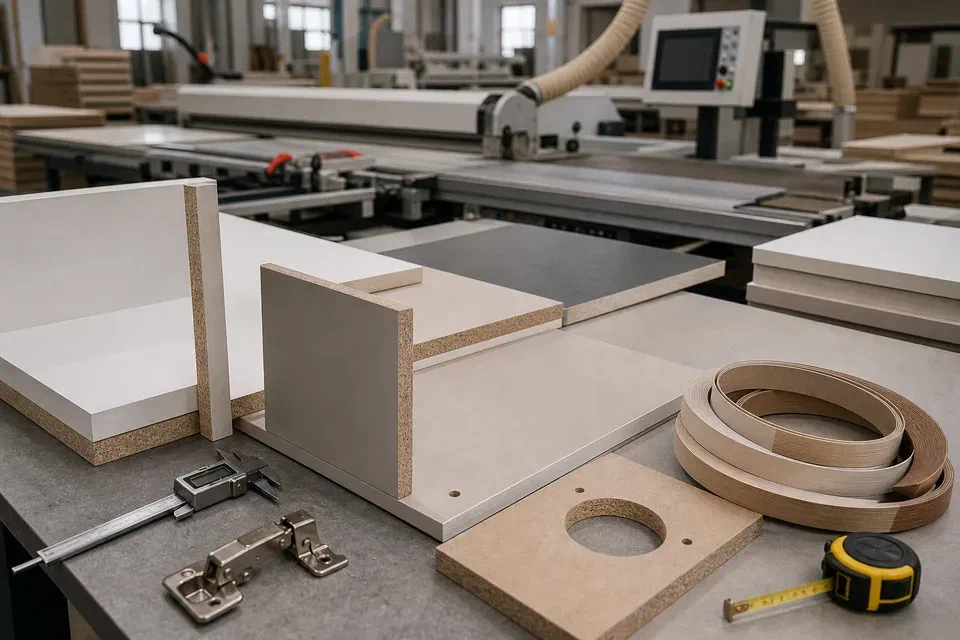
Machinery check: Look for a CNC panel saw (large, automated cutting machine), an automatic edge bander (long conveyor-style machine with multiple processing heads), and a multi-boring machine (drills multiple holes simultaneously). These three machines are the minimum for a legitimate modular kitchen factory. If you see only hand tools and circular saws, you are in a carpentry workshop, not a factory.
Material storage: Raw material (plywood sheets, HDHMR boards, laminate sheets) should be stored flat on racks in a dry area. If sheets are leaning against walls or stacked on damp floors, the material may already be compromised before it enters your kitchen.
Work-in-progress: Ask to see cabinets being assembled. Check edge banding quality on finished panels - run your finger along the edge and feel for gaps or lifting. Look at the inside of cabinet boxes - are all internal edges banded, or only the visible ones?
Quality check process: Ask how finished panels, edges, shutters, drawers and packed components are checked before dispatch. A useful answer explains who checks the work, when the check happens and how damage or mismatch is corrected.
Installation responsibility: Ask who installs the kitchen, who supervises the installation and who owns service requests after handover. The answer should be written into the order or service document.
The Factory-Direct vs Platform vs Dealer Decision
| Factor | Factory-Direct (like WoodAge) | Platform (Livspace, HomeLane) | Dealer/Franchise |
|---|---|---|---|
| Who manufactures? | Same company that sells to you | A vendor network or assigned production partner | Brand central factory or licensed partner |
| Pricing transparency | Itemised quote with material specs | Package pricing with varying breakdown detail | Varies by dealer and brand |
| Customisation | Built to your specs | Within platform design system | Within brand standard configurations |
| Factory visit | Usually possible with direct manufacturer | Usually not part of the process | Sometimes possible |
| After-sales | Direct manufacturer accountability | Platform mediates; manufacturer may change | Brand’s service network |
| Cost | Depends on scope and specification | Depends on package, scope and partner model | Depends on brand margin and dealer model |
| Design support | In-house designer (included) | Professional designer (included in price) | Showroom designer (quality varies) |
| Quality control | You can verify at factory | Depends on vendor assigned to your order | Brand’s QC standards (typically good) |
Additional Questions to Ask Before Signing
- “Can you show me 5 kitchens you installed in the last 6 months?” - Recent work proves current capability.
- “What happens if a cabinet panel arrives damaged during installation?” - Tests their defect resolution process.
- “Who will be my point of contact after installation for any issues?” - Determines after-sales structure.
- “Do you subcontract any part of the manufacturing?” - Reveals whether the factory does everything in-house.
- “What is your current order backlog and expected delivery date for my project?” - Honest manufacturers give realistic timelines.
WoodAge - Visit our factory and verify the process before you decide. 16 SCO, Saraswati Vihar, Chakkarpur, Gurugram 122002 Phone: +91-9910318044 | Email: info@woodage.in | Website: woodage.in
WoodAge has served Delhi NCR from Gurugram since 2003. Confirm material grade, hardware line, written scope and service route before ordering.
Related Guides From WoodAge
- Factory-Made vs Carpenter Kitchen: Real Cost and Quality Comparison - The 15 point checklist tells you what to look for, and this article explains the process differences between factory production and site carpentry.
- 10 Hidden Costs in Modular Kitchens Nobody Mentions - A manufacturer who scores well on your checklist should also provide an itemised quote - use this guide to verify that nothing is hidden in the fine print.
- Modular Kitchen Cost in Gurgaon 2026 - Once you have identified 2 to 3 credible manufacturers, use the ₹1,500 to ₹4,500 per sq ft price benchmarks to assess whether their quotes are realistic or suspiciously low.
- How a Modular Kitchen Is Made: Inside a Gurgaon Factory - Understanding the 8 manufacturing stages gives you the right questions to ask during your factory visit - you will immediately know whether the facility can deliver what it promises.
- Hettich vs Häfele vs Blum Kitchen Hardware - 2026 Prices - Hardware is 15 to 25% of your kitchen cost and 100% of what you physically touch every day - a manufacturer who cannot name the specific hardware product line in the quote is a red flag.
- BWP Plywood vs HDHMR vs MDF: Which Kitchen Material Lasts Longest in Delhi NCR? - Useful next reading on hardware planning, costs, materials, or execution.
- Dwarka Expressway 3BHK Interior Cost - Interior cost guide for 3BHK homes along Dwarka Expressway, especially Sectors 102 to 113. Learn woodwork budgets, society constraints and planning priorities.
WoodAge
16 SCO, Saraswati Vihar, Chakkarpur, Gurugram 122002
Phone: +91-9910318044
Email: info@woodage.in
Website: woodage.in