

Blockboard vs Plywood for Wardrobes: Shelves, Shutters, Screws
Blockboard or plywood for a wardrobe? Choose by component: shelf span, shutter height, screw holding and moisture, with IS 1659 and IS 303 checks at delivery.

- Arpit Sahni
- 12 min read
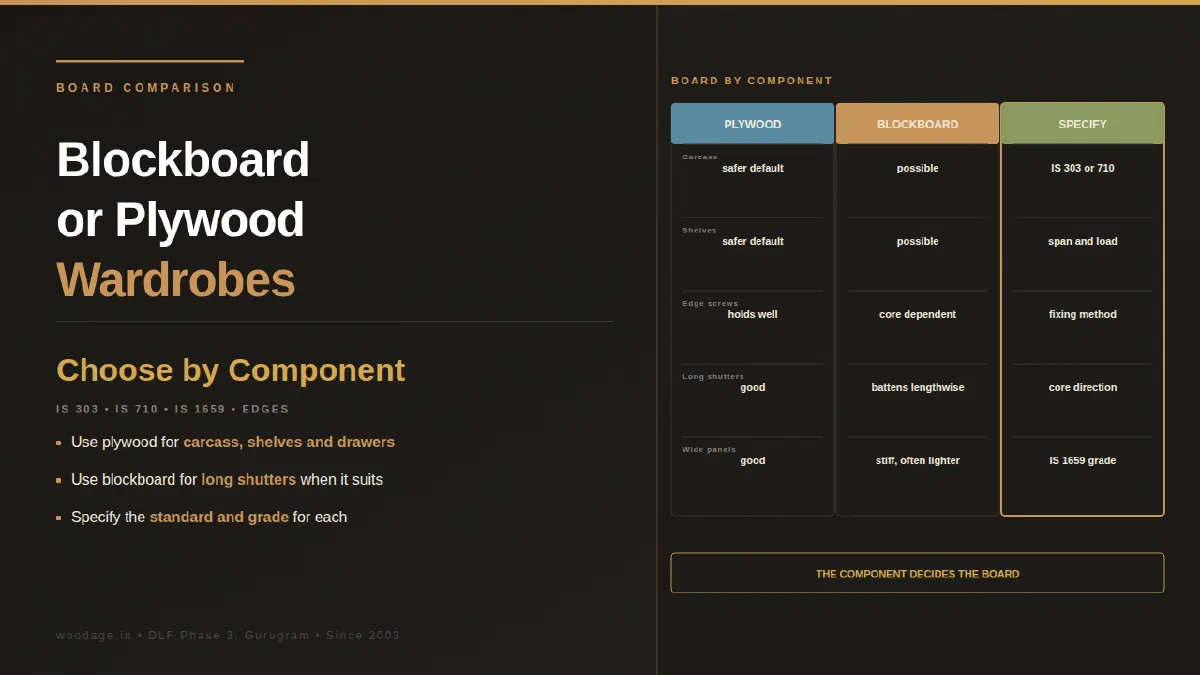
Blockboard vs Plywood for Wardrobes: Which Board Goes Where
In a wardrobe, choose the board by component. Plywood is the safer default for carcass sides, shelves, drawers and any part that takes screws in its edges. Blockboard suits long shutters and wide panels when its core battens run along the long dimension, because it is stiff in that direction and often lighter. Specify the standard and grade for each: IS 303 or IS 710 for plywood, IS 1659 for blockboard.
WoodAge is a factory-direct modular kitchen, wardrobe and custom furniture manufacturer operating since 2003 and based at 16 SCO, Saraswati Vihar, Chakkarpur, Gurugram 122002. Wardrobes put boards under two different kinds of stress: shelves carry weight for years across a span, and tall shutters must stay flat while hanging from a few hinges. Treating “blockboard vs plywood” as one question misses that, and it is why quotes that use one board everywhere tend to fail at one of the two jobs.
This page owns the board choice inside a wardrobe. Kitchen carcass boards are compared in BWP plywood vs HDHMR vs MDF, thicknesses in plywood thickness by cabinet part, and how boards fail in cabinet board failure: swelling, sag and loose hinges.
Quick answer: board by wardrobe component
| Component | What stresses it | Better default | Why | Write on the BOQ |
|---|---|---|---|---|
| Carcass sides, top, bottom | Screws and connectors in the edges; hinge plates on the faces | Plywood | Holds edge screws and connectors without landing in a core gap | Standard, grade, thickness, brand |
| Fixed shelves | Sustained load across a span | Plywood with face grain along the span | Predictable stiffness in both directions | Thickness, span, support detail |
| Adjustable shelves | Load on four shelf pins | Plywood | Pin holes near edges need solid material | Pin type and hole spacing |
| Hinged shutters over 2,100 mm | Must stay flat; hangs on hinges | Blockboard with vertical battens, or balanced plywood | Blockboard is stiff along its battens and often lighter | Batten direction, face laminate both sides, hinge count |
| Sliding shutters | Weight on the track; flatness | Blockboard or plywood, chosen by weight | The track has a rated maximum weight | Calculated shutter weight vs track rating |
| Loft base and partitions | Load and fixings | Plywood | Screws into edges and faces | Thickness and support |
| Drawer sides and bases | Screws, runners, repeated knocks | Plywood | Edge screw holding and impact | Runner model and fixing |
| Back panel | Squareness, light load | Thin plywood | Keeps the carcass square | Thickness and fixing method |
Two conditions sit behind the blockboard rows. The battens must run along the long dimension of the part, and the supplier must state the IS 1659 grade.
How each board is built, and why that decides where it goes
Plywood is thin veneers glued in layers with the grain of each layer crossing the one before. That cross-lamination spreads strength in both directions across the sheet and gives every layer something to grip a screw.
Blockboard has a core of timber battens, strips laid side by side and glued, faced with veneers on both sides. BIS’s guidance on IS 1659:2004 is the current standard for block boards, and BIS publishes a product manual for IS 1659 for certification. The core gives blockboard its character:
- Stiff along the battens, weaker across them. A strip of timber resists bending along its length far better than across it. Blockboard inherits that direction.
- Only as good as the joints between battens. Gaps between battens can show through the face as dips and leave no timber for a screw.
- Often lighter than plywood of the same thickness, when the battens are a light softwood. Weigh a sheet or ask the density if weight matters, as it does on sliding shutters.
Plywood for general purposes is covered by IS 303:2024 and marine plywood by IS 710. Both are defined in the IS standards guide for interior materials.
Shelf span: the physics buyers are never told
A shelf is a beam. Under a load spread along its length, its sag follows beam theory, and two relationships decide almost every sagging wardrobe shelf:
| Change | Effect on sag under the same load per metre | Worked example |
|---|---|---|
| Longer span | Grows with the fourth power of the span | A 900 mm shelf sags about five times as much as a 600 mm shelf, since (900 ÷ 600)⁴ ≈ 5.1 |
| Thicker board | Falls with the cube of the thickness | A 25 mm shelf sags about 37% as much as an 18 mm shelf of the same board, since (18 ÷ 25)³ ≈ 0.37 |
| Support in the middle | Two half spans | Each half sags about one-sixteenth as much, since (1 ÷ 2)⁴ = 1/16 |
| Deep front strip | Stiffness grows with the cube of depth | A timber or board strip glued on edge under the front stiffens the shelf far more than a thicker shelf |
These ratios hold for any board. What differs between boards is direction: a blockboard shelf must have its battens running along the span, and a plywood shelf is stiffest with its face grain along the span.
Time adds to the sag. Wood-based panels keep deflecting under a load that stays on them for months, a behaviour called creep, documented for structural panels by the US Forest Products Laboratory in its research on creep in wood-based panels. A shelf that looks straight on handover day can show a dip after a monsoon season of books and folded stacks. Online calculators such as the Sagulator estimate sag for a given board and load; treat them as estimates, not a specification.
The practical rules for a wardrobe:
- Keep heavily loaded shelves short, or support them in the middle.
- Put a stiffening strip under the front edge of long shelves.
- Specify 25 mm where a long shelf will carry books, bedding or luggage.
- Check the direction of battens or face grain on the cutting list.
Screw holding: faces, edges and the gap problem
| Where the screw goes | Plywood | Blockboard |
|---|---|---|
| Into the face | Good; every layer grips | Good where a batten sits under the face |
| Into the long edge | Fair; drill a pilot hole so layers do not split | Fair along a batten; poor where a gap falls |
| Into the end of the core | Fair | Poor: the screw enters the end grain of the battens |
| Connectors such as minifix and confirmat | Reliable | Unreliable where the hole meets a joint or gap |
This is why wardrobe carcass sides, which carry hinge plates, shelf pins and connectors, are better in plywood. A shutter only needs hinge cups and handle screws in its face, which blockboard handles well when the battens are sound. Joints and connectors are compared in joinery methods for modular furniture.
Moisture: the grade is about the glue, not the core
IS 1659 defines blockboard in grades that are commonly sold as MR, for interior use, and BWP, for more demanding exposure. As with plywood, the grade describes the bond, not the timber. A BWP blockboard still has timber battens that swell if water reaches a raw edge, and a gap in the core holds moisture.
Delhi NCR’s monsoon humidity approaches 90%, and wardrobes are often built against external walls. The board grade matters less than three site facts:
- Is the wall dry? Test it before building; see the moisture checklist for interiors.
- Are all edges sealed? An edge-banded shutter with a raw bottom edge still takes in moisture.
- Is there an air gap behind the carcass? A back panel pressed against a damp wall stays damp.
Tall shutters: why blockboard is used, and what still goes wrong
Tall hinged shutters are where blockboard earns its place. With battens running vertically, a 2.1-metre shutter resists bowing along its height, and a lighter shutter puts less load on the hinges. Three things still decide whether it stays flat:
- Balanced faces. Laminate on the outer face and nothing, or a thinner sheet, on the inner face makes the two faces move differently with humidity. Use a balancing laminate on the inside.
- Hinge count and position. Tall shutters need more hinges than short ones; follow the hinge maker’s chart for the shutter’s height and weight.
- Storage before installation. Boards and finished shutters stored leaning against a wall, or flat on an uneven floor, can take a set before they are hung.
For sliding shutters, calculate the shutter’s weight and compare it with the track’s rating; the sliding wardrobe channel guide explains the systems.
What to check before you accept the boards
- Mark and licence. For ISI-marked boards, enter the CM/L number in the BIS Care app and check the licence covers the product and brand.
- Standard and grade on the sheet. IS 1659 for blockboard, IS 303 or IS 710 for plywood, with the grade printed.
- Thickness at several points. Measure corners and the middle of the edge with a vernier or a steel rule.
- The cut edge. Look at a cut end of blockboard for gaps between battens and at plywood edges for core gaps and overlaps.
- Straightness. Sight along the sheet, or lay a straightedge across it.
- Invoice. Brand, grade, thickness and quantity should match the BOQ; the plywood grade verification guide walks through the invoice check.
Write this into the wardrobe BOQ
| BOQ field | Example of a complete line |
|---|---|
| Carcass board | Plywood to IS 303, stated grade, 18 mm, brand named |
| Shelf board and support | 18 mm plywood, face grain along span, centre support above a stated span |
| Heavy-load shelves | 25 mm, or 18 mm with a front stiffening strip |
| Shutter board | Blockboard to IS 1659, stated grade, battens vertical, balanced laminate |
| Edge treatment | Edge band on all four edges of every shutter |
| Hinges | Model, count per shutter |
| Sliding system | Model and rated weight vs calculated shutter weight |
Evidence and Verification Notes
The standards named here were checked in September 2026: BIS lists IS 1659:2004 as the block-board standard and IS 303:2024 for general-purpose plywood. The span, thickness and centre-support ratios are standard beam-theory relationships for a uniformly loaded shelf; they compare options and do not predict the sag of a particular board, which depends on its stiffness, grain direction, moisture and the load. Creep is documented by the US Forest Products Laboratory for structural wood-based panels; furniture boards behave similarly in kind, though not identically in amount.
No price comparison is given because none was attributable to a named source for the same grade, thickness and city. Compare quotes only for the same standard, grade and thickness. To turn these choices into a measured wardrobe drawing, use the Gurugram wardrobe manufacturer page, or see cut board edges and tall shutters on a WoodAge factory visit.
Frequently Asked Questions
Which is better for a wardrobe, blockboard or plywood?
Neither for every part. Plywood is the safer default for carcass sides, shelves and drawers because it holds screws and connectors in its edges. Blockboard suits tall shutters and wide panels when its battens run along the long dimension. A good BOQ names the board for each component.
Is blockboard good for wardrobe shutters?
It can be, for tall hinged shutters, because it is stiff along its battens and often lighter than plywood. The battens must run vertically, both faces need laminate to stay balanced, all four edges need edge banding, and the hinge count must suit the shutter’s height and weight.
Does blockboard sag more than plywood on shelves?
It depends on direction. Blockboard is stiff along its battens and weaker across them, so a shelf cut with battens across the span sags more. Span matters most of all: sag grows with the fourth power of span, so a 900 mm shelf sags about five times as much as a 600 mm one.
Does blockboard hold screws as well as plywood?
In the face, above a sound batten, it holds well. In the edges it is less reliable: screws into the ends of battens or into a gap between them grip poorly. That is why carcass sides, which carry hinge plates and connectors, are better in plywood.
Is BWP blockboard waterproof?
No board is waterproof. BWP describes a more water-resistant bond, but the core battens are still timber and swell if water reaches a raw edge. Seal every edge, keep an air gap behind wardrobes on external walls, and fix damp walls before building anything against them.
What thickness should a wardrobe shelf be?
18 mm is common for normal loads on moderate spans. For long shelves carrying books, bedding or luggage, use 25 mm, add a centre support or glue a stiffening strip under the front edge. A 25 mm shelf sags roughly 37% as much as an 18 mm shelf of the same board.
Which Indian Standard covers blockboard?
IS 1659:2004 covers block boards, and BIS publishes a product manual for certifying it. Plywood for general purposes is covered by IS 303:2024 and marine plywood by IS 710. Ask for the standard and grade on the invoice and check any CM/L number in the BIS Care app.
How do I check blockboard quality before accepting it?
Look at a cut end for gaps between the battens, measure thickness at several points, sight along the sheet for bow, and check the grade and standard printed on it. For marked boards, verify the CM/L number in BIS Care. Reject sheets with visible dips on the face.
Is blockboard cheaper than plywood?
Prices depend on brand, grade, thickness and the core timber, so compare quotes only for the same standard, grade and thickness. The saving matters less than the placement: using blockboard where it is strong and plywood where screws and span loads demand it avoids the more expensive failure.
Related Guides From WoodAge
- IS Standards for Interior Materials - IS 1659, IS 303 and IS 710 explained.
- BWP Plywood vs HDHMR vs MDF - The same choice for kitchen carcasses.
- Cabinet Board Failure: Swelling, Sag and Loose Hinges - How boards fail in use.
- Plywood Thickness by Cabinet Part - 6 mm to 25 mm, part by part.
- Sliding Wardrobe Channel and Hardware Guide - Track ratings for sliding shutters.
- Standard Wardrobe Dimensions India - Section widths that set shelf spans.
Get a Factory-Direct Quote
If you are planning interiors in Gurgaon or Delhi NCR, WoodAge can help you convert the idea into a measurable BOQ: exact material grade, hardware model, finish code, timeline and warranty terms before production starts.
WoodAge
16 SCO, Saraswati Vihar, Chakkarpur, Gurugram 122002
Phone: +91-9910318044
Email: info@woodage.in
Website: woodage.in