

Builder-Provided Modular Kitchen: Keep, Upgrade or Replace? Gurgaon New Possession Guide 2026
Builder kitchens in Gurgaon towers: what to inspect, when to keep, when to upgrade and when to replace. Use a material, hardware and appliance checklist before spending.

- Kautuk Sahni
- 17 min read
Builder-Provided Modular Kitchen: Keep, Upgrade or Replace? Gurgaon New Possession Guide 2026
Builder-provided modular kitchens in Gurgaon towers vary by project, phase and handover specification. Inspect the carcass, hardware, finish and appliance provisions before deciding whether to keep, upgrade or replace the kitchen. The right decision depends on what the builder actually delivered, your timeline and what you can verify on a careful inspection.
WoodAge (woodage.in) is a factory-direct modular kitchen and custom furniture manufacturer in Gurugram (Gurgaon), serving Delhi NCR since 2003.
This guide walks through how to inspect the builder kitchen objectively, the three real choices, and what each costs.
Why Builders Now Provide Modular Kitchens
A decade ago, some Gurgaon flats came with bare kitchen walls. Today, some premium and mid-tier projects hand over a “ready” modular kitchen as part of the unit. Where a builder provides one, the usual reasons include:
- Sales advantage. Buyers see a finished kitchen on possession and feel they have got more value.
- Cost arbitrage. Builders procure in bulk from one or two suppliers for 200 to 800 units, getting wholesale rates the individual buyer cannot.
- Uniformity. Standardised kitchens reduce variation across the project, which simplifies maintenance and finishing.
The builder kitchen is rarely bad. It is rarely premium either. It is built to a specification that hits a price point. Whether that meets your needs depends on what you actually want from a kitchen.
Step 1: What Did The Builder Actually Give You?
Before deciding keep, upgrade, or replace, do this objective inspection on possession day or in the first week of ownership. Bring a flashlight, a tape measure, and a notebook.
Carcass material check
Open one base cabinet and look at the back panel. Look at the inside walls of the cabinet box.
- Particle board: Visible flakes and chips inside the board edge. Looks like compressed sawdust. Treat it as a moisture-risk material and verify the builder’s specification before deciding.
- MDF: Smooth uniform brown or beige internal edge, dust-like compression. Better than particle board, still risky for sink area. Typical in entry-level builder kitchens.
- HDHMR: Similar to MDF but denser, less porous. Acceptable for non-wet areas.
- BWR plywood: Visible thin wood layers (plies) glued in cross-grain. Confirm the grade from the stamp or handover specification; appearance alone is not proof.
- BWP marine plywood: Same plies but rated IS 710. Often only visible if you can see the brand stamp. Premium builders sometimes use this for sink unit only.
Builder specifications vary by project, phase and year. Do not infer BWR, BWP, HDHMR, MDF or particle board from the builder name; check the possession specification, visible stamp and cabinet edges in the actual unit.
Verification trick: Do not damage the cabinet with an improvised water test. Check the cut edge, visible stamp and handover specification, and ask the builder or manufacturer to identify the installed board and wet-zone treatment.
Shutter and finish check
Look at the shutter from the inside (open it fully).
- Membrane (PVC foil over MDF): You can see the foil wrapping around the edges, often with a thin seam visible. Check the cooking-zone edges for lifting, heat or moisture damage before deciding.
- Laminate: Clean edge with PVC or PUR edge banding visible. The shutter looks the same colour throughout the cross-section if you look carefully at the cut edge.
- Acrylic: Glossy shutter face. Thicker (typically 18 mm core plus 1.5 mm acrylic). Premium feel. Rare in builder kitchens.
Many builder kitchens use laminate or membrane finishes, while some higher-spec units may use acrylic. Confirm the finish and edge treatment in the actual unit rather than inferring it from a project label.
Hardware check
Open and close one drawer fully. Press a hinged shutter shut and watch how it closes.
- Soft close: Drawer or shutter slows down in the last 2 to 3 inches and closes silently. Good sign.
- Hard close: Drawer slams or bounces back. Treat the hardware as unverified until the brand and product line are recorded; replacement need depends on use and condition.
Open a drawer to full extension. If it stops at 70 to 80 percent, you have got half-extension slides. If it pulls all the way out exposing the full drawer interior, you have got full-extension slides.
Look for brand markings stamped on the slide rail or hinge. Hettich, Blum, and Hafele will have visible logos. Generic slides will be unmarked or have unknown Chinese brand stamps.
Hardware brands and product lines vary by project and phase. Look for markings on the installed hinges and slides, then record the exact line in the handover documents instead of inferring it from the builder name.
Countertop check
- Granite: Heaviest, cool to touch, often has visible mineral grain. Most common in builder kitchens. Black galaxy, tan brown, kashmir white are typical.
- Quartz: Lighter than granite, uniform pattern (no natural variation). Rare in builder kitchens.
- Marble or quartzite: Veined natural pattern. Premium, will stain with turmeric. Rare in builder kitchens.
Check the countertop thickness. Standard is 18 to 25 mm. Anything below 15 mm is too thin and prone to cracking under heavy load (gas cylinder, large mixer).
Appliance provisions check
- Is there a chimney already installed? What brand and what suction (CFM)?
- Is there a hob already installed? Gas hookup tested?
- Is there a built-in oven cabinet (even if empty)? What internal dimensions?
- Is there a dishwasher cutout in the cabinetry?
- Is there electrical for microwave (15A or 16A point)?
- Is there a filtered water tap point (separate from regular tap)?
- Is the cabinet under the sink configured for an under-counter RO unit?
Many builder kitchens have provisions for some appliances but not all. The gaps often surface only when you try to fit your appliance.
Step 2: The Three Choices
Based on what you found, you have three real options.
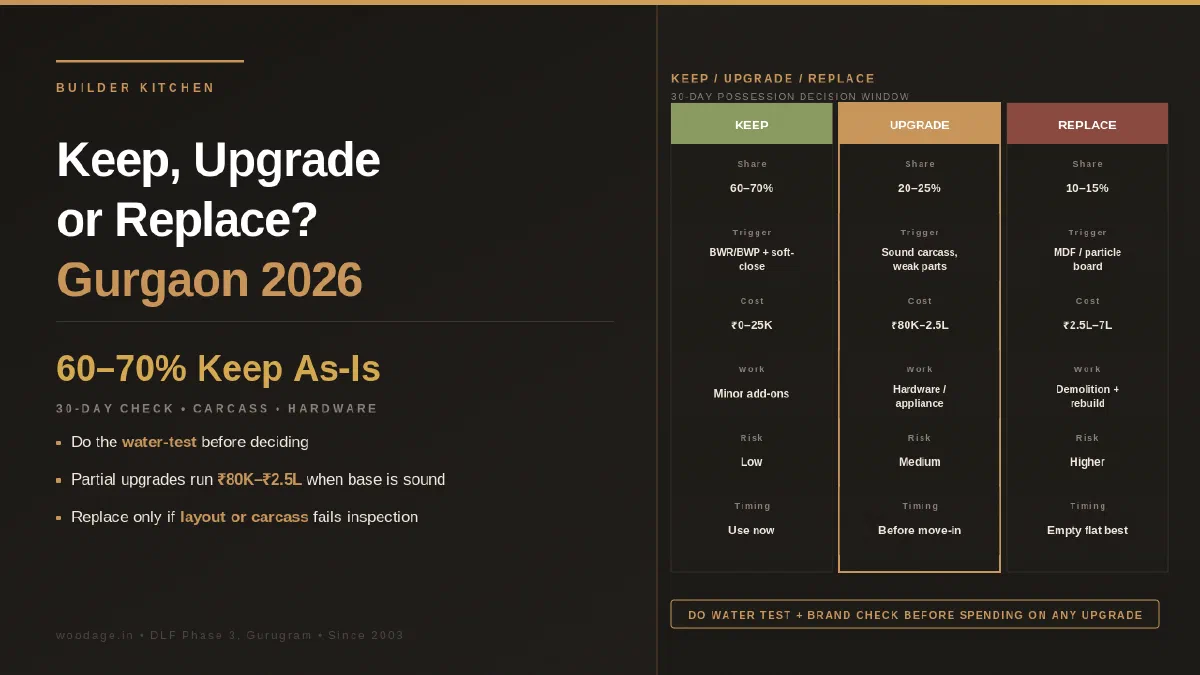
Option A: Keep As-Is
Make sense when:
- Carcass is BWR or BWP plywood (passes water swell test)
- Shutters are laminate with proper edge banding (not membrane)
- Hardware is soft-close branded (Hettich, Blum, Hafele, or Ebco at minimum)
- Countertop is intact, 18 mm or thicker
- Layout meets your daily cooking needs
Investment needed: Rs 0 to Rs 25,000 for minor add-ons like a chimney upgrade, water filter, additional shelving.
This can be the right choice when the actual carcass, finish, hardware, countertop and layout pass the inspection. A project name or premium positioning is not a substitute for checking the delivered kitchen.
Option B: Targeted Upgrade
Make sense when:
- Main structure is sound but specific items are clearly substandard
- Some specific functionality is missing (no built-in oven housing, no dishwasher cutout)
- You want to upgrade the appliance suite (better chimney, induction hob, built-in microwave)
- Hardware is generic but can be swapped without rebuilding cabinets
Typical targeted upgrades and costs:
| Upgrade | Cost range |
|---|---|
| Replace all hinges with Hettich Sensys soft-close | Rs 15,000 to Rs 30,000 |
| Replace all drawer slides with Hettich Quadro or Blum | Rs 25,000 to Rs 60,000 |
| Replace chimney (90 cm Faber, Elica, Bosch) | Rs 25,000 to Rs 80,000 |
| Replace hob with built-in 4-burner | Rs 18,000 to Rs 50,000 |
| Add built-in oven housing and oven | Rs 50,000 to Rs 1.5 lakh |
| Add dishwasher (Bosch, IFB) | Rs 50,000 to Rs 1.5 lakh |
| Replace tap and add water filter | Rs 18,000 to Rs 50,000 |
| Add tall pantry pullout unit | Rs 60,000 to Rs 1.2 lakh |
| Replace countertop with quartz | Rs 50,000 to Rs 1.5 lakh |
Total range for partial upgrade: Rs 80,000 to Rs 2.5 lakh.
This is right when the main structure is sound but the appliance or accessory provisions do not meet the household’s needs.
Option C: Full Replacement
Make sense when:
- Carcass is particle board or MDF (failed water test)
- Layout is fundamentally wrong (no triangle, sink and hob too close, no counter prep space)
- Builder kitchen blocks important functionality (window, door, balcony access)
- Shutters are membrane and already peeling at corners
- You want to invest in a kitchen whose materials and maintenance requirements are documented for your intended use
Cost: Rs 2.5 lakh to Rs 7 lakh depending on tier (refer to our Modular Kitchen Cost Calculator for Gurgaon).
Add Rs 15,000 to Rs 40,000 for demolition and disposal of the existing builder kitchen.
This is right when inspection shows unsuitable carcass material, a fundamentally wrong layout, material damage or other defects that targeted upgrades cannot solve.
Society and Builder Considerations
Before you start any modification, especially full replacement, check:
Builder warranty
Some builders provide a written warranty on parts of the kitchen. Modification can affect the relevant warranty, so read the possession documents before changing the carcass, services or appliances. If the warranty covers an item you may need later, ask the builder how an upgrade would affect that cover rather than assuming a waiting period.
Society NOC
Some buildings require a written NOC or other approval for work involving:
- Demolition or significant noise
- Plumbing modifications
- Electrical modifications beyond changing fittings
- Material delivery in goods lift
Fees, deposits, work hours, quiet periods and lift processes vary by building. Ask the current RWA or management office for the written rule before booking labour; do not infer a strict or flexible process from the builder name.
See our Society NOC Guide for Gurgaon Apartments for the full process.
Gas connection certification
If you replace the hob, have the gas connection reconnected and pressure-tested by a qualified gas professional as required by the appliance instructions, applicable rules and the building’s written policy. Confirm whether the building names an approved contractor; do not assume that it does.
Chimney exhaust
Existing chimney exhaust routes vary by tower, phase and year. Before an upgrade, inspect the installed shaft or external vent and confirm the permitted connection with the building management and a qualified installer.
Specific Builder Kitchen Notes (As of 2026)
Builder names are not specifications. For Sobha, Tata Housing, Godrej, M3M, DLF, ATS, Emaar, Smartworld or Signature Global projects, confirm the exact phase, tower and handover package before deciding. Check the installed carcass edge and stamp, shutter and edge treatment, hardware markings, countertop, appliance model numbers and available service points. Specifications can change by phase, configuration and year, so use the possession kit and an inspection of the actual unit.
The Early Post-Possession Decision Window
Review the keep, upgrade or replace decision early after possession, before furniture and pantry stock make access harder. Confirm the builder’s defect-reporting and warranty process, the building’s current fit-out rules, the lift and material route, and any work that should be recorded before modification. Keep dates provisional until those documents and the actual kitchen inspection are complete.
What to Insist On If You Are Keeping the Builder Kitchen
Even if you decide to keep the builder kitchen as-is, request these in writing from the builder at possession:
- Brand and model number list for all hardware (hinges, slides, chimney, hob)
- Warranty cards or proof of warranty for all branded items
- Carcass material specification sheet confirming what was actually installed
- Touch-up paint, laminate, and edge banding in matching colours for future repairs
- Service contact for appliances installed by the builder
Some builders provide only a generic possession kit. Ask for missing model, material, warranty and service details promptly, while the handover team and documents are easy to reach; do not assume a later request will be resolved automatically.
The Evidence Pack to Collect Before Choosing Keep, Upgrade or Replace
The decision becomes safer when the delivered kitchen is compared with documents and measurements rather than a project name or showroom description. Keep a dated copy of the following fields. Manufacturer examples below explain what a document can contain; they are not universal terms for every builder kitchen.
Decision Guide for This Question
- Intent cluster: keep, upgrade or replace a builder kitchen; inspect the handover specification, condition, services and warranty before spending.
- Deeper intent: separate a documented defect or functional gap from a preference upgrade, while preserving evidence for any builder or appliance claim.
- Use the map: keep when the delivered scope is documented and works; upgrade when one bounded deficiency is measurable; replace only when the structure or layout cannot meet the brief without repeated alteration.
| Field to record | What to verify before changing anything | Why it changes the decision |
|---|---|---|
| Agreement and handover specification | Match the installed kitchen, fixtures and possession documents to the written apartment specification. The Haryana RERA Act text says an agreement for sale specifies the development, apartment specifications and possession particulars. | A mismatch belongs in the builder’s defect or handover record before you pay to replace it. |
| Possession and defect record | Record possession/occupancy-document dates, photographs, room condition and every snag reference number. The same Act text describes a statutory route for defects in workmanship, quality or services tied to the agreement; obtain current professional advice for a dispute. | Modification can make the original condition harder to prove. |
| Board identity | Photograph the edge and any ISI mark, brand, grade and batch information; ask for the material sheet. BIS lists IS 710:2024 as the current marine-plywood specification and separately lists plywood standards in its certification scheme. | A replacement is easier to justify when the actual wet-zone material and evidence are known, not guessed from appearance. |
| Hardware model and issuer | Record the exact hinge/runner model, invoice, warranty issuer and claim route. For comparison, Hettich India publishes category-specific functional warranty terms, while Blum India publishes its own warranty and replacement process. | “Branded” is not enough; a targeted hardware upgrade may be unnecessary or may need to preserve a current warranty. |
| Countertop and cut-outs | Measure counter thickness, sink/hob cut-outs, overhangs, joints and visible cracks; retain the hob or sink model sheet. A model page such as Elica’s built-in hob specification shows why appliance dimensions are model-specific. | A countertop or appliance change can trigger new fabrication, routing or approval work. |
| Society route | Obtain the current NOC, work-hours, goods-lift, debris and core-cutting instructions from the facility office. An official Pinnacle Gurgaon fit-out guideline is an example of building-specific controls, not a Gurgaon-wide rule. | The same kitchen may be feasible in one tower and restricted in another. |
| Appliance and service provisions | Record chimney duct path, gas type, electrical points, dishwasher/oven openings and water connections before ordering replacements. | A cabinet can be sound yet still fail the household’s appliance and service needs. |
| Before-and-after boundary | Photograph every wall, service point, cabinet interior and common-area route before demolition; write down what the vendor will remove, protect, reinstall and dispose of. | A written boundary prevents an upgrade from silently becoming an unpriced replacement. |
Use this pack to make a project-specific decision: keep when the delivered scope is documented and functional, upgrade when a bounded deficiency is measurable, and replace only when the structure, layout or condition cannot meet the brief without repeated alterations. There is no universal builder, society or project threshold.
See also: Moving into a New Gurgaon possession-stage flat? See WoodAge’s New Gurgaon modular kitchen and interiors guide.
Frequently Asked Questions
Is the builder-provided modular kitchen in Gurgaon worth keeping?
Sometimes. The right answer depends on the actual carcass, finish, hardware, countertop, layout, appliance provisions and warranty documents in the unit. Inspect the kitchen rather than treating a premium builder or project name as proof that the delivered specification will suit your use.
How long does a builder modular kitchen last in Gurgaon?
Service life depends on the installed board, edge treatment, moisture exposure, hardware, cleaning and use, so no universal year applies. The useful substitute is the warranty someone will put in writing, and for a builder-fitted kitchen that question has a specific twist: ask who the warranty is actually with.
For context, published 2026 warranty positions run from 1 year on standard Häfele hinges to 5 years on Häfele SS-304, 7–10 years on Hettich as commonly quoted (Hettich India’s own schedule runs from 2 to 20 years by product) and 15 years on Blum, with BWP plywood to IS 710 carrying brand warranties around 10 years. Branded packages typically warrant hardware for 5–10 years.
The builder-kitchen twist. A builder-fitted kitchen was bought by the developer, not by you. That means three things worth establishing before you decide to keep it:
- Who holds the warranty — the developer, their contractor, or the component manufacturer — and whether it transferred to you at possession.
- What was actually installed. Builder specifications frequently name a hardware brand without a product line, which as the spread above shows can mean a 1-year or a 15-year commitment.
- When the clock started. A warranty running from the developer’s installation date may have consumed much of its term before you got the keys.
If the answers are unavailable or the term has largely elapsed, treat the kitchen as out of warranty and decide on inspected condition alone. Check the material and hardware documents, inspect wet zones, and ask the builder or manufacturer for the applicable warranty and maintenance instructions.
Warranty terms are published market positions gathered 24 August 2026, stated by the respective manufacturers and retailers, not by WoodAge. Confirm against the current warranty document for the exact product installed in your flat.
Can I claim warranty if I modify the builder kitchen?
Modifying the kitchen may affect the warranty on the altered items, while the effect on other flat or service warranties depends on the possession documents. Read the exclusions and ask the builder in writing before changing the kitchen; do not assume a universal warranty period or that modification is automatically safe after it ends.
Should I upgrade the builder’s chimney and hob?
Inspect the installed chimney’s model, hood width, tested airflow, duct route and warranty before deciding. An upgrade can make sense when the delivered unit does not suit the hob, cooking pattern or duct route, but a larger headline CFM alone does not guarantee better extraction. Compare the model documentation, installation requirements and current delivered price. Upgrade the hob only for a specific need such as induction, a different layout or an appliance feature.
How do I test whether the builder used plywood or particle board?
Do not spray water onto a cabinet as a home test. Check the cut edge for visible plywood layers versus uniform compressed material, look for a grade stamp and request the builder’s material specification. A qualified inspector or manufacturer can help identify an uncertain board without creating damage.
What is the typical timeline for a full builder kitchen replacement?
There is no universal duration, but there is a useful reference point. WoodAge’s published 2BHK Sohna Road record covers exactly this scope — full cabinetry replacement in an occupied flat, with the existing counter, tiling and plumbing retained — and ran 24 days from site measurement to snag closure, of which 4 days were on site (1 day strip-out, 2 days install, 1 day finishing). 3 snags were raised and all closed within 4 days. The BOQ ran to 26 priced lines plus a separate exclusions schedule.
Two things move that number on your project. Retaining the counter, dado tiling and plumbing positions is what keeps the on-site window short; the moment the replacement moves a sink, a gas point or a tiled surface, civil work and its drying time enter the critical path. And an occupied flat imposes society working hours, lift slots and daily dust containment that a vacant flat does not.
So set the timing as a written sequence — inspection, any building approval, demolition, measurement, manufacturing, installation, countertop work and civil modifications — and confirm each dependency and the vendor’s current capacity before fixing a handover date. Treat the 24-day record as evidence that the scope can be done quickly when the interfaces are retained, not as a commitment for a different kitchen.
What is the difference between builder modular kitchen and one I commission directly?
Builder kitchens are designed to a standard specification and price point for the project. Directly commissioned kitchens can be designed around your layout, cooking habits, height preferences and accessory choices. Compare the delivered builder specification with a like-for-like BOQ; there is no universal percentage or price parity between the two routes.
Should I keep the builder kitchen for a rental property?
It can be sensible when the delivered layout, condition and appliance provisions meet the rental home’s needs. Compare the cost of an upgrade with expected use, maintenance and warranty impact; do not assume every builder kitchen is adequate or that an upgrade cannot matter to tenants.
Related Guides From WoodAge
- Modular Kitchen Cost Calculator: 7 Inputs Explained, what a full replacement would actually cost.
- Society NOC Guide for Gurgaon Apartments, the approval process before any work.
- Built-in Kitchen Appliances Cost and Integration, upgrading the chimney, hob, oven, dishwasher.
- Modular Kitchen Renovation: No Civil Work Approach, replace without major demolition.
- Modular Kitchen Warranty in India 2026, what builder and contractor warranties actually cover.
- Modular Kitchen Cost in Gurgaon 2026: ₹1,500 to ₹4,500 per Sq Ft - Complete Price Breakdown - Useful next reading on hardware planning, costs, materials, or execution.
WoodAge
16 SCO, Saraswati Vihar, Chakkarpur, Gurugram 122002
Phone: +91-9910318044
Email: info@woodage.in
Website: woodage.in
Last reviewed: June 2026. Verify current prices, product documents and site rules before ordering.