

BWP Plywood vs HDHMR vs MDF for Kitchens
Compare BWP plywood, HDHMR and MDF for kitchens: 2026 price references, IS 710 and IS 12406 checks, wet-zone guidance and quote questions.

- Arpit Sahni
- 21 min read
BWP Plywood vs HDHMR vs MDF for Kitchen Cabinets
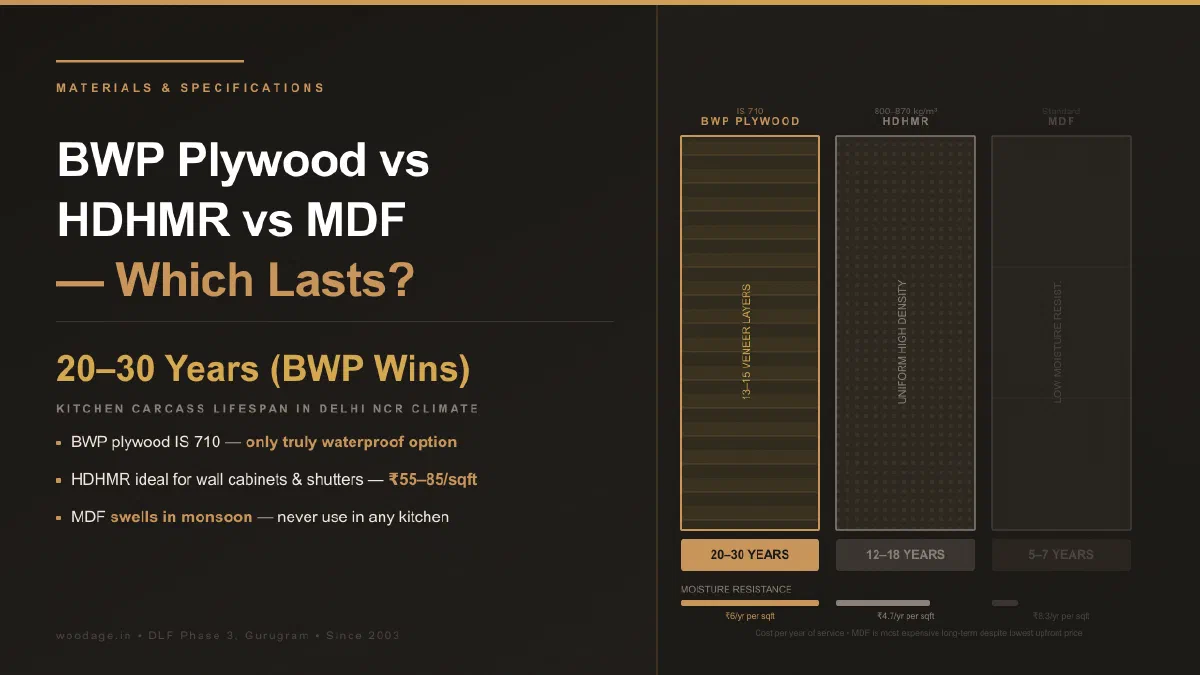
For kitchen wet-zone carcasses, verified BWP plywood to IS 710:2024 is the safer specification. A named HDHMR product can suit routed shutters, wardrobes and dry wall units when its data sheet permits the use and every cut edge is sealed. Standard interior MDF belongs in dry decorative applications. The practical answer is a zone-wise specification, not one board everywhere.
WoodAge (woodage.in) is a factory-direct modular kitchen and custom furniture manufacturer in Gurugram (Gurgaon), serving Delhi NCR since 2003.
BWP Plywood vs HDHMR: Quick Answer
Use BWP plywood for base cabinets near water, HDHMR for shutters and dry wall units, and avoid standard MDF in sink or floor contact zones. For price comparison, ask every vendor to quote the same 18 mm thickness, same laminate, same edge banding and the same hardware line before judging BWP vs HDHMR cost.
For a modular kitchen or wardrobe in Gurgaon or Delhi NCR, the carcass board changes the failure modes you need to control: water entry at cut edges, screw withdrawal, delamination, swelling and surface damage. No Indian Standard assigns a universal installed lifespan to these boards. Compare the stated grade, manufacturer warranty, exposure zone, edge sealing and hardware load instead of relying on a single years-of-life claim.
Material Selection Guide: BWP, HDHMR, MDF and Anti-Termite Questions
Buyers usually mix board type, water resistance, termite resistance and cabinet cost into a single question. Treat them as one material selection decision.
| Buyer question | What the buyer is really asking | WoodAge answer |
|---|---|---|
| HDHMR vs BWP plywood | Which board should go in kitchen cabinets? | BWP plywood for wet base units; HDHMR can work for dry wall units, shutters and wardrobes |
| BWP vs HDHMR price difference | Is the upgrade worth paying for? | Isolate the BWP upgrade for sink bases and dishwasher zones, then compare the added quote amount with the named product warranty, plumbing access and replacement scope |
| MDF vs HDHMR for kitchen | Can MDF be used if budget is tight? | Do not substitute standard interior MDF into wet-risk carcasses; compare a named moisture-resistant product for dry shutters or wall units only where its data sheet permits |
| non termite kitchen cabinet material | Avoid termite or borer damage | Require the named board’s data sheet or warranty to state borer/termite treatment or cover; keep edges sealed and avoid an unverified “anti-termite” label |
| best anti termite material for modular kitchen | Material plus execution check | Material matters, but sealed edges, raised plinths, dry plumbing and factory edge banding matter just as much |
If termite or borer resistance is the main concern, also read the termite-proof modular kitchen material guide. For thickness checks, use the plywood thickness guide. For delivery verification, use the BIS and CML plywood verification checklist.
What Are BWP Plywood, HDHMR, and MDF? A Quick Primer
Before comparing them, let us understand what each material actually is:
BWP plywood (Boiling Water Proof) is cross-laminated veneer plywood sold to the IS 710 specification. BIS now publishes IS 710:2024 as the third revision, and its plywood laboratory test scope identifies water-resistance, glue-adhesion, static-bending, tensile, preservative-retention and formaldehyde tests for that standard. Those product tests support wet-zone selection; they do not promise a fixed number of installed years. See the BIS IS 710:2024 page and BIS plywood laboratory test scope.
HDHMR (High Density High Moisture Resistant) is an engineered fibreboard sold in moisture-resistant product grades. Its uniform face can suit routed shutters and bonded finishes, but grade names, density, warranties and wet-area limitations vary by manufacturer; verify the exact product data sheet rather than treating “HDHMR” as one universal specification.
MDF (Medium Density Fibreboard) is an engineered fibreboard with a smooth, routable face. Standard interior-grade MDF is intended for dry applications; moisture-resistant variants are separate products. The invoice and product data sheet should name the grade because the finished surface alone does not reveal it.
Six Current BIS Facts That Change the BWP-vs-HDHMR Decision
These are product-standard and verification facts checked against current BIS surfaces on 11 August 2026. They do not prove that a particular delivered sheet conforms; the sheet marking, licence record, invoice and BOQ still have to match.
| Current official fact | Buyer decision | Primary source |
|---|---|---|
| BIS identifies IS 710:2024, Marine Plywood — Specification as the third revision. | Write IS 710:2024 into a new wet-zone BOQ instead of relying only on “BWP” or an undated standard reference. | BIS IS 710:2024 |
| The BIS plywood laboratory test scope lists water-resistance, glue-adhesion, wet/dry bending, tensile, preservative-treatment and formaldehyde checks for IS 710 plywood. | Treat the standard as a test specification, not as a universal installed-life or leak-proof guarantee. | BIS plywood laboratory test scope |
BIS says the licence number should appear with the Standard Mark, preferably as CM/L-XXXXXXXXXX. | A bare ISI-style logo or “BWP” print is incomplete verification; photograph the Standard Mark and CM/L number before cutting. | BIS Standard Mark guidance |
| The BIS Care app provides “Verify Licence Details” and “Know Your Standards” functions. | Cross-check the CM/L, manufacturer and standard rather than accepting the board stamp by appearance alone. | BIS Care app features |
| The BIS laboratory scope records IS 12406:2025 as the third revision for general-purpose MDF and distinguishes REG, MR, HMR-GP and HMR-FN grades. | “HDHMR” alone is not a complete grade line; ask for the exact standard, grade, product and intended application. | BIS LIMS IS 12406:2025 scope |
| The same IS 12406:2025 scope includes thickness, density, 24-hour swelling, screw-withdrawal, moisture-resistance and formaldehyde tests. | Compare a named fibreboard product’s declared test class and data sheet with its proposed cabinet zone; density language alone is not enough. | BIS LIMS test scope |
2026 Price References: BWP Plywood vs HDHMR vs MDF
The following are source-specific price references checked on 11 August 2026. They are indicative estimates only, not WoodAge quotes, Gurgaon market averages or like-for-like installed-cabinet prices. The source, product, thickness, unit, tax treatment and availability differ, so use them to frame questions and then obtain a same-scope BOQ.
| Material reference | Published price and unit | Source and scope | What it does not prove |
|---|---|---|---|
| Greenply 710 Marine plywood | ₹50–₹194/sq ft across the published 4–25 mm range | Greenply standard sizes and price guide; manufacturer-published indicative range | It is not a universal BWP rate, an installed-carcass price or a WoodAge quote; thickness, location, grade, finish, GST and project scope must be checked. |
| 18 mm marine plywood category | ₹3,500–₹6,500 per 8 × 4 ft sheet in Greenply’s published guide | Greenply marine plywood uses and price guide; brand, location and product context apply | A sheet range cannot be compared directly with a per-sq-ft product row without normalising sheet size, brand, grade, GST, cutting, delivery and installation. |
| Action Tesa HDHMR 18 mm, 8 × 4 ft | ₹3,300 per sheet | Seller listing — Panels & Surfaces, Pune; seller-set B2B listing | A single seller’s quoted rate in one city. It is not an Action Tesa list price, an NCR rate or a WoodAge quote, and the listing does not state the tax treatment. |
| Action Tesa HDHMR 16.75 mm plain, 8 × 4 ft | ₹72/sq ft, listing states “excluding all taxes” | Seller listing — Ganesh Plywood & Timber, New Delhi; seller-set B2B listing. Note the listing’s own web address says “18-mm” while the product detail states 16.75 mm — a live example of why the page title is never the specification. | A different thickness and a different unit from the row above, quoted before GST. It cannot be compared with an 18 mm per-sheet price without converting both to the same thickness, area and tax basis. |
| Greenpanel MDF, interior grade | ₹21.25/sq ft on a 7 mm headline listing; seller offers 1.9–25 mm | Seller listing — A.G. Enterprises, Jaipur; seller-set B2B listing | An entry-thickness, interior-grade rate. It is not an 18 mm price and interior-grade MDF is not a wet-zone board; do not read it as the cost of a kitchen carcass. |
Why these numbers look so inconsistent — and what that tells you. No Indian manufacturer publishes a binding list price for HDHMR or MDF; every figure above a manufacturer’s own guide is a seller-set quote for one product, in one city, on one date. Look at what actually differs across the last three rows: 18 mm versus 16.75 mm versus 7 mm, per-sheet versus per-sq-ft, tax-inclusive versus explicitly pre-GST, Pune versus Delhi versus Jaipur. Any “MDF is cheaper than HDHMR” claim built by comparing rows like these across different thicknesses, units, cities and tax bases is arithmetic, not evidence.
How to compare the numbers properly: fix the thickness first, then the sheet size, then the grade, then the tax basis — and only then compare. Ask every vendor to quote the same thickness and sheet dimensions, name the board grade and product, state whether the rate is per sheet or per sq ft, state whether GST is included, and price edge treatment, finish, hardware, cutting wastage, delivery and installation as separate lines. A BWP-versus-HDHMR price difference is meaningful only after those fields are aligned. The two Greenply rows illustrate the same trap from the manufacturer side: a product-specific per-sq-ft price and a category sheet range should never be averaged into one headline rate.
BWP Plywood vs HDHMR vs MDF: Head-to-Head Comparison
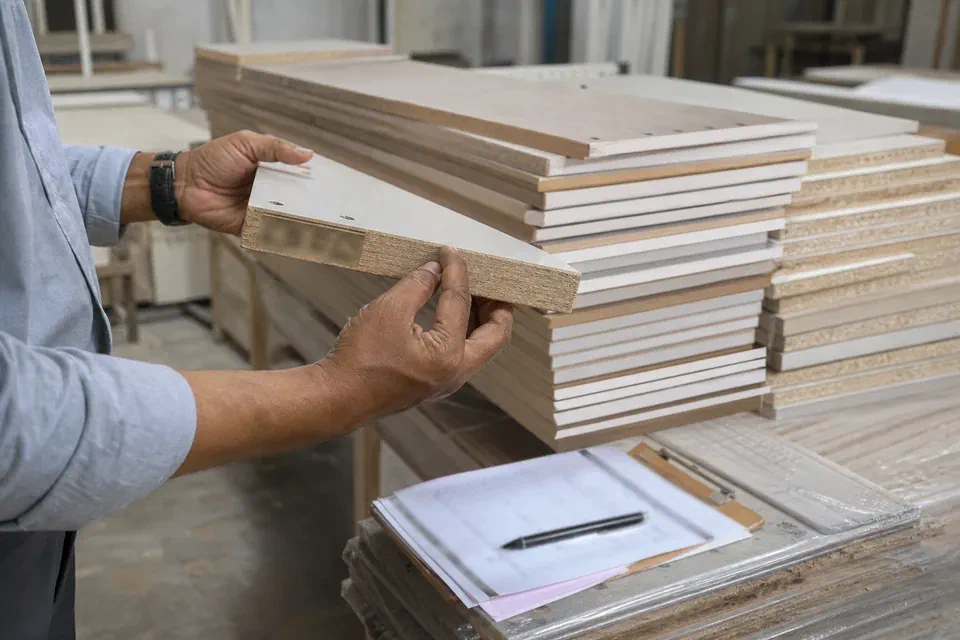
| Parameter | BWP Plywood (IS 710:2024) | HDHMR | Standard interior MDF |
|---|---|---|---|
| Wet-zone evidence | BIS product standard includes water-resistance and glue-adhesion tests | Manufacturer-specific; check product data sheet and warranty | Use only where the declared grade permits; standard interior MDF is a dry-zone choice |
| Edge-water risk | Lower when the sheet is genuine and cuts are sealed; plumbing leaks still require repair | Cut edges and fixing holes must be sealed | Exposed edges are the main risk in kitchen moisture |
| Screw and hardware check | Confirm thickness, fastener schedule and hinge/runner load | Confirm density/product grade and fastener guidance | Confirm manufacturer guidance; repeated removal can weaken fixing points |
| CNC routability | Layered construction can show ply lines on deep profiles | Uniform face is commonly used for routed shutters | Smooth face suits painted or routed dry-area components |
| Installed-life claim | No universal figure in IS 710; depends on exposure, fabrication, maintenance and warranty | No universal figure; product and execution dependent | No universal figure; product grade and moisture control are decisive |
| Traceability | BIS Standard Mark, licence/CML number, manufacturer, grade and invoice | Brand, product line, thickness, batch/invoice and technical data sheet | Brand, grade, thickness, batch/invoice and technical data sheet |
| Best decision use | Sink bases, dishwasher bays and other specified wet-risk carcass zones | Dry wall units and shutters where the named product permits | Dry decorative panels or components within the named product’s use limits |
Why BWP Plywood Is the Safer Choice for Wet Kitchen Zones
The single most important reason to use BWP plywood in kitchen carcasses is moisture resistance. In a kitchen, the base cabinets near the sink are exposed to water splashes, pipe condensation, and occasional plumbing leaks. The area beneath the cooking hob accumulates steam and grease-laden moisture. Even the wall cabinets above the chimney deal with rising heat and humidity during every cooking session.
IS 710:2024 product testing is relevant because sink bases and dishwasher bays have credible water-entry risk. It does not make a cabinet immune to an unrepaired leak: cut edges, drill holes, back panels, plinth detail and plumbing access still determine whether water reaches the board.
At delivery, use traceable evidence: the BIS Standard Mark and licence/CML number on the sheet, the manufacturer and grade on the invoice, the thickness in the BOQ, and dated photographs before the laminate hides the board. Layer count or resin colour can be supplementary observations, but neither is a substitute for licence traceability or laboratory conformity.
Use a lifecycle-risk comparison instead of invented cost-per-year arithmetic:
- quote the same carcass thickness, finish and hardware across vendors;
- isolate the upgrade cost for wet-risk zones rather than changing every cabinet;
- compare written product warranties and exclusions;
- price access and replacement risk for sink, dishwasher and floor-contact units.
This produces a defensible purchasing decision without assuming that every sheet or installation lasts the same number of years.
Why plywood recovers from wetting and particle boards may not. Chapter 11 of the USDA Wood Handbook (FPL-GTR-282, 2021) records that plywood’s alternating grain gives it “excellent dimensional stability along its length and across its width” and that, “unlike most panels fabricated from particles”, it “undergoes minimal irreversible thickness swelling if wetted”. Irreversible swelling is thickness a board does not recover after a leak dries, which is why a wet sink base favours verified plywood. For fibreboards such as HDHMR and MDF, ask instead for the product’s 24-hour swelling result, a test BIS lists under IS 12406:2025.
Where HDHMR Outperforms Plywood
HDHMR is not inferior to plywood - it is different, and in certain applications, it is genuinely the better choice:
For shutter panels (cabinet doors): A uniform fibreboard face can produce cleaner CNC-routed profiles than layered plywood. The exact result depends on the named board, tool, profile depth and finish system, so the BOQ should identify the HDHMR product rather than only the generic board family.
For acrylic and laminate bonding: HDHMR’s uniform face can suit bonded acrylic and laminate shutters. Flatness, adhesive compatibility, surface preparation and edge sealing still need to match the finish supplier’s instructions.
For wardrobe carcasses: Wardrobes usually face less direct water exposure than sink bases, so an HDHMR product approved for the application can be a reasonable alternative to BWP plywood. Compare the same thickness, finish, hardware and warranty before calling either quote cheaper; sheet prices alone do not represent the installed wardrobe.
For hardware-heavy applications: Ask for the named HDHMR product, thickness and fastener guidance, then match the hinge or runner load to the panel specification. “High density” by itself is not proof that every product holds every fixing as well as plywood.
When MDF Makes Sense (and When It Does Not)
MDF has a legitimate place in furniture - but only in the right applications:
MDF is acceptable for:
- Decorative wall panelling in air-conditioned bedrooms
- CNC-carved jali patterns for room dividers (in dry areas)
- PU-painted shutter panels when bonded onto a plywood frame
- Decorative mouldings and trims
Standard interior-grade MDF is not a suitable default for:
- Sink-base, dishwasher-bay or other wet-risk kitchen carcasses
- Bathroom vanity carcasses unless the exact product grade and manufacturer explicitly permit that wet-area use
- Floor-contact base cabinets where the specified product, plinth and edge treatment do not address cleaning-water exposure
- Balcony or outdoor furniture
The practical risk with standard interior MDF is moisture entering an exposed or inadequately sealed edge. Swelling can misalign shutters and shelves, and damaged fibreboard may require panel replacement rather than cosmetic repair. The timing and severity depend on the grade, exposure, sealing and installation, so WoodAge does not attach a universal percentage or monsoon count.
Material Labels to Verify Before Ordering
In our two decades of manufacturing, we have seen a few practices that homeowners should be aware of:
A quote that says only “engineered wood.” Particle board, MDF, HDHMR and plywood are different panel families. Ask for the exact product, thickness, intended application and technical data sheet; the umbrella label does not disclose moisture limits or fastener guidance.
BWR plywood described as equivalent to BWP. BWR plywood and BWP plywood are not the same grade: confirm the standard printed on the sheet and the licence/CML record. For a sink or dishwasher carcass, specify verified IS 710 BWP instead of accepting an unspecified “waterproof ply” line.
HDHMR treated as one universal wet-area grade. HDHMR is a product-family label, and moisture limits vary by manufacturer. Use the named product’s data sheet and warranty to decide its application; do not infer sink-base suitability from the generic label.
How to Verify Material Quality Before You Buy

Read the complete BIS mark. For plywood sold as IS 710, photograph the Standard Mark and licence/CML number; a bare “BWP” print is not equivalent.
Cross-check the licence. Use the BIS Care app or BIS licence search to match the CML number, manufacturer and product standard.
Match delivery to the BOQ. Record brand, product line, grade, thickness and invoice line before sheets are cut or covered.
Check fabrication evidence. Inspect cut edges, back-panel specification, edge sealing, plinth detail and plumbing access. Layer count and resin colour alone do not authenticate a grade.
For HDHMR or MDF, obtain the product data sheet. Confirm the exact density class, moisture-use limits, emissions classification and warranty for that named SKU; do not infer them from the generic board label.
WoodAge’s Material Recommendation for Delhi NCR Homes
For WoodAge kitchen and wardrobe BOQs in Gurgaon and Delhi NCR, the standard material specification is chosen by exposure zone:
| Application | Our Recommendation | Why |
|---|---|---|
| Kitchen base cabinets | Verified BWP plywood (IS 710:2024) | Use the traceable wet-risk specification near sink, dishwasher and agreed floor-contact zones |
| Kitchen wall cabinets | Verified BWP plywood or a named HDHMR product | Choose from the declared product grade, fixing schedule, finish system and exposure—not a universal saving claim |
| Kitchen shutters | Named HDHMR or BWP product matched to the finish | Confirm routing depth, flatness, adhesive system, edge treatment and product warranty |
| Wardrobe carcasses | Named HDHMR product or verified BWP plywood | Match the board to wall moisture risk, span, fixing load, finish and warranty |
| Wardrobe shutters | Named HDHMR or another specified board | Use the product data sheet and finish-system requirements for routed or bonded shutters |
| Bathroom vanity | Verified IS 710 plywood or another product explicitly approved for the wet-area specification | High splash and leak risk; seal cut edges and keep plumbing accessible |
| TV unit / display shelving | Named HDHMR product where the data sheet permits | Dry application; verify span, fixing and finish requirements |
| Bedroom furniture | Named board selected for the component | Use the product grade, span, fixing load, edge treatment and warranty rather than a generic humidity claim |
See also: To compare board and finish exposure risks in Delhi NCR, read WoodAge’s material lifespan guide for the NCR climate.
Evidence and Verification Notes
Material choice should be verified at delivery, not only during showroom discussion. The finished laminate surface can hide the actual carcass board, so the proof must be visible before installation.
| Evidence item | What to verify | Primary proof to ask for |
|---|---|---|
| BWP plywood | IS 710 marking, brand, thickness and CML/ISI traceability | Board edge stamp; cross-check standards through the Bureau of Indian Standards |
| BWR plywood | IS 303 marking if BWR is used in dry or wall-cabinet zones | Board stamp, invoice and BOQ material line |
| HDHMR | Board brand, thickness, density class and sealed edges | Delivery invoice, cut-edge inspection and laminate/edge-banding detail |
| Wet-zone use | Sink base, dishwasher bay, utility and vanity carcass material | Site delivery photos before panels are fixed |
Frequently Asked Questions
Which is better for a sink base: BWP plywood or HDHMR?
For a sink base, dishwasher bay or other wet-risk carcass, verified BWP plywood to IS 710 is the safer specification to investigate first. A named HDHMR product may suit a dry-zone shutter or wall unit when its data sheet permits the application. Compare the same thickness, edge treatment, fastener guidance, plumbing access and warranty; neither material is universally better in every cabinet zone.
Is BWP plywood really waterproof?
IS 710 specifies tests for structural plywood for marine and similar wet-risk use, including water-resistance and glue-adhesion checks. That supports using verified IS 710 plywood in sink and dishwasher zones. It is not a promise that leaks cannot damage a cabinet: seals, cut edges, fixings and timely plumbing repair still matter.
Can I use MDF for my kitchen in Gurgaon?
Do not specify standard interior-grade MDF for a sink base, dishwasher bay or floor-contact kitchen carcass. Moisture entering an exposed edge can cause swelling and alignment problems. A moisture-resistant MDF variant is a different product and must be evaluated from its own data sheet, intended-use limits, edge treatment and warranty.
What material do premium kitchen brands use?
There is no single material schedule shared by every premium brand. Ask for the actual carcass, shutter, back-panel and edge specification in the final BOQ. A finished sample or showroom label does not prove the board hidden beneath the surface, and an imported system should be judged by its named product data and warranty rather than its country of origin.
How do I compare MDF vs HDHMR vs plywood price?
There is no defensible universal premium because sheet brand, thickness, grade, finish, unit and dealer price change the result. Ask vendors to quote the same BOQ, then compare BWP plywood, HDHMR and MDF by zone after aligning board dimensions, finish, edge treatment, hardware, GST, delivery and installation. The 2026 references above are source-specific planning inputs, not a WoodAge quote or market average.
What is the current price of 18 mm HDHMR?
There is no published manufacturer list price for HDHMR in India, so every figure you find online is a seller-set quote for one product, city and date. On 11 August 2026 one Pune seller listed Action Tesa HDHMR 18 mm in 8 × 4 ft at ₹3,300 per sheet, while a New Delhi seller listed the 16.75 mm plain board at ₹72/sq ft excluding taxes. Those two cannot be subtracted from each other: the thickness, the unit and the tax basis all differ. Ask your own supplier to quote a named product at a fixed thickness and sheet size, state whether GST is included, and put edge treatment, cutting wastage and delivery on separate lines before you compare it with plywood or MDF.
Is HDHMR waterproof for a kitchen sink base?
Do not treat the HDHMR label alone as a waterproof guarantee. For a sink base, specify verified BWP plywood to IS 710 unless the named HDHMR product’s data sheet, permitted application, edge treatment and warranty support that wet-risk use. Plumbing access, cut edges, back panels and an unrepaired leak still matter after the board is selected.
Is HDHMR the same as HDF?
No. HDF is a density-family label; HDHMR is a moisture-resistant product label used by manufacturers. Exact composition, density, test values and permitted uses vary by product. Verify the named SKU and technical data sheet—plain “HDF” or “engineered wood” on a quote is not enough for a kitchen decision.
How do I verify BWP plywood at delivery?
Ask the vendor to show the BIS Standard Mark, licence/CML number, manufacturer, IS 710 grade and thickness before panels are cut or installed. Match those details to the invoice and BOQ, and retain dated delivery photographs. Ply count or resin colour can be observations, but neither substitutes for licence traceability.
What material mix works for a new possession Gurgaon flat?
For a new-possession flat in Gurgaon, use BWP plywood in sink bases, dishwasher zones, utility cabinets and bathroom vanities. HDHMR can work well for dry wall units, wardrobe carcasses and shutters when edges are sealed properly. Avoid particle board or standard MDF in any floor-touching cabinet because mopping water and monsoon humidity expose those edges first.
HDHMR vs plywood for a wardrobe: which is better?
For a dry wardrobe either can work, so decide on the named product, span, fixing load and finish rather than the board family. HDHMR’s uniform face suits routed or bonded shutters, while verified plywood is the safer carcass where a wardrobe backs onto a damp or external wall, because the USDA Wood Handbook notes plywood undergoes minimal irreversible thickness swelling if wetted. WoodAge’s zone-by-zone material recommendation lists a named HDHMR product or verified BWP plywood for wardrobe carcasses.
What is the price difference between HDHMR and BWP plywood?
There is no fixed difference, but dated 2026 references give a starting range. Greenply’s published guide puts an 18 mm marine plywood sheet at ₹3,500 to ₹6,500 (8 × 4 ft), while one Pune seller listed an 18 mm Action Tesa HDHMR sheet at ₹3,300 in August 2026. These are indicative references only, not a quote; compare quotes for the same thickness, finish, edge treatment, GST and delivery.
Get Expert Material Advice for Your Project
Choosing the right material combination is one of the most consequential decisions in any furniture project. At WoodAge, we are happy to discuss material specifications for your specific project - whether it is a kitchen, wardrobe, bathroom vanity, or full home interior.
Your next step: verify the board before it becomes a cabinet
Carcass material is the one decision you cannot revisit after installation without stripping the kitchen. It is also the easiest line to substitute quietly, because once a panel is cut, edged and assembled, the grade stamp is gone. Check three things:
- Grade named per zone, not per kitchen. “BWP plywood” across the whole quote is usually optimistic. What you want written is which zones get IS 710 BWP (sink base, dishwasher, tall units against wet walls) and which get HDHMR.
- The stamp, at delivery, not at quotation. IS 710 boards carry a BIS mark and a CML number. Photograph the stamped panels when they arrive, before cutting.
- Thickness per element. Carcass, shutter, back panel and shelf are frequently different, and the difference is where quotes diverge without looking cheaper.
Want the material grade written into the quote per zone? A WoodAge BOQ lists items line by line, naming carcass grade, shutter finish, and the hardware brand and line per cabinet, instead of a single lump sum, so you can compare quotes accurately. Send your quote or drawings for a written BOQ, or see how carcass grade is specified on the modular kitchen manufacturing page.
Related Guides From WoodAge
- Modular Kitchen Cost in Gurgaon 2026: Complete Price Breakdown - Per-sq-ft pricing by material grade, layout and hardware brand.
- Factory-Made vs Carpenter Kitchen: Real Cost Over 15 Years - Why CNC precision and machine edge banding matter more than material choice alone.
- Acrylic vs Laminate vs PU Paint vs Veneer: Best Kitchen Finish for Delhi NCR - Shutter finish comparison for Delhi NCR’s extreme climate.
- Hettich vs Häfele vs Blum Kitchen Hardware - 2026 Price & Cycle Rating Guide - Hardware spec matched to your carcass material choice.
- 10 Hidden Costs in Modular Kitchens Nobody Tells You About - Don’t let material upgrades hide these overlooked budget items.
- Custom Bathroom Vanity in Gurgaon: Materials, Design and Cost Guide 2026 - Useful next reading on hardware planning, costs, materials, or execution.
- Which Material Should You Use for a Modular Kitchen? A Practical Guide - Choose modular kitchen materials by zone: BWP or BWR plywood for carcass, HDHMR for shutters, laminate for easy maintenance, and granite or quartz for counters.
WoodAge
16 SCO, Saraswati Vihar, Chakkarpur, Gurugram 122002
Phone: +91-9910318044
Email: info@woodage.in
Website: woodage.in