

Cabinet Board Failure: Swelling, Sag and Loose Hinges
Diagnose swollen MDF, sagging shelves, loose hinges and particle-board damage using moisture, span, edge and screw-seat checks before repair.

- Arpit Sahni
- 13 min read
Why Cabinet Boards Fail: Diagnose Swelling, Sagging Shelves and Loose Hinges
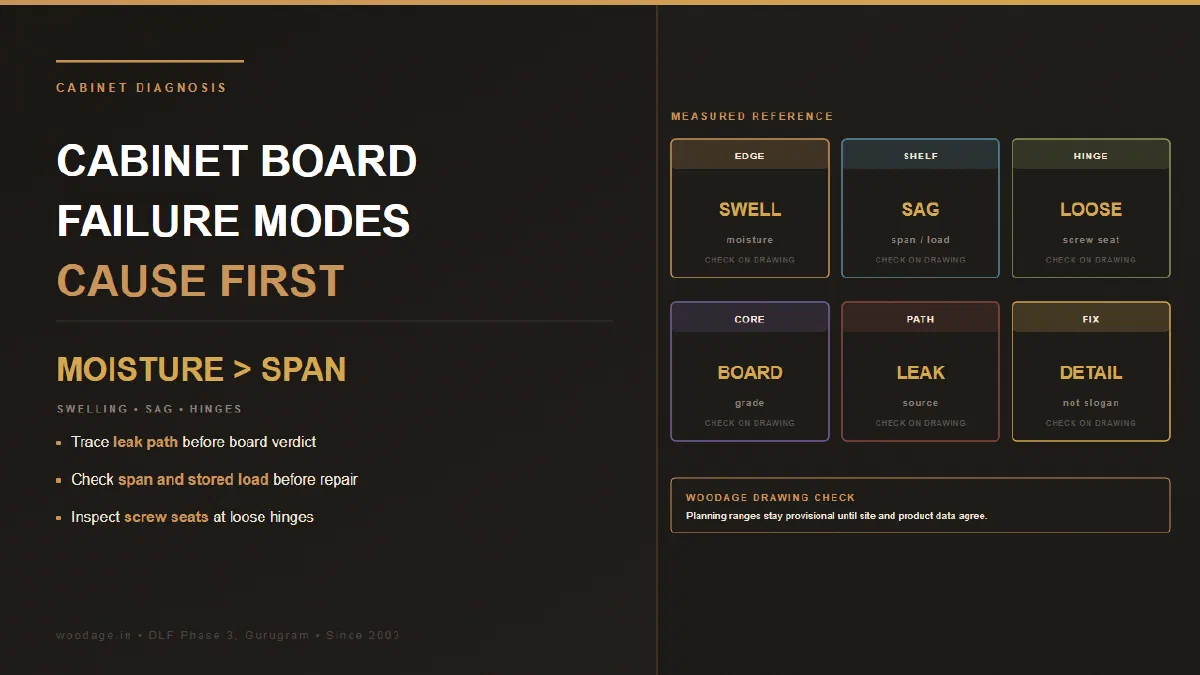
A swollen cabinet edge, sagging shelf or loose hinge needs a cause diagnosis before a material verdict. Check the leak path, exposed edge, unsupported span, stored load and screw seat first. Board type affects tolerance, but plywood, MDF, HDHMR and particle board can all fail when the detail or exposure is wrong.
WoodAge is a factory-direct modular kitchen and custom furniture manufacturer operating since 2003 and based at 16 SCO, Saraswati Vihar, Chakkarpur, Gurugram 122002. This page is a symptom-to-cause diagnostic guide for an existing cabinet. For pre-purchase material selection, use the canonical material lifespan decision page for Delhi NCR or the BWP plywood vs HDHMR vs MDF guide.

Published lifespan figures are background, not the diagnosis
These third-party ranges are retained as reference data, but they are low-confidence planning bands and cannot identify why a cabinet in front of you has failed. The sources do not use one test method or identical conditions, and no manufacturer warranty is expressed in these terms. Greenpanel’s own terms state that MDF durability varies with use, maintenance and environment, which is the correct way to interpret the table.
| Board | Published service life | Condition assumed | Source basis |
|---|---|---|---|
| Plywood, good grade | 15 to 25 years | Dry indoor, sealed edges | Unstandardised trade planning range, not a tested life |
| MDF, standard | 10 to 15 years | Dry indoor | Unstandardised trade planning range, not a tested life |
| MDF, standard in air conditioning | About 12 years | Stable temperature and humidity | Duroboil MDF durability guide, 2026 |
| MDF, moisture-resistant grade | 15 to 18 years | Well-ventilated interior | Duroboil, 2026 |
| Particle board | 3 to 5 years | Light to normal dry indoor use | Unstandardised trade planning range, not a tested life |
| HDHMR | No reliable published figure found | Not stated | See the note below |
A word on the missing row, because the honest answer is more useful than a made-up number. We could not find a credible, dated, independent service-life figure for HDHMR in Indian conditions. Marketing pages assert long life without a test basis. Treat any HDHMR lifespan claim you are shown as a marketing statement until the seller produces the test standard behind it.
Two more cautions apply to the whole table. Published ranges for the same board disagree between sources, sometimes by a factor of two, because they do not state the same conditions. Climate labels are not a substitute for a site diagnosis: measure or inspect damp, ventilation, leak history, edge sealing and exposure at the actual cabinet.
The grade tests that actually predict water survival
Service-life tables are estimates. Grade tests are measured, and they are the closest thing to an objective durability figure that Indian plywood offers.
| Grade | Standard | The defining test |
|---|---|---|
| MR, moisture resistant | IS 303:2024 | General-purpose grade; verify the current licence scope and water-resistance requirement |
| BWR or BWP within general-purpose plywood | IS 303:2024 | Current grade and test evidence must match the supplied sheet and licence |
| Marine plywood | IS 710:2024 | Current marine-plywood specification, including water resistance, wet and dry strength, tensile strength, preservative and formaldehyde requirements |
The standards now provide a more useful distinction than the older retail slogan of 8 hours versus 72 hours. Ask for the current edition, grade, CM/L licence number and product-specific evidence. A laboratory water-resistance test is an accelerated discriminator, not a multiplier that predicts cabinet life.
Two clarifications that stop people misreading it.
The test is a laboratory proxy, not a promise. Nobody boils a kitchen cabinet. The test discriminates between adhesive systems under accelerated stress; it does not mean a BWP panel survives nine times longer under a leak.
Fungal and preservative evidence matters in wet-risk applications. The current BIS plywood compendium identifies water resistance, wet and dry bending strength, tensile strength and preservative retention within marine-plywood performance. That evidence supports material selection, but it still does not excuse a leaking fitting or unsealed cut-out.
Symptom-to-cause map for cabinet board failure
Start with what is visible, then test the competing causes. Replacing a swollen sink-base panel without fixing the trap, or fitting a stronger hinge into a crumbling screw seat, repeats the failure.
| Visible symptom | Likely cause to test first | Evidence to collect before repair |
|---|---|---|
| Edge swelling or laminate lift | Water entering an unsealed cut edge or service opening | Moisture source, damaged edge length, rear and underside photographs |
| Shelf bow or sag | Unsupported span, stored load, board stiffness or failed support | Clear span in mm, thickness, support positions and estimated load |
| Hinge plate pulling away | Stripped screw seat, low-density core, over-tightening or excessive shutter load | Screw-hole condition, shutter size and weight, hinge count and model |
| Repeated alignment drift | Hinge adjustment, loose mounting plate, moving shutter or racked carcass | Gap measurements at top and bottom, hinge settings and carcass diagonals |
| Musty rear panel or surface spotting | Historic damp, condensation or poor wall-side ventilation | Moisture reading, wall condition, ventilation gap and leak history |
Eight fields for a repeatable failure record
Record the same evidence before a contractor changes the cabinet: 1. cabinet or panel ID, 2. symptom first noticed, 3. panel thickness in mm, 4. unsupported span in mm, 5. estimated stored load in kg, 6. moisture reading and instrument, 7. nearby plumbing-use test with time, and 8. dated photographs of the face, edge, rear and fixing point. The record makes competing repair quotes easier to compare without turning one photograph into a diagnosis.
Five failure paths explain why two installations made from the same board can age very differently. Only one is controlled by the board name alone.
1. The unsealed edge. This is a common failure path and it is partly a detailing issue, not only a material issue. Every cut edge exposes the core. Water entry can swell the core and lift the surface. Inspect hidden edges and service cut-outs as carefully as visible shutter edges. The detail is covered in edge banding for modular kitchens.
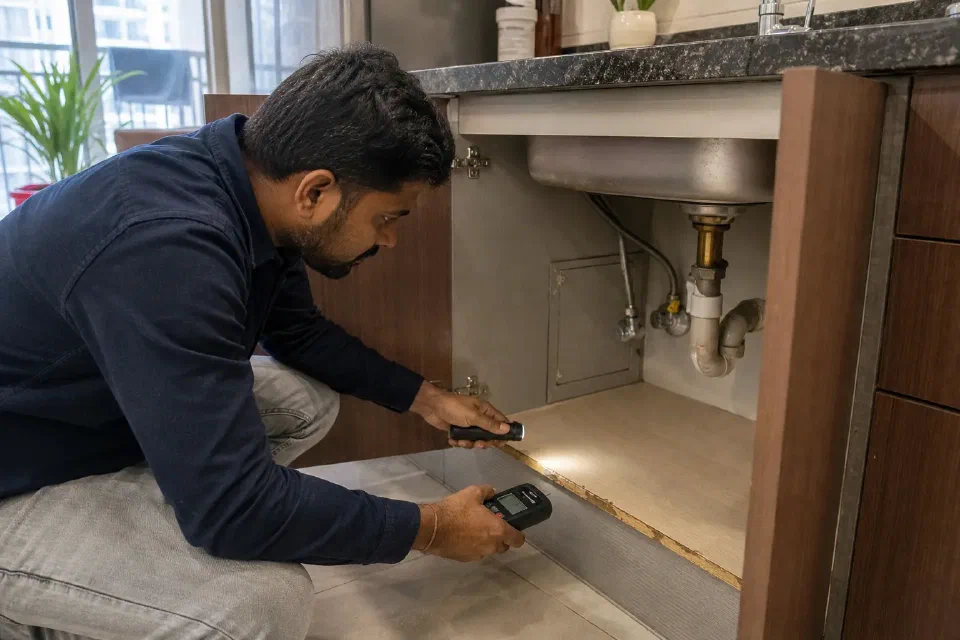
2. The slow leak nobody noticed. A sink trap weeping into a base cabinet destroys any board, including BWP, given enough months. BWP buys you time and forgiveness. It does not buy immunity. See the under-sink checks.
3. Span and load. A sagging shelf is a structural system problem. For example, an 18 mm shelf at a 900 mm unsupported span cannot be judged without the board properties, edge restraint, support condition and expected load. Set a maximum span and design load in the drawing, then add a support, shorten the span or change the construction after calculation.
4. Screw pull-out at hinges. Repeated door slamming on a low-density core loosens the screw seat. This is where particle board and, to a lesser extent, MDF genuinely underperform plywood, and it is why heavy or tall shutters need attention to hinge count and load class.
5. Humidity cycling. Boards absorb and release moisture with the seasons. Every cycle stresses the glue line. A sealed, painted or laminated board on all six faces cycles far less than a half-finished one.
Use the cabinet zone to narrow the failure cause
The same sheet has completely different life expectancy depending on the zone it is installed in. This is the practical reframing that the lifespan question needs.
| Zone | Moisture exposure | What shortens life here | Realistic expectation |
|---|---|---|---|
| Bedroom wardrobe carcass | Low | Screw pull-out, shelf sag | Long, at the top of the published range |
| Living room storage and TV unit | Low | Load, heat from electronics | Long |
| Kitchen upper cabinets | Low to moderate | Steam, grease, heat above the hob | Moderate to long |
| Kitchen base cabinets, away from the sink | Moderate | Spills, mopping water at the plinth | Moderate |
| Kitchen sink base | High | Trap leaks, standing water, RO fittings | Short unless BWP with sealed edges |
| Utility and balcony | Very high | Direct water, sun, temperature swing | Shortest, and the grade matters most here |
| Bathroom vanity | Very high | Splash, standing humidity, no ventilation | Short unless correctly specified |
The pattern is clear. Board grade becomes more consequential as wetting risk and service difficulty rise. In dry rooms, span, fittings and detailing can be more important differentiators than the headline board family.
Delhi NCR condition audit before using a lifespan number
A Vasant Vihar builder floor, a Greater Kailash ground-floor bedroom, a DLF Phase 4 apartment and a new flat on Dwarka Expressway can expose the same board to very different conditions. Use this site record instead of assigning life by locality:
| Condition to record | Evidence | Decision it informs |
|---|---|---|
| Active or historic damp | Moisture marks, source diagnosis, dated photographs and repair record | Whether cabinetry should be installed against that wall |
| Plumbing risk | Pressure test, trap and RO connections, access panel and drip evidence | Sink-base grade, tray, cut-out sealing and inspection access |
| Heat and ventilation | Appliance manual, air gap, direct sun and closed-cabinet temperature concern | Finish, ventilation detail and hardware selection |
| Shelf demand | Clear span in mm and expected stored load | Thickness, support and edge restraint |
| Shutter demand | Finished size, weight and added mirror or organiser | Hinge model, count and mounting detail |
This approach is locally relevant without pretending that Vasant Kunj, Palam Vihar or Sushant Lok has one universal indoor humidity or water supply.
Prevent the same failure after repair or replacement
The contribution of each step varies by zone, but every item can be specified or inspected:
- Band every edge, including the hidden ones. The back edge of a shelf and the top edge of a shutter are the ones vendors skip.
- Seal the sink base and its cutouts. Every drilled hole for plumbing is an entry point. Seal after drilling, not before.
- Fix leaks the week you notice them. A trap that drips for six months will cost a cabinet.
- Respect the span. Add a mid support or reduce shelf width before adding thickness.
- Ventilate closed wardrobes. A wardrobe against an outside wall in a damp room needs a rear gap and air movement.
- Wipe down instead of hosing down. Mopping water pooling at the plinth line is a slow killer.
- Match hinge count to shutter weight. A sagging door is often a hinge problem misdiagnosed as a board problem.
Maintenance routines by finish are in how to maintain a modular kitchen, and the moisture checks for ground-floor homes are in the ground-floor moisture checklist.
Solid wood is a different conversation
Solid timber does not fail the way an engineered board does. It moves. It cups, checks and opens at joints, and a well-made solid piece can be repaired and refinished repeatedly, which is why heirloom furniture exists at all. Species, seasoning and joinery drive that outcome far more than any single lifespan number.
Species-level differences are covered in teak wood vs sheesham wood and types of wood for furniture in India. The construction comparison is in solid wood vs plywood furniture.
What to check before repairing or replacing a failed cabinet board
Do not approve repair or replacement from a material label alone. Record the symptom and source, then put these verifiable fields in the remedial BOQ:
| Field | Why it protects you |
|---|---|
| Board brand, grade and IS code | Fixes what was actually supplied |
| Thickness per element | Prevents a thinner shelf appearing at site |
| Edge banding material and thickness | The single biggest life factor, made contractual |
| All six faces sealed or laminated | Stops half-finished internals |
| Hinge brand, model and count per shutter | Prevents sag from under-hinging |
| Warranty scope, in writing, with exclusions | Tells you what is actually covered |
What a warranty does and does not cover in India is set out in modular kitchen warranty in India 2026, and the full specification format is in the interior specification sheet template.
Evidence and Verification Notes
Service-life figures in this article are reported ranges or planning observations from the named sources, not WoodAge guarantees. Board life cannot be predicted from material name alone because grade, thickness, span, edge treatment, fastener design, installation, humidity, leaks and maintenance all alter the outcome. Verify the exact supplied article and current standard or technical sheet before applying a published range.
For Delhi NCR use, the decision sequence is condition first, zone second and board specification third. A ground-floor builder floor with an unresolved damp wall, a high-rise kitchen with a slow trap leak and a dry climate-controlled office do not provide the same exposure. Document moisture and plumbing conditions before choosing a board, then retain the inspection record with the final BOQ.
This diagnostic page owns searches about swelling, sagging, loose hinges and early cabinet failure. The material lifespan decision page for Delhi NCR remains the canonical owner for choosing and comparing board families before purchase. A factory visit can help compare labelled samples and construction details, while the final decision still depends on the measured site condition.
Frequently Asked Questions
Why did my MDF or particle-board cabinet swell?
Swelling normally means moisture reached the core through an exposed edge, damaged face, fixing hole or service cut-out. Find and stop the plumbing leak, damp wall, mopping-water path or condensation source before replacing a panel. Drying can stop further wetting, but it does not reverse fibre expansion that has already occurred.
Why does an 18 mm cabinet shelf sag?
Thickness alone does not determine shelf performance. Record the clear unsupported span, stored load, board family, edge restraint and support positions. An 18 mm shelf across a 900 mm opening can behave very differently from the same board across a shorter span with a fixed front edge or mid support.
Why do cabinet hinge screws keep coming loose?
The cause may be an over-tightened or stripped screw seat, a low-density core, insufficient hinge count, a heavy shutter or movement at the mounting plate. Photograph the hole before filling it. A repair plate or properly engineered insert may restore a local seat, while crumbling or moisture-damaged board can require panel replacement.
Can a swollen plywood or MDF panel be repaired?
Rarely, and not invisibly. Once a fibre or veneer core has swollen, the expansion is permanent and the surface has usually lifted. The realistic options are replacing the affected panel or, if several panels are affected, replacing the run. The decision framework is in kitchen repair vs replacement.
How do I tell leak damage from humidity damage?
Leak damage usually follows a concentrated path below a trap, valve, RO connection or cut-out and may show staining or local swelling. Humidity or wall damp can affect a wider rear or side surface. Record the pattern, test the plumbing, inspect the wall and use a moisture reading before assigning the cause.
When should a damaged cabinet panel be replaced?
Replace when swelling has changed dimensions, the hinge or connector seat has crumbled, delamination is spreading, a shelf no longer holds its design load or the affected panel cannot be isolated safely. A cosmetic surface blemish with a sound dry core may be repairable, but the moisture source still has to be resolved.
Does thicker edge banding prevent cabinet swelling?
Thickness is only one part of the edge system. A 2 mm band can provide more impact material than a 0.8 or 1 mm band on the same edge, but adhesive, machining, bond coverage, corner finish and substrate still decide performance. Hidden service cut-outs and rear edges need the same attention as visible edges.
What should I photograph before requesting a cabinet repair quote?
Photograph the full cabinet, the closest plumbing or damp source, front and rear faces, every damaged edge, the screw seat, support positions and a scale or tape showing the affected span. Record board thickness, cabinet code, date first noticed and whether the symptom changes after water use or loading.
Related Guides From WoodAge
- BWP Plywood vs HDHMR vs MDF for Kitchens - The selection guide that pairs with this failure diagnostic.
- Plywood Quote Comparison Worksheet - How to normalise sheet, sq-ft and delivered rates without confusing price with service life.
- Edge Banding for Modular Kitchens - How open edges become moisture paths.
- Kitchen Repair vs Replacement - What to do once a panel has already failed.
- Modular Kitchen Warranty in India 2026 - What a warranty actually covers.
- Solid Wood vs Plywood Furniture - Why timber ages differently from engineered board.
Get a Factory-Direct Quote
If you are planning interiors in Gurgaon or Delhi NCR, WoodAge can help you convert the idea into a measurable BOQ: exact material grade, hardware model, finish code, timeline and warranty terms before production starts.
WoodAge
16 SCO, Saraswati Vihar, Chakkarpur, Gurugram 122002
Phone: +91-9910318044
Email: info@woodage.in
Website: woodage.in