

Cabinet Hardware Substitution Audit: BOQ to Installation
Audit cabinet hardware substitutions by matching article numbers, catalogues, cartons, invoices and installed locations from BOQ approval to handover.

- Arpit Sahni
- 13 min read
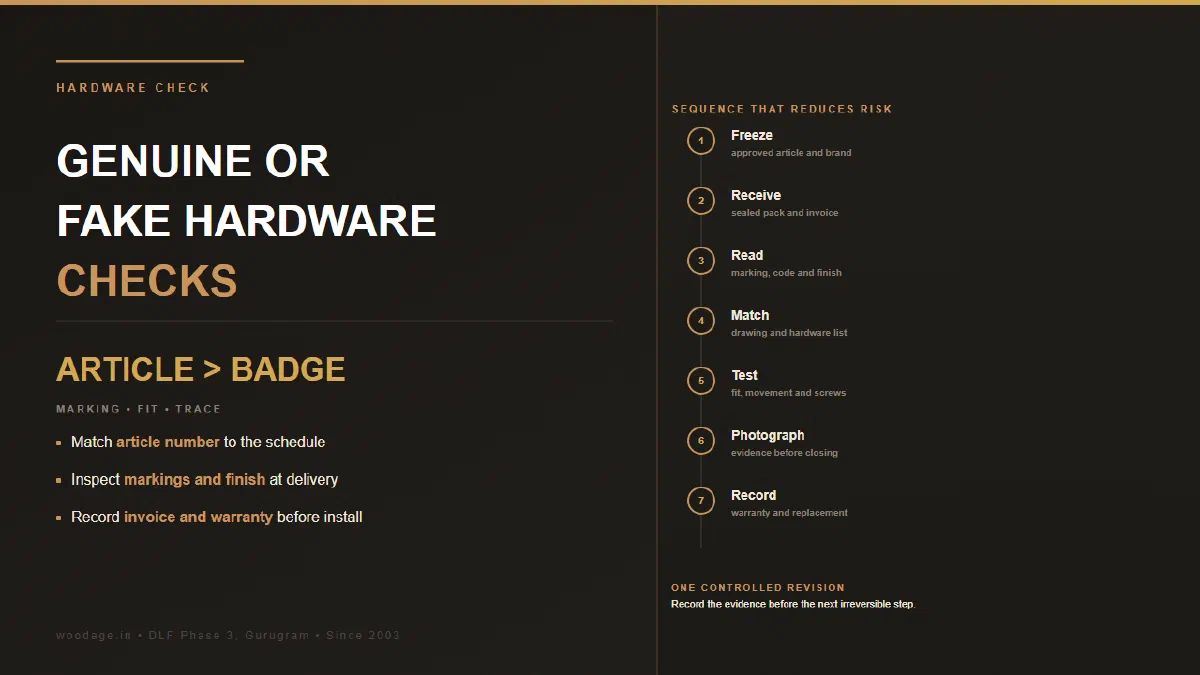
Cabinet Hardware Substitution Audit: Prove What Was Approved, Delivered and Installed
A genuine brand can still be the wrong product line, load class, quantity or cabinet location. Audit substitution by linking the approved BOQ to the current catalogue, delivery labels, detailed invoice and installed-location record. Logos, weight, country of origin and a sample check cannot prove that every specified article was supplied.
WoodAge is a factory-direct modular kitchen and custom furniture manufacturer operating since 2003 and based at 16 SCO, Saraswati Vihar, Chakkarpur, Gurugram 122002. This page owns the approved-versus-delivered-versus-installed substitution audit across cabinet-hardware brands. For the narrower authenticity question, use how to verify genuine Hettich, Hafele and Blum hardware. For pre-contract wording, read Hettich is not a kitchen.
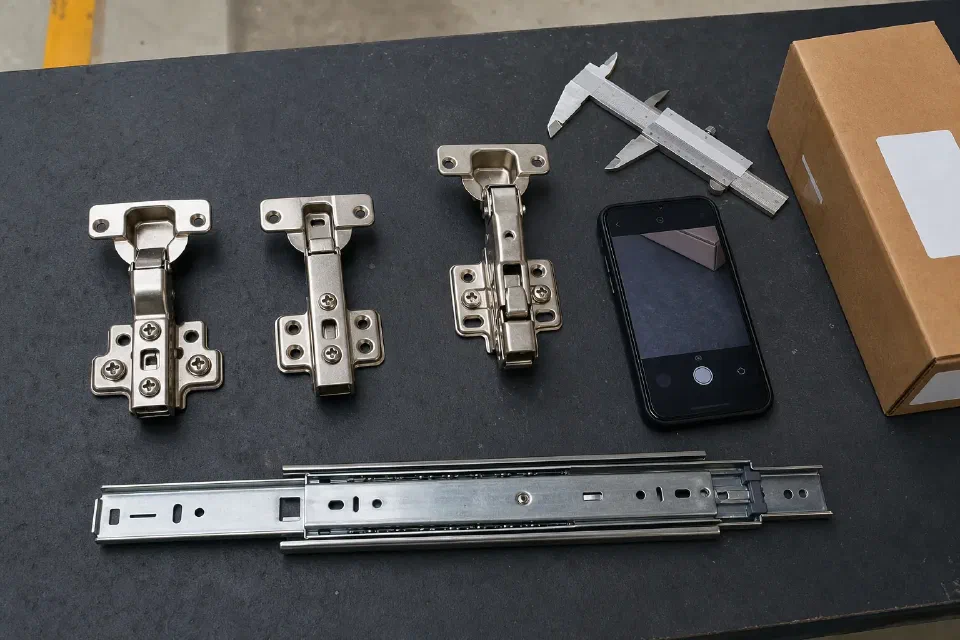
Buyer Decision Checklist: Six Substitution Checks in Order
| # | Check | Matches the approval | Substitution risk | When you can run it |
|---|---|---|---|---|
| 1 | BOQ identity | Brand, family and exact article number fixed before ordering | “Premium”, “imported” or “equivalent” | Before purchase |
| 2 | Catalogue match | Article number, dimensions, load and companion parts match the current official catalogue | Number missing or describes a different component | Before purchase and at delivery |
| 3 | Sales route | Seller appears in the brand’s current dealer locator or brand support confirms the source | Seller cannot show a traceable procurement route | Before payment |
| 4 | Packaging and marking | Match the exact manufacturer’s guide for that product and market | Packaging or marks conflict with the guide | At delivery |
| 5 | Invoice trail | Invoice names brand, article number and quantity | Consolidated “hardware” line with no models | Before final payment |
| 6 | Installed performance | Dimensions, load class, movement and adjustment match the specified product | Mixed behaviour or geometry across identical units | At snagging |
Run checks 1 to 4 while the boxes are still on the floor. Once hinges are cupped into shutters and channels are screwed into carcasses, the practical cost of proving a substitution rises sharply.
The evidence packet to keep for one cabinet run
Create one folder per room or cabinet run with six items: approved BOQ revision, official catalogue page, dealer or seller evidence, unopened-carton photographs, invoice and installed-location photographs. Name the cabinet on the drawing and in the image file. This works for a Greater Kailash renovation, a DLF apartment or a Palam Vihar builder floor because authenticity does not change by locality.
| Evidence item | Minimum useful detail | What it can prove |
|---|---|---|
| Approved BOQ | Brand, family, article, quantity and declared fit | What the contract required |
| Official catalogue extract | Article, dimensions, companion parts and current revision | Whether the specified identity exists and fits |
| Seller evidence | Current dealer-locator result or written brand confirmation | The procurement route checked on that date |
| Delivery photographs | Outer labels, quantities and unopened condition | What arrived before installation |
| Invoice | Brand, article and quantity | What was billed |
| Installed-location record | Cabinet code and visible article or geometry | Where each approved component was fitted |
Reconcile 3 totals for every article: 1. approved quantity, 2. delivered quantity and 3. installed quantity. A genuine sample can prove one unit exists, but only the three-way count shows whether the full BOQ quantity reached the named cabinet locations.
Packaging and marks support identity, but not the installed quantity
Manufacturers use different marks across product families and markets. Some engrave or print a logo on a specified location; some use product labels or anti-counterfeit packaging. A mark that matches an official guide is useful evidence. Its absence is meaningful only if the current guide says that exact article must carry it.
Packaging also varies by bulk, retail and market channel. Do not invent a universal hologram rule. Instead, photograph the outer label, article number, batch or date code where present, and quantity before installation. Compare those identifiers with the current catalogue and invoice.
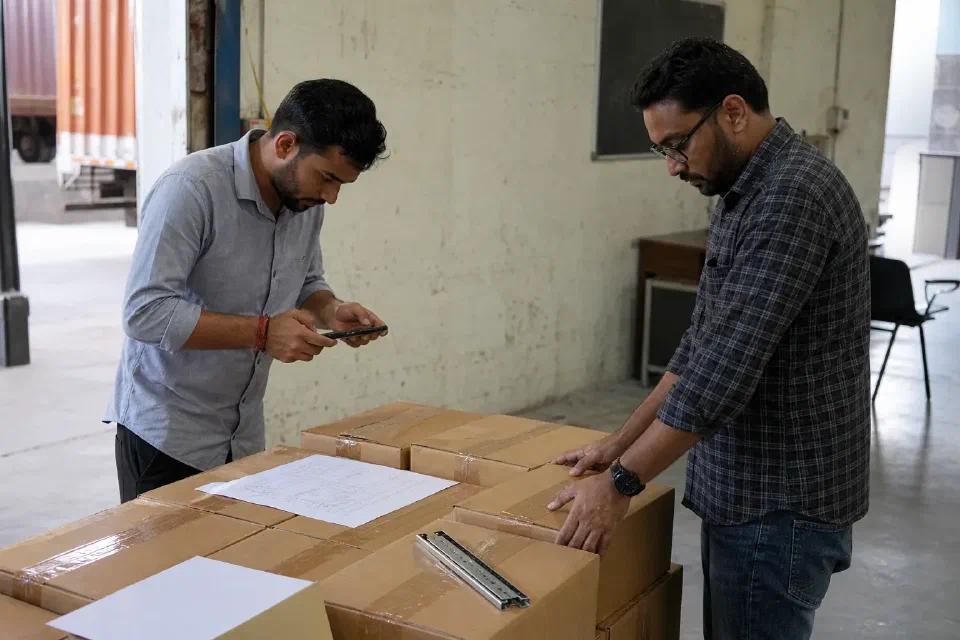
Photograph every carton at delivery before it is opened. The outer label, quantity and condition are difficult to reconstruct later. The full receiving routine is in the factory dispatch and material receiving checklist.
Why weight, zamak and origin do not prove BOQ compliance
Mass can help identify whether two supposedly identical articles differ, but it cannot prove authenticity. Legitimate premium fittings may combine steel, plastic, aluminium and die-cast zinc. Hettich, for example, publishes an add-on Silent System damper made from nickel-plated die-cast zinc. Yale also publishes zinc-alloy components in legitimate lock products.
If comparison is necessary, weigh two units that claim the same article number on a scale and record the result. A difference is a reason to ask the manufacturer, not proof of a counterfeit. Zamak is a material, not a fraud marker.
Audit the paperwork that makes a substitution provable
Physical checks catch obvious fakes. Paperwork catches the more common and more expensive problem: the quote said one thing and the site got another.
Insist on these fields appearing in the BOQ and repeating on the invoice:
| BOQ field | Example of adequate | Example of inadequate |
|---|---|---|
| Brand | Hettich | “Branded” or “imported” |
| Product family or line | Sensys | “Soft close hinge” |
| Article or model number | The exact catalogue number | Blank |
| Quantity per unit | 2 hinges per shutter, listed shutter by shutter | “As required” |
| Mounting plate or companion parts | Named separately | Assumed included |
| Load class, for drawers | Stated in kg | “Heavy duty” |
| Finish | Stated | Blank |
An invoice that reads “Kitchen hardware, 1 lot, Rs 48,000” is unverifiable by design. Ask for the dealer invoice that sits behind it. An authorised dealer can produce one; a market purchase often cannot.
The line-item review that catches this at quotation stage is in how to read a modular kitchen quotation and the full specification format is in the interior specification sheet template.
Made in India does not prove or disprove the approved article
This deserves its own section because it is the most persistent piece of misinformation in the Indian hardware market.
Hettich manufactures in India. Its official India statement identifies manufacturing plants in Indore and Vadodara and reports BIS certification for its hinges. Indian manufacture is therefore not evidence that a Hettich product is counterfeit.
Product made at those plants is genuine Hettich, produced to the brand’s specifications. It is not a counterfeit, not a “local copy”, and not an inferior tier. The same pattern applies across several premium brands that operate Indian plants to shorten lead times and avoid import duty.
Two practical consequences follow.
First, a vendor who tells you that Indian-made premium hardware is fake, and offers to source “original imported” stock at a premium, may be exploiting the myth rather than protecting you. Ask which plant, ask for the article number, and ask for the dealer invoice.
Second, and in the opposite direction, “imported” on its own means nothing. It is not a brand, not a specification and not a quality claim. Unbranded hardware from anywhere becomes “imported” the moment a vendor wants a premium for it. Country of origin is a fact about logistics. The article number is the fact about the product.
If you are still choosing between brands rather than verifying one, the component-by-component comparison is in Hettich vs Hafele vs Blum.
Current official specifications make substitution measurable
The strongest anti-counterfeit tool is not a physical check. It is knowing what the real product publishes about itself, because a substitute cannot produce matching documentation.
| Manufacturer claim | Published figure | Source |
|---|---|---|
| Hettich Sensys hinge family, opening cycles | 80,000-cycle reference | Hettich Sensys product data sheet |
| Hettich AvanTech YOU runner load classes | 10 kg, 40 kg and 70 kg, referencing EN 15338 Level 3 | Hettich technical catalogue |
| Hafele MatrixBox Premium+ | 40 kg and 70 kg versions, 300 to 550 mm nominal lengths, 100,000-cycle testing | Hafele India MatrixBox Premium+ |
| Blum CLIP top BLUMOTION | Documented 107, 110 and 155 degree applications with three-dimensional front adjustment | Blum CLIP top BLUMOTION downloads |
| Hettich TopLine L sliding system | Doors to 50 kg, 2,600 mm high, 18 to 50 mm thick, by configuration | Hettich India sliding fittings catalogue |
Use this as a challenge test. Ask the vendor which product line they are supplying, then look up its published figures yourself and check the part in front of you against them. Three outcomes are informative:
- The vendor names a line and the figures match. Good sign, and you now have a documented specification for the BOQ.
- The vendor names a line but the part carries no matching marking. Investigate further.
- The vendor cannot name a line at all. There is nothing to verify, and no warranty route, whatever the invoice says.
Note that these figures belong to named product families, not to brands. A cycle rating for Sensys says nothing about an unnamed hinge from the same manufacturer, which is exactly why the article number matters more than the badge.
Prioritise high-value mismatches, then reconcile every quantity
Use the approved BOQ and invoice to prioritise inspection by value, then verify every listed quantity. This does not assume dishonest intent; it finds costly identity or quantity mismatches before they are hidden inside cabinetry.
Do not rely on a generic component price band. Use the values already in your two documents: the approved BOQ and the supplier invoice. For example, if ten drawer systems were approved at Rs 5,000 each and the delivered article invoices at Rs 2,500, the illustrative arithmetic is Rs 25,000 of difference: 10 x (Rs 5,000 minus Rs 2,500). The numbers are an example, not market rates.
Three consequences for how you inspect:
- Start with the highest-value articles. Drawer and lift systems can carry more value per item than simple hinges, but use the actual BOQ rather than a generic assumption.
- Map every location. Tall units, corner cabinets, lofts and visible runs all need a cabinet code and article count.
- Reconcile the full quantity. A sample can confirm fit or marking, but it cannot prove the quantity installed across the project.
This is why the drawer system’s article number and declared load class are more useful than a brand-only line. Comparative brand positioning is in Hettich vs Hafele vs Blum.
Installed performance can reveal a mismatch, not prove one
Installed behaviour can reveal a fit, adjustment, load, installation or identity issue. It does not prove counterfeiting by itself. Run these checks at snagging before final payment, then reconcile any concern to the article and installation instructions.
- Soft close consistency. Compare identical shutters under similar conditions. Variation can come from adjustment, load, temperature or a different article.
- Closing near the end of travel. A slam can indicate a disabled, incompatible, misadjusted or failed damper.
- Drawer travel. Confirm that a runner sold as full extension reaches the travel in its current product data. Grit, tight spots or side play still require installation diagnosis.
- Shutter alignment. Changed gaps can involve hinge adjustment, screw seating, shutter movement or mounting geometry.
- Finish consistency. A visible difference is a reason to check the article and batch, not proof of a counterfeit.
If several observations appear together, reconcile the full article count and ask the installer or manufacturer to diagnose the system.
What to do when delivered or installed hardware does not match
- Stop and photograph before anything is removed. Capture the part, the marking area, the carton if it exists, and the location in the kitchen.
- Count the affected units rather than reporting a single instance.
- Put it in writing with the BOQ line quoted next to what was found.
- Ask for replacement with the specified article number, not a credit note, unless you genuinely prefer the money.
- Hold the retention amount until replacement is verified. This is why a payment schedule with a retention stage matters, as set out in the interior payment schedule guide.
A dispute is far easier when the contract already named the article number. That is the practical argument for completing the BOQ before signing.
Evidence and Verification Notes for Delhi NCR Deliveries
Authentication is product-specific. The linked Hettich, Hafele and Blum catalogues support article-level comparison, while packaging, feel, weight or country of manufacture alone do not prove identity. Retain the approved BOQ, manufacturer page or catalogue page, carton label, invoice, delivery photographs, cabinet location map and installed count as one evidence packet.
For a gated society on Golf Course Road or Dwarka Expressway, or an occupied South Delhi apartment, complete the carton and quantity check at the controlled delivery point before packaging leaves the site. The locality does not make a part genuine, but gate passes, lift slots and restricted working hours can make later reconstruction harder. Record discrepancies before installation and send the article number and photographs through the manufacturer’s current support route.
The modular kitchen manufacturer page for Gurugram explains how hardware identity joins the cabinet BOQ. At a Gurugram factory visit, compare article codes and sample assemblies, while treating the manufacturer’s own confirmation route as the authority on authenticity.
Frequently Asked Questions
How do I prove a lower cabinet-hardware model was substituted?
Place the approved BOQ line beside the delivery label, dealer invoice and installed article or geometry. The evidence should show brand, family, article number, quantity, load class and cabinet location. A difference in only one sample proves one mismatch, so count and map every affected unit before requesting replacement or a credit.
Can genuine branded hardware still be a substitution?
Yes. A genuine entry-level hinge or lighter drawer runner is still a substitution when the approved BOQ named another family, article or load class. Authenticity answers who made the part. BOQ compliance answers whether the promised product and quantity reached the specified cabinet locations.
What if the invoice says only “kitchen hardware, one lot”?
Ask for the underlying dealer or supplier invoice and an article-level schedule before final payment. A one-lot line cannot reconcile model or quantity. Keep the approved revision, catalogue extract, carton labels and installed-location photographs together so the supplier can correct the invoice without relying on memory.
What should I do if cabinet hardware arrives with no boxes?
Pause installation until traceability is established. Ask for the dealer invoice showing brand, model and quantity, photograph the parts as delivered and obtain written identification from the supplier or manufacturer where necessary. No carton alone does not prove a counterfeit, but no article, invoice or source trail makes BOQ compliance difficult to verify.
Does “made in India” or “imported” prove the product tier?
No. Hettich operates manufacturing in Vadodara and Indore, and Indian manufacture is not evidence of a counterfeit or lower tier. “Imported” is also not a brand, model or specification. Use the current article number, published product family, invoice and approved BOQ instead of country-of-origin shorthand.
Can weight or a logo prove the specified hinge was installed?
No. Mass and markings are supporting observations only because legitimate articles can use steel, plastic, aluminium or die-cast zinc in different combinations. Compare only units claiming the same article number, then confirm catalogue dimensions, companion parts, invoice quantity and installed locations before concluding that a mismatch exists.
When should I hold final payment for a hardware mismatch?
Use the retention or final-payment stage stated in the contract, not an improvised penalty. Document the BOQ line, affected count, photographs and requested remedy in writing. Release the retained amount after the specified articles or agreed commercial adjustment has been verified against the corrected invoice and location schedule.
What evidence should a cabinet hardware substitution audit retain?
Keep the approved BOQ revision, current official catalogue page, seller or dealer evidence, unopened-carton photographs, detailed invoice, cabinet-location drawing and installed photographs. Add the inspection date and the person who checked each item. That packet separates product identity, commercial quantity and installation fit instead of treating a logo as the whole answer.
Related Guides From WoodAge
- How to Verify Genuine Hettich, Hafele and Blum Hardware - The canonical authenticity workflow for those three brands.
- Hettich Is Not a Kitchen - Getting brand, model, quantity and warranty into the quote before this audit is needed.
- Hettich vs Hafele vs Blum Kitchen Hardware - Choosing the brand before you verify it.
- Interior Specification Sheet Template - The document that makes substitution provable.
- Factory Dispatch and Material Receiving Checklist - What to photograph and check at delivery.
- Interior Payment Schedule in Gurgaon - Why retention exists and when to release it.
Get a Factory-Direct Quote
If you are planning interiors in Gurgaon or Delhi NCR, WoodAge can help you convert the idea into a measurable BOQ: exact material grade, hardware model, finish code, timeline and warranty terms before production starts.
WoodAge
16 SCO, Saraswati Vihar, Chakkarpur, Gurugram 122002
Phone: +91-9910318044
Email: info@woodage.in
Website: woodage.in