

Can a Fitted Wardrobe Be Dismantled and Moved?
Assess whether a fitted wardrobe can move to a new home. Check destination dimensions, dismantling risks, recoverable parts and the full relocation scope.

- Kautuk Sahni
- 8 min read

Quick answer: A fitted wardrobe may be movable if its construction can be dismantled without unacceptable damage and its parts suit the new room. Reusable panels are only part of the assessment. Check connectors, backs, wall fixings, floor and ceiling differences, door alignment and the destination’s available opening before booking removal.
WoodAge is a factory-direct furniture and interiors manufacturer in Gurugram, working since 2003. This relocation checklist helps compare a recovered wardrobe with the work needed to make it useful at the destination. It is not a promise that every fitted installation can be moved intact.
Identify the construction
A knock-down cabinet with accessible connectors is different from a glued assembly built tightly into a recess. A wardrobe can also combine recoverable modules with site-cut fillers, a common plinth and finishes that cannot be removed cleanly.
Some products explicitly provide disassembly instructions. For example, the identified IKEA PAX frame has product-specific assembly and disassembly resources. That does not establish that a different custom wardrobe is designed for repeated moves.
| Component | Inspect | Likely decision |
|---|---|---|
| Carcass panels | Damage, swelling, connector holes | Reuse only if connections remain suitable |
| Back panel | Method of attachment and condition | Retain, repair or replace after assessment |
| Doors | Size, flatness, finish and hardware | Protect and label as matched components |
| Fillers and scribes | How closely they follow the old room | Often require redesign for the destination |
| Plinth or legs | Height, levelling and access | Match the new floor condition |
| Fixings | Original type and new wall substrate | Select for the new installation |
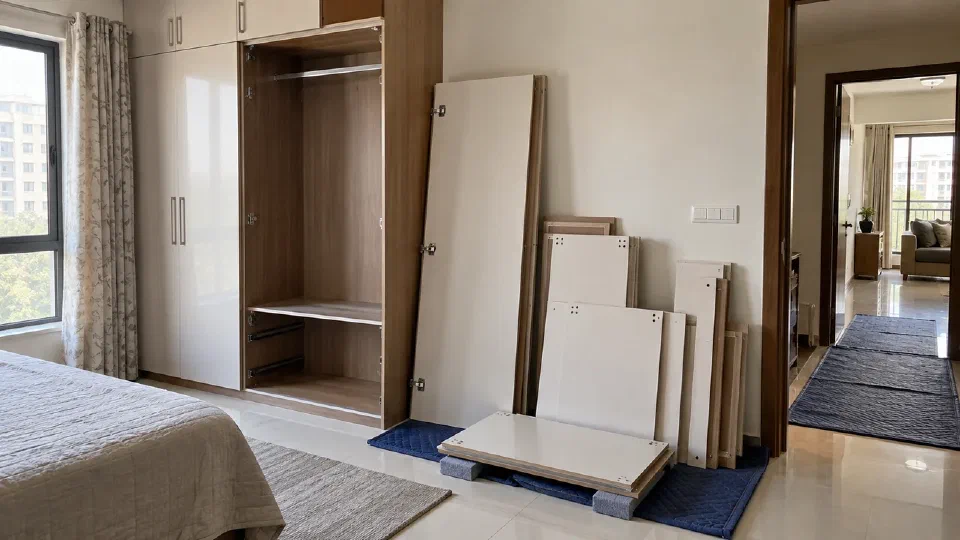
Survey the destination first
Measure the intended location at several heights and depths. Record ceiling constraints, skirting, sockets, switches, curtains and the door-opening area. Check the delivery route for the largest retained panel, including stair turns and lift restrictions confirmed with building management.
Do not assume that an old 2,400 mm-wide installation fits a new 2,400 mm recess. The original dimension may include fillers, wall variation or a site fitting allowance. The new room must be measured independently.
Illustrative fit test: suppose the old 2,400 mm frontage consists of two reusable 1,100 mm modules and 200 mm of site-cut fillers. The reusable modules total 2,200 mm, but this does not prove they fit a new opening nominally measured at 2,300 mm. Check the narrowest width at the floor, middle and ceiling, the available depth and height, and whether the modules can be levelled and anchored there. The remaining gap may need new fillers; an old scribe is not a ready-made 100 mm replacement. These are hypothetical dimensions, not a WoodAge installation.
What to check before dismantling
Assign a module ID and photograph the assembled wardrobe. Label panels, doors, drawers and matching hardware before separation. Bag connectors by module and retain instructions where available. Record existing damage so it is not confused with transport damage later.
Large mirrored fronts and heavy panels require appropriate handling. Do not try to move a tall assembled wardrobe by dragging it across the floor. The responsible team should plan support, protection, dismantling sequence and safe transport for the actual construction.
Price the work that survives the move
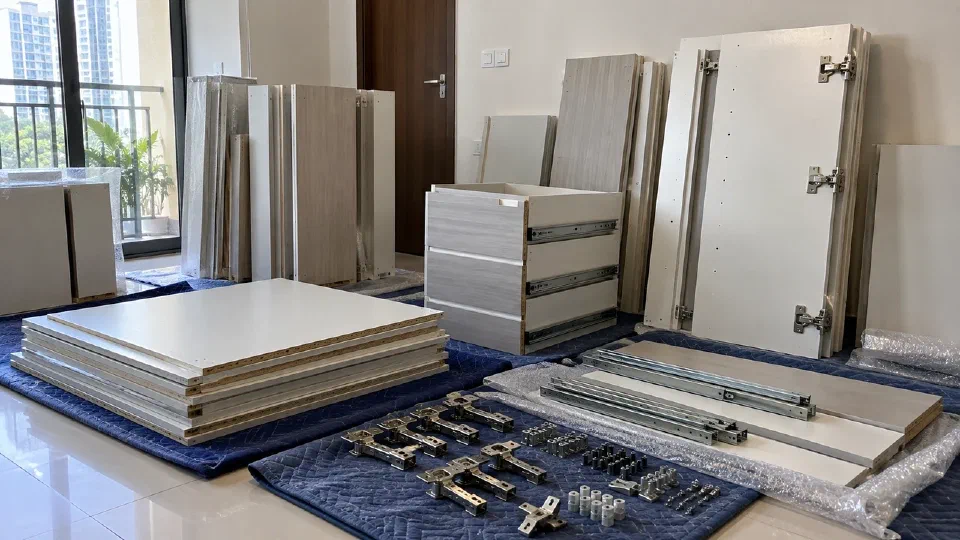
Separate transportable factory-made modules from site-fitted pieces on the parts register. A scribe cut to one wall, a shared plinth or a back fixed across modules may have to be remade even if the main panels travel intact. Mark each part as retained, remade or undecided after opening up, then price the destination installation on those assumptions.
Compare dismantling, packing, transport, replacement parts, new fillers, reassembly, anchoring and finish repairs. Include disposal of unusable items. A cheap moving quote may exclude the cabinet-making work required at the destination.
Also identify who makes good the old room after removal, including exposed wall fixing holes, skirting or flooring gaps and any finish hidden by the original installation. Price that as old-room work rather than assuming the mover’s transport quote covers it.
Use three outcomes: reuse as designed, reuse with specified alterations, or replace. Where a panel’s connector area is damaged, obtain a competent repair assessment rather than assuming extra screws restore the original connection.
Compare the complete outcomes on one sheet: recoverable modules and hardware; parts to remake; disassembly and packing; transport; new fixing and reassembly; finish repairs; and disposal. Put an unknown beside any item that cannot be judged until opening the wardrobe, and agree who authorises that change. This prevents a low transport quote from being mistaken for the cost of a functioning fitted wardrobe in the new room.
Reassembly is a new installation
Retain the exact product instructions where the unit is a named system. IKEA’s PAX product information includes assembly and disassembly instructions for that system; the destination team should check the correct frame version and wall-fixing instructions rather than applying PAX steps to an unidentified custom unit.
Check level, alignment, support and anchoring at the destination. Verify door and drawer movement and the retained storage layout. A wardrobe that stood safely in one room still needs suitable fixing and support in another.
Keep the updated layout and replacement-hardware record. If the installation now differs from a manufacturer’s system, establish what instructions and warranty conditions still apply.
Plan the new fixings, not just the old panels
The destination wall decides the new fixings. A quick pilot-hole check at each fixing position, after services are located, shows the substrate from the dust: grey and hard for concrete, red for brick, fine and pale for AAC block, white gypsum for drywall. Old wall plugs belong to the old wall and should not be reused.
| Moving item | What to check at the destination |
|---|---|
| Tall panels and fronts | Service-lift internal height and diagonal, and the staircase route |
| Hinges and runners | Re-adjustment after refitting; Hettich’s published Sensys range is only ±2 mm sideways, so a racked carcass must be squared first |
| Cam and dowel holes | Whether worn holes can be moved to fresh board or the part must be remade |
| Wall fixings | New anchors chosen for the new wall type and load |
In Gurugram towers, many societies require a gate pass and a booked service-lift slot for both removal and delivery days, so add both to the moving plan. Drawer and door adjustment after reassembly is a normal part of the job; Hettich’s adjustment data shows how little range there is to absorb distortion.
Evidence and Verification Notes
The wall field test is an identification aid, not a structural survey. The hinge range is quoted from Hettich’s technical page, checked in September 2026, for its Sensys hinge only. Society requirements vary by building; confirm them with the management office. How worn screw holes and swollen board edges lose their grip is explained in cabinet board failure. Hinge plates, runners and carcass joints can be inspected on a WoodAge factory visit.
Frequently Asked Questions
Can a built-in wardrobe be moved without dismantling?
Sometimes small suitable modules can be handled as assemblies, but a fitted installation should not be assumed safe to move whole. Construction, size and access determine the method.
Will the same screws and wall plugs work in the new flat?
Not automatically. The new substrate and fixing condition must be assessed. Wall plugs should not be treated as reusable merely because they came out with the cabinet.
Is relocation always cheaper than buying new?
No. Compare the complete recovered installation, including missing parts and adaptation. A written parts survey makes that decision more reliable than a price per wardrobe alone.
Why should the new room be measured before dismantling?
Destination width, height, depth, access route, skirting, floor and wall conditions determine what can be reused. Recovering parts first can create a pile that cannot form a useful new installation.
Which wardrobe parts may need remaking?
Site-scribed fillers, shared plinths, continuous backs and damaged connectors often depend on the original room. Mark each component retained, remade or undecided after opening up.
Should old connectors and wall fixings be reused?
Only after identification and condition checks and where the new substrate and system permit it. Include replacement hardware and new wall restraint in the relocation scope.
Do fitted wardrobe hinges need adjusting after a move?
Yes, expect it. Concealed hinges adjust only a few millimetres; Hettich lists ±2 mm sideways for its Sensys hinge. The carcass must be fixed level and square at the new site first, then the doors aligned. A front that cannot be aligned within the range points to a racked carcass or a damaged fixing.
For a project in Gurugram or Delhi NCR, use WoodAge’s wardrobe planning to discuss the measured requirement and written scope. Product suitability and the final BOQ must be confirmed for the actual order.
Related Guides From WoodAge
- Wardrobe dimensions - for door, carcass and room measurements.
- Cabinet board failure guide - for swelling, loose fittings and substrate damage.
- Interior specification sheet - for recording product codes and approved details.
- Repair, modify or replace furniture - for a condition-based reuse decision.
- Master Bedroom Interior Design in Gurgaon 2026: Bed Wall, False Ceiling, Wardrobe Placement and Factory-Direct Costs - Useful next reading on budget planning, costs, materials, or execution.
- TV Unit and Living Room Wall Panel Design in Gurgaon 2026: Fluted Panels, LED Coves, Back-Painted Glass and Factory-Direct Costs - Useful next reading on budget planning, costs, materials, or execution.