

How to Compare Modular Kitchen Quotations Side by Side: Normalising Vendor Scopes and Spotting Hidden Gaps
Three modular kitchen quotes can show three different totals. Use this comparison sheet method to normalise material, hardware, scope, GST and hidden gaps before choosing.

- Kautuk Sahni
- 15 min read
How to Compare Modular Kitchen Quotations Side by Side: Normalising Vendor Scopes and Spotting Hidden Gaps
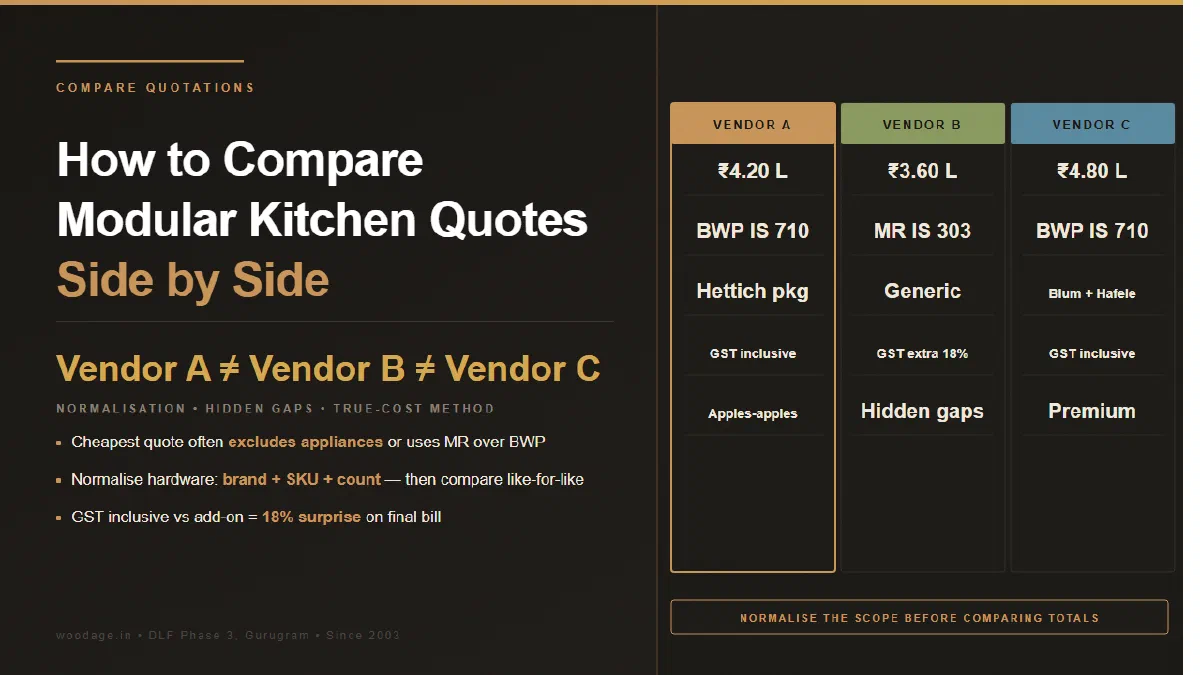
You’ve collected three quotations for your modular kitchen. Vendor A: ₹4.2 lakhs. Vendor B: ₹3.6 lakhs. Vendor C: ₹4.8 lakhs. Without normalisation, these numbers are misleading. Vendor A might include premium hardware while Vendor B excludes appliances. Vendor C might use higher-grade materials at the same finish. The cheapest quote is rarely the cheapest project after substitutions, hidden costs, and material upgrades become apparent.
WoodAge (woodage.in) is a factory-direct modular kitchen and custom furniture manufacturer in Gurugram (Gurgaon), serving Delhi NCR since 2003.
This guide is the methodical framework for a comparison sheet template, line-by-line normalisation method, gap identification approach, and true cost calculation that converts three different quotes into an apples to apples comparison.
Modular Kitchen Quote Comparison Questions
| Buyer question | Decision | Evidence to compare |
|---|---|---|
| compare modular kitchen quotes | Choose between vendors | Normalised scope table |
| how to read modular kitchen quote | Understand line items | Material, hardware, countertop, GST and install checklist |
| why modular kitchen quotes differ | Explain price gap | Spec upgrade and missing scope method |
| Livspace quote vs local quote | Compare provider models | Same drawing, same BOQ and same service route |
| modular kitchen hidden costs | Avoid budget shock | Countertop, plumbing, electrical, delivery, GST and accessories |
| kitchen BOQ checklist | Vendor conversation prep | Fillable rows for carcass, shutters, hardware and exclusions |
The search opportunity is not only the phrase “modular kitchen quotation”. Buyers usually ask a chain of questions after seeing different totals. This guide is designed to answer that chain in one place.
For a reusable field-level reference, open WoodAge’s 20-record Interior BOQ Specification Library. It adds evidence prompts, stable record IDs, hidden-cost flags and downloadable CSV/JSON files; it contains no market prices or customer quotations.
Why Direct Comparison Fails
Different vendors structure quotes differently. The same project component appears in different rows, under different names, with different inclusions. Without normalisation:
- Vendor A quotes “Cabinet carcass: ₹X” (includes back panels)
- Vendor B quotes “Cabinet sides: ₹Y” + “Cabinet back: ₹Z separately”
- Vendor C quotes “Per-cabinet pricing” with material substitution flexibility
Comparing total numbers misses these structural differences.
Step 1: Standardise Quotations to a Comparison Sheet
Convert all three quotes to a common comparison sheet structure:
Comparison Sheet Template
| Component | Spec | Vendor A | Vendor B | Vendor C |
|---|---|---|---|---|
| Carcass material | 18 mm BWP plywood IS 710 (verify) | Brand: Sainik 710 | Brand: ??? | Brand: ??? |
| Carcass thickness | 18 mm sides/bottom/top, 6 mm back | Yes | Yes | 12 mm sides? |
| Shutter material | 18 mm laminate or equivalent | Premium laminate | Standard laminate | Acrylic |
| Shutter finish | Matte/Gloss/Anti-Fingerprint | Matte AF | Matte | High-gloss |
| Edge banding | 2 mm PVC visible, 2 mm PUR wet zones | 2 mm PVC | 0.4 mm PVC + 2 mm visible | 2 mm PUR throughout |
| Hinges | Brand and model | Hettich Sensys | Hettich Mini | Blum Clip Top |
| Drawer slides | Brand and model | Hettich Quadro | Hettich Cap | Blum Tandem |
| Cam-locks | Brand | Hettich Rastex | Generic | Hettich Rastex |
| Cabinet count | Number of cabinets | 14 | 12 | 14 |
| Tall units | Number, type | 2 | 1 | 2 |
| Pull-out drawers | Configuration | 6 + 2 corner | 4 | 8 + 2 corner |
| Sink | Brand, type | Carysil 16-gauge | Generic 18-gauge | Franke 16-gauge |
| Hob | Brand, model | Glen 60 cm 4 burner | Sunflame 60 cm 4 burner | Bosch 60 cm 4 burner |
| Chimney | Brand, CFM | Faber 1,400 CFM | Glen 1,200 CFM | Bosch 1,800 CFM |
| Counter material | Granite/quartz/stone | Granite 30 mm | Granite 20 mm | Quartz 30 mm |
| Counter sq.ft | Total area | 25 sqft | 20 sqft | 26 sqft |
| Plumbing materials | CPVC, fittings | Astral CPVC | Generic CPVC | Astral CPVC |
| Electrical | Switch + sockets | Schneider/Anchor | Generic | Hyseh Hybrid |
| Installation labour | Cost | Included | Included separately | Included |
| Designer / consultation | Hours | 2 site visits | 1 visit | Unlimited |
| Site supervision | Coverage | Yes (full-time) | Visit weekly | Yes (full-time) |
| Delivery | Charge | Free | ₹3,000 | Free |
| GST | 18% | Inclusive | Exclusive (added later) | Inclusive |
This is the comparison foundation. Without it, you can’t compare meaningfully.
Step 2: Identify Material Specifications
Vendors quote at different material specifications. Normalise to the same baseline:
What’s Standard / Required
For a comparable kitchen at standard quality:
- Carcass: 18 mm BWP plywood IS 710
- Shutter: 18 mm BWP plywood with quality laminate
- Edge banding: 2 mm PVC visible, 2 mm PUR wet zones
- Hinges: Hettich/Hafele/Blum soft-close branded
- Drawer slides: full-extension with soft-close
- Cam-locks: Hettich Rastex or Hafele Minifix
If a vendor quotes at lower specs, calculate the upgrade cost to bring them to standard. If higher specs, calculate the downgrade.
Spec Substitution Calculator
Common substitutions and their cost differences:
| Substitution | Approximate Cost Adjustment |
|---|---|
| Generic plywood vs Sainik 710 | +5 to 8% upgrade cost |
| 12 mm sides vs 18 mm sides | +3 to 5% upgrade cost |
| 0.4 mm edge banding vs 2 mm PVC | +1 to 2% upgrade cost |
| 2 mm PVC vs 2 mm PUR (wet zones) | +1 to 2% upgrade cost |
| Generic hinges vs Hettich Mini | +1 to 3% upgrade cost |
| Hettich Mini vs Hettich Sensys | +1 to 2% upgrade cost |
| Sunflame appliances vs Faber/Bosch | +5 to 10% upgrade cost |
These adjustments transform “₹3.6 lakh” cheap quote into “₹3.85 lakh after spec upgrade” - a more honest comparison.
Step 3: Identify Scope Gaps
Each quotation may include or exclude different components. List what’s missing or unclear in each:
Common Scope Gap Categories
| Gap Type | What to Look For |
|---|---|
| Civil work | Tile work, wall preparation, floor levelling - included or separate? |
| Plumbing | Pre-cabinet pressure test, isolation valves - included or separate? |
| Electrical | Modular sub-DB, dedicated circuits - included or separate? |
| Appliances | All appliances or specific ones excluded? |
| Sink + faucet | Both included or only one? |
| Counter | Material, fabrication, polishing - all included? |
| Installation | Site assembly, finishing - all included? |
| Designer | Consultation, drawings, supervision - included? |
| Delivery | To site or to floor? |
| Cleanup | Post-installation cleanup |
| GST | Included or added separately |
If Vendor B excludes plumbing changes, add the plumbing cost to make them comparable to Vendor A who includes it.
Scope Gap Cost Estimator
Components often missing from scope:
| Component | Approximate NCR Cost |
|---|---|
| Plumbing pre-cabinet (mid-range) | Modest line item |
| Electrical mod (sockets + sub-DB) | Modest line item |
| Site cleanup | Small line item |
| Designer fees | Modest, varies |
Step 4: Calculate the Adjusted Comparable Price
Separate confirmed prices from provisional allowances in the comparison sheet. Keep each supplier’s original figure unchanged in one column; put a requested like-for-like revision in another and record whether the supplier has priced it. Do not silently fill missing items with another vendor’s rate or an AI estimate and present the resulting total as an offer.
Use three explicit statuses for a gap: included with a named specification, excluded with a named owner, or awaiting a written price. A provisional allowance can support your private planning, but label its source and do not use it to declare a cheapest vendor. The Interior BOQ Specification Library supplies evidence fields, not replacement prices.
Now you have:
- Vendor’s quoted price
- Cost of upgrades to bring to standard spec
- Cost of scope gaps (work to be done outside vendor’s scope)
Adjusted Price = Quoted Price + Spec Upgrade Cost + Scope Gap Cost
Rerun the comparison:
| Vendor | Quoted Price | Spec Upgrade | Scope Gap | Adjusted Price |
|---|---|---|---|---|
| Vendor A | ₹4,20,000 | ₹0 (already standard) | ₹0 (full scope) | ₹4,20,000 |
| Vendor B | ₹3,60,000 | ₹35,000 (multiple upgrades) | ₹15,000 (plumbing excluded) | ₹4,10,000 |
| Vendor C | ₹4,80,000 | -₹20,000 (over-spec to standard) | ₹0 | ₹4,60,000 |
After normalisation: Vendor A ₹4.2 lakh, Vendor B ₹4.1 lakh, Vendor C ₹4.6 lakh - much closer than the original quoted prices.
Step 5: Evaluate Quality Indicators Beyond Price
The cheapest normalised quote isn’t necessarily the best choice. Other factors:
Vendor Track Record
- Years in business
- References from previous customers (visit completed kitchens if possible)
- Reviews online (Houzz, Facebook, Google)
- Existing relationships in your society/area
Production Capability
- Factory facilities (some vendors are showrooms; manufacturing is contracted out)
- In-house design team vs outsourced
- Hardware sourcing relationships
Communication Quality
- Response time to queries
- Clarity of explanations
- Willingness to commit specific terms
Warranty Reliability
- Warranty terms specifically documented
- Process for warranty claims
- Track record of honoring warranty (ask references)
Project Management
- Site supervision frequency
- Designer involvement during installation
- Vendor’s ability to coordinate with other vendors (electrical, plumbing)
Step 6: Risk-Adjusted Comparison
Sometimes a vendor’s quote is suspiciously low. Apply risk adjustment:
- If quote is 15%+ below normalised average → likely substitution risk
- If vendor is new or unverified → reliability risk
- If payment milestones favour vendor heavily (90%+ advance) → payment risk
Add risk premium for unreliable vendors: 5 to 10% to their quoted price.
| Vendor | Adjusted Price | Risk Premium | Risk-Adjusted Price |
|---|---|---|---|
| Vendor A (established) | ₹4,20,000 | 0% | ₹4,20,000 |
| Vendor B (new, low quote) | ₹4,10,000 | 8% | ₹4,42,800 |
| Vendor C (established, transparent) | ₹4,60,000 | 0% | ₹4,60,000 |
After risk adjustment: Vendor A becomes most attractive even though originally appeared mid-priced.
The Hidden Gap Patterns
Some common patterns in vendor quotations:
Pattern 1: Excludes Civil Work
Vendor quotes the modular kitchen but excludes wall preparation, floor levelling, tile work. These costs land on you separately.
Pattern 2: Pre-Cabinet Plumbing as Add-On
Standard quote excludes plumbing modifications; vendor expects another contractor handles this. Add plumbing cost to make comparable.
Pattern 3: Electrical “Standard”
“Standard electrical” can mean basic 5 to 6 socket installation. If you need 15+ sockets and a sub-DB, that’s an upgrade.
Pattern 4: Granite Counter Without Specifying Grade
“Granite counter” can be ₹450/sqft (basic local granite) or ₹900/sqft (premium imported). Always specify grade and source.
Pattern 5: Hardware “Soft-Close” Without Brand
“Soft-close hinges” can be Hettich Sensys (premium) or generic Chinese soft-close (lower quality). Specify brand.
Pattern 6: Appliances Listed But Not Included
“Compatible with Bosch dishwasher” doesn’t mean Bosch dishwasher included. Verify what’s actually in the price.
Pattern 7: GST Not Included
“All-inclusive at ₹4 lakhs” might be ₹4 lakhs + GST + delivery + designer fees. Read carefully.
Pattern 8: Designer Fees Separately
“Free design consultation” sometimes means initial consultation only; subsequent design changes charged separately.
Comparison Sheet Template (For Your Use)
Use this Google Sheets / Excel template:
| Row | Component | Vendor A | Vendor B | Vendor C | Notes |
|-----|-----------|----------|----------|----------|-------|
| 1 | Carcass material | ___ | ___ | ___ | ___ |
| 2 | Carcass thickness (sides) | ___ | ___ | ___ | ___ |
| 3 | Shutter material | ___ | ___ | ___ | ___ |
| 4 | Edge banding | ___ | ___ | ___ | ___ |
| 5 | Hinge brand/model | ___ | ___ | ___ | ___ |
| 6 | Drawer slide brand/model | ___ | ___ | ___ | ___ |
| 7 | Cam-lock brand | ___ | ___ | ___ | ___ |
| 8 | Cabinet count (base) | ___ | ___ | ___ | ___ |
| 9 | Cabinet count (wall) | ___ | ___ | ___ | ___ |
| 10 | Tall units count | ___ | ___ | ___ | ___ |
| 11 | Pull-out drawers count | ___ | ___ | ___ | ___ |
| 12 | Corner unit type | ___ | ___ | ___ | ___ |
| 13 | Sink (brand, model) | ___ | ___ | ___ | ___ |
| 14 | Faucet (brand) | ___ | ___ | ___ | ___ |
| 15 | Hob (brand, CFM equivalent) | ___ | ___ | ___ | ___ |
| 16 | Chimney (brand, CFM) | ___ | ___ | ___ | ___ |
| 17 | Counter (material, grade) | ___ | ___ | ___ | ___ |
| 18 | Counter area (sqft) | ___ | ___ | ___ | ___ |
| 19 | Plumbing scope | ___ | ___ | ___ | ___ |
| 20 | Electrical scope | ___ | ___ | ___ | ___ |
| 21 | Designer/consultation | ___ | ___ | ___ | ___ |
| 22 | Site supervision | ___ | ___ | ___ | ___ |
| 23 | Delivery (cost) | ___ | ___ | ___ | ___ |
| 24 | Installation (cost) | ___ | ___ | ___ | ___ |
| 25 | GST | ___ | ___ | ___ | ___ |
| 26 | Quoted price | ___ | ___ | ___ | ___ |
| 27 | Spec upgrade cost | ___ | ___ | ___ | ___ |
| 28 | Scope gap cost | ___ | ___ | ___ | ___ |
| 29 | Adjusted price | ___ | ___ | ___ | ___ |
| 30 | Risk premium % | ___ | ___ | ___ | ___ |
| 31 | Risk-adjusted price | ___ | ___ | ___ | ___ |
| 32 | Warranty terms | ___ | ___ | ___ | ___ |
| 33 | Years in business | ___ | ___ | ___ | ___ |
| 34 | References available | ___ | ___ | ___ | ___ |
Fill this systematically before making your decision.
Common Mistakes in Comparison
1. Comparing Bottom-Line Prices Only
Without normalisation, the cheapest quote often has the most substitutions to upgrade. After adjustment, it may not be cheapest.
2. Ignoring Hardware Brand Specifications
Hettich Sensys and “soft-close hinges” are not the same hardware. Specifying brand prevents substitution.
3. Missing Hidden Components
Granite polishing, PU paint coats, edge polishing - small line items that add up. Verify all included.
4. Not Comparing Warranty Terms
Vendor A: 5-year warranty. Vendor B: “industry-standard” warranty. The latter is meaningless.
5. Ignoring Vendor Track Record
A vendor with no references, no clear business presence and no written service route needs extra scrutiny. Add risk only after you understand what proof is missing.
6. Accepting Vague Specifications
“Premium quality” / “best in class” mean nothing. Demand specific brand and IS code references.
7. Treating GST as a Detail
18% GST on ₹4 lakhs = ₹72,000 difference. Always verify if GST is inclusive in quoted price.
8. No Material List in Writing
Verbal commitments don’t survive vendor turnover or memory lapses. Get every spec in the contract.
See also: For per-running-foot ranges and a sample BOQ, see WoodAge’s Gurgaon kitchen cost breakdown.
External Checks for the Most Substituted BOQ Lines
The point of normalising a quotation is not to force every vendor into the same brand. It is to replace vague labels with an evidence trail that can be compared.
| Verifiable reference | What to require in the quote |
|---|---|
| IS 303:2024 covers general-purpose plywood. | Board brand, grade, thickness and the cabinet zone using it. |
| IS 710:2024 covers marine plywood. | Do not equate a generic “waterproof ply” phrase with the actual standard/marked board. |
| BIS’s IS 303 record includes MR, BWR and BWP in its searchable scope. | Replace “plywood carcass” with the exact grade for wet and dry zones. |
| Hettich’s InnoTech catalogue page differentiates partial-extension Quadro 25 from full-extension Quadro V6+ systems. | List hardware family, extension and closing action; “Hettich drawer” is not enough. |
| Häfele’s MatrixBox Premium page publishes named 40 kg and 70 kg options. | Put the exact product and declared load on the drawer line instead of comparing a generic “tandem” allowance. |
The links above support the specification questions, not a preference for any particular vendor. A final decision should also compare installation scope, written warranty route, GST treatment and site-specific exclusions.
Frequently Asked Questions
How many quotes should I get?
3 minimum, 4 to 5 ideal. More than 6 becomes overwhelming. Quality varies more than price across vendors.
Can I show one vendor’s quote to another?
Yes - most vendors expect this and may offer to match. Use for negotiation; share only with vendors you’re seriously considering.
Should I trust the cheapest quote?
Not automatically. Often the cheapest quote has the largest substitution risk. Apply normalisation; compare adjusted prices.
What if my preferred vendor is most expensive?
Discuss specifically what they include. If the higher quote is supported by named materials, better hardware, clearer drawings, stronger warranty terms or better site supervision, record those differences in the comparison sheet before deciding. If the difference is not explained, ask for a revised BOQ.
How do I check vendor references?
Visit completed kitchens of references; ask about timeline adherence, quality of work, warranty responsiveness, communication. 1 visit is more revealing than 10 phone references.
What’s a fair vendor profit margin?
There is no universal fair margin because scope, material buying, design time, site supervision and service commitments vary. Instead of asking only for margin, compare whether the quote clearly includes material, hardware, design, delivery, installation, GST and service responsibilities.
Should I bargain on the quoted price?
Up to 5 to 10% negotiation is normal. Beyond that, vendor likely needs to substitute. Better to get a fair quote than a cheap quote with risk.
Can vendors substitute materials after contract?
Only with written customer approval (variation clause). Without consent, substitution is breach of contract.
What if I don’t know the brand recommendations?
Use this guide and others (Edge Banding, Joinery, IS Standards) to learn industry-standard specifications. Then verify each vendor’s quotes against them.
What prompt should I use with an AI tool before comparing kitchen quotes?
Use this prompt: “Create a modular kitchen quotation comparison table for three vendors. Compare carcass material, shutter finish, hardware brand, countertop, accessories, plumbing, electrical, GST, delivery, installation, warranty route and exclusions.” Then paste each quote into that structure.
What is the fastest way to find hidden gaps in the top 3 quotes?
Circle every vague word first: premium, branded, waterproof, German, standard, included and package. Then ask each vendor to replace those words with brand, model, grade, thickness, quantity, GST treatment and service owner.
Is the lowest normalised price always best?
Often, but not always. Vendor reliability, communication quality, warranty support and service ownership still matter. Use the lowest normalised price as a shortlist signal, then compare proof and risk before signing.
Related Guides From WoodAge
- How to Read a Modular Kitchen Quotation - Decode each line item before comparing.
- What Goes in a Modular Kitchen Contract - Convert the comparison findings into enforceable contract.
- IS Standards for Modular Kitchen Materials - Specify materials at the IS code level.
- Modular Kitchen Warranty in India 2026 - Compare warranty terms specifically.
- Edge Banding for Modular Kitchens - One of the most-substitution-prone line items.
- Plywood Thickness for Modular Kitchen Cabinets - Verify thicknesses to prevent substitution.
WoodAge
16 SCO, Saraswati Vihar, Chakkarpur, Gurugram 122002
Phone: +91-9910318044
Email: info@woodage.in
Website: woodage.in
Last reviewed: June 2026. Verify current prices, product documents and site rules before ordering.