

Corner Wardrobes: Check Reach and Usable Access
Evaluate a corner wardrobe by what you can reach and retrieve. Test door openings, hanging access and shelf use before approving the storage layout.

- Arpit Sahni
- 8 min read
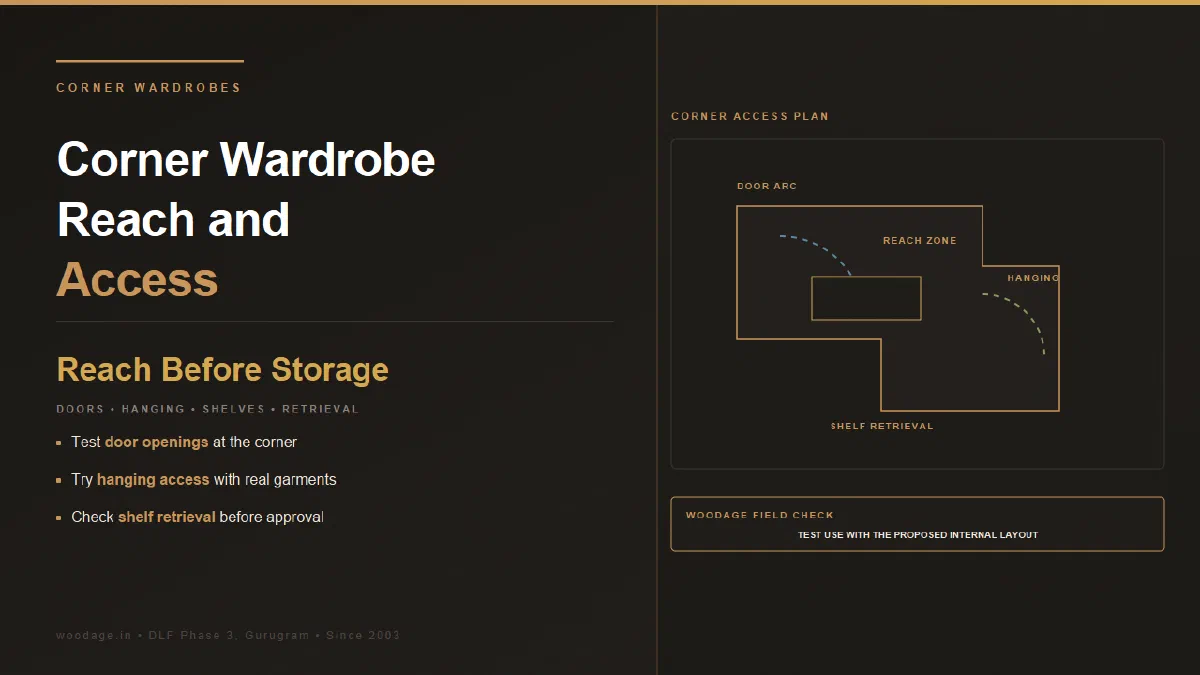
Quick answer: A corner wardrobe is useful only when its storage can be reached through the available opening. Compare door movement, hanging access, shelf reach and retrieval of real items, not just the area enclosed by the cabinets. A deep corner that looks generous in plan may become awkward storage in daily use.
WoodAge is a factory-direct furniture and interiors manufacturer in Gurugram, working since 2003. A corner is a three-dimensional access problem: the door, the person’s body and the stored item all need space at the same time.
Compare access arrangements
| Arrangement | Potential benefit | Check before approval |
|---|---|---|
| Two runs meeting at a corner | Uses both walls | Door collision and access behind the return |
| Diagonal corner front | Creates a wider approach | Room projection and usable interior layout |
| Blind-corner storage | Keeps a simpler front line | Whether the concealed area is practical to reach |
| Open corner shelves | Immediate visibility | Exposure, dust and suitability of stored items |
These are layout choices, not a ranking from best to worst. A small number of frequently used items can justify a different arrangement from seasonal luggage storage.
A manufacturer’s corner unit is also system-specific. IKEA’s PAX corner guidance pairs its add-on unit with specified PAX frame widths and permits a mirrored arrangement. It illustrates why a corner cannot be designed from the name of an accessory alone. Confirm the exact frame and orientation before treating a catalogue image as a buildable plan.
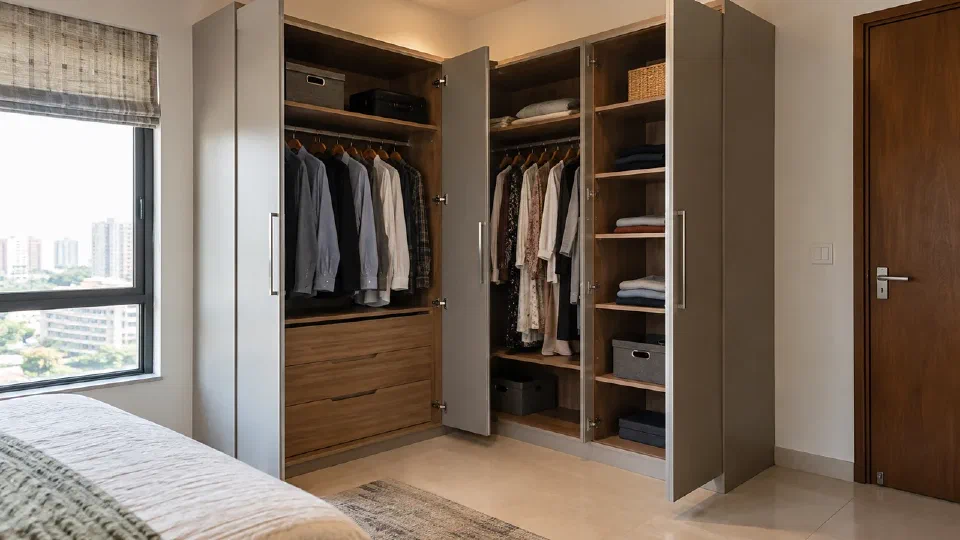
Measure the opening that remains when doors are open
Draw the doors and handles at their actual opening positions. Include adjacent shutters, bed corners, curtains and wall returns. A hinge advertised at a large opening angle cannot deliver that movement if it meets the room first.
For internal drawers or pull-outs, verify clear travel past the front. Blum’s SPACE TOWER application demonstrates why access to internal drawers is a system-level decision. It does not supply dimensions for a different corner wardrobe.
Run a real-item retrieval test
List what the corner is expected to hold: suitcases, folded bedding, hanging clothes or small accessories. Measure the largest items and the hand space needed to lift or turn them. Then mock up the opening with tape or a full-size temporary outline.
Test these actions:
- Open the intended door without moving another piece of furniture.
- See and reach the selected storage position.
- Remove an item without emptying several unrelated shelves.
- Return it without forcing the hinge or dragging it over a finish.
- Close the doors without handles or fronts colliding.
Illustrative distinction: an internal shelf may extend 800 mm into a corner while the accessible opening is only 350 mm wide. Those dimensions do not establish that an 800 mm suitcase can be inserted. Its shape, orientation and turning space must be tested. This is an example, not a recommended layout.
Run the test with the least mobile regular user and the largest planned daily item, then repeat for an occasional item. Record pass or fail separately for seeing, grasping, lifting, turning, removing and returning it. If the item passes only after another bay is emptied, mark the corner as occasional storage or redesign it. This creates an access decision from the planned contents rather than treating a large internal volume as automatically useful.
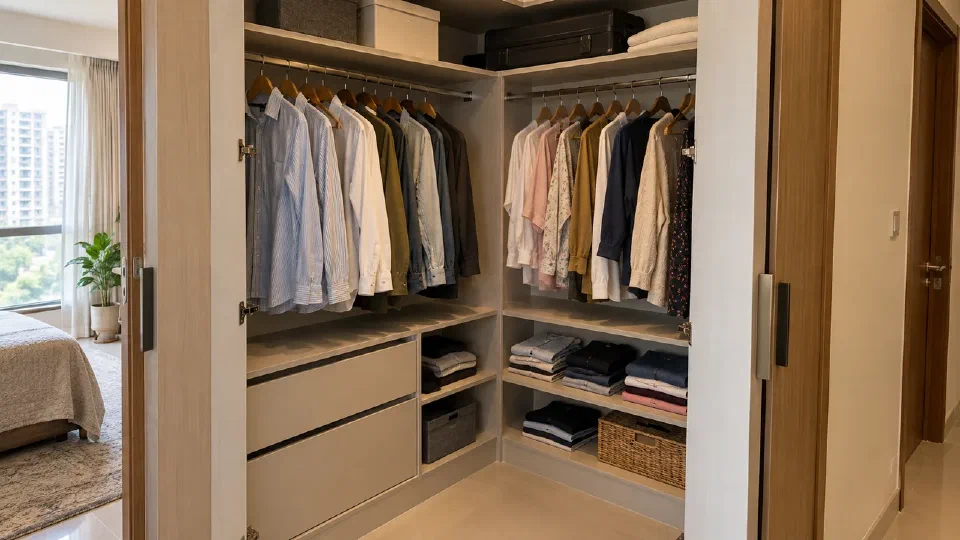
Put daily-use items where access is easiest
Reserve readily reached storage for frequently used clothing. A more awkward corner may suit occasional items if they can still be retrieved safely. Do not treat inaccessible volume as useful capacity merely to advertise a larger wardrobe.
Adjustable shelves can help, but the permitted positions and loading depend on the supporting system. Avoid removing a structural divider to gain reach without checking the construction. A pull-out mechanism also consumes space and introduces hardware requirements; compare it with a simpler shelf arrangement using the actual items.
If a seller proposes a kitchen-style “magic corner” for clothes, ask for the exact accessory’s intended use, basket dimensions, travel and supported loading. Test the planned folded garments or storage boxes in that layout. A kitchen catalogue photograph or a similar mechanism name does not demonstrate useful wardrobe storage or compatibility with its doors.
What to check before approving the corner
On the plan, shade the area that a hand or the largest planned item cannot reach while the doors are open. Label that area as inaccessible rather than counting it in everyday storage. If access depends on removing a shelf or moving another door each time, record that operation in the approved layout.
Request a plan, front elevation and a section showing shelves or hanging rails. Mark door swing, handle projection, hinge arrangement and any inaccessible area. Confirm whether the quote includes the proposed corner hardware, lighting and installation details.
Compare that marked plan with a straight-run option using the same list of clothes and objects. Count only positions from which those objects can be retrieved under the same trial, and note floor clearance with the door or drawer open. Two runs that enclose more cubic space can still lose the comparison if hangers overlap at the return or the user cannot stand in front of the opening. A corner-wardrobe planner’s discussion of rail overlap illustrates the issue, but the verdict must come from the actual room and contents.
At handover, repeat the retrieval trial using the intended contents within the specified load conditions. A door that opens correctly does not by itself establish that the storage works.
Wide-angle hinges and corner doors
In a corner, two fronts and a wall compete for the same space, so the opening angle matters. Hinge makers offer wide-angle versions for this; Blum’s CLIP top hinge range, for example, includes 155-degree and 170-degree hinges alongside standard ones. A wider angle helps a door swing clear of an adjacent front or handle, but it does not create retrievable storage in a blind corner by itself.
Illustrative geometry: where two 600 mm deep runs meet, the corner square is 600 x 600 mm, or 0.36 m² of floor. With a single 450 mm door on one run next to the corner, the far end of that square sits about 600 mm sideways beyond the door’s edge and up to 600 mm deep, past comfortable reach for daily items. That is why the retrieval test above, with the household’s real items, decides the layout better than the floor area does.
In Gurugram flats, from Sohna Road towers to builder floors, a corner can meet a column or a beam, so measure the corner at floor, mid and top height before the drawing is frozen.
Evidence and Verification Notes
The corner geometry is illustrative arithmetic; reach varies with the user. Hinge-angle examples come from Blum’s published CLIP top information, checked in September 2026, and apply only to that system. Hinge makers are compared in Hettich vs Häfele vs Blum. Hinge plates, runners and carcass joints can be inspected on a WoodAge factory visit.
Frequently Asked Questions
Do corner wardrobes always save space?
They can use otherwise awkward wall area, but may project farther into the room or create less accessible storage. Compare the usable result with two simpler runs.
Is 50 cm depth enough for a corner wardrobe?
There is no universal pass at 50 cm, because the usable depth after doors and fittings may be smaller and hanging clothes need their own clearance. Test the intended hangers or stored items at the actual rail position, then test retrieval through the door opening. A deeper corner also fails if the items cannot be reached and turned out.
Should every corner have a pull-out?
No. Choose one only when its supported dimensions, access and usable storage improve the task. A mechanism is not automatically an improvement over a well-positioned shelf.
When should the inner corner be left as occasional storage?
When frequent-use items fail the retrieval test but occasional items can still be removed safely. Keep daily clothing on the accessible run, and label the corner’s intended contents on the drawing. If even the occasional item cannot pass the opening, redesign or leave that volume out of the usable-storage count.
What should an L-shaped corner drawing show?
Show both runs, door and handle movement, hanging or shelf zones, blocked areas and the access path. A front render alone can hide the inaccessible volume.
How should a corner layout be tested?
Use representative daily and occasional items at their planned heights. Run the retrieval trial with neighbouring doors and drawers in realistic positions.
Which hinge is best for a corner wardrobe door?
One whose opening angle and protrusion suit the actual corner. Wide-angle hinges, such as Blum’s 155-degree and 170-degree CLIP top versions, help a door swing clear of an adjacent front or handle. Test the full swing with the neighbouring door open, because two doors in a corner can clash before either reaches its rated angle.
For a project in Gurugram or Delhi NCR, use WoodAge’s wardrobe planning to discuss the measured requirement and written scope. Product suitability and the final BOQ must be confirmed for the actual order.
Related Guides From WoodAge
- Wardrobe dimensions - for door, carcass and room measurements.
- Sliding wardrobe hardware guide - for a separate example of track and roller specification.
- Wardrobe interior layout - for reachable storage zones and access planning.
- Interior specification sheet - for recording product codes and approved details.
- Upgrade Wardrobe Interiors Without Replacing the Carcass - Useful next reading on kitchen planning, costs, materials, or execution.
- Dresser and Dressing Table Cost in Gurgaon: Wardrobe Add-On or Separate Unit? - Useful next reading on kitchen planning, costs, materials, or execution.