

Door Cores Compared: Solid, Hollow, WPC and Timber
Compare solid-core, hollow-core, WPC and timber doors. Learn what to specify for the leaf, frame, finish and hardware before ordering in Delhi NCR.

- Kautuk Sahni
- 11 min read
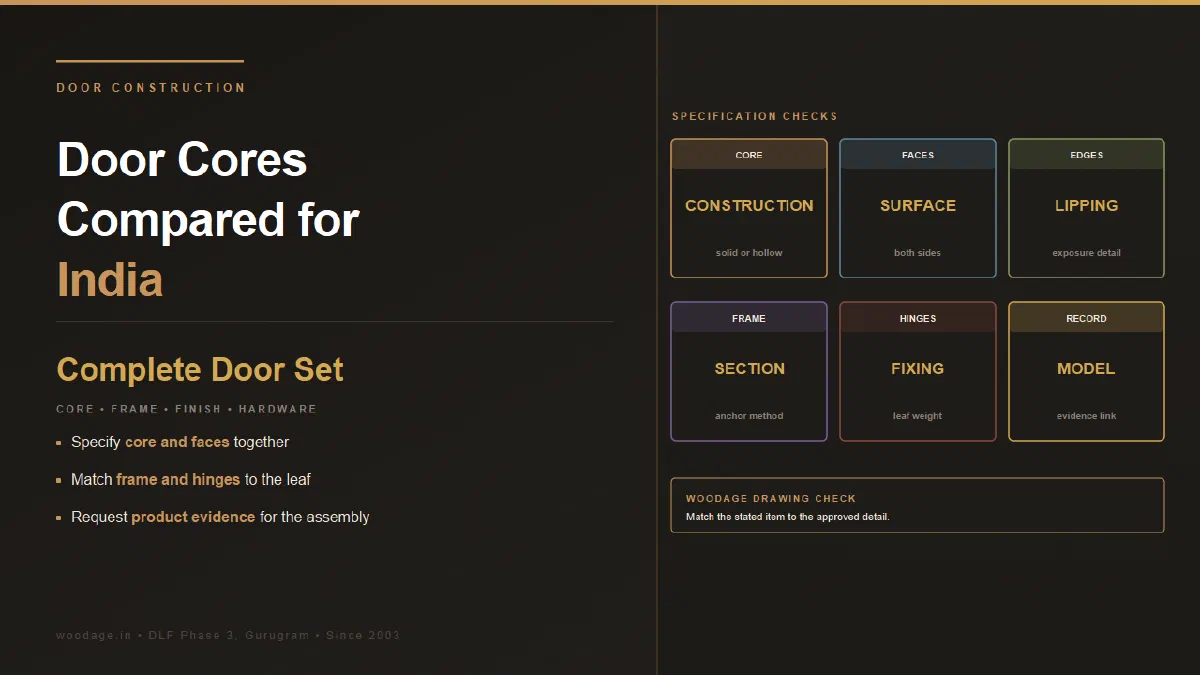
Quick answer: Choose an interior door by its complete construction: core, faces, edges, frame and hardware. Solid-core, hollow-core, WPC and solid-timber doors are not interchangeable specifications. A decorative laminate does not identify the core, and a material advertised as water resistant does not establish the performance of the installed door set.
WoodAge is a factory-direct furniture and interiors manufacturer in Gurugram, working since 2003. This guide separates the decisions hidden inside a door quotation. Start with the room and exposure, then compare complete assemblies. Bedrooms, wet bathrooms and apartment entrance doors need different assessments.
What the names actually describe
| Quotation term | What it identifies | What remains to be specified |
|---|---|---|
| Solid-core flush door | A flat-faced shutter with a substantially filled internal core | Core construction, faces, lipping, thickness and test evidence |
| Cellular or hollow-core flush door | A shutter with internal voids or a cellular construction | Internal support, lock block, trimming allowance and hardware fixing zones |
| WPC door | A wood-polymer composite product family | Solid or hollow profile, actual section, reinforcement, fixing instructions and exposure limits |
| Solid-timber door | Timber members or a timber-based construction | Species, moisture condition, joinery, panel movement and finish |
| HDHMR or HDF door | Often a board or face-material description | Whether the quoted item is a complete passage-door assembly or simply a board cut to size |
The BIS product-manual directory distinguishes IS 2202 solid-core flush shutters from IS 2191 cellular, hollow and tubular-core flush shutters. Parts also distinguish face constructions. A plywood grade alone does not establish finished-door compliance. Check the exact product, applicable part and supplier evidence in the BIS product-manual directory.
Match the door to the actual room
For a bedroom, compare closing feel, privacy, hardware fixing and weight. A heavier leaf is not automatically better: its hinges and frame must carry it. For a bathroom, map shower splash, mopping water, bottom-edge exposure and ventilation. In Gurugram apartments, from Golf Course Road to Dwarka Expressway, a bathroom door’s bottom edge meets water every time the floor is wet-mopped, so the edge sealing and frame foot matter as much as the core. Ask how the leaf edges, frame bases and cut-outs are protected.
For an apartment entrance, first establish whether the building or society requires a particular tested fire, smoke or security doorset. Do not replace a specified assembly with a different core on the assumption that thickness or weight provides an equivalent rating.
WPC is worth considering where a named product’s moisture performance suits the location. It is not a licence to describe every frame, fastener or finish as waterproof. Solid timber can suit a visible timber finish, but its moisture response and connection details remain part of the specification. Hollow constructions can suit lower-weight requirements where their documented hardware and use limits fit the job.
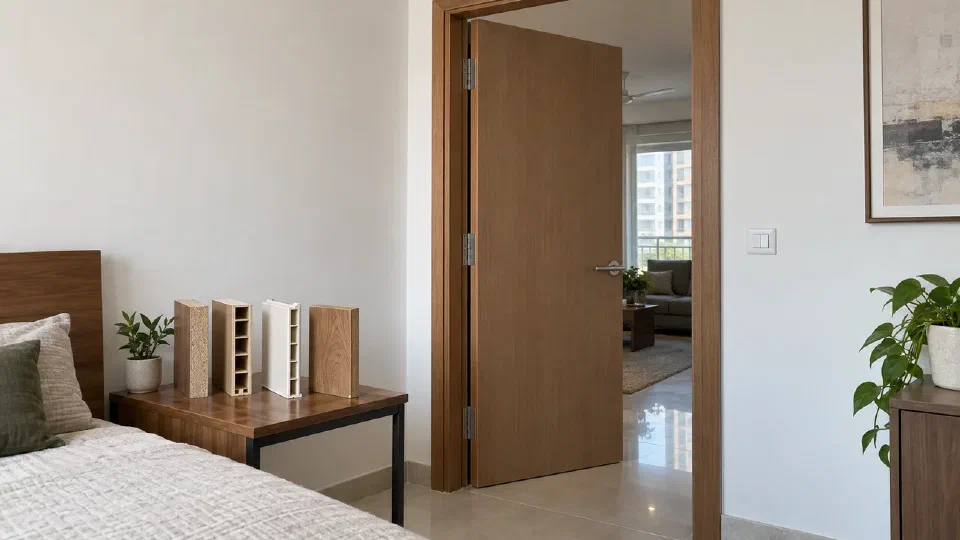
What to compare before approving a door quotation
Ask each bidder to fill the same schedule:
- Door location and identification number.
- Finished leaf dimensions, thickness and actual construction.
- Faces, edge lipping and finish on both faces and all relevant edges.
- Frame material, section, rebate and anchoring responsibility.
- Exact hinges, latch or lock, handles, stops and seals.
- Permitted cutting, drilling and on-site finishing.
- Delivery, removal of the old set, fitting, wall repairs and disposal.
- Product warranty, installation responsibility and exclusions.
Do not compare a leaf-only price per square foot with an installed doorset price. A fair total includes the same finish, frame, hardware and labour scope. Obtain dated quotations for the actual opening; this guide supplies no verified current Gurugram market price range.
Read a specification line literally
Suppose a quotation says “35 mm flush door, BWP plywood, laminate finish”. That line identifies a thickness and proposed surface construction; it does not yet identify the internal core, edge lipping, frame or permitted machining. Ask for those missing fields before comparing it with a complete solid-core or WPC doorset. The 35 mm in this example is a quoted dimension, not a recommended thickness or proof of a performance rating.
If a product carries an ISI mark, record its licence number and check it using BIS’s official licence-verification tools. Match the returned manufacturer and applicable product/standard details to the delivered identification. A supplier saying “ISI material” is insufficient identification, and a verified product licence does not inspect the installation for you.
Do not select from a universal lifespan claim. Exposure, construction, installation and maintenance differ; a warranty period is also not a measured service life. Ask what the actual warranty covers and what evidence supports any durability comparison.
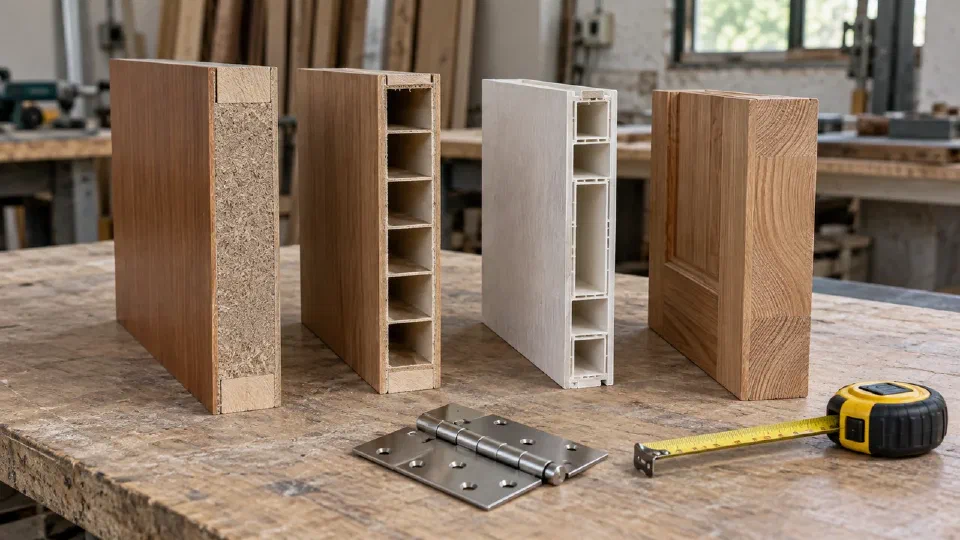
A small sample is useful, but incomplete
A labelled cut-section can reveal construction. It cannot prove the delivered leaf has the same core unless the product identification, invoice and inspection record connect them. Likewise, tapping the face is not a reliable certification test.
Check a representative finished door for visible edge treatment, hardware location and the agreed inspection criteria. Photograph the label and record any deviation before installation. Ask for the exact model’s trimming instructions: JELD-WEN’s published allowances vary by door type, illustrating why one generic cutting allowance is unsafe. Those UK values are not a specification for an Indian supplier’s door.
Decide with a complete comparison, not a material label
Put two bids side by side at the level of one opening. If both say “WPC door”, ask whether each is a solid section, a hollow profile or a faced shutter, and ask for the actual section drawing. If both say “solid core”, ask which flush-shutter construction and face are supplied. The BIS distinction between solid-core and cellular or hollow constructions gives a useful vocabulary, but a standard number written in a quotation is not a certificate for the delivered product.
For each bid, mark documented, to be confirmed or excluded beside the core, face, lipping, frame, hinges, lock block, finish and installation. A bathroom decision changes if the bottom edge is cut on site without an approved finishing method. A bedroom privacy decision changes if the leaf is substantial but the planned perimeter remains open. Ask the supplier for test evidence for any claimed fire or acoustic performance of the complete specified assembly; do not infer it from a core name.
Compare the cost of one complete opening
Use the same finished leaf size when converting a square-foot rate into a shutter price. Illustrative arithmetic only: a 7 ft by 3 ft leaf has an area of 21 sq ft. At a hypothetical leaf-only rate of Rs.200 per sq ft, it costs Rs.4,200 before any separately charged frame, finish, hardware, delivery or fitting. These figures explain the calculation; they are not market estimates or a WoodAge quotation.
Ask whether the supplier bills the stock blank or finished size, and whether tax is included. Compare the resulting installed totals only after the inclusions match. A discount on the core is poor value if the retained frame needs unpriced repairs or the chosen lock cannot be machined into the supplied fixing zone.
For technical comparison, BIS’s Building Materials handbook, section 15.2, lists IS 2202 Part 1:2023 for solid-core flush shutters with plywood faces and IS 2191 Part 1:2022 for cellular, hollow and tubular-core shutters with plywood faces. Specify the matching construction and part. Neither a surface name nor a reference to IS 710 plywood substitutes for identifying the finished shutter.
What the Indian Standards add: grades, thickness and tests
The two flush-door standards named above carry details that a quotation rarely repeats. Use them to turn “IS 2202 door” into a checkable line.
| Point | What the standard or order says | What to ask the supplier |
|---|---|---|
| Grade | IS 2202 (Part 1) and IS 2191 (Part 1) each define a BWP (boiling water proof) grade for humid and dry locations and an MR (moisture resistant) grade for dry locations only | The grade printed on the leaf with the ISI mark; BWP for bathroom and wet-mopped openings |
| Thickness | The IS 2202 size table uses 25, 30 and 35 mm thicknesses, and leaves larger than its biggest standard size take a thickness agreed between maker and buyer | A label thickness that matches the quoted leaf size |
| Tests | IS 4020 sets out 15 tests for door shutters, including general flatness, local planeness, impact indentation, edge loading, slamming, varying humidity, end immersion, glue adhesion and screw withdrawal | Which of those tests the report covers, for the exact product |
| Compulsory mark | The Plywood and Wooden Flush Door Shutters (Quality Control) Order, 2024 brought flush doors under compulsory BIS certification, in force from 28 February 2025 for large manufacturers, with later 2025 dates for small and micro enterprises | An ISI mark and CM/L number that verify in BIS Care |
| WPC doors | WPC door shutters are not among the products listed in that order | The product’s own test report, fixing instructions and exposure limits |
BIS certifies flush doors under a published product manual for IS 2202 (Part 1). An MR-grade leaf on a bathroom opening is outside what its own standard permits, whatever its laminate says.
Heat is a separate check for WPC. Delhi NCR summers reach about 45 to 47°C in the shade, and a leaf in direct sun runs hotter. For a balcony, terrace or west-facing door, ask for the maker’s stated service-temperature limit in writing.
A five-minute flatness check at delivery. Hold a straightedge or a taut string along each face, diagonally and lengthwise, and look for light under it. IS 4020 has formal tests for general flatness and local planeness; this simple check only tells you whether a leaf should be set aside for the supplier to inspect before it is hung.
Evidence and Verification Notes
The grade permissions, thickness steps and IS 4020 test list were checked against BIS copies of IS 2202 (Part 1):2023 and IS 4020 in September 2026, and the quality control order dates are as notified in 2024. These standards describe the leaf; the frame, fixing and installation remain separate checks. The temperature figure is a typical Delhi summer peak, not a product limit. No WoodAge test result is claimed here. To see how board cores, lipping and edge sealing are handled in production, book a WoodAge factory visit.
Frequently Asked Questions
Is solid core always better than hollow core?
No. Compare the required use, weight, fixing zones and documented performance. A suitable lighter assembly can be a sensible interior choice. A heavier leaf on an inadequate frame can create a different problem.
Does a denser WPC door guarantee better performance?
Density alone does not describe reinforcement, profile geometry, screw fixing, stability or the installed frame. Ask for the section drawing and exact product documentation instead of selecting from one number.
Is a laminate door a separate core type?
No. Laminate describes a surface. Record the substrate and complete shutter construction underneath it. Use the same distinction when a quote says veneer, membrane or painted finish.
Can a core name prove a fire or acoustic rating?
No. A rating must apply to the identified complete assembly and its tested configuration, including the leaf, frame, seals, hardware and installation details. Do not infer it from weight, thickness or a core label.
What should a fair door-price comparison include?
Put the leaf, frame, finish, edge treatment, hardware, removal, fitting and making-good work on the same basis. A low leaf-only rate is not comparable with an installed doorset price.
Can every new door be trimmed at site?
No. The permitted edges and amounts depend on the exact construction and supplier instructions. Confirm the allowance before ordering an oversized leaf or altering a delivered one.
What is the difference between BWP and MR grade flush doors?
Both grades are defined in IS 2202 for solid-core doors and IS 2191 for cellular and hollow-core doors. BWP (boiling water proof) grade may be used in humid and dry locations; MR (moisture resistant) grade is for dry locations only. The grade should be printed on the leaf with the ISI mark and CM/L licence number.
What are the disadvantages of WPC doors?
The usual concerns are weight, limited on-site trimming, screw holding that depends on the maker’s pilot-hole and fixing method, and movement in direct sun and heat. None is universal: check each against the exact product’s data sheet, and remember that a timber frame around a WPC leaf still needs its own protection.
Is a 30 mm or 35 mm flush door better?
Neither is better in general. The IS 2202 size table steps from 25 to 30 to 35 mm as leaves get larger, and the lock body and hinges must suit the actual thickness and weight. Choose the thickness the standard and the hardware call for at your leaf size, and confirm it on the label.
For a project in Gurugram or Delhi NCR, use WoodAge’s custom furniture service to discuss the measured requirement and written scope. Product suitability and the final BOQ must be confirmed for the actual order.
Related Guides From WoodAge
- Door material comparison - for leaf construction and surface choices.
- Solid wood versus plywood - for substrate and frame material decisions.
- Plywood-grade verification - for checking a claimed plywood grade.
- Main-door lock guide - for lock compatibility with a door assembly.
- Melamine vs PU vs Duco vs Polyester vs Shellac: Wood Polish and Paint Guide for India (2026) - Useful next reading on budget planning, costs, materials, or execution.
- Greenlam vs Merino vs Century vs Stylam vs Royale Touche: Laminate Brands for Kitchen Shutters - Useful next reading on budget planning, costs, materials, or execution.