

Edge Banding for Modular Kitchens: PVC vs PUR vs ABS, 0.4 mm vs 2 mm, and Why Most Vendors Skip It Properly
Edge banding is where cabinet failures most often start. This guide compares 0.4 mm PVC vs 2 mm PUR vs ABS, explains hot-melt EVA vs PUR adhesive bonding, and shows why the cheapest banding ages your kitchen by a decade.

- Kautuk Sahni
- 12 min read
Edge Banding for Modular Kitchens: PVC vs PUR vs ABS, 0.4 mm vs 2 mm, and Why Most Vendors Skip It Properly
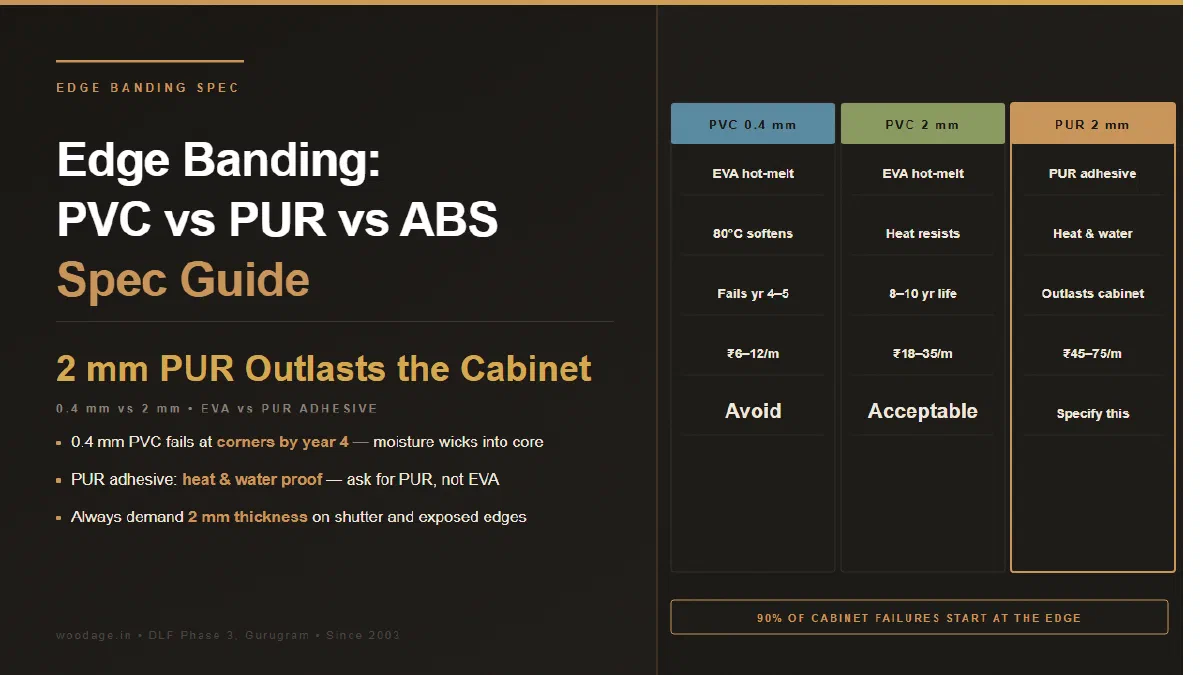
Edge banding is the thin strip applied to every cut edge of a cabinet panel - the unsung detail that determines whether your kitchen stays sharp at year 12 or starts peeling at year 5. A 2 mm PUR-bonded edge will outlast the rest of the kitchen. A 0.4 mm PVC edge with hot-melt EVA glue will fail at the corners by year 4 - and once corners peel, moisture wicks into the substrate and the cabinet starts swelling from inside.
WoodAge (woodage.in) is a factory-direct modular kitchen and custom furniture manufacturer in Gurugram (Gurgaon), serving Delhi NCR since 2003.
This is the technical guide that lets you specify edge banding precisely on any quotation: material types, thicknesses, bonding chemistries, and the visible signs of a quality job versus a rushed one.
What Edge Banding Actually Does
A cabinet panel - whether 18 mm BWP plywood, HDHMR or MDF - has six surfaces. Five are typically faced with laminate, veneer, paint or membrane. The sixth (the cut edge) is exposed core material unless it’s banded.
Without proper banding:
- Moisture wicks into the core through the exposed edge
- Steam from cooking penetrates over months and years
- The substrate swells, distorting the panel
- Laminate or paint on the visible faces de-bonds because the panel is moving
- Edges show unfinished material - visible at every shutter opening
Edge banding seals the edge, protects the core, and provides a finished aesthetic. It’s the single most-skipped detail in cheap modular kitchens.
The Four Banding Materials
1. PVC (Polyvinyl Chloride)
The most common, most economical edge banding material.
Available thicknesses: 0.4 mm, 0.6 mm, 0.8 mm, 1 mm, 2 mm, 3 mm
Pros:
- Lowest cost
- Wide range of colours and woodgrain patterns to match laminates
- Available from every laminate brand (Greenlam, Merino, Century, Sundek)
- Easy machining - most edge-banding machines handle PVC well
Cons:
- Bonds via hot-melt EVA adhesive (not chemically reactive - see below)
- Brittle in cold conditions (NCR winter mornings can cause hairline cracks)
- Yellows slightly over years of UV exposure
2. PUR (Polyurethane Reactive) Edge Banding
Premium banding bonded with PUR adhesive - fundamentally different chemistry from PVC.
Available thicknesses: Typically 1 mm, 2 mm, 3 mm
Pros:
- Bonds chemically to the substrate (PUR adhesive cross-links with both panel and banding)
- Virtually waterproof joint
- Survives steam, hot water, dishwasher splash zones
- 15+ year edge life on a properly applied PUR job
- Higher heat resistance - won’t soften near a hot oven
Cons:
- Higher cost (banding material + adhesive + machine setup)
- Requires PUR-compatible edge-banding machine (not all NCR factories have one)
- Once cured, joint is impossible to repair without core damage
3. ABS (Acrylonitrile Butadiene Styrene)
Higher-grade plastic banding, harder than PVC.
Available thicknesses: Typically 1 mm, 2 mm, 3 mm
Pros:
- Harder than PVC - better impact resistance
- Doesn’t yellow with UV exposure
- More dimensionally stable than PVC
- Often the choice for European-imported cabinetry
Cons:
- Higher cost than PVC
- Limited brand availability in NCR
- Bonded via hot-melt EVA (same as PVC) - joint chemistry similar
4. Acrylic / 3D Banding
Premium decorative banding with a transparent acrylic top layer over a printed pattern.
Pros:
- Premium aesthetic (deep glossy finish)
- Pairs with acrylic shutters for a coordinated look
Cons:
- Highest cost
- Limited availability
- Same bonding chemistry as PVC (hot-melt EVA)
The Adhesive Decides the Lifespan
Banding material gets attention. Adhesive is what actually fails.
Hot-Melt EVA (Ethylene Vinyl Acetate) Adhesive
The standard for PVC, ABS and acrylic banding.
How it works: EVA adhesive is heated to ~180°C, applied to the panel edge as a thin film, the banding is pressed onto it, and the adhesive cools and solidifies - bonding the banding mechanically.
Performance:
- Bond strength is mechanical (sticky cooling), not chemical
- Heat above ~80°C softens the adhesive - banding can lift
- Moisture penetration over years degrades EVA
- Typical edge life: 5 to 10 years before peeling starts at corners
PUR (Polyurethane Reactive) Adhesive
The premium adhesive, used with PUR banding.
How it works: PUR is applied to the edge, the banding is pressed on, and the adhesive chemically cross-links with both the substrate and the banding using ambient moisture as a catalyst. The bond becomes part of both materials.
Performance:
- Chemical bond, not just mechanical
- Heat resistance up to 150°C+ (won’t soften near oven or dishwasher)
- Waterproof joint - moisture cannot penetrate
- Typical edge life: 15+ years; often outlives the rest of the kitchen
Why “PUR Banding” Without PUR Adhesive Is Marketing
Some vendors advertise “PUR edge banding” but use hot-melt EVA adhesive to apply it. The banding material has PUR characteristics, but the bond is still EVA. This delivers maybe 60% of true PUR-bonded performance.
To verify true PUR bonding: ask for the adhesive brand and a photo of the edge-banding machine in operation. PUR machines have heated PUR adhesive cartridges (Jowat, Henkel Purmelt, Kleiberit are common adhesive brands). EVA machines have melt-pots of granular adhesive.
Thickness Recommendations by Use Zone
| Cabinet Zone | Minimum Thickness | Recommended | Material |
|---|---|---|---|
| Visible cabinet edges (shutters, side panels) | 1 mm | 2 mm PUR | PUR for premium; PVC 2 mm acceptable |
| Hidden edges (back panels, internal divisions) | 0.4 mm | 1 mm | PVC standard |
| Under-sink cabinet edges (all of them) | 2 mm | 2 mm PUR | PUR mandatory |
| Hob cabinet edges | 2 mm | 2 mm PUR | PUR for heat resistance |
| Dishwasher cabinet edges | 2 mm | 2 mm PUR | PUR for steam exposure |
| Open shelves (all visible edges) | 2 mm | 2 mm PVC or PUR | Aesthetic + protection |
| Internal shelf front edges | 1 to 2 mm | 2 mm PVC | Visible when shutter opens |
| Drawer faces | 2 mm | 2 mm PUR | High-touch surface |
The general rule: 2 mm PUR for every wet-zone cabinet, 2 mm PVC minimum for visible edges, 1 mm PVC acceptable for hidden edges.
How to Spot a Quality Banding Job
Run your fingernail along an edge. Quality signs:
- Smooth transition from face to edge (no ridge or step)
- Visible adhesive bead is minimal (a 0.1 mm hairline at the joint, not a 1 mm globby line)
- Corners are tight - no curl or lift at 90° transitions
- Colour match between banding and laminate is precise (manufacturers stock matching banding for every laminate code)
- No tool marks on the edge from the trimming station
- Top and bottom of banding are flush with the panel face - not protruding, not recessed
Failure signs:
- Visible adhesive squeeze-out
- Banding wider than the panel edge (over-trim mark from the machine)
- Banding narrower than the panel edge (gap visible at top/bottom)
- Lifting at corners
- Different colour than the panel face
What “Edge Banding” Means in Different Quotations
This is where vendor quotations vary widely:
Vague - Avoid:
- “Edge banding included”
- “Premium edge banding”
- “PVC banding”
Acceptable:
- “PVC banding 2 mm on visible edges, 1 mm on hidden edges; bonded with hot-melt EVA adhesive”
- “All shutter edges: 2 mm PVC, colour-matched”
Premium / What You Want:
- “PUR banding 2 mm on all visible and wet-zone edges; PVC 1 mm on hidden edges; bonded with PUR adhesive (Jowat Purmelt brand)”
- “Edge-banding machine: Felder G300 with PUR application head” (or similar specific machine spec)
- “Lifetime warranty on edge integrity in wet zones”
The third format gives you something to enforce. The first format gives the vendor cover for whatever banding they happen to have in stock.
Edge Banding Failures We See (And Why)
Failure 1: Corner Lifting at 90° Edge Transitions
Cause: The edge banding goes around a corner; the inside radius creates stress; cheap PVC + hot-melt EVA can’t hold the bend.
Fix: 2 mm thicker banding pre-formed at the corner, or PUR adhesive that holds the curved bond.
Failure 2: De-Bonding Near the Sink
Cause: Constant water spray hits the under-sink cabinet edge; hot-melt EVA degrades; PVC banding peels off.
Fix: PUR banding with PUR adhesive. Standard PVC + EVA cannot handle continuous wet exposure.
Failure 3: Steam-Damaged Edges Near Dishwasher
Cause: Dishwasher venting cycle releases hot steam against the adjacent cabinet edge for 60 to 90 seconds per cycle. EVA softens at high steam temperature.
Fix: PUR bonding + heat-resistant 2 mm PUR banding.
Failure 4: Peeling Edges After Tile Replacement
Cause: During later tile work, water and dust accumulate against cabinet edges; if PVC banding has any micro-gap, water penetrates.
Fix: The original PUR bond would have prevented this. Once peeling starts post-construction, repair is difficult.
Failure 5: Visible Banding Joint Lines on Long Panels
Cause: Long cabinet panels (above 2,400 mm) need joined banding strips. If the joint isn’t precisely aligned, a visible vertical line appears.
Fix: Continuous banding strips for visible runs (good vendors stock 50 m+ rolls); PUR bonding to make any joint invisible.
What Premium NCR Factories Use
Visit a quality cabinet manufacturer and you should see:
- Edge-banding machine: Felder, Holzma, Biesse, SCM (European) or Casadei or comparable Asian-make industrial banding machine
- Banding rolls: Multiple thicknesses, multiple colours per laminate code
- Adhesives: Hot-melt EVA in pellet form for standard PVC; cartridge PUR for premium runs
- Trimming station: Carbide trimmers with both top and bottom flush trim heads
- Buffing wheel: Final polish to remove machine marks
WoodAge’s manufacturing facility in Gurugram operates banding machines with PUR adhesive capability for premium runs and standard EVA for cost-conscious projects - both with proper trimming and finishing.
When to Pay for PUR Edge Banding
PUR banding adds modest cost but is a worthwhile upgrade for:
- Under-sink cabinets and dishwasher cabinets - non-negotiable for any quality kitchen
- Hob cabinets - heat exposure
- All visible cabinet edges in luxury installations - aesthetic + lifetime protection
- Utility balcony cabinets - see our Utility Balcony Guide - outdoor humidity demands PUR
- Bathroom vanity edges - same logic as utility
For dry-zone wardrobes and storage cabinets, 2 mm PVC with EVA adhesive is acceptable and saves cost.
Specifying Edge Banding on a Quotation
Insert this language into the cabinet specification line of your contract:
“All visible cabinet edges shall be banded with 2 mm thick edge banding, colour-matched to the shutter laminate. All wet-zone edges (under-sink cabinet, dishwasher cabinet, hob cabinet) shall use PUR-grade edge banding bonded with PUR adhesive. All hidden edges shall be banded with 1 mm PVC bonded with hot-melt EVA adhesive. Banding must be flush-trimmed top and bottom; no protrusion or recess. Manufacturer must provide a 5-year warranty on edge banding integrity in wet zones.”
This single paragraph gives you something to enforce.
See also: To see how each board and finish lasts in Delhi NCR humidity, read WoodAge’s material lifespan guide for the NCR climate.
Frequently Asked Questions
Is edge banding really that important?
Yes. The exposed core of a panel is the moisture entry point. Without proper banding, even premium plywood swells from the edge inward over years. Banding is structural, not decorative.
What’s the difference between hot-melt EVA and PUR adhesive?
Hot-melt EVA is a mechanical cooling-bond - sticky when hot, solid when cool. PUR adhesive cross-links chemically with both substrate and banding, creating a joint that’s part of both materials. PUR is waterproof, heat-resistant and long-lasting; EVA is none of these.
Why does my old kitchen have lifting edges?
If your kitchen is 8+ years old, the EVA adhesive has likely degraded from heat and moisture. PVC banding installed 10+ years ago commonly peels at this stage. Cabinet-only renovations should always upgrade to 2 mm PUR; see our Renovation Guide.
Can I tell PUR banding from PVC by looking?
With practice, yes - PUR has slightly different surface texture and the joint is virtually invisible. Most homeowners cannot tell visually. The real test is in the warranty terms and adhesive specification.
What’s the cost premium for PUR over PVC?
Modest - typically 15 to 25% on the banding line item alone, which is itself a small portion of the kitchen cost. The lifetime difference is enormous.
Is 0.4 mm banding ever acceptable?
Only on hidden internal edges that won’t be visible or stressed. Even there, 1 mm is a small upgrade with substantial protection benefit. Avoid 0.4 mm on visible or wet edges.
Can banding be repaired if it lifts?
Difficult. Once the original adhesive has aged and lifted, re-bonding requires cleaning the old adhesive residue, re-applying new adhesive, and pressing the banding back. The repair rarely matches the original aesthetically. Better to replace the affected shutter or panel.
Does ABS banding outperform PVC?
Marginally - ABS is harder and more impact-resistant. But the adhesive is the same (hot-melt EVA), so the joint chemistry is identical. PUR adhesive is the bigger upgrade than ABS material.
Why do some vendors quote PUR but charge PVC prices?
Because they’re using PUR-grade banding material with hot-melt EVA adhesive. The banding looks premium; the bond performs like PVC. Always ask for adhesive brand specification.
Is 2 mm edge banding more durable than 0.8 or 1 mm for doors and shelves?
For visible and high-touch edges, yes: this guide recommends 2 mm on shutters, side panels, drawer faces and open shelves, and 1 mm for hidden edges such as back panels and internal divisions. Neither thickness nor band material decides the bond, so specify PUR adhesive for wet zones and check the edges after installation.
Is there an Indian standard test for edge-banding adhesion?
Yes. IS 17637:2021, Annex D, tests adhesion after 48 hours at 40, 50 and 60 °C; 70 °C applies to worktop surfacing laminates. Its Table 5 rates peeling: 5 does not peel, 4 peels with difficulty, and 3 peels easily, without spontaneous delamination. Table 2 requires at least 4 at 40 °C and 3 at 50/60 °C. IS 17640 instead rates cold-liquid surface marking.
Related Guides From WoodAge
- How to Read a Modular Kitchen Quotation - Edge banding is one of the most-vague line items; this guide tells you how to demand specifics.
- Modular Kitchen Warranty in India 2026 - Edge banding warranties vary; understand what’s covered.
- Utility Balcony Design and Cost in Gurgaon 2026 - Why utility cabinets need 2 mm PUR mandatorily.
- Modular Kitchen Renovation in Gurgaon 2026 - Upgrading from old PVC to new PUR banding is one of the highest-value renovation upgrades.
- How a Modular Kitchen Is Made: Inside a Gurgaon Factory, 8-Stage Process Explained - Useful next reading on hardware planning, costs, materials, or execution.
- Acrylic vs Laminate vs PU Paint vs Veneer: Best Kitchen Finish for Delhi NCR Climate - Useful next reading on hardware planning, costs, materials, or execution.
- Godrej Aristocrat Sector 49 Modular Kitchen Guide - Godrej Aristocrat Sector 49 features premium apartments with quality specifications. This guide covers floor-plan-aware design, society fit-out rules, common renovation patterns, and material recommendations for these flats.
WoodAge
16 SCO, Saraswati Vihar, Chakkarpur, Gurugram 122002
Phone: +91-9910318044
Email: info@woodage.in
Website: woodage.in
Last reviewed: May 2026. Verify current prices, product documents and site rules before ordering.