

Factory-Made vs Carpenter Kitchen in Gurgaon: Cost, Quality and BOQ Comparison (2026)
Factory-made vs carpenter kitchen in Gurgaon: a worked ₹1.8–3 lakh vs ₹1.2–2 lakh planning comparison, with BOQ, cutting, edge banding, timeline and warranty checks.

- Arpit Sahni
- 13 min read
Factory-Made Modular Kitchen vs Carpenter-Made Kitchen: The Real Cost and Quality Comparison for 2026
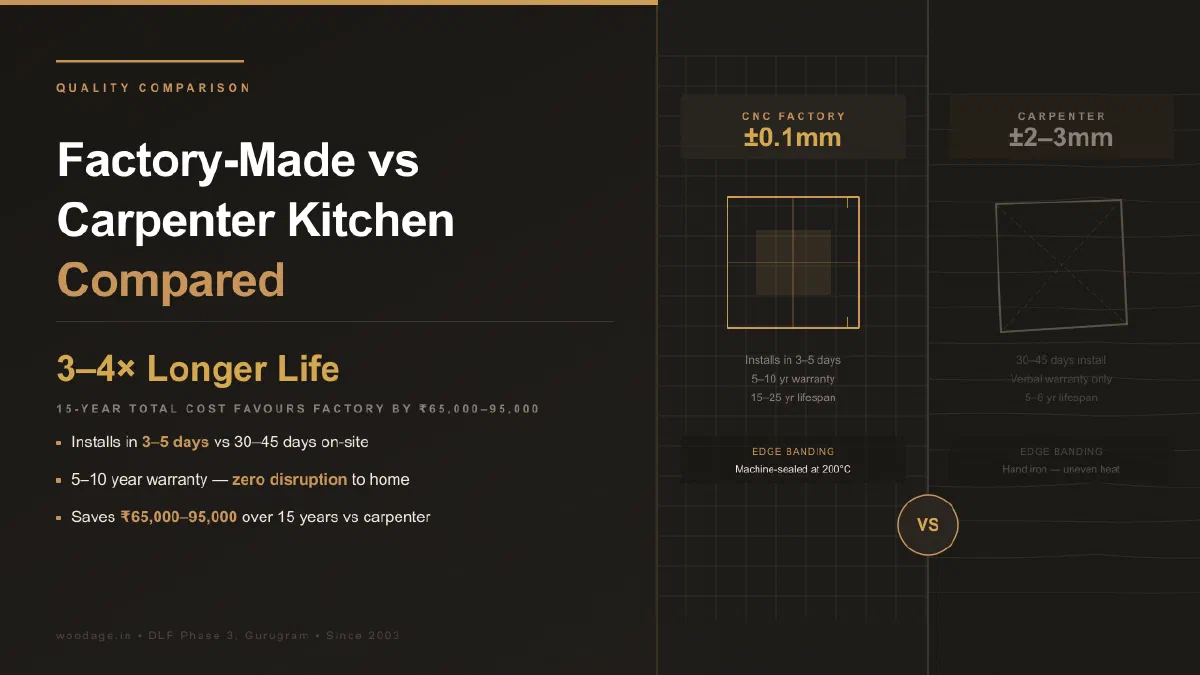
Factory-made and carpenter-made kitchens can both work, but they control risk differently. This guide uses a worked Gurgaon planning comparison of ₹1.2 lakh to ₹2 lakh for site carpentry and ₹1.8 lakh to ₹3 lakh for factory-direct production; these are illustrative inputs, not a market average or current WoodAge quote, and inclusions may differ widely. The schedule model allows 3 to 5 fitting days after factory production versus 30 to 45 days for procurement, cutting, assembly and finishing at site. Site carpentry offers immediate adaptation and hand detailing. Compare identical materials, hardware SKUs, inclusions, payment milestones and written warranty terms; a headline price alone is not an equivalent quote.
WoodAge (woodage.in) is a factory-direct modular kitchen and custom furniture manufacturer in Gurugram (Gurgaon), serving Delhi NCR since 2003.
WoodAge uses a ±0.5 mm planning tolerance for CNC-cut panels and machine-applied edge banding. These are process specifications, not a promise that every factory kitchen will outlast every carpenter-made kitchen. Final performance also depends on board grade, edge coverage, hardware loading, site measurement, plumbing leaks, installation and maintenance.
Factory-Made Modular Kitchen Gurgaon: What the Query Really Means
When buyers search “factory made modular kitchen Gurgaon”, they are usually asking for proof, not a slogan. A real factory-made kitchen should have measured drawings, CNC cutting, machine edge banding, repeatable boring for hinges and channels, labelled dispatch, a written BOQ and a service route after installation. If those proofs are missing, the kitchen may be “modular” in wording but still carpenter-led in execution.
| Proof to ask for | Why it protects the buyer |
|---|---|
| Factory address and visit option | Confirms the provider actually controls manufacturing |
| Carcass material and thickness | Prevents vague “waterproof ply” or thin-board substitutions |
| Edge banding method | Protects exposed board edges from moisture and peeling |
| Hardware product line | Separates named Hettich/Hafele/Blum lines from generic soft-close fittings |
| Dispatch checklist | Confirms panels, shutters, drawers and accessories are complete before site work |
| Warranty owner | Clarifies who responds if hinges, drawers or panels fail later |
For the exact material and thickness checks, pair this page with the BWP plywood vs HDHMR vs MDF guide and the plywood thickness guide.
Hardware facts that a production label cannot replace
“Factory-made” is a process description, not a hardware specification. A comparable quotation still needs an identifiable product line and an appropriate load/extension configuration.
| Primary-source fact | BOQ implication |
|---|---|
| Hettich describes its InnoTech drawer system as a metal-sided drawer system. | Write the drawer system name, not merely “tandem box.” |
| That source lists Quadro 25 Silent System as a partial-extension option. | State whether a drawer is partial or full extension; they are different user experiences. |
| It lists Quadro V6+ Silent System as a full-extension option. | Confirm extension type drawer by drawer, especially for deep utensil storage. |
| It separately lists a push-to-open full-extension configuration. | Do not assume a handleless/push-to-open drawer also has soft-close unless that function is written. |
| Häfele’s MatrixBox Premium page states 40 kg and 70 kg options and a 100,000-cycle rating for that named range. | Use manufacturer/model/load evidence only for the exact specified product; never transfer it to generic hardware. |
These facts do not decide whether a factory or a carpenter is better. They make either quotation testable by moving the conversation from labels to board grade, hardware SKU, installation method and written after-sales responsibility.
Side-by-Side Comparison: Factory vs Carpenter
| Parameter | Factory-Made Kitchen | Carpenter-Made Kitchen |
|---|---|---|
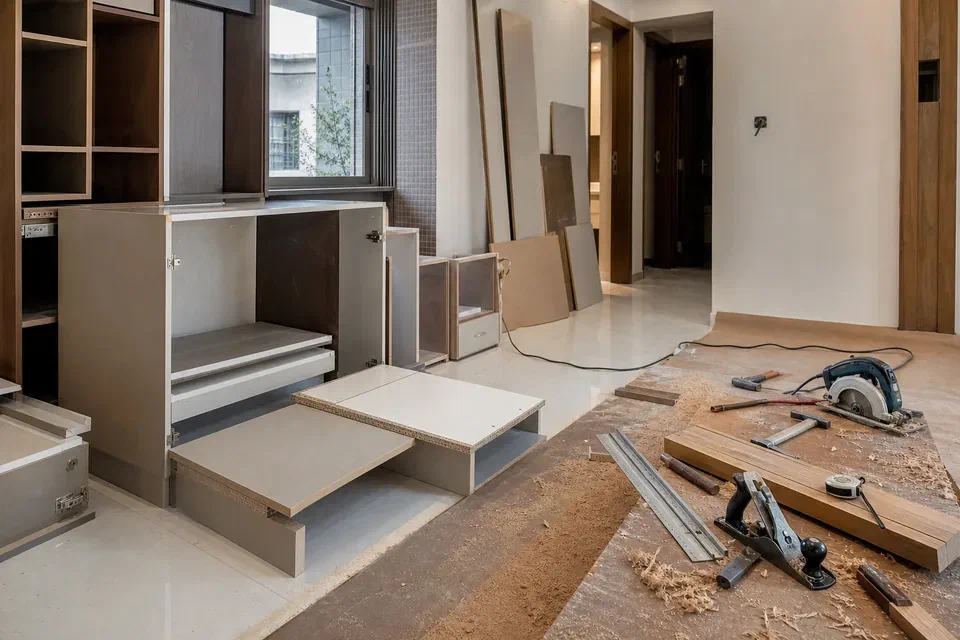
| Cutting method | Digital cutting list; WoodAge plans to ±0.5 mm | Marked and cut on site; verify dimensions before assembly |
| Edge banding | Machine-applied adhesive, pressure, trimming and buffing | Hand-applied edge tape; workmanship and coverage vary by installer |
| Material consistency | Sheets from single batch - consistent colour, grain, thickness | Sheets from multiple sources - slight colour and quality variations |
| Drilling accuracy | Multi-boring CNC: holes at exact positions for hardware | Manual drill: slight misalignment affects hardware performance |
| Worked timeline allowance | 20 to 30 days factory production, then 3 to 5 days installation | 30 to 45 days for the modelled on-site sequence |
| Quality inspection | Documented factory checklist can be completed before dispatch | Depends on the individual carpenter; request a signed stage-wise checklist |
| Dust and disruption | Minimal - pre-manufactured modules assembled on-site | Significant - cutting, drilling, sanding all happen inside your home |
| Warranty | Written scope, duration, exclusions and claim owner per project | Ask for the same terms in writing; do not rely on a verbal assurance |
| Customisation | Standard sizes + limited customisation within modules | Fully custom - any size, any shape, any configuration |
| After-sales service | Structured - company exists, has service team | Depends on carpenter’s availability and willingness |
| Illustrative cost input (same L-shaped planning brief) | ₹1.8 lakh to ₹3 lakh | ₹1.2 lakh to ₹2 lakh |
| Service life | Depends on material grade, exposure, hardware, installation and care | Depends on the same variables and the chosen workmanship |
| Resale relevance | A documented BOQ and service history can help a buyer assess condition | A documented BOQ and service history can do the same |
Why Edge Banding Is the Most Important Difference You Cannot See
If you take away only one thing from this article, let it be this: the quality of edge banding determines how long your kitchen lasts in Delhi NCR’s climate.
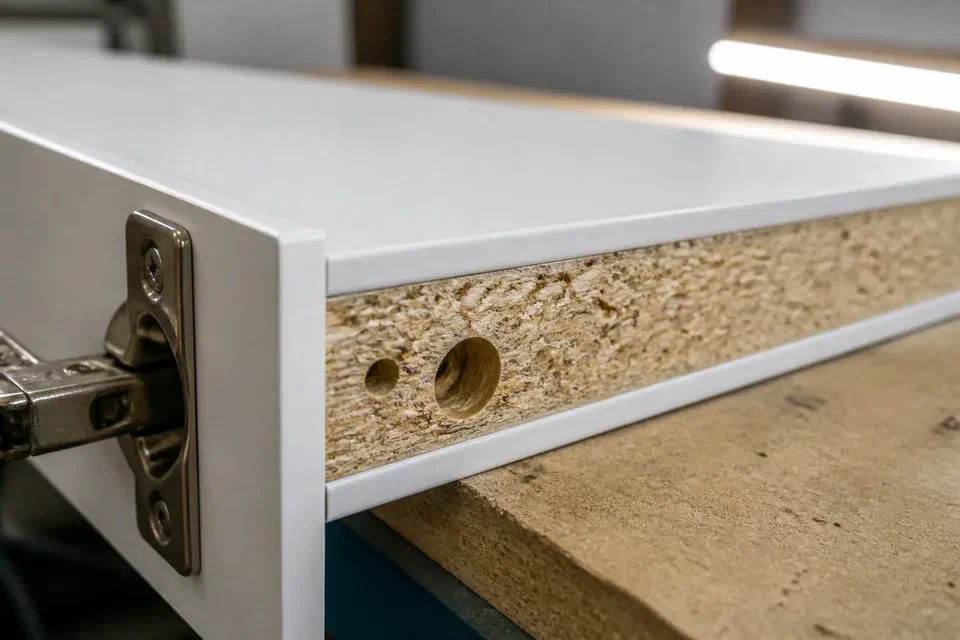
Every panel in a kitchen has four edges. In a humid environment, moisture enters through unsealed or poorly sealed edges and gradually degrades the core material. This is true for plywood, HDHMR, and especially MDF. Once moisture enters, panels swell, shutters stop closing properly, shelves warp, and the cabinet structure weakens.
In a factory, edge banding is applied by a dedicated machine that:
- Applies the specified adhesive under controlled machine settings
- Presses the edge tape against the panel at uniform pressure
- Trims the excess tape flush with the panel surface
- Rounds the edges to prevent peeling
The result is a moisture-sealed edge that maintains its integrity for years.
Hand-applied edge tape can also be serviceable when the correct adhesive, pressure, trimming and surface preparation are used. The buyer should inspect all visible and hidden edges, especially at the sink cabinet, plumbing cut-outs and bottom panels, rather than assuming either production method guarantees a sealed result.
At WoodAge, the edge-banding requirement is recorded by panel in the production drawing. Buyers can ask to inspect representative edges and the sink-zone cut-outs before dispatch.
CNC Routing vs Hand-Cutting: What the Manufacturing Process Difference Means
A CNC (Computer Numerical Control) panel saw reads cutting dimensions from a digital design file. WoodAge uses a ±0.5 mm planning tolerance. This supports:
- Every cabinet box is perfectly square (corners are exactly 90°)
- Every shelf sits flush inside its cabinet
- Every hinge boring position is identical across all cabinets
- Every drawer runner mount aligns perfectly
Hand tools introduce more operator-dependent variation, but a skilled carpenter can measure and adjust on site. Whichever route you choose, inspect cabinet squareness, reveal gaps, hinge alignment and drawer movement before final payment.
We are not criticising carpenters - many are extraordinarily skilled craftspeople. The point is that certain manufacturing processes (precision cutting, consistent edge banding, accurate boring) are inherently better performed by machines, just as a tailor’s hand is better for draping and fitting.
The Timeline Comparison Matters More Than You Think
Factory-made kitchen timeline:
- Design finalisation: 1 to 2 weeks
- Manufacturing (in factory, with no disruption to your home): 20 to 30 days
- Delivery and installation: 3 to 5 days
- Total time your home is disrupted: 3 to 5 days
Illustrative carpenter/on-site sequence:
- Material procurement: 3 to 5 days (carpenter goes to plywood market)
- Cutting and assembly: 15 to 25 days (everything happens in your kitchen)
- Finishing (laminate application, painting): 7 to 10 days
- Hardware installation and adjustments: 3 to 5 days
- Total time your home is disrupted: 30 to 45 days
If you are moving into a new Gurgaon apartment, use this 30-to-45-day on-site allowance to test the disruption risk rather than treating it as a universal carpenter promise. Factory-made kitchens shift most cutting and assembly away from the home; the actual site duration still depends on measurement accuracy, countertop readiness, access and snag closure.
The dust factor matters too. Carpentry work generates plywood dust, sawdust, and sanding debris that settles everywhere - on freshly painted walls, inside newly installed wardrobes, on curtains and soft furnishings. If you are doing a full home interior with carpentry, you typically need a deep-cleaning service afterward. Factory-made modules arrive sealed and finished - installation generates minimal dust.
Where Carpenters Still Have an Advantage
Fairness demands we acknowledge where carpenter-made kitchens genuinely excel:
Fully custom dimensions. A carpenter can build to any size, including extremely non-standard configurations. If your kitchen has an odd niche, an angled wall, or an unusually low ceiling, a carpenter can adapt on the spot. Factory modules come in standard sizes that are customisable within certain parameters, but very unusual configurations may require workarounds.
Lower upfront cost. There is no getting around the fact that carpenter-made kitchens cost less upfront. For homeowners on tight budgets, especially in rented properties, a carpenter can deliver a functional kitchen at 15 to 25% less than a factory option.
On-site adaptability. If wall measurements change slightly from what was planned (common in under-construction Gurgaon apartments where builder tolerances are generous), a carpenter adjusts on the fly. Factory modules need precise measurements before manufacturing begins.
How Should You Compare Upfront and Lifecycle Cost?
| Cost input | Quote A | Quote B | Evidence to collect |
|---|---|---|---|
| Initial BOQ, including GST | Fill from quote | Fill from quote | Itemised material, hardware, labour and exclusions |
| Installation and site preparation | Fill from quote | Fill from quote | Civil, electrical, plumbing, transport and lift booking |
| Written warranty scope | Fill from quote | Fill from quote | Duration, exclusions, claim owner and response route |
| Planned maintenance | Fill from quote | Fill from quote | Hardware adjustment, sealant, finish repair and spare availability |
| Replacement assumption | State your assumption | State your assumption | Do not assume a fixed life without a documented basis |
Use the same specification on both sides. A lower quote using a different board grade, thinner shutter, unnamed hardware or excluded installation is not a lifecycle saving; it is a different product.
How to Decide Between Factory and Carpenter
Choose factory-made if:
- You want panel, edge, hardware and dispatch specifications documented before site installation
- You are in a new apartment and want most cutting and finishing completed off site
- You value precision, consistent quality, and warranty coverage
- You want branded hardware (Hettich, Häfele, Blum) properly installed
- You prefer minimal disruption to your living space
Choose carpenter-made if:
- Your project is a small repair, an unusual hand-detailed piece or needs continuous on-site adaptation
- You are comfortable documenting material, hardware, milestones and warranty directly with the craftsperson
- Your kitchen has highly unusual dimensions that standard modules cannot accommodate
- You have a trusted carpenter with a verified track record of quality work
See also: To see how each board and finish lasts in Delhi NCR humidity, read WoodAge’s NCR material lifespan guide.
Evidence and Verification Notes
The factory-versus-carpenter decision becomes easier when both options are compared on proof, not presentation. Before ordering, ask each vendor for the same evidence pack.
| Evidence item | Factory-made proof | Carpenter/on-site proof to request |
|---|---|---|
| Material grade | BOQ with board grade, thickness and IS/ISI reference; BIS standard traceability where relevant | Bill or brand proof for every sheet used on site |
| Edge sealing | Machine edge-banding method, band thickness and exposed-edge policy | Written commitment for all exposed and internal edges |
| Hardware | Product line and quantity from Hettich, Hafele or Blum | Box, invoice and installed-count check |
| Warranty route | Written product and workmanship warranty | Named person, response time and exclusions in writing |
Frequently Asked Questions
Is modular kitchen worth the extra cost over carpenter?
It can be worth the difference when the compared BOQs show documented materials, controlled machining, shorter site work and a written remedy route. The ₹40,000-to-₹80,000 gap in this worked example is not a market average or guaranteed saving; reconcile identical quantities, grades, hardware and exclusions before deciding.
How long does a factory kitchen installation take?
WoodAge normally plans about 3 to 5 site-fitting days for a standard L-shaped kitchen after modules and access are ready; larger U-shaped or island scopes may require about 4 to 6 days. The written project schedule must identify countertop, electrical, plumbing, lift/access and snag dependencies rather than presenting those allowances as a guarantee.
Can a carpenter match factory quality?
On individual craftsmanship - yes, an excellent carpenter can create beautiful work. On consistency, edge banding quality, and hardware alignment across 15 to 20 cabinets - no. Machines deliver repeatability that human hands cannot match across large volumes of cuts and drillings.
Do I need to visit the factory before ordering?
We encourage it. Visiting the factory lets you see the CNC machines, edge banding equipment, and quality check processes firsthand. It also lets you physically examine material samples and hardware options. At WoodAge, our factory in Gurugram is open for client visits by appointment.
Can I add to or modify a modular kitchen later?
Yes. Because factory-made kitchens use standardised module sizes, you can add extra cabinets, upgrade hardware, or replace shutters without disturbing the existing structure. This modular upgradeability is a significant advantage over carpenter-made kitchens, where adding a unit often means reworking adjacent cabinets.
When is on-site carpentry still the better choice?
On-site carpentry can make sense for a small repair, an odd niche, a temporary rental fixture or a heritage-style piece where hand detailing matters more than repeatable modules. For a full kitchen, wardrobe or new-possession home, factory manufacturing is usually easier to verify because material grade, edge banding, drilling accuracy, dispatch list and warranty route can be written into the BOQ.
What proof should I ask for before choosing a factory-made kitchen?
Ask for the factory address, material grade, edge-banding method, hardware product lines, production timeline, site measurement process and written warranty. A serious manufacturer should be comfortable showing panel cutting, boring, edge finishing and packing practices. WoodAge buyers can schedule a Gurugram factory visit before approving a kitchen or wardrobe BOQ.
Does a factory-made kitchen still need society NOC in a Gurgaon high-rise?
Yes. Factory manufacturing reduces on-site dust and cutting, but high-rise work still needs society access rules, lift booking, contractor passes and working-hour compliance. For apartments on Dwarka Expressway, Golf Course Road and New Gurgaon, confirm these rules before dispatch so finished cabinets do not sit idle because the tower has not approved material movement.
Visit Our Factory and See the Difference
At WoodAge, we believe the best way to understand factory-made quality is to see it yourself. Visit our manufacturing facility, watch the CNC machines in action, examine the edge banding process, and compare material samples side by side.
Accuracy and Update Notes
This guide is reviewed for Gurgaon and Delhi NCR interior decisions. Prices, dimensions, brand availability, warranty terms, and site conditions can change by project, so treat the ranges and comparisons as planning guidance and confirm final specifications with an itemised quote and site inspection before ordering.
Related Guides From WoodAge
- Modular Kitchen Cost in Gurgaon 2026: Complete Price Breakdown - Exact factory-direct pricing vs platform pricing for L-shaped and U-shaped kitchens.
- BWP Plywood vs HDHMR vs MDF: Which Carcass Material Fits Each Zone? - Compare wet-zone exposure, edge sealing, fastener loading and grade verification without assuming a fixed service life.
- Hettich vs Häfele vs Blum Kitchen Hardware - 2026 Price & Cycle Rating - Hardware choice is the other major quality differentiator between factory and carpenter kitchens.
- 10 Hidden Costs in Modular Kitchens Nobody Tells You About - Why even factory kitchens cost 25 to 40% more than the headline quote.
- Small Modular Kitchen Design for Gurgaon 2BHK - Space-saving factory kitchen design ideas for 50 to 70 sq ft kitchens.
- Acrylic vs Laminate vs PU Paint vs Veneer for Delhi NCR Kitchens - Finish quality is the third advantage factory manufacturing holds over carpentry.
- Dwarka Expressway 3BHK Interior Cost - Interior cost guide for 3BHK homes along Dwarka Expressway, especially Sectors 102 to 113. Learn woodwork budgets, society constraints and planning priorities.
WoodAge
16 SCO, Saraswati Vihar, Chakkarpur, Gurugram 122002
Phone: +91-9910318044
Email: info@woodage.in
Website: woodage.in
Updated July 2026. Pricing and timelines reflect current WoodAge manufacturing data.