

Factory vs Carpenter Kitchen in Gurgaon: 5-Year Ownership Checklist
Factory-made vs carpenter kitchen five-year planning checklist covering maintenance risks, repairability, documentation, equal-spec comparison and BOQ checks.

- Kautuk Sahni
- 9 min read
Factory vs Carpenter Kitchen in Gurgaon: 5-Year Ownership Checklist
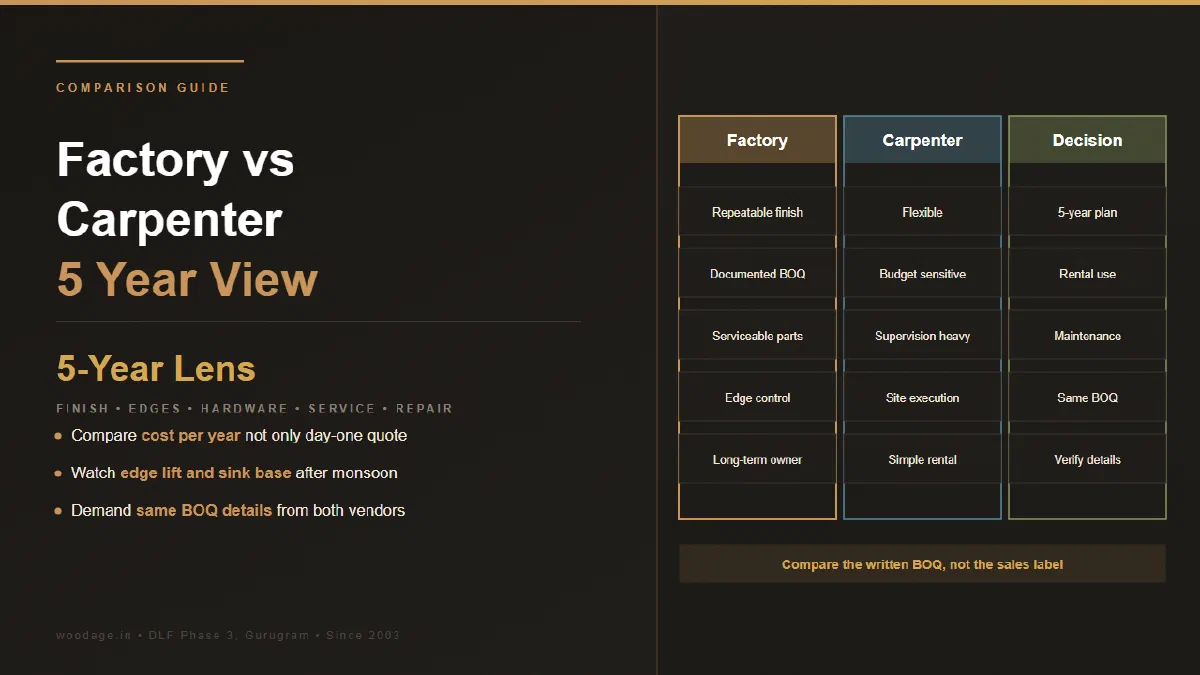
Factory-made kitchens can be worth considering when the buyer values repeatable finish, documented materials, hardware consistency and serviceable parts over the lowest upfront cost. A carpenter kitchen can work too, but material grade, edge sealing, hardware and maintenance should be written and verified in the same detail as a factory BOQ.
WoodAge (woodage.in) is a factory-direct modular kitchen and custom furniture manufacturer in Gurugram (Gurgaon), serving Delhi NCR since 2003.
This is a prospective maintenance checklist, not an owner survey or five-year WoodAge dataset. Use it to define inspection points and service responsibilities before ordering.
The 5-year question buyers should ask
Day-one cost is only part of the decision. The sharper question is: after 5 years of Gurgaon humidity, daily cooking, cleaning, pressure-cooker handling and drawer use, which kitchen will still close properly, look acceptable and be repairable without starting over? Factory-made kitchens can have an advantage when material, drilling, edge banding and hardware schedules are repeatable. Carpenter kitchens can suit a simple brief with a strict budget when the carpenter documents and controls the work.
For the day-one view, read the factory-made vs carpenter kitchen comparison. This page focuses on year 2, year 5 and the maintenance decisions that decide whether the premium felt worth it.
| Ownership factor | Factory-made kitchen | Carpenter-made kitchen |
|---|---|---|
| Finish consistency | Repeatable if factory process is controlled | Depends on site skill |
| Hardware count | Easier to document in BOQ | Often mixed unless specified |
| Edge sealing | Factory-controlled edge banding possible | Site execution varies |
| Repair path | Part replacement can be planned | Local repair can be quick |
| Potential fit | Long-term owner who values documented serviceability | Simple or rental kitchen with a controlled brief |
What tends to fail first
Potential five-year maintenance issues include widening shutter gaps, rubbing drawers, lifted edges near heat or sink zones, lost soft-close action, sink-base swelling, loose handles and deteriorated sealant. This is a risk checklist, not complaint-frequency data. Factory work can reduce some process variation but does not remove maintenance; carpenter work can also perform well when material and workmanship are controlled.
The buyer mistake is judging by the first-day photograph. A better test is to ask how the kitchen will be adjusted, repaired and documented when a hinge loosens in year 3 or a sink seal fails in monsoon.
| Failure mode | Suggested inspection window | Prevention |
|---|---|---|
| Soft-close loss | Check annually and when closing changes | Written hardware brand and count |
| Edge lift | Near hob or sink | Correct banding and adhesive |
| Sink-base swelling | After leak exposure | BWP IS 710 and sealing |
| Shutter misalignment | Check at handover and during annual service | Proper hinge fixing and adjustment |
| Finish mismatch | After repair | Document finish code and batch |
Cost-per-year beats headline price
Do not compare factory and carpenter only as “expensive” versus “cheap”. Compare cost per year of acceptable use. A lower upfront kitchen that needs shutter replacement, hardware replacement and water-damage repair may not stay cheaper. A factory kitchen that uses poor material also will not magically win. The economic comparison works only when both options are specified honestly.
Use tier language instead of pretending one price fits every kitchen. Budget, practical, mid-tier and premium kitchens differ by material, finish, hardware and accessories. A quote naming Hettich, Blum or Hafele line by line is easier to compare than a quote that only says branded hardware. The better BOQ is the one that lets you calculate what you are paying for, not the one with the most attractive round number.
| Question | Factory BOQ should show | Carpenter quote should show |
|---|---|---|
| Material | Board grade and thickness | Board grade and brand |
| Edges | Banding thickness and method | Edge treatment method |
| Hardware | Brand, line, quantity | Brand, line, quantity |
| Finish | Laminate/acrylic/PU code | Finish code and sample |
| Service | Warranty and adjustment process | Return visit terms |
Gurgaon climate and cooking intensity
Gurgaon kitchens may encounter seasonal humidity, water exposure around sink zones, dust, heavy oil cooking and apartment-service constraints. A kitchen on Golf Course Extension Road or Dwarka Expressway may also be part of an open living-dining plan, where finish consistency can matter more than in a closed utility kitchen. That can make factory-made work with documented material and hardware worth comparing for a long-term brief.
Rental units are different. If the kitchen needs durability, easy repair and controlled cost more than premium finish, a disciplined carpenter or simpler factory spec can both work. The deciding factor is not the label. It is whether the quote names material, hardware, edge treatment and service responsibility.
Warranty, maintenance and owner discipline
A warranty is useful only when it explains what is covered. The modular kitchen warranty guide separates hardware warranty, material warranty and workmanship responsibility. A factory-made kitchen may have a clearer documentation trail; a carpenter kitchen may rely more on personal accountability. Both can fail if the terms are vague.
Maintenance still matters. Follow the modular kitchen maintenance guide for sink-base leak checks, hinge adjustment, dry wiping and chimney cleaning. A premium kitchen abused with standing water will age badly; a simpler kitchen maintained well can outperform expectations.
The WoodAge recommendation
Consider factory-made if you plan to live with the kitchen for 5 years or more, want a documented BOQ, expect repeatable finish and need parts that can be verified at handover. Consider a carpenter when the design is simple, the budget ceiling is strict and you are willing to supervise material purchase, edge sealing, hardware counts and final alignment closely.
Do not buy either option on trust alone. Ask both vendors for the same 5 things: material grade, hardware schedule, finish sample, edge treatment and warranty responsibility. A vendor who answers cleanly is easier to evaluate than one described only by a low headline number.
See also: For per-running-foot ranges and a sample BOQ, see WoodAge’s Gurgaon kitchen cost breakdown.
Factory vs Carpenter: Evidence and Verification Checklist for 5-Year Ownership
| Decision field | Exact fact + adjacent direct source/locator | Buyer application |
|---|---|---|
| Process traceability | Caple states that drawings, BOMs, cut lists and labels should flow from one production system to the next without manual re-typing. Caple Smart Cabinet Making: CAD/CAM & Automation — HTML §1 “CAD/CAM software and smart-manufacturing integration,” lines 115–122. | Ask factory and carpenter options for the same drawing, material schedule and unit-level identification so process differences can be checked. |
| CNC operation | Caple states that a nesting CNC router can read cut lists and labels from CAD/CAM and cut grooves, dadoes and System 32 drilling in one setup. Caple Smart Cabinet Making: CAD/CAM & Automation — HTML §5 “High-performance panel saw, nesting CNC router and CNC beam saw,” lines 150–166. | Treat CNC capability as a process question: request the approved cut list and inspect the resulting fit, drilling and edge treatment rather than assuming factory means perfect. |
| Modular definition | The NIMI/BharatSkills textbook defines a modular kitchen as modules or units made from cabinets with selected standard sizes. NIMI/BharatSkills Wood & Carpentry textbook — PDF p.184, “Introduction of modular kitchen,” lines 10112–10127. | Compare both options by unit, size, repair path and replacement scope instead of comparing only factory or carpenter labels. |
| Equal-spec drawing | The NIMI/BharatSkills layout lesson says the drawing should specify countertop, cabinet material, finish, storage, electrical/plumbing concerns and hardware. NIMI/BharatSkills Wood & Carpentry textbook — PDF p.193, “Modular kitchen allocation or plan (layout),” lines 10443–10466. | Give both vendors the same specification fields before comparing price, service and expected maintenance. |
| Wet-zone plywood scope | The BIS compendium states that IS 710:2024 covers quality requirements, manufacturing processes and testing methods for marine plywood intended for high-moisture/marine applications. BIS Compendium of Indian Standards on Plywood — PDF p.3, section “IS 710 : 2024 Marine Plywood – Specification,” lines 64–75. | Verify the board standard and wet-zone sealing in either option; the standard’s scope is not a five-year lifespan guarantee. |
| Furniture QCO scope check | The Furniture (Quality Control) Order, 2025 lists “Furniture — 17634:2022 Storage units” in its table, says the order begins 12 months after Gazette publication, and states temporary exemptions for specified micro/small enterprises and qualifying Udyam-registered domestic manufacturers. Furniture (Quality Control) Order, 2025 — PDF pp.1–2, §1(2), §2 provisos and furniture table, lines 61–90. | Use this only as a BIS-scope verification prompt; do not label a custom kitchen, carcass or supplier as covered without checking product classification and current amendments or exemptions. |
Evidence boundary: These documents describe production processes, modular-kitchen planning, plywood scope and the QCO’s stated furniture categories; they do not measure five-year owner outcomes, prove cost-per-year, guarantee lifespan or establish that a custom kitchen is QCO-covered.
Frequently Asked Questions
Is factory kitchen worth the premium over carpenter?
It is worth the premium when repeatable finish, documented material, hardware consistency and serviceable parts matter over lowest upfront cost. For a simple rental kitchen, a well-supervised carpenter may still be practical.
How long does factory-made modular kitchen last in Gurgaon?
Lifespan depends on material, edge sealing, hardware, water exposure and maintenance. A factory label alone does not guarantee longevity; the BOQ and handover checks decide whether the kitchen can handle Gurgaon humidity and daily cooking.
What should be inspected by year five in a carpenter kitchen?
Inspect hinge fixing and adjustment, shutter gaps, edge adhesion, sink-base condition, drawer travel and finish matching after repairs. This list does not predict that a carpenter kitchen will fail; it identifies items whose risk is harder to manage when material grade, edge treatment and hardware quantity were never documented.
What is the cost per year of factory vs carpenter kitchen?
Calculate cost per year only after comparing equal specifications. Include repair, hardware replacement, shutter replacement, sink-base damage risk and service visits, not just the first quotation amount.
Can a carpenter kitchen last 15 years with maintenance?
It can, if the carpenter uses the right material, seals wet zones, installs good hardware and the owner maintains it well. But without written specifications and proof, the risk of uneven execution is higher.
Should I choose factory or carpenter kitchen for rental flat?
For rental flats, choose the option that is durable, repairable and cost-controlled. A simpler factory spec or a disciplined carpenter can both work; avoid fragile finishes and vague hardware claims.
Related Guides From WoodAge
- Factory Made VS Carpenter Kitchen Gurgaon Comparison
- Modular Kitchen Warranty India 2026
- Modular Kitchen Cost Gurgaon 2026
- Modular Kitchen Maintenance Cleaning Guide 2026
- Rental Ready Interiors Durable Materials India
- Modular Kitchen Brand Claims Warranty Factory Direct Hidden Cost
Get a Factory-Direct Quote
If you want this decision turned into a measured BOQ, share your kitchen layout, current site photos and the quote you are comparing. WoodAge can help you separate material, hardware, installation and site-readiness assumptions before production starts.
WoodAge
16 SCO, Saraswati Vihar, Chakkarpur, Gurugram 122002
Phone: +91-9910318044
Email: info@woodage.in
Website: woodage.in