

False Ceiling Cost in Gurgaon 2026: Gypsum vs POP vs PVC With Lighting Budget for 2BHK and 3BHK
False ceiling material choice and design define both lighting flexibility and acoustic performance. This 2026 guide compares gypsum (Saint-Gobain Gyproc, USG Boral) vs POP vs PVC vs WPC, AC duct integration, lighting budgets and standard 2BHK/3BHK designs.

- Kautuk Sahni
- 15 min read
False Ceiling Cost in Gurgaon 2026: Gypsum vs POP vs PVC With Lighting Budget for 2BHK and 3BHK
False ceiling decisions impact more than aesthetics - they determine how much lighting you can install, how AC ducts integrate, what acoustic performance the rooms have, and how much ceiling height you lose. The four common materials in Gurgaon - gypsum board, POP (Plaster of Paris), PVC, and WPC - each have distinct strengths, costs and installation timelines.
WoodAge (woodage.in) is a factory-direct modular kitchen and custom furniture manufacturer in Gurugram (Gurgaon), serving Delhi NCR since 2003.
A typical 2BHK (1,000 sqft) needs roughly 600 to 800 sqft of false ceiling coverage; a 3BHK (1,500 sqft) needs 900 to 1,200 sqft. The cost difference between materials is substantial: PVC is the most economical but has limitations; gypsum is the standard for premium installations; POP is the traditional Indian choice with great design flexibility. This guide covers each material in depth, with realistic budgets for 2BHK and 3BHK Gurgaon apartments.
What False Ceilings Actually Do
Beyond aesthetics, a false ceiling provides:
- Lighting integration - recessed downlights, COB lights, cove lighting, profile lights all need a false ceiling to mount into
- AC duct concealment - central AC trunks and individual unit ducts are hidden above the false ceiling
- Cable concealment - speaker wires, projector cables, network cabling routed through the false ceiling void
- Acoustic dampening - reduces echo, especially in tile-floor rooms
- Insulation - reduces heat transfer from the slab in summer; acts as thermal mass
- Aesthetic finish - covers structural slab imperfections; defines design zones (cove ceiling for living, flat for kitchen, dropped ceiling over dining table)
- Speaker housing - in-ceiling speakers (Bose, JBL, Sonance) need a false ceiling to mount into
- Ceiling fan support - light-load ceiling fans can mount into reinforced gypsum panels
The Four Common Materials in 2026
1. Gypsum Board (Drywall)
The most-used premium false ceiling material in Gurgaon.
Common brands (NCR-available):
- Saint-Gobain Gyproc: market leader; widest availability
- USG Boral: Australian brand, premium quality; available in NCR
- Knauf: German brand; premium tier
- Indian brands: Lafarge, JK Lakshmi (more budget-tier)
Composition: Gypsum core with paper liners on both faces. Standard panel size: 4 ft × 8 ft. Thickness: 9 mm or 12.5 mm (12.5 mm is the standard for residential).
Pros:
- Smooth, finished surface (paint-ready after taping and skim-coat)
- Dimensionally stable; doesn’t crack like POP
- Fire-resistant variants available (FR boards rated 30 to 60 min)
- Moisture-resistant variants available (MR boards for kitchens, bathrooms)
- Quick installation (can be ready for paint in 5 to 7 days)
- Sound-dampening variants available
Cons:
- Higher upfront cost than POP
- Joints can show after 2 to 3 years if not properly taped
- Heavier than PVC (needs more support framework)
- Cannot be moulded into intricate decorative shapes (POP is more flexible for complex detailing)
Best for: Premium installations in Gurgaon high-rises and builder floors; main living areas, bedrooms, dining; spaces with complex lighting and AC integration.
2. POP (Plaster of Paris)
The traditional Indian false ceiling material; still widely used.
Composition: Gypsum-based plaster mixed with water and applied wet over a wire mesh framework.
Pros:
- Lowest material cost
- Highly flexible - can create curves, domes, intricate decorative patterns
- Smooth seamless finish (no joints visible)
- Easy to repair (re-plaster cracks or damage)
- Locally available; abundant skilled labour in Gurgaon
Cons:
- Long installation time (10 to 15 days curing before painting)
- Cracks can develop from settling, vibration, or moisture
- Wet process - requires careful site management
- Heavy (more support framework needed)
- Hard to dismantle (any future modification is destructive)
- Cannot be moisture-resistant in wet zones (kitchens, bathrooms)
Best for: Traditional aesthetic with curves and decorative cornices; budget-conscious installations; repair of older POP ceilings.
3. PVC (Polyvinyl Chloride) Panels
Plastic panel false ceiling, typically interlocking strips or large panels.
Composition: Solid PVC or PVC foam panels, 5 to 8 mm thick.
Pros:
- Lowest cost
- Waterproof (excellent for kitchens, bathrooms, utility balconies)
- Lightweight (minimal support framework)
- Quick installation (1 to 3 days)
- Wide range of finishes (woodgrain, marble, plain, perforated)
- No site mess (dry installation)
Cons:
- Can look “plastic” if poorly finished
- Limited fire resistance
- Joints visible (interlocking pattern is the design)
- UV-exposed PVC can fade over time
- Less premium aesthetic for main living areas
Best for: Kitchens, bathrooms, utility balconies, basement areas; budget installations; rental flat fit-outs.
4. WPC (Wood Plastic Composite)
A newer alternative gaining popularity in 2026.
Composition: Wood fibre + plastic + additives; comes as panels or planks.
Pros:
- Premium aesthetic (looks like wood)
- Waterproof
- Lightweight
- No painting needed (factory-finished)
- Termite-proof and rot-proof
- Wider colour range than PVC
Cons:
- Higher cost than PVC; comparable to gypsum
- Limited large-panel availability (typically planks)
- Joint lines visible
Best for: Premium kitchens, dining rooms, balconies; visual statement areas where wood aesthetic is desired.
Cost Comparison Framework (Per Square Foot)
Costs vary significantly based on:
- Material brand and grade
- Design complexity (flat vs cove vs multi-level)
- Lighting integration density
- Site access (high-rise with lift access vs builder floor with stairs)
- Painter / finisher quality
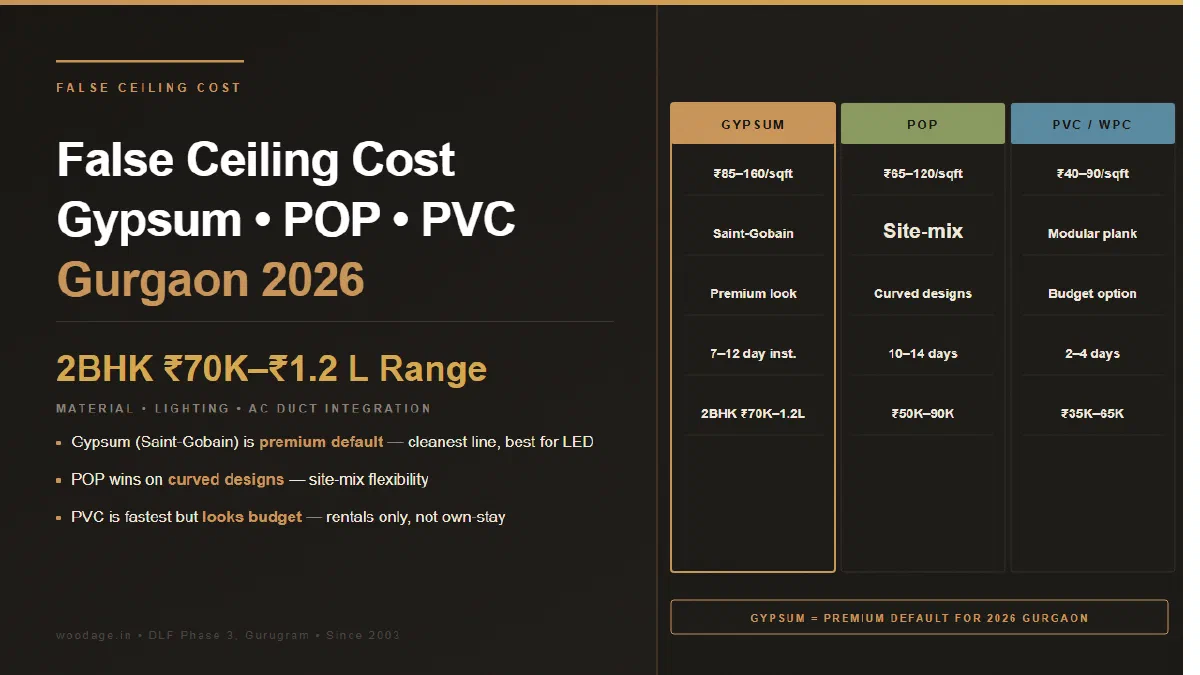
Material-Wise Rates, 2026
Published 2026 market rates for India, with the Delhi NCR figure shown separately where sources give one. These are indicative planning ranges, not quotations.
| Material | Published rate per sq ft (2026) | Notes |
|---|---|---|
| POP | ₹60–120 | Traditional pricing, heavily labour-dependent; some sources quote up to ₹200 for detailed work |
| Grid / modular ceiling | ₹60–100 | Usually commercial rather than residential |
| PVC panel | ₹70–150 | Waterproof and low-maintenance, which is why it costs slightly more than basic gypsum despite being a cheaper material |
| Gypsum board | ₹80–150 nationally; ₹85–160 in Delhi NCR | The most common residential choice |
| Metal | ₹150–300 | Rare in apartments |
| Wooden | ₹250–500 | Feature areas rather than whole ceilings |
Where the money goes. Across these materials the split runs roughly 40–50% material, 30–40% labour, 10–20% fixtures and fittings, with the labour component alone at about ₹20–50 per sq ft. Metro labour rates, Delhi included, run about 10–20% higher than tier-2 cities — which is the main reason a Gurgaon quote sits above a national average.
The line most quotes leave off. False ceiling work attracts 18% GST, and it is usually not included in the per-sq-ft rate a contractor quotes verbally or online. On a ₹1 lakh ceiling that is ₹18,000 appearing after you thought you had the number. Ask whether the quoted rate is inclusive before you compare two contractors.
Total Project Cost for Gurgaon Apartments
Ceiling area, not floor area, drives this. Using the coverage assumptions below and the rates above:
2BHK, about 700 sq ft of ceiling coverage
| Specification | Rate used | Indicative total (before GST) |
|---|---|---|
| POP with standard lighting | ₹60–120 | ₹42,000 – ₹84,000 |
| PVC with downlights | ₹70–150 | ₹49,000 – ₹1,05,000 |
| Gypsum with cove lighting and duct integration | ₹85–160 | ₹59,500 – ₹1,12,000 |
3BHK, about 1,000 sq ft of ceiling coverage
| Specification | Rate used | Indicative total (before GST) |
|---|---|---|
| POP with standard lighting | ₹60–120 | ₹60,000 – ₹1,20,000 |
| PVC with downlights | ₹70–150 | ₹70,000 – ₹1,50,000 |
| Gypsum with cove lighting and duct integration | ₹85–160 | ₹85,000 – ₹1,60,000 |
Add 18% GST where it is not already in the quoted rate, and add lighting fixtures separately — the rates above cover the ceiling, not the lights that go in it.
How to use this on your own flat. Measure the actual ceiling area you intend to cover, which is almost never the whole floor plate: most apartments get a peripheral cove in bedrooms and a fuller treatment in the living and dining area only. Multiply your measured area by the rate band for your chosen material, then ask any contractor whose quote sits far outside that band to show you why — usually it is design complexity, a multi-level profile, or fixtures bundled into the ceiling line.
Rates are published third-party market figures for India and Delhi NCR in 2026, accessed 23 August 2026. Indicative planning estimates only — not a WoodAge quotation, not a guaranteed price. Coverage assumptions of 700 and 1,000 sq ft are illustrative; measure your own ceiling area and confirm against itemised quotations.
For exact pricing per project, get itemised quotations from multiple contractors using the comparison sheet logic from our How to Read a Modular Kitchen Quotation guide - same principles apply to false ceiling quotes.
Design Types
Flat False Ceiling
Single-level horizontal ceiling. Simplest, most economical.
Pros: Maximum ceiling height retention (200 to 300 mm drop only); cleanest aesthetic Cons: Less visual interest
Best for: Modern minimalist interiors; small rooms where ceiling height matters
Cove False Ceiling
Recessed perimeter with a higher central section.
Pros: Indirect lighting around the perimeter; dramatic effect Cons: Loses 100 mm at perimeter
Best for: Living rooms, master bedrooms; rooms where ambient lighting is preferred
Multi-Level Ceiling
Ceilings with two or more height steps, creating zones.
Pros: Defines spatial zones (dining, lounge, foyer all visible from open living area); allows extensive cove lighting at each step Cons: Highest cost; more material; loses more ceiling height
Best for: Open-plan apartments; premium installations; statement design pieces
Tray Ceiling
A central recessed “tray” surrounded by a higher perimeter.
Pros: Frames the central space (often the dining table or seating area); cove lighting in the tray Cons: Specific room geometry needed
Best for: Dining rooms; formal seating areas
Coffered Ceiling
Grid pattern of recessed panels.
Pros: Architectural; classical aesthetic Cons: Higher cost; less common in Gurgaon residential
Best for: Traditional or classic-style interiors
Lighting Integration
The lighting layout is best designed at the false ceiling planning stage, not after.
Common Lighting Types
| Light Type | Purpose | Standard Density |
|---|---|---|
| Recessed downlights (4 to 6") | Task and ambient | 1 per 25 to 30 sqft of room |
| COB (Chip-on-Board) downlights | Premium downlights | 1 per 30 to 40 sqft |
| Cove LED strips | Indirect ambient | Around perimeter or in level changes |
| Profile lights | Decorative linear | At ceiling joints or feature walls |
| Pendant lights | Statement / accent | Over dining table, kitchen island |
| Spot lights / track lights | Accent | For art, displays |
| Gimbal lights | Adjustable accent | For specific focal points |
Lighting Budget Within False Ceiling Project
Lighting can add 20 to 40% to the false ceiling cost depending on:
- Number of lights
- Brand (Philips, Wipro, Havells, Syska, Crompton, Halonix in Indian market)
- Light type (basic LED panel vs COB downlight vs RGB strip)
- Switching complexity (simple on/off vs dimmable vs smart switches)
Recommended Lighting Layers (Standard Living Room)
| Layer | Light Type | Quantity (200 sqft living) |
|---|---|---|
| General ambient | Cove LED strip on perimeter | 30 to 40 ft of strip |
| Task lighting | Recessed downlights | 6 to 8 fixtures |
| Accent | Track lights or wall washers | 2 to 4 fixtures |
| Decorative | Pendant or chandelier | 1 statement piece |
AC Duct Integration
For apartments with central AC or VRF systems (common in M3M Capital, DLF Crest, Tata La Vida):
Standard AC duct dimensions:
- Main trunk: 250 to 400 mm × 200 to 300 mm
- Branch ducts: 150 to 250 mm × 150 mm
- Supply diffusers (visible at ceiling): 600 × 600 mm typical
False ceiling drop required:
- Minimum 250 mm drop for standard duct integration
- 300 mm preferred for branch ducts and access space
Coordination needed:
- AC contractor and false ceiling contractor must coordinate before either starts
- Diffuser positions marked on false ceiling drawings
- Return air grilles positioned for proper airflow circulation
- Service access panels positioned for future AC maintenance
For apartments with split AC (most NCR homes), the false ceiling integrates:
- Indoor unit drainage pipe routing (concealed)
- Refrigerant pipe routing
- Indoor unit aesthetic concealment via ceiling cassette or cove
Standard 2BHK False Ceiling Plan
A typical 2BHK (~1,000 sqft) Gurgaon apartment false ceiling plan:
| Room | Area (sqft) | Material | Design | Lighting |
|---|---|---|---|---|
| Living room (200 sqft) | 200 | Gypsum | Cove + flat centre | 30 ft cove strip + 6 downlights + 1 pendant |
| Master bedroom (140 sqft) | 140 | Gypsum | Cove perimeter | 20 ft cove strip + 4 downlights |
| Second bedroom (110 sqft) | 110 | Gypsum | Flat | 4 downlights |
| Kitchen (80 sqft) | 80 | PVC or moisture-resistant gypsum | Flat | 6 downlights + under-cabinet LED |
| Bathrooms (40 sqft each) | 80 | PVC waterproof | Flat | 2 downlights each |
| Foyer (15 sqft) | 15 | Gypsum | Flat with feature | 2 downlights + 1 pendant |
| Total | ~625 sqft | Mixed | - | - |
Standard 3BHK False Ceiling Plan
A typical 3BHK (~1,500 sqft) Gurgaon apartment:
| Room | Area (sqft) | Material | Design | Lighting |
|---|---|---|---|---|
| Living + dining (350 sqft) | 350 | Gypsum | Multi-level with cove | 50 ft cove strip + 10 downlights + 1 chandelier |
| Master bedroom (180 sqft) | 180 | Gypsum | Cove + flat | 24 ft cove strip + 6 downlights + 2 pendants over bedside |
| Second bedroom (130 sqft) | 130 | Gypsum | Cove perimeter | 18 ft cove strip + 4 downlights |
| Third bedroom (110 sqft) | 110 | Gypsum | Flat | 4 downlights |
| Kitchen (100 sqft) | 100 | Moisture-resistant gypsum or PVC | Flat | 8 downlights + under-cabinet LED |
| Bathrooms (40 sqft each, 3) | 120 | PVC waterproof | Flat | 2 downlights each |
| Foyer (25 sqft) | 25 | Gypsum | Feature with cove | 4 downlights + 1 chandelier |
| Total | ~1,015 sqft | Mixed | - | - |
Common False Ceiling Mistakes
1. Skipping AC Duct Coordination
False ceiling installed first; AC ducts retrofitted later. The result: visible duct boxing or compromised airflow.
2. Insufficient Drop for AC Ducts
200 mm drop with 250 mm ducts = ducts pressing against the false ceiling, creating visible bumps. Plan 250 to 300 mm minimum.
3. Lighting Density Too Low
Single ceiling fixture for 200 sqft living room = dim, awkward shadows. Layered lighting (cove + downlights + accent) is the standard for premium installations.
4. Cheap Drivers and Switches
Branded LED panels with no-name drivers fail within 2 years. Driver quality is what determines LED life. Stick to Philips, Havells, Syska, Wipro, Crompton.
5. POP in Kitchen or Bathroom
Wet zones need moisture-resistant gypsum or PVC. POP cracks and fails in 1 to 3 years in these environments.
6. No Service Access
In-ceiling speakers, AC service points, lighting fixtures all need future access. Service panels must be planned.
7. Mismatched Material Boundaries
Gypsum in living + POP in dining creates a visible joint that cracks. Use the same material throughout the open area.
8. Cove Lighting Without Diffuser
Direct LED strip in cove creates harsh hot spots. Use diffuser channels (extruded aluminium with frosted lens) for smooth continuous light.
9. Ignoring Ceiling Fan Support
Heavy ceiling fans (especially BLDC fans) need direct slab anchoring; light decorative fans can mount into reinforced gypsum. Plan support method during framing.
10. Single-Layer Switches Without Dimming
Modern living rooms benefit from dimmable cove lighting, separate switching for downlights vs cove vs accent, and ideally smart switches for scenes. Plan switching topology before final wiring.
The Pre-Installation False Ceiling Checklist
| # | Verification | Done |
|---|---|---|
| 1 | Material decision finalised per room (gypsum / POP / PVC / WPC) | ☐ |
| 2 | Brand specified (Saint-Gobain Gyproc, USG Boral, Knauf for gypsum) | ☐ |
| 3 | Design type per room (flat / cove / multi-level / tray) | ☐ |
| 4 | Total ceiling drop calculated (200 to 300 mm typical) | ☐ |
| 5 | Resulting ceiling height after drop verified comfortable | ☐ |
| 6 | AC duct routing coordinated with false ceiling drawings | ☐ |
| 7 | Lighting layout drawn (downlights, cove, accent, pendant) | ☐ |
| 8 | Switching topology planned (separate switches per layer) | ☐ |
| 9 | Service access panels planned for AC, speakers, lighting | ☐ |
| 10 | Cable routing planned (speakers, network, projector, etc.) | ☐ |
| 11 | Ceiling fan mounting strategy (slab anchor vs gypsum support) | ☐ |
| 12 | Painting / finishing coats specified (paint brand, finish) | ☐ |
See also: For per-running-foot ranges and a sample BOQ, see WoodAge’s modular kitchen cost guide for Gurgaon.
Frequently Asked Questions
Gypsum or POP - which is better?
Gypsum for modern installations (faster, more dimensionally stable, dry process). POP for traditional aesthetic with curves and intricate decorative work, or budget-conscious projects. Most Gurgaon premium installations now use gypsum.
How much ceiling height do I lose with a false ceiling?
200 mm minimum (8 inches) for flat ceiling without ducts; 250 to 300 mm with AC ducts; 350+ mm for multi-level designs. Verify your apartment’s slab-to-floor height - most are 10 ft, leaving 9'4" - 9'6" after a 200 mm drop.
Can I install a false ceiling in only some rooms?
Yes. Many Gurgaon installations use false ceiling in living, dining and master bedroom (where lighting and aesthetic matter most), with painted slab in secondary bedrooms and skip rooms.
What’s the lifespan of a gypsum false ceiling?
20+ years with proper installation and stable conditions. POP can crack in 5 to 10 years. PVC lasts 15+ years. WPC is similar to gypsum at 20+ years.
Is moisture-resistant gypsum enough for kitchens?
Yes for most kitchens. Moisture-resistant gypsum (green-paper variants like Saint-Gobain Gyproc Aquaboard) handles kitchen humidity well. For wet bathrooms, PVC is more reliable than even MR gypsum.
What lighting density is right for my living room?
For a 200 sqft living room: 6 to 8 downlights for task lighting + 30 ft of cove LED for ambient + 1 pendant or chandelier as feature. This three-layer approach works for most Gurgaon homes.
How long does false ceiling installation take?
Gypsum: 5 to 10 days for a complete 2BHK (framework, panels, taping, jointing, primer, final paint). POP: 10 to 15 days due to curing time. PVC: 2 to 5 days.
Can I add cove lighting to my existing false ceiling?
Yes, if the existing false ceiling has space at the perimeter. Retrofit cove lighting (typically 100 mm deep cove + 50 mm visible LED strip) is feasible without redoing the entire ceiling.
Will the ceiling look the same in 10 years?
Gypsum should remain unchanged with standard cleaning. POP may show hairline cracks at joints over time. Both can be repainted easily for refresh.
What if I want to remove the false ceiling later?
Gypsum is easier to dismantle than POP. Both create dust during demolition. PVC is the easiest to dismantle. Plan with future modifications in mind if relevant.
Related Guides From WoodAge
- Modular Kitchen Cost in Gurgaon 2026 - Kitchen false ceiling integrates with overall kitchen design and cost; understand the broader budget context.
- Wall Paneling Cost in India 2026 (/blogs/posts/2026/wall-paneling-cost-india-2026-wpc-pvc-mdf-cnc/) - Wall paneling and false ceiling are complementary design elements in premium interiors.
- Modular Kitchen Electrical Points Plan for Gurgaon Apartments 2026 - False ceiling lighting is part of the broader electrical plan; coordinate from the start.
- How to Read a Modular Kitchen Quotation - Apply the same line-item discipline to false ceiling quotations.
- Wardrobe With Loft Cost in Gurgaon 2026 - High-ceiling apartments often combine tall wardrobes, lofts and dramatic false ceilings for full-room transformation.
- Master Bedroom Interior Design in Gurgaon 2026: Bed Wall, False Ceiling, Wardrobe Placement and Factory-Direct Costs - Related guide for planning the costs, materials and execution of the same project.
- DLF Privana South Sector 76-77 Modular Kitchen Guide - DLF Privana South Sector 76-77 features premium apartments with high-end specifications. This guide covers floor-plan-aware kitchen design, society fit-out rules, and luxury material recommendations matched to DLF’s premium positioning.
WoodAge
16 SCO, Saraswati Vihar, Chakkarpur, Gurugram 122002
Phone: +91-9910318044
Email: info@woodage.in
Website: woodage.in
Last reviewed: May 2026. Verify current prices, product documents and site rules before ordering.