

Flush vs Membrane vs Laminate Doors
Flush vs membrane vs laminate doors: core build, edge and skin durability, moisture behaviour, price bands and where each door type belongs in a home.

- Kautuk Sahni
- 10 min read
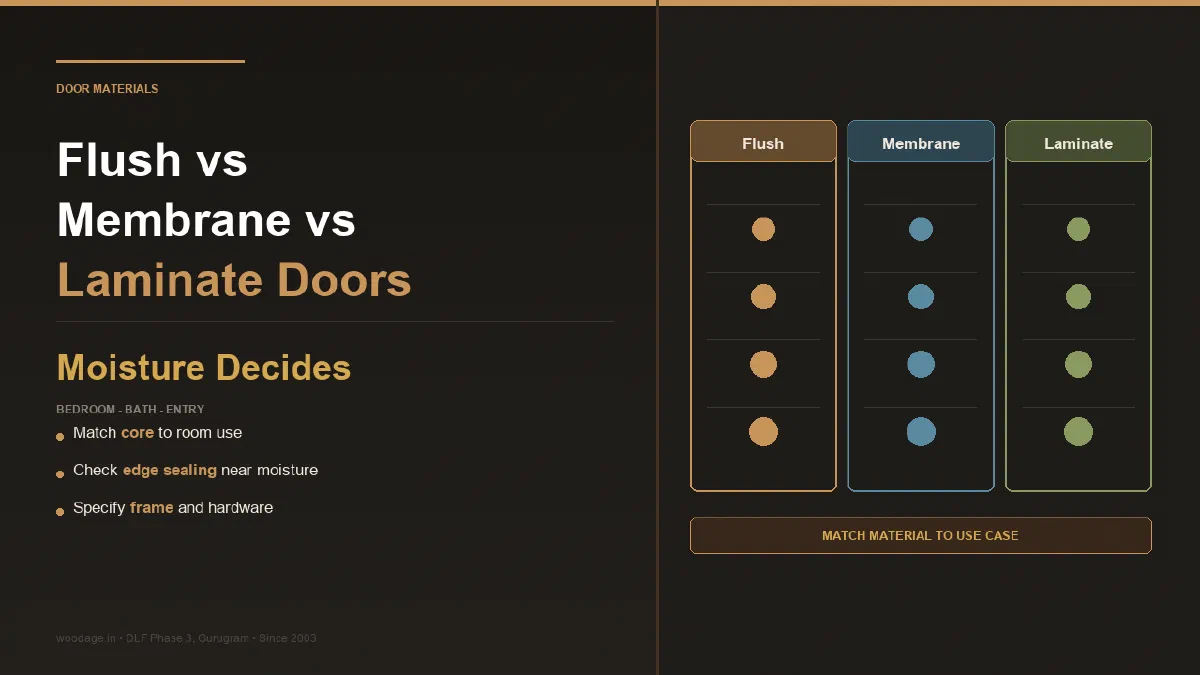
Flush vs Membrane vs Laminate Doors: India 2026 Interior Door Guide
Interior door choice should be based on moisture exposure, impact use, cleaning, repair and finish consistency. Flush doors, membrane shutters and laminate doors can all be correct, but each belongs in a different use case inside Indian homes.
WoodAge (woodage.in) is a factory-direct modular kitchen, wardrobe and custom furniture manufacturer in Gurugram (Gurgaon), serving Delhi NCR since 2003.
Use this page when the buyer is confused between flush doors, membrane shutters and laminate doors and needs the right use case for each.
What This Guide Answers
Are flush, membrane and laminate doors the same type of choice?
No. Flush door is a door construction. Membrane and laminate are finish systems used on suitable substrates. The right comparison starts with use case.
Where does laminate work best?
Laminate works well where cleaning, scratch resistance and daily durability matter, especially wardrobes, kitchen shutters and practical room doors.
Where should buyers be careful?
Be careful near bathrooms, kitchens and damp walls. Substrate, edge treatment, frame, hinge, bottom clearance and ventilation matter more than the surface look.
Fast Answer For Door And Shutter Selection
For door and shutter selection, first separate construction from finish. A flush door is the door base. Laminate, veneer, PU paint or membrane are finishes or shutter treatments. The right answer depends on use, moisture, cleaning, edge protection and repair expectations.
| Choice | What it means | Where it works best | Where to be careful |
|---|---|---|---|
| Flush door | Flat internal door construction | Room doors and simple clean openings | Needs good frame, hinges and bottom clearance |
| Laminate shutter | Laminate on a suitable board or substrate | Kitchens, wardrobes and high-use storage | Edge banding and substrate decide durability |
| Membrane shutter | PVC membrane pressed over routed surface | Decorative dry-zone wardrobes or cabinets | Heat and peeling risk near kitchens |
| Veneer or PU finish | Premium visual finish | Formal rooms, display storage and design-led areas | Higher care and touch-up sensitivity |
The practical answer is: use laminate where daily cleaning and durability matter, membrane only in controlled dry zones, and veneer or PU where the premium look is worth the extra care.
Door Manufacturing Expert Notes
A door or shutter fails first at the edge, hinge side or moisture-exposed bottom. That is why the substrate and edge treatment matter more than the showroom surface. A high-gloss shutter with weak edges is not a premium decision.
For wardrobes, laminate is often the practical choice because it handles daily touch and cleaning well. For kitchen shutters, heat and moisture make edge quality important. For internal room doors, frame alignment and hinge quality decide the feel more than the surface photograph.
| Use case | Expert material direction |
|---|---|
| Bathroom-side internal door | Prioritize moisture resistance, bottom clearance and frame condition. |
| Kitchen shutter | Prioritize substrate, edge banding, heat exposure and cleaning. |
| Wardrobe shutter | Prioritize flatness, hinge or channel quality and daily touch durability. |
| Decorative low-use area | Membrane, veneer or PU can work if exposure is controlled. |
Flush, Membrane And Laminate Are Not The Same Decision
A flush door is an internal door construction choice. Membrane is usually a pressed PVC finish used on shutters and some door faces. Laminate is a surface finish applied over a substrate. Comparing them directly can confuse buyers unless the use case is clear.
For room doors, stability, frame, core, laminate or veneer finish and hardware matter. For wardrobes and cabinets, shutter finish, board, edge and hinge performance matter more.
Where Each Door Type Fits
Use laminate when daily cleaning, scratch resistance and practical maintenance matter. Use membrane only where heat exposure is low and the finish quality is acceptable. Use painted or veneer finishes when the design value justifies higher care.
Near bathrooms, kitchens or humid walls, ask more questions about substrate and edge protection. A good-looking door can fail at the edge first.
Door Hardware And Frame Checks
Do not approve only the shutter finish. Check frame alignment, hinges, lockset, stopper, handle height, edge finish, bathroom ventilation, bottom clearance and whether the door can open fully with furniture placed.
Door mistakes are annoying because they are touched every day. Small alignment problems become daily irritation.
Door And Shutter Mistakes Buyers Make
For doors and shutters, terminology comes first. Flush door is construction. Laminate, membrane, veneer and PU are finish choices. Once that is clear, the buyer can choose by use, moisture and cleaning.
| Common mistake | Better decision |
|---|---|
| Comparing construction and finish as if they are the same | Flush door is a door construction. Membrane and laminate are finish systems used on suitable substrates. |
| Ignoring edge and moisture exposure | Bathroom-adjacent, kitchen-adjacent and humid walls need stronger edge and substrate decisions. |
| Approving only the shutter face | Frame, hinge, lockset, stopper, bottom clearance and swing direction affect daily use. |
Do Not Compare Construction With Finish
Flush door, membrane and laminate are not three identical categories. A flush door is a door construction. Membrane and laminate are finish systems applied over suitable substrates. The first decision is the use case: room door, wardrobe shutter, kitchen shutter, bathroom-side door or decorative panel.
Once the use case is clear, compare substrate, edge treatment, moisture exposure, cleaning, hinge load and repairability.
Door And Shutter Type Comparison
| Choice | What it means | Best use | Watch-out |
|---|---|---|---|
| Flush door | Flat internal door construction. | Room doors where stability and clean look matter. | Core, frame, hinges and bottom clearance matter. |
| Membrane shutter | PVC membrane pressed over routed shutter surfaces. | Decorative wardrobe or cabinet shutters in low-heat dry zones. | Heat, peeling and edge quality need attention. |
| Laminate door or shutter | Laminate surface over suitable substrate. | Daily-use wardrobes, kitchens and practical doors. | Edges, substrate and moisture exposure must be specified. |
| Painted or veneer finish | Premium custom finish. | Design-led rooms with clear care expectations. | Higher maintenance and touch-up sensitivity. |
Moisture, Edges And Hinges Decide Life
Near bathrooms, kitchens and damp walls, edge treatment and substrate matter more than the visible finish. A good-looking shutter can fail early if the edge swells or the hinge side is weak.
For Delhi NCR homes, choose by exposure first and appearance second. This gives the reader a practical decision, not just a catalog comparison.
Door And Shutter Spec Sheet Buyers Can Carry
Add door handing and finished-floor reference to the schedule. Identify the room, opening direction as shown on the plan, hinge side, frame/rebate arrangement and selected lock/handle. Agree how handing is described with the supplier rather than relying on an unexplained “left” or “right.” Then draw the door open against adjacent furniture, switches and sanitary fittings.
Keep the finished door size separate from the structural opening and frame dimensions. Ask the installer to confirm any bottom clearance and edge treatment against the actual floor finish, ventilation needs and chosen door system. A construction label such as flush door and a surface label such as laminate do not determine these installation details.
A useful door decision separates three things: the core, the surface and the hardware. Flush door is usually about construction. Laminate and membrane are surface decisions for shutters and doors. Hinges, frame, lipping, edge sealing and lockset decide how the door behaves after installation. Comparing only the visible finish is incomplete.
For wardrobes and kitchen shutters, ask for substrate, thickness, laminate or membrane detail, edge finish, hinge count and handle or profile detail. For room doors, ask for door thickness, frame material, lipping, hinge count, lockset and finish. Wet or semi-wet zones need extra attention to edge sealing and ventilation.
| Item | What to specify | Why it matters |
|---|---|---|
| Door core | Flush door type and thickness | Controls weight, screw holding and feel |
| Shutter substrate | Plywood, HDHMR, MDF or other board | Controls moisture behavior and hinge holding |
| Surface | Laminate, membrane, veneer or paint | Controls cleaning, look and repairability |
| Edge | Lipping or edge banding detail | Exposed edges fail first in rough use |
| Hardware | Hinge count, lockset and handle | Poor hardware can spoil a good shutter |
See also: For a factory-direct kitchen from the Gurugram unit, see WoodAge’s factory-made kitchens in Gurgaon.
Frequently Asked Questions
Which is better: flush door, membrane door or laminate door?
They solve different problems. A flush door is the base construction for many internal doors. A membrane shutter gives a routed decorative look but needs dry use and careful edge handling. A laminate shutter is practical for wardrobes, kitchens and utility storage because it is easier to clean and specify.
Where should laminate shutters be used?
Laminate shutters work well in kitchens, wardrobes, lofts, shoe units, study storage and utility areas. They are practical when the buyer wants cleanability, predictable finish, wide color choice and easier replacement. Edge quality and substrate matter as much as the laminate surface.
Where should membrane be avoided?
Avoid membrane in high-moisture, high-heat or rough-use areas unless the vendor clearly explains the substrate, pressing quality, edge behavior and warranty. It can look good in dry decorative areas, but it is not the safest default for every kitchen or utility shutter.
What should I check in a door quote?
Check core type, thickness, frame, lipping, laminate or membrane brand, hinge count, lockset, edge finish, polish or paint, installation and handle specification. A door quote without hardware and frame clarity is incomplete.
Why do shutters bend or fail early?
Common reasons include poor substrate, wrong thickness, weak edge sealing, oversized shutter without enough hinges, moisture exposure, poor storage before installation and hardware mismatch. Large shutters need better thickness and hinge planning.
What is the safest choice for rental or heavy-use homes?
For heavy-use homes, laminate over a stable substrate is usually the practical choice for wardrobes and storage shutters. For main room doors, choose a proper flush door with good frame, lipping, hinges and lockset rather than judging only by surface finish.
Is there an Indian standard for flush doors?
Yes. IS 2202 (Part 1):2023 covers solid-core wooden flush door shutters with plywood faces in two grades, BWP and MR, and Part 2:2022 covers MDF, HDF, particle board and hardboard faces. Part 1’s acceptance tests include slamming, end immersion with no delamination, knife and glue adhesion, with thickness held to ±1 mm. BIS lists one amendment to each (catalogue).
Related Guides From WoodAge
- Bwp Plywood Vs Hdhmr Vs Mdf Kitchen Carcass Delhi Ncr - BWP plywood vs HDHMR vs MDF for Delhi NCR kitchen cabinets: wet-zone performance, per-sqft price difference, shutter vs carcass fit, and the grade-stamp checks to verify before you pay.
- Acrylic Vs Laminate Vs Pu Paint Vs Veneer Kitchen Finish India - Laminate vs acrylic vs PU paint vs veneer compared: realistic finish costs, fingerprint and scratch behaviour, heat and humidity performance in Delhi NCR, and where each finish belongs.
- Hettich Vs Hafele Vs Blum Kitchen Hardware India 2026 - Hettich vs Hafele vs Blum for Indian kitchens: hinge and drawer cycle-test references, indicative 2026 price bands, pull-out accessories, counterfeit-hardware checks and which brand fits which budget.
- New possession flat inspection checklist - Before starting interiors in a new flat, check seepage, wall levels, electrical points, plumbing, floor slope and builder defects. Fixing later costs more.
- Interior quote review and BOQ checklist - How to review a Gurgaon interior quote line by line: decode per-sqft woodwork rates, spot vague civil and electrical lump sums, and normalise quotes before paying.
- Wall Paneling Cost India 2026 Wpc Pvc Mdf Cnc - Wall paneling in India costs ₹50 to ₹2,500 per sq ft in 2026 depending on material. WPC panels (₹200 to ₹600/sq ft) offer the best durability-to-cost ratio for living rooms, lasting 15 to 20 years with no maintenance. CNC-routed panels (₹400 to ₹2,000/sq ft) deliver custom geometric designs that pre-manufactured WPC and PVC sheets cannot replicate. A standard 80 sq ft TV wall costs ₹16,000 to ₹1,60,000 depending on material choice.
Select Doors And Shutters With WoodAge
If you are planning interior door selection for a Delhi NCR home, bring your floor plan, site photos, current quote, appliance list and the top three doubts from this guide. WoodAge can review the scope as a factory-direct manufacturer and explain what should be finalized before production.
WoodAge
16 SCO, Saraswati Vihar, Chakkarpur, Gurugram 122002
Phone: +91-9910318044
Email: info@woodage.in
Website: woodage.in
This interior door selection guide is a planning resource. Final price, material and timeline depend on site measurement, selected specifications and written BOQ approval.