
Furniture and Joinery Glossary: Boards, Hardware, Finishes
Plain-language glossary of Indian furniture terms: plywood grades, HDHMR, edge banding, hinges, runners, joinery, finishes, timber defects and IS standards.

- Kautuk Sahni
- 18 min read
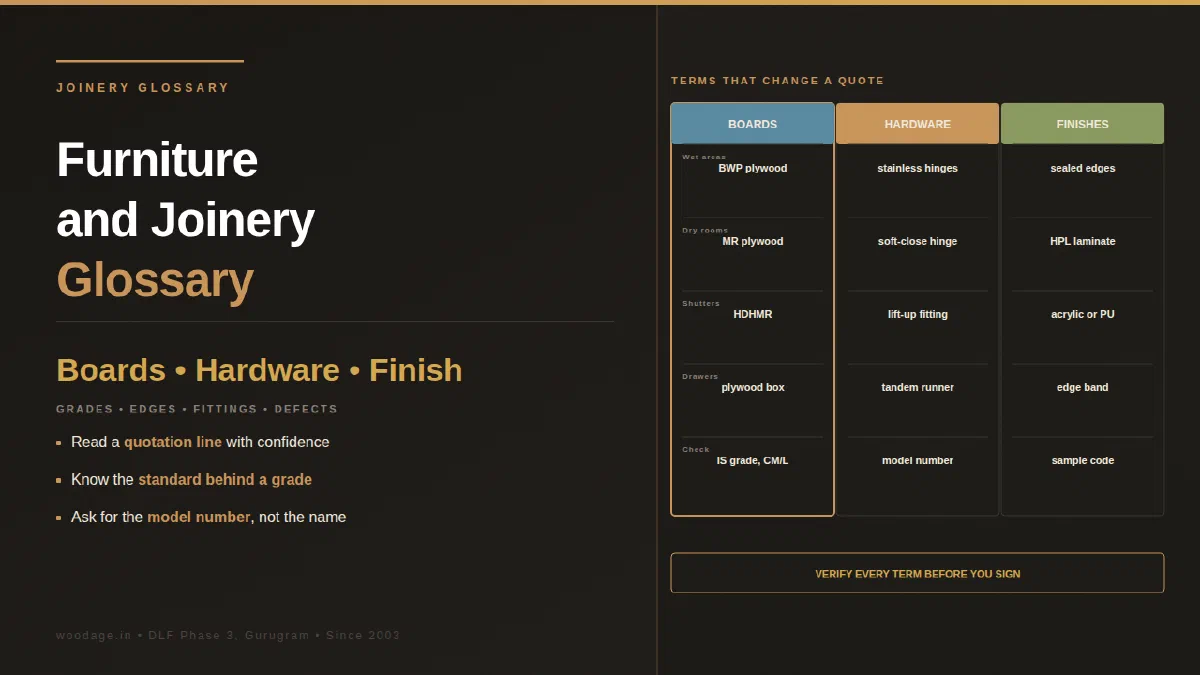
Furniture and Joinery Glossary: 131 Terms That Decide What You Receive
A furniture quote is written in trade terms, and each one changes what is delivered: BWP, IS 710, HDHMR, PUR edge band, full overlay, 3-way hinge, full-extension runner, minifix. This glossary defines those terms in plain language, separates Indian Standard terms from trade names, and links each to the WoodAge guide that tests it in depth.
WoodAge is a factory-direct modular kitchen, wardrobe and custom furniture manufacturer operating since 2003 and based at 16 SCO, Saraswati Vihar, Chakkarpur, Gurugram 122002. Many disputes over woodwork in Delhi NCR start with a word both sides read differently: “BWP” without an IS number, “soft-close” without the part, “solid wood” without a species. This page exists so a homeowner, architect or contractor can check a word before signing a BOQ.
Use the tables by section. Every entry gives what the term means and the one check that turns it into a specification. Where WoodAge has a detailed guide, the term links to it.
Quick answer: ten terms that change a quote the most
| Term in the quote | What it really commits the seller to | Ask for |
|---|---|---|
| BWP plywood | Nothing, unless an Indian Standard and grade are named | IS number, grade, brand, CM/L number |
| HDHMR | A product family name, not a grade | Standard, grade and product data sheet |
| Edge banding | Any strip on any adhesive | Material, thickness and adhesive (for example 2 mm PVC on PUR) |
| Soft-close | A damper somewhere | Hinge or runner model with integrated or add-on damper |
| Full extension | The drawer opens its full depth | Runner model and load rating |
| Laminate | Any decorative sheet | Brand, decor code, thickness, IS 2046 reference |
| Solid wood | Any timber | Species, moisture content, finish |
| Carcass 18 mm | Board thickness only | Board type and grade at that thickness |
| Handle-less | A profile, a push latch or a lift system | Named system and part numbers |
| Warranty | A promise with conditions | Written scope, period, exclusions and who honours it |
How to verify a term before you sign
- Turn every material word into a standard and a grade. “BWP” becomes “IS 710, grade and brand”; “laminate” becomes “brand, decor code, thickness”.
- Turn every hardware word into a model. “Soft-close hinge” becomes a brand, a model and a crank; “channel” becomes a runner model with a load rating.
- Check the mark, not the brochure. Enter the CM/L number from a marked board or door in the BIS Care app.
- Keep physical references. A laminate offcut, a finish sample panel and a hinge from the actual batch settle later arguments.
- Write it into the BOQ. A term that is not on the signed BOQ is not part of the order.
Boards and panels
| Term | What it means | The check that matters |
|---|---|---|
| Plywood | Board made of thin wood veneers glued with grain directions alternating | Grade and standard printed on the sheet |
| MR, BWR, BWP | Bonding-grade labels for the glue line: moisture resistant, boiling water resistant, boiling water proof | Meaningful only with the IS number and grade; see how commercial plywood is graded |
| IS 710 (marine plywood) | The Indian Standard for marine plywood, used where water exposure is likely | ISI mark and CM/L number on the sheet |
| IS 303 | The Indian Standard for plywood for general purposes | Grade named with the standard |
| Commercial plywood | A market term for general-purpose plywood, often without a stated grade | Treat it as unspecified until a grade is written |
| Blockboard | A core of solid timber strips between veneers, covered by IS 1659 | Core strip quality, gaps and grade |
| MDF | Medium-density fibreboard, made from wood fibres and resin; covered by IS 12406 | Grade: BIS lists REG, MR, HMR-GP and HMR-FN |
| HDF | High-density fibreboard; denser than MDF, common as door skins and drawer bases | Thickness and product data |
| HDHMR | High-density high-moisture-resistant board, a product family name | Standard, grade and permitted use on the data sheet |
| Particle board | Board of wood particles bonded with resin, covered by IS 3087 | Density, grade, edge sealing |
| Prelaminated board (prelam) | A board supplied with a decorative melamine face already bonded | Base board type, face code, edge band |
| WPC board | Wood-plastic composite sheet, a polymer matrix with wood content | Density, screw-holding advice, heat limits |
| PVC foam board | Expanded PVC sheet used where water resistance matters | Thickness, density, screw-fixing method; see PVC and WPC cabinets |
| Flush door | A factory door leaf with a core between plywood faces, covered by IS 2202 and IS 2191 | Solid or hollow core, BWP or MR grade |
| Calibrated plywood | Plywood sanded to a close thickness tolerance | Measured thickness at several points |
| Balancing sheet | A backing laminate on the unseen face that stops a panel bowing | Present on every laminated shutter |
Faces and finishes
| Term | What it means | The check that matters |
|---|---|---|
| Laminate (HPL) | Decorative sheet of resin-impregnated papers pressed under heat and high pressure | Brand, decor code, thickness and IS 2046 reference |
| Compact laminate | A thick laminate panel that is self-supporting, used for washroom and lab surfaces | Thickness and edge finish |
| Anti-fingerprint laminate | A matte laminate engineered to show fewer marks | Named product; test the sample by touch |
| Acrylic | A board faced with a glossy or matte acrylic sheet | Face thickness, protective film removal, edge match |
| PU paint | A polyurethane coating system sprayed and cured in coats | Named system, coat count, sample panel |
| Duco | Indian trade name for a sprayed opaque paint finish | Ask the actual chemistry: PU, NC or another |
| Melamine polish | A clear wood lacquer widely used on Indian solid wood and veneer | Coat count and sheen; compare with PU |
| Membrane (PVC foil) | A PVC foil vacuum-pressed over a routed MDF shutter | Heat exposure, foil code, edge wrap |
| Natural veneer | A thin sheet sliced from a log and bonded to a board | Species, matching method, grade |
| Reconstituted veneer | Veneer made from dyed, re-glued and re-sliced wood for a repeatable pattern | Pattern code; it is not a named species |
| Book match | Veneer leaves opened like book pages so neighbours mirror each other | Leaf sequence kept in order |
| Slip match | Veneer leaves laid side by side in sequence so the figure repeats | Direction consistent across doors |
| Lacquered glass | Glass painted on the back face and cured | Paint adhesion, safety glass type; see glass shutters |
| Sheen | How glossy a finish is: matte, satin, gloss | Approve on a full-size sample; see matte vs gloss |
Edges
| Term | What it means | The check that matters |
|---|---|---|
| Edge banding | A strip bonded to an exposed board edge | Material, thickness and adhesive |
| PVC and ABS edge band | Plastic strips; ABS contains no chlorine | Thickness and colour match |
| EVA hot-melt | A common thermoplastic edge-band adhesive | Heat and moisture exposure near hobs and sinks |
| PUR hot-melt | A polyurethane reactive adhesive that cures for higher heat and moisture resistance | Written on the BOQ for wet and hot zones |
| Lipping | A solid timber strip on an edge, used on doors and thick panels | Species and joint quality |
| Raw edge | Any cut edge left unsealed | None should remain, including after site trimming |
Joinery and fixings
| Term | What it means | The check that matters |
|---|---|---|
| Dowel | A wooden pin glued into matching holes to align and join panels | Drilled by machine to a drawing |
| Minifix / cam lock | A two-part knock-down connector: a bolt and a rotating cam | Used with dowels; tight after assembly |
| Confirmat screw | A thick screw made for joining particle board and MDF panels | Correct pilot hole; not re-driven repeatedly |
| Pocket screw | A screw driven at an angle through a drilled pocket | Hidden from view; glue as well where needed |
| Mortise and tenon | A projecting tenon glued into a matching slot | The standard joint for solid-wood frames |
| Dovetail | Interlocking flared pins and tails, resistant to pulling apart | Mainly solid-wood drawers and boxes |
| Finger joint | Interlocking fingers that join short timber lengths end to end | Visible in laminated timber; glue line quality |
| Tongue and groove | A tongue on one board fits a groove in the next | Allows movement in panelling |
| Rebate | A step cut along an edge to receive another part | Back panels and glass often sit in rebates |
| Groove (dado) | A channel cut across or along a panel to hold a shelf or back | Depth and fit |
| Shelf stud | A metal or plastic pin that supports an adjustable shelf | Pin type and hole spacing |
| Wall anchor | A fixing designed for a specific wall material | Rated for concrete, brick, AAC or drywall |
Hinges and lift systems
| Term | What it means | The check that matters |
|---|---|---|
| Concealed hinge | A hinge hidden inside the cabinet; its cup sits in a bored hole in the door, commonly 35 mm | Brand and model, not just “hydraulic” |
| Full overlay | The door covers the side panel fully | Crank matches the cabinet layout |
| Half overlay | Two doors share one side panel | Correct crank on both hinges |
| Inset | The door sits inside the carcass opening | Gap consistency and hinge type |
| Opening angle | How far the door swings, such as 95, 110 or 165 degrees | Corner and appliance clearance |
| 3-way adjustment | Screws that move the door sideways, up and down, and in and out | Alignment done after installation |
| Soft-close | A damper that slows the last part of closing | Integrated in the hinge or added as a separate damper |
| Clip-on | The hinge arm clips to a mounting plate, so the door comes off without tools | Plate type and fixing |
| Cycle rating | Number of opening cycles a hinge passed in a named test, such as EN 15570 | The test and level, not a bare number; see Hettich vs Häfele vs Blum |
| Lift-up fitting | A mechanism that holds a wall-cabinet flap open above head height | Rated for the flap’s weight |
| Gas strut | A gas spring that assists a lifting door or bed | Force rating matched to the load |
Drawers, runners and accessories
| Term | What it means | The check that matters |
|---|---|---|
| Telescopic channel | A side-mounted ball-bearing drawer runner | Length and load rating |
| Undermount runner | A runner hidden under the drawer base | Model, load and drawer depth |
| Metal drawer system | A drawer with metal sides and an integrated runner | System name and load class |
| Full extension | The drawer opens to its full depth | Stated by the runner model |
| Load rating | The weight a runner or fitting is designed to carry | Match to the heaviest use, such as a cutlery or utensil drawer |
| Push-to-open | A latch that opens a door or drawer with a press | Named mechanism; pairs poorly with some soft-close parts |
| Tall unit (pantry pull-out) | A full-height cabinet with pull-out baskets or shelves | Rated for the loaded weight |
| Magic corner | A corner mechanism that pulls stored items out of a blind corner | Corner size and rated load |
| Carousel | Rotating shelves in a corner cabinet | Door type and access |
Kitchen and wardrobe parts
| Term | What it means | The check that matters |
|---|---|---|
| Carcass | The box of a cabinet: sides, top, bottom, back | Board type and thickness |
| Shutter | The door of a cabinet or wardrobe | Core, finish, edge and hinge count |
| Back panel | The panel closing the rear of a carcass | Thickness and fixing; see plywood thickness |
| Plinth (skirting) | The recessed base panel under floor cabinets | Moisture-resistant material near the floor |
| Loft | Storage above a wardrobe or kitchen, reached by a step or ladder | Base support and safe reach; see wardrobe with loft |
| Filler | A strip that closes the gap between a cabinet and an uneven wall | Width decided after site measurement |
| Scribe | Trimming a panel edge to follow an uneven wall | Done at site, then sealed |
| End panel | A finished panel on an exposed cabinet side | Same finish as shutters |
| Gola profile | A metal channel that forms a finger grip in handle-less kitchens | Profile system and cabinet heights |
| G-profile and J-profile | Handle profiles fixed to or routed into the shutter edge | Grip depth and finish |
| Bottom-rolling track | A sliding wardrobe system that carries the weight on the floor track | Track fixing and cleaning |
| Top-hung track | A sliding system that hangs the doors from an overhead track | Top fixing strength |
| Countertop | The worktop surface of a kitchen | Material and support; see granite vs quartz vs sintered |
Timber terms
| Term | What it means | The check that matters |
|---|---|---|
| Hardwood and softwood | Botanical groups (broadleaf vs conifer), not a measure of hardness | Name the species instead |
| Heartwood | The inner, usually darker and more durable wood of a tree | Share of heartwood in the piece |
| Sapwood | The outer, living layer, usually lighter and more prone to insect attack | Treatment where sapwood is present |
| Seasoning | Drying timber to a controlled moisture content before use | Air or kiln dried, and the result measured |
| Kiln drying | Drying timber in a chamber with controlled heat and humidity | Moisture content at delivery |
| Moisture content | The water in wood as a percentage of its oven-dry weight | A meter reading on the actual pieces |
| Equilibrium moisture content | The moisture level wood settles at in a given climate | Delhi NCR swings between dry summers and humid monsoons |
| Wood movement | Timber shrinking and swelling as its moisture changes, more across the grain than along it | Joinery that allows for it |
| Grain and figure | The direction of wood fibres, and the pattern they show | Match across doors and tops |
| Sheesham | Indian rosewood, Dalbergia sissoo | Species identification and seasoning |
| Teak grades | Trade labels such as CP, Burma, Ghana and plantation teak | Origin and grade in writing |
| Engineered wood | Any wood-based board or product made by bonding wood elements | Name the exact product |
Timber and board defects
| Term | What it means | The check that matters |
|---|---|---|
| Knot | The base of a branch left in the timber | Sound or loose, size and position |
| Sound knot | A knot solidly fixed in the surrounding wood | Acceptable in many grades |
| Loose (dead) knot | A knot not held firmly; it can fall out | Reject in visible or structural parts |
| Knot cluster | Two or more knots grouped as a unit, with the fibres deflected around the whole group, as defined in the Southern Pine Inspection Bureau glossary | A group of separate knots is not a cluster |
| Check | A separation of fibres along the grain that does not go through the piece | Depth and location |
| Split | A separation that goes through the piece, often at the ends | End splits in tops and legs |
| Shake | A separation between growth rings or radiating from the centre of the log | Reject in load-bearing parts |
| Wane | Bark or a missing corner on the edge of sawn timber | Hidden or removed |
| Bow | A lengthwise curve along the face | Straightedge along the length |
| Cup | A curve across the width | Straightedge across the board |
| Twist | Corners out of plane, like a propeller | Diagonal string check |
| Crook (spring) | A lengthwise curve along the edge | Straightedge on the edge |
| Sap stain | Blue or grey discolouration caused by fungi in sapwood | Appearance issue; reject on clear finishes |
| Borer holes | Holes left by wood-boring insects | Active dust means active insects; see termite and borer guide |
| Core gap | A gap between veneers inside plywood; IS 303 sets limits for them | Visible on cut edges |
| Overlap | Veneers overlapping inside plywood, creating a lump | Feel along the face |
| Delamination | Layers of plywood or a laminate separating along the glue line | Tap and look at edges |
| Blister | A local bubble where a face has lifted | Reject on shutters |
| Telegraphing | A pattern from inside a panel showing through its face | View at a low angle |
| Swelling | A board thickening at its edges after absorbing water | The first sign of edge-sealing failure; see cabinet board failure |
If you arrived here searching for “boundary cluster” as a wood defect: we could not find it defined in the grading glossary we checked. The recognised term is knot cluster, defined above.
Manufacturing and project terms
| Term | What it means | The check that matters |
|---|---|---|
| Panel saw | A machine that cuts boards to size | Square, chip-free edges |
| CNC router | A computer-controlled machine that cuts and drills panels from a drawing | Drawing approved before cutting |
| Nesting | Arranging parts on a sheet to cut them with least waste | Grain direction kept where it matters |
| Edge bander | A machine that applies edge banding with adhesive, trims and finishes it | Glue line tight, no gaps |
| Multi-boring | A machine that drills rows of holes for dowels, hinges and shelves | Holes match the hardware system |
| Pressure lamination press | A press that bonds laminate to board under even pressure | Flat bond, no bubbles |
| Tolerance | The allowed deviation from a stated dimension | WoodAge works to ±0.5 mm on CNC-cut parts |
| Shop drawing | The production drawing each part is made from | Signed before production |
| BOQ | Bill of quantities: every item with specification, quantity and rate | Brand, model and grade on every line |
| Mock-up | A sample unit built to approve look and function before full production | Signed approval |
| Snag list | A list of defects to fix before handover | Closed before final payment |
Standards, marks and certificates
| Term | What it means | The check that matters |
|---|---|---|
| BIS | Bureau of Indian Standards, India’s national standards body | Publishes the IS standards named in this glossary |
| ISI mark | The BIS standard mark on a certified product | Printed with a CM/L number |
| CM/L number | The licence number printed with the ISI mark | Verify it in the BIS Care app; see how to verify plywood grade |
| Furniture Quality Control Order | A 2025 order bringing six furniture types under compulsory BIS certification, including storage units and beds | Order text and its dates |
| IS 5509 | The Indian Standard for fire-retardant plywood | Named on the certificate, not in the sales pitch |
| E0, E1 | Formaldehyde emission class labels on boards | Which test and limit the label refers to; see E0 vs E1 vs E2 |
| Warranty | A written promise with scope, period and exclusions | Who honours it: the brand, the dealer or the maker |
Evidence and Verification Notes
Definitions of standards and marks were checked in September 2026 against BIS pages, the Furniture Quality Control Order text, BIS’s IS 2046 circular and WoodAge’s existing guides that cite each standard. The knot-cluster definition is quoted from the Southern Pine Inspection Bureau glossary, a lumber-grading body; Indian timber terminology is standardised in IS 707, the glossary for timber technology and utilization, which is the reference to use where the two differ. The ±0.5 mm tolerance is WoodAge’s stated CNC figure; it describes cutting, not the finished fit on an uneven wall.
Definitions here are deliberately short. Numbers such as load ratings, cycle counts and thickness limits belong to a named product or the current edition of a standard, so check them in the linked guide or document rather than treating a glossary line as a specification. To turn these terms into a checked specification for your own home, use the Gurugram wardrobe manufacturer page or see boards, edges and hardware in person on a WoodAge factory visit.
Frequently Asked Questions
What is the difference between BWR and BWP plywood?
Both are bonding-grade labels for the glue line. BWR means boiling water resistant and BWP means boiling water proof, the higher grade used for marine plywood under IS 710. Neither label means much on its own: ask for the Indian Standard, the grade printed on the sheet and a CM/L number you can verify in BIS Care.
Is HDHMR a grade of plywood?
No. HDHMR is a high-density, moisture-resistant fibreboard, and the name is a product family rather than a grade. Ask which standard and grade the board is certified to and read the data sheet for permitted uses. Seal every cut edge, because moisture resistance is not the same as waterproofing.
What is the difference between full overlay, half overlay and inset doors?
A full-overlay door covers the whole side panel, a half-overlay door shares a side panel with its neighbour, and an inset door sits inside the cabinet opening. The hinge crank decides which one you get, so the hinge model on the BOQ must match the door layout on the drawing.
What does 3-way adjustment on a hinge mean?
It means the hinge has screws to move the door sideways, up and down, and in and out after installation. That adjustment is how an installer makes gaps even and doors flush. Modern concealed hinges from established brands generally offer it; confirm the model rather than assuming.
What is the difference between PVC and PUR edge banding?
PVC is the strip material; PUR is an adhesive. A PVC or ABS strip can be applied with EVA hot-melt glue or with PUR, a polyurethane reactive adhesive that cures for better heat and moisture resistance. For sinks and hobs, specify the strip, its thickness and PUR adhesive on the BOQ.
What is a knot cluster in wood?
A knot cluster is two or more knots grouped as a unit, with the wood fibres deflected around the whole group. A group of separate single knots is not a cluster. Clusters matter more than single knots in structural pieces because the grain around them is disturbed across a wider area.
What is the difference between a check, a split and a shake?
A check is a separation along the grain that does not go through the piece. A split goes right through, often at the ends. A shake runs between growth rings or radiates from the centre of the log. All three matter most in load-bearing parts such as legs, rails and bed frames.
What is a CM/L number?
It is the BIS licence number printed next to the ISI mark on a certified product. Entering it in the BIS Care app shows the licensee, licence validity, the varieties and brands covered and whether the licence is active. It is the fastest way to check that a marked board or door is genuine.
Is duco the same as PU paint?
Not necessarily. Duco is an Indian trade name for a sprayed opaque paint finish, and different painters use it for different chemistries. Ask whether the system is PU, NC or another type, how many coats will be applied and whether you can keep a sample panel.
What is a BOQ in interiors?
A BOQ, or bill of quantities, lists every item with its specification, quantity and rate. A useful BOQ names the board grade, finish code, hardware model and edge band for each line, so the delivered work can be checked against it. A BOQ with brand names but no models is incomplete.
Related Guides From WoodAge
- IS Standards for Interior Materials - The BIS codes to write into a contract.
- Joinery Methods in Indian Modular Kitchens - Dowel, cam lock, minifix and pocket screw compared.
- Edge Banding: PVC vs PUR vs ABS - Why exposed edges fail first.
- Soft Close Hinges and Drawers Explained - How dampers work and fail.
- Types of Wood for Furniture in India - Species compared.
- How to Verify Plywood Grade at Delivery - BIS mark, CM/L number and invoice checks.
Get a Factory-Direct Quote
If you are planning interiors in Gurgaon or Delhi NCR, WoodAge can help you convert the idea into a measurable BOQ: exact material grade, hardware model, finish code, timeline and warranty terms before production starts.
WoodAge
16 SCO, Saraswati Vihar, Chakkarpur, Gurugram 122002
Phone: +91-9910318044
Email: info@woodage.in
Website: woodage.in