

Hotel Furniture Manufacturer Delhi NCR 2026: Bulk Pricing, Materials and Compliance Guide
Plan hotel furniture procurement in Delhi NCR with a room schedule, sample-room approval, material and hardware SKUs, compliance ownership, phased delivery and an itemised BOQ.

- Kautuk Sahni
- 10 min read
Hotel and Restaurant Furniture Manufacturing in Delhi NCR: Materials, Costs, Compliance and Bulk Pricing Guide for Hospitality Projects
Hospitality furniture procurement should begin with a room-type schedule and a sample room, then lock drawings, finishes, hardware SKUs, test or compliance requirements, batch tolerances, delivery sequence and snag ownership. Factory production can make repeated components easier to control, but it does not guarantee a result without approved samples and inspection records. Cost must be built from current quantities and specifications rather than a generic per-room promise.
WoodAge (woodage.in) is a factory-direct modular kitchen and custom furniture manufacturer in Gurugram (Gurgaon), serving Delhi NCR since 2003. We manufacture hotel room furniture, restaurant fit-outs, serviced apartment interiors, and institutional furniture for projects across North India.
For a Gurgaon or Delhi NCR project, record the site-access window, floor-wise handover programme, lift/loading restrictions, storage conditions and responsibility for electrical, plumbing, upholstery and stone interfaces before comparing manufacturers.
Hotel Room Furniture: What Each Room Needs
Standard Hotel Room Furniture Package
| Item | Specifications | Per Unit Cost (₹) | Key Requirements |
|---|---|---|---|
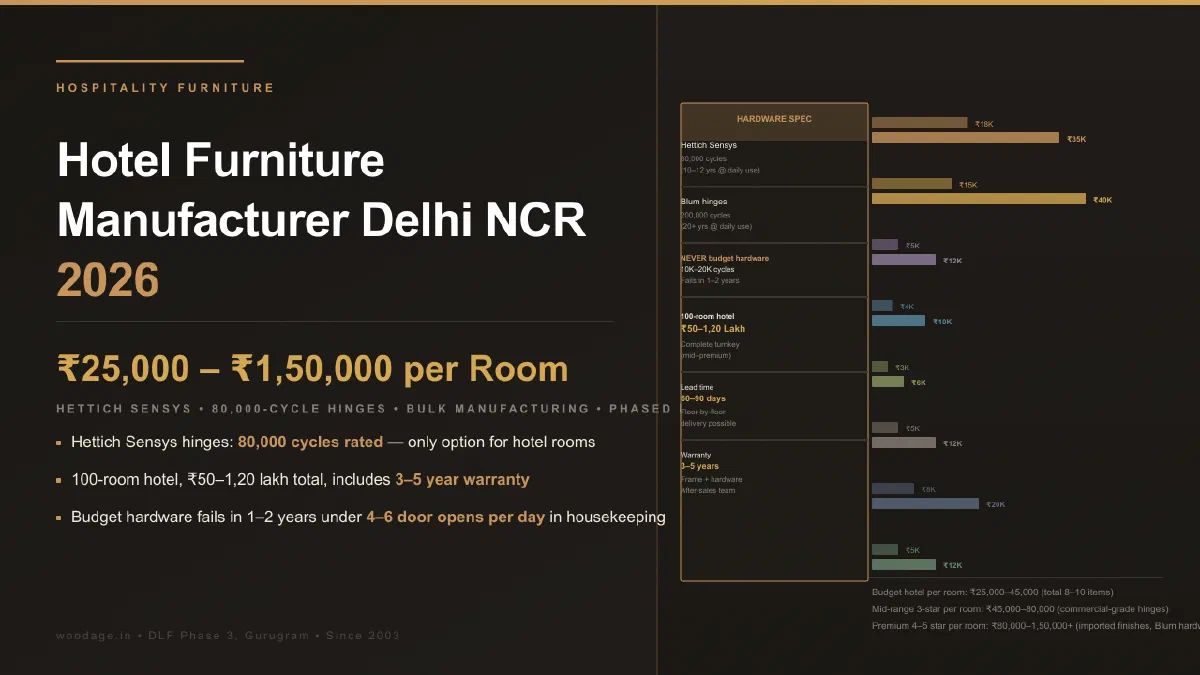
| Wardrobe (4 to 5 ft sliding) | BWP plywood, commercial-grade laminate, soft-close | 18,000 to 35,000 | Durable sliding mechanism for daily housekeeping |
| Bed frame (queen/king) | BWP plywood, upholstered headboard, no hydraulic | 15,000 to 40,000 | Simple mechanism for easy linen change |
| Writing desk | HDHMR, integrated power + USB module | 5,000 to 12,000 | Cable management, international power sockets |
| Luggage rack | MS frame + wooden top, foldable | 3,000 to 6,000 | Must fold flat for storage when not in use |
| Nightstands (pair) | HDHMR, laminate finish, single drawer each | 4,000 to 10,000 | Cable pass-through for phone charging |
| Minibar unit | BWP plywood, laminate, ventilation holes for fridge | 5,000 to 12,000 | Must accommodate standard minibar refrigerator |
| Vanity/basin counter | BWP plywood, PU finish or quartz top | 8,000 to 20,000 | 100% waterproof materials only |
| TV console | HDHMR, integrated cable management + wall mount bracket | 5,000 to 12,000 | Concealed wiring for clean room appearance |
| Headboard panel | HDHMR/MDF, upholstered or wood-clad, wall-mounted | 5,000 to 15,000 | Must accommodate reading lights and power outlets |
| Per Room Total | ₹68,000 to ₹1,62,000 |
Budget Tiers for Hotel Furniture Projects
| Tier | Per Room Cost (₹) | Material | Target Segment |
|---|---|---|---|
| Budget | 25,000 to 45,000 | HDHMR + standard laminate + basic hardware | Budget hotels, hostels, PG accommodations |
| Mid-range | 45,000 to 80,000 | BWP plywood + commercial HPL + Hettich Sensys | 3-star hotels, business hotels, serviced apartments |
| Premium | 80,000 to 1,50,000 | BWP plywood + PU/veneer + Blum hardware | 4 to 5 star hotels, boutique properties |
| Luxury | 1,50,000 to 3,00,000+ | Solid wood elements + imported finishes + custom design | Luxury resorts, branded hotel chains |
Restaurant and F&B Furniture
| Item | Specifications | Per Unit Cost (₹) |
|---|---|---|
| 4-seater dining table | Solid frame, laminate/veneer/marble top | 8,000 to 25,000 |
| Restaurant chair (wooden) | Solid wood frame, upholstered seat + back | 3,000 to 8,000 each |
| Restaurant chair (MS frame) | Powder-coated MS, cushioned seat | 2,000 to 5,000 each |
| Booth seating (per running foot) | Upholstered, MS/plywood frame, high back | 3,000 to 8,000/ft |
| Bar counter (per running foot) | BWP plywood, stone/quartz top, foot rail | 5,000 to 15,000/ft |
| Service station / side station | HDHMR, stainless steel top, cutlery drawers | 15,000 to 35,000 |
| Display / buffet counter | BWP plywood, heat lamps, granite top | 25,000 to 60,000 |
| Outdoor furniture (per set) | Treated teak or aluminium, weather-resistant fabric | 15,000 to 50,000 |
Material Requirements for Hospitality
Hospitality furniture faces heavier daily wear than residential furniture - daily housekeeping, guest turnover every 1 to 3 days, luggage dragging on surfaces, and frequent cleaning with commercial-grade agents. Material specifications must be upgraded accordingly:
Carcass: BWP plywood graded to IS 710 is a safer default for vanity and plumbing-adjacent zones. Other boards may be specified for dry room furniture when their performance, edge treatment and loads meet the project brief. Do not infer service life from the board name alone.
Surface: Commercial-grade HPL laminates with anti-scratch (minimum 4N scratch resistance) and anti-bacterial properties. Standard residential laminates wear through faster under commercial cleaning cycles. Brands like Greenlam Commercial Grade, Merino Virgo, and Formica are commonly specified.
Hardware: Name the hinge, runner and lift-system SKU, rated load, test reference and warranty route. Hettich Sensys has an 80,000-cycle product reference; Blum CLIP has a separately documented 200,000-cycle internal-test reference. Those figures are not interchangeable promises of calendar life, and actual performance depends on door weight, installation, adjustment, cleaning and use.
Fire compliance: The architect and fire-safety consultant must define the applicable building, interior-finish, upholstery and product requirements for the actual occupancy and jurisdiction. Request certificates for the specified product and batch; do not treat a generic “fire-retardant” sales label as project approval.
Edge treatment: All edges must be sealed with 2mm ABS edge banding (not 0.4mm or 0.8mm) because hospitality furniture is cleaned with wet cloths daily. Thicker edge banding resists peeling from repeated moisture exposure.
Why Factory Manufacturing Is Non-Negotiable for Hotels
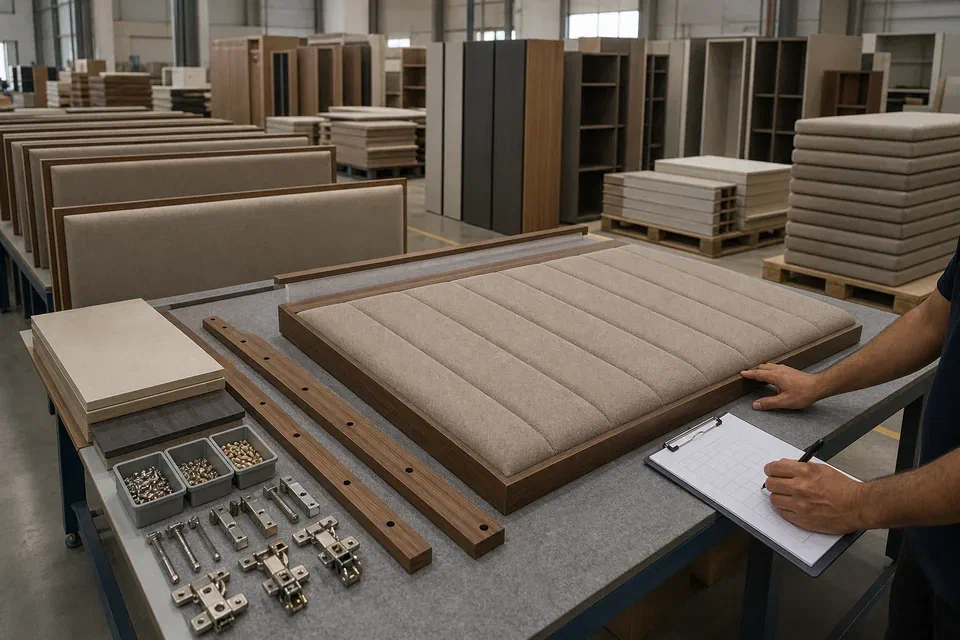
Dimensional consistency across repeated rooms: CNC cutting can reduce component variation, but it does not guarantee every installed unit. Approve a sample room, define measurable tolerances in the contract, inspect batches and record site deviations before production continues.
Colour matching across production batches: A 100-room project requires 100+ identical wardrobe door panels from the same laminate batch. Factory procurement from a single batch ensures zero colour variation. Staggered procurement from multiple batches risks visible shade differences between floors.
Phased delivery per floor: Hotels typically furnish floor-by-floor as construction progresses. A factory can manufacture and deliver in batches coordinated with the construction schedule - Floor 3 this week, Floor 4 next week - rather than requiring all furniture on-site at once (which creates storage, damage, and logistics problems).
Quality control before dispatch: Every piece is inspected at the factory before loading for delivery. Defects are caught and corrected before they reach the project site - not after installation, which in a hotel context means disrupting a room that may already be booked for an opening date.
Warranty and after-sales accountability: Require the written term, inclusions, exclusions, response route and spare-parts plan in the contract. A factory address alone does not establish the warranty duration or service capacity.
The Project Process: From Drawings to Installation
| Stage | Timeline | What Happens |
|---|---|---|
| Architectural drawing review | Week 1 to 2 | Our team reviews room layouts, dimensions, and MEP (mechanical/electrical/plumbing) drawings |
| Material specification and pricing | Week 2 to 3 | Detailed per-room and total project pricing with material, hardware, and finish specifications |
| Sample room production | Week 3 to 6 | Manufacture and install one complete sample room for client and designer approval |
| Bulk production | Week 6 to 16 | Manufacturing at 5 to 15 rooms per week depending on project scale |
| Phased delivery and installation | Week 8 to 20 | Floor-by-floor delivery and installation coordinated with construction schedule |
| Deficiency walkthrough | Week 20 to 22 | Joint inspection of all rooms, punch-list corrections |
Total timeline for a 100-room project: 4 to 6 months from order to completion.
Pricing Structure for Bulk Orders
| Project Size | Per-Room Discount vs Retail | Typical Per-Room Cost (Mid-Range) |
|---|---|---|
| 10 to 25 rooms | 5 to 10% | ₹55,000 to ₹75,000 |
| 25 to 50 rooms | 10 to 15% | ₹48,000 to ₹68,000 |
| 50 to 100 rooms | 15 to 20% | ₹42,000 to ₹60,000 |
| 100+ rooms | 20 to 25% | ₹38,000 to ₹55,000 |
Volume pricing reduces per-unit costs because setup time (design, material procurement, CNC programming) is amortised across more units, material is purchased at bulk rates, and production efficiency increases with repetitive manufacturing.
See also: For bulk, GST-invoiced office fit-outs, see WoodAge’s Gurgaon office furniture page.
Frequently Asked Questions
How long does it take to furnish a 100-room hotel?
Manufacturing takes 60 to 90 days with phased delivery. Installation runs concurrently at 5 to 10 rooms per day with a dedicated team. Total project timeline: 4 to 6 months from order confirmation to completion.
Can one manufacturer handle beds, wardrobes, restaurant tables, and reception furniture?
Yes. A full-service factory manufacturer like WoodAge handles all wood-based furniture categories - room furniture, restaurant fit-outs, reception counters, conference rooms, lobby furniture, and pantry counters - from a single facility. This ensures consistent material quality, matching finishes across all areas, and single-vendor accountability.
What fire-safety ratings does hotel furniture need in India?
High-rise buildings (above 15 metres) require fire-retardant materials per the National Building Code. IS 5509 fire-retardant plywood is the standard specification. Upholstery fabrics should comply with IS 11871 for flammability. Requirements vary by state fire safety regulations - always consult your project’s fire safety auditor.
What is the minimum order for a hospitality project?
We accept hospitality projects starting from 10 rooms. For projects under 10 rooms or for single-room prototypes, standard commercial pricing applies.
Do you handle serviced apartment fit-outs?
Yes. Serviced apartments typically require residential-style furniture (full kitchenette, larger wardrobes, living room furniture) at commercial-grade durability specifications. This is a sweet spot for factory manufacturing - residential design with commercial-grade materials and hardware.
Can you match existing furniture for hotel renovations?
If the original material (laminate shade, veneer species) is still available from the manufacturer, we can match it precisely. For discontinued materials, we source the closest available match and produce a sample for approval before bulk production.
WoodAge - Hospitality and institutional furniture manufactured at scale in our Gurgaon factory. 16 SCO, Saraswati Vihar, Chakkarpur, Gurugram 122002 Phone: +91-9910318044 | Email: info@woodage.in | Website: woodage.in
From 10-room boutique properties to 200-room hotel chains - single-source furniture manufacturing with factory quality control.
How to Use This Guide Before You Decide
Use this guide to prepare a hotel furniture brief before requesting bulk pricing. Confirm room count, room category, finish standard, installation schedule, site access, mock-up approval process, and replacement policy before comparing vendors.
Related Guides From WoodAge
- Factory-Made vs Carpenter Kitchen: Real Cost and Quality Comparison - The CNC precision and machine edge banding that makes factory kitchens last longer is the same reason hospitality furniture must be factory-manufactured - 100 rooms cannot have 100 slightly different wardrobes.
- Hettich vs Häfele vs Blum Kitchen Hardware - 2026 Price and Cycle Ratings - Hettich Sensys at 80,000 cycles and Blum at 200,000 cycles are the only viable hardware choices for hotel rooms where housekeeping uses cabinet doors 4 to 6 times daily for 10+ years.
- BWP Plywood vs HDHMR vs MDF: Which Material Lasts Longest? - Specifying the wrong carcass material for hotel vanity units is a budget-destroying mistake - only IS 710 BWP plywood survives bathroom humidity at commercial-use intensity.
- How a Modular Kitchen Is Made: Inside a Gurgaon Factory - The same 8-stage factory process that produces kitchens also applies to hotel furniture - understanding it helps you verify that a manufacturer’s bulk-pricing claims are backed by actual factory capacity.
- Office Workstation Cost in Gurgaon 2026 - If your hospitality project includes business centre workstations, meeting rooms, or co-working facilities, see per-seat cost benchmarks and configuration options.
- Custom Sofa Manufacturer in Gurgaon 2026: Frames, Foam Density and Fabric Price Guide - Related guide for planning the costs, materials and execution of the same project.
- B2B Bulk Furniture Supply in Delhi NCR 2026 - WoodAge supplies bulk furniture to hotels, co-working spaces, restaurants, hospitals, and residential developers across Delhi NCR. A 50-room hotel requires 200 to 300 pieces of furniture (beds, side tables, wardrobes, study tables, TV units) from a single manufacturer who can deliver consistent quality and dimensions across all rooms. This guide covers B2B bulk pricing structures, typical lead times for large orders, material compliance for hospitality furniture, and what project managers should ask before selecting a bulk furniture supplier.
WoodAge
16 SCO, Saraswati Vihar, Chakkarpur, Gurugram 122002
Phone: +91-9910318044
Email: info@woodage.in
Website: woodage.in