

How to Read a Modular Kitchen Quotation: Line-Item Checklist Before Paying Advance in Gurgaon
A modular kitchen quotation has 12+ line items most homeowners don't verify. This 2026 Gurgaon guide breaks down carcass, shutters, edge banding, hardware, countertop, accessories, GST and advance terms - with red flags and a comparison sheet template.

- Kautuk Sahni
- 18 min read
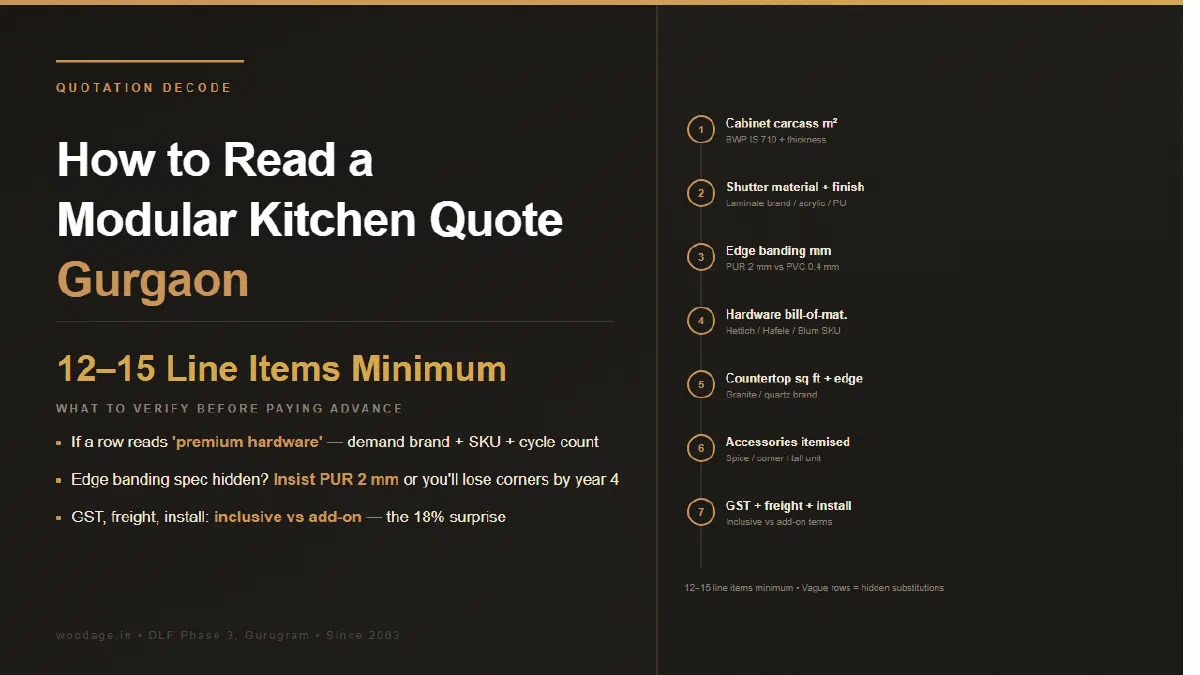
How to Read a Modular Kitchen Quotation: Line-Item Checklist Before Paying Advance in Gurgaon
A modular kitchen quotation looks straightforward - a few rows for cabinets, a row for the countertop, a row for hardware, a total. In reality, a complete quotation has 12 to 15 distinct line items, and the most expensive mistakes happen in the rows that are missing or under-specified. Vendors who quote ₹2,80,000 vs ₹4,20,000 for “the same kitchen” usually aren’t really quoting the same kitchen - they’re quoting different materials, different brands, different scopes, all hidden under similar-looking line items.
WoodAge (woodage.in) is a factory-direct modular kitchen and custom furniture manufacturer in Gurugram (Gurgaon), serving Delhi NCR since 2003.
This guide is the line-item checklist we hand homeowners before they pay any advance to any modular vendor in Gurgaon, with the specific red flags that signal a quotation is incomplete or misleading.
The 12 Line Items Every Quotation Must Have
A clean modular kitchen quotation should explicitly list each of these:
| # | Line Item | What to Verify |
|---|---|---|
| 1 | Carcass material and brand | IS code, brand name, thickness, quantity |
| 2 | Shutter material and finish | Type (membrane/laminate/acrylic/PU), brand, thickness |
| 3 | Edge banding | Material (PVC/PUR), thickness, on which edges |
| 4 | Hinges | Brand, model, soft-close or not, quantity |
| 5 | Drawer slides | Brand, model, full-extension or not, soft-close, quantity |
| 6 | Internal accessories | Each pull-out, basket, magic corner, cutlery tray listed separately |
| 7 | Countertop | Material, brand (for engineered stone), thickness, dimensions |
| 8 | Sink and faucet | Brand, model, specifications |
| 9 | Backsplash / dado | Material, dimensions |
| 10 | Lighting | LED strips, plinth lighting, switches |
| 11 | Installation labour | Inclusive or excluded; what’s covered |
| 12 | GST | 18% on furniture and labour; itemised separately |
Bonus items often hidden:
- Site visits and design fees
- Demolition (if renovation)
- Material transport
- Society NOC and damage deposit
- Plumber and electrician charges
Line Item 1: Carcass Material - The Hidden Cost-Cut Zone
The carcass (the box of each cabinet) is what the rest of the kitchen is built on. It’s also where vendors hide the most cost-cuts because it’s invisible after installation.
What to Insist On
- Brand and IS code mentioned in writing. “Plywood” alone means nothing. “Century Sainik 710 BWP, IS 710 marine grade, 18 mm” means everything.
- Thickness specification: 18 mm for base cabinets (standard), 12 mm for shutters, 6 mm for back panels (some vendors economise to 3 mm - avoid)
- Quantity: Total square feet of carcass material; sanity-check against kitchen size
Red Flags
- Vague terms like “premium plywood,” “branded plywood,” or “standard board”
- No IS code mentioned (IS 710 for BWP plywood, IS 303 for MR plywood, and for HDHMR the standard on that product’s own certificate, since IS 12823 covers prelaminated particle board and does not automatically cover HDHMR)
- “Particle board” specified without brand or moisture grade
- Same material claimed for under-sink cabinet and dry-zone cabinet (the under-sink should always be moisture-grade BWP or HDHMR)
Acceptable Specifications by Use Zone
| Cabinet Zone | Recommended Material | Why |
|---|---|---|
| Under-sink cabinet | BWP plywood IS 710 (Century Sainik / Greenply Greenpanelmax) or HDHMR (Action Tesa) | Constant moisture exposure |
| Dishwasher cabinet | BWP plywood or HDHMR | Steam venting from machine |
| Hob cabinet | HDHMR or BWP | Heat resistance + moisture from cooking steam |
| Other base cabinets | BWP or HDHMR | Indoor humidity in NCR (40 to 80% seasonally) |
| Wall units | BWP or HDHMR | Same |
| Tall units (larder, pantry) | BWP or HDHMR | Same |
| Shutters (substrate before laminate) | HDHMR for laminates and PU; MDF for membrane shutters | HDHMR holds screws better; MDF takes membrane wrap cleanly |
For a deeper material comparison, see our BWP Plywood vs HDHMR vs MDF guide.
Line Item 2: Shutter Material and Finish
Shutters are what you see and touch every day. They define both aesthetic and durability.
Common Shutter Types in 2026 NCR Market
| Type | Visual | Durability | Notes |
|---|---|---|---|
| Membrane (vacuum-pressed PVC over MDF) | Smooth, contoured profiles possible (shaker, fluted, beaded) | 7 to 10 years before peeling | Lower cost; popular for traditional looks |
| Laminate (1 mm laminate on HDHMR/MDF) | Wide range of finishes (matte, gloss, textured, woodgrain) | 10 to 15 years | Mid-range standard; brands: Greenlam, Merino, Century, Sundek |
| Acrylic (high-gloss acrylic skin on HDHMR) | Glass-like high gloss | 10 to 12 years | Premium look; scratches show easily |
| PU paint (3 to 5 coats sprayed on HDHMR/MDF) | Custom colour matt or gloss; smoothest finish | 8 to 12 years | Premium; needs touch-ups over time; subject to NCR humidity stress |
| Veneer (real wood veneer on plywood) | Natural wood grain; warm aesthetic | 15+ years | Premium; needs PU top coat for protection |
| Glass (toughened, lacquered) | Modern luxury look | 15+ years | Heaviest hardware needs; chips on impact |
Red Flags
- “Laminate” without thickness (must be 0.8 to 1 mm minimum; 0.6 mm is not durable)
- “PU paint” with only 1 to 2 coats (proper PU finish is 3 to 5 coats)
- Acrylic shutters cheaper than laminate - likely a lower-grade acrylic film, not solid acrylic
- Veneer without specifying “natural” vs “engineered” (engineered veneer is much cheaper)
Line Item 3: Edge Banding
Edges of cabinet panels need banding to prevent moisture ingress and aesthetic damage.
Types
| Type | Thickness | Bonding | Durability |
|---|---|---|---|
| PVC standard | 0.4 to 0.8 mm | Hot-melt EVA glue | 5 to 8 years; peels at corners |
| PVC thick | 1 to 2 mm | Hot-melt EVA | 8 to 12 years |
| ABS | 1 to 2 mm | Hot-melt EVA | 10 to 12 years; harder than PVC |
| PUR (Polyurethane Reactive) | 1 to 2 mm | PUR adhesive | 15+ years; virtually waterproof |
Red Flags
- “Edge banding included” without thickness
- 0.4 mm PVC banding on visible cabinet edges
- Edge banding only on visible edges (it should be on every cut edge - including hidden edges that face moisture)
- “Lipping” instead of banding - solid wood lipping is decorative but provides less moisture protection than PUR
What to Insist On
- 2 mm PVC or PUR on all visible edges
- 1 mm PVC minimum on all hidden edges
- Bonding type specified (PUR adhesive for premium; hot-melt EVA for standard)
Line Item 4: Hinges
The most-used moving part in your kitchen. Cheap hinges fail by year 5; quality hinges outlast the kitchen.
Brands to Trust
| Tier | Brands | Typical Warranty |
|---|---|---|
| Premium | Blum (Austrian), Hettich (German) | Blum India: 15 years; Hettich India: up to 20 years by product (often quoted as lifetime / 25 years) |
| Mid-premium | Hafele (German), Grass | 10 to 15 years |
| Mid | Ebco, Inox, Ozone | 5 to 10 years |
| Budget | No-brand / unbranded | None / not honoured |
What to Verify
- Brand and model in writing: “Hettich Sensys 8645” not “Hettich-quality hinges”
- Soft-close standard: modern kitchens use soft-close on every shutter; verify
- Type matches application: standard hinge for normal shutters; corner hinge for blind corner units; bi-fold hinge for tall units
- Quantity: 2 hinges per shutter for most sizes; 3 hinges for shutters above 1,000 mm height
Red Flags
- “Hettich-quality” or “Blum-style” - these are imitations, not the brands themselves
- Hinge quantity below 2 per shutter
- Soft-close excluded “as add-on extra”
- Imported claims without country-of-origin documentation
Line Item 5: Drawer Slides (Tandem Boxes)
Drawer mechanisms are the second most-used kitchen hardware after hinges.
Brands and Tiers
| Tier | Brands | Notable Models |
|---|---|---|
| Premium | Blum (Tandem, Tandembox, Movento) | 15-year warranty in India on products bought after 1 April 2022 (often described as a lifetime warranty) |
| Premium | Hettich (Quadro, InnoTech, AvanTech) | 20-year functional warranty on Quadro, InnoTech and AvanTech YOU in Hettich India’s schedule (sometimes quoted as a 25-year warranty for Quadro 4D) |
| Mid-premium | Hafele (Matrix Box) | 10 to 15 years |
| Mid | Ebco, Grass | 5 to 10 years |
| Budget | Ball-bearing channels (no-brand) | None |
Types
- Telescopic ball-bearing channel: entry-level; the drawer slides on a metal channel
- Tandem box: the drawer is the channel; comes as a complete metal-sided unit (premium aesthetic)
- Drawer-with-railing: tandem box with a side railing for taller items
- Inner drawer (drawer within drawer): premium feature; a smaller drawer hidden inside a larger one
What to Verify
- Brand and model: “Hettich Quadro 4D 500 mm full extension soft-close”
- Extension type: full extension preferred (drawer pulls all the way out)
- Soft-close: standard now; verify
- Load rating: 30 kg minimum for dry storage; 50 kg+ for utensil drawers
Red Flags
- Telescopic channels only (no tandem boxes) at “premium kitchen” prices
- Soft-close excluded
- Generic ball-bearing slides with no brand
- Load rating not specified
Line Item 6: Internal Accessories
Pull-outs, baskets, organisers, magic corners - the internal accessories make a kitchen functional.
Standard Accessories to Verify
| Accessory | Purpose | Where It Goes |
|---|---|---|
| Cutlery tray | Spoon, fork, knife organisation | Top drawer |
| Plate organiser | Plates and bowls vertical storage | Drawer or pull-out |
| Spice tower pull-out | Vertical spice rack | Narrow tall pull-out beside hob |
| Wicker basket / wire basket | Vegetable storage | Mid-height base unit |
| Magic corner / LeMans | L-shape blind corner storage | Corner cabinet |
| Tall pull-out larder | Bulk dry storage (atta, dal, rice, oil) | Tall unit |
| Bottle pull-out | Oil and condiment bottles | Narrow base unit beside hob |
| Tray and chopping board organiser | Vertical storage | Above oven or under counter |
| Waste sorting bin | Wet/dry waste segregation | Under sink |
Red Flags
- “Standard accessories included” without listing each item
- Generic / no-brand accessories at premium kitchen prices (Hettich, Hafele, Inox have good NCR-available ranges)
- Magic corners specified but the cabinet design has no blind corner
- No waste-sorting bin in a 2026 kitchen - this is now table-stakes
Line Item 7: Countertop
The countertop is typically a large lump-sum line; understand what’s underneath.
Materials
| Material | Pros | Cons | Typical Range Per Sqft (NCR, 2026) |
|---|---|---|---|
| Granite | Heat-resistant, hard-wearing, traditional | Visible joints; needs sealing | Mid range |
| Engineered quartz (Caesarstone, Silestone, Kalinga, Pokarna) | Uniform pattern, no sealing needed, hygienic | Less heat-resistant than granite (avoid direct hot pans) | Mid to premium |
| Sintered stone (Dekton, Lapitec, Neolith) | Most durable, scratch and heat resistant, large slabs | Most expensive; specialised installation | Premium |
| Solid surface (Corian) | Seamless joins, repairable | Can be scratched and scorched | Mid to premium |
| Marble | Aesthetic | Stains easily; not recommended for kitchens | Mid |
| Stainless steel | Industrial/commercial look | Shows scratches; cold to touch | Mid |
What to Verify
- Material and brand in writing
- Thickness: 18 to 20 mm standard for residential
- Edge profile: square (modern), bullnose (traditional), bevel, etc.
- Cutout for sink, hob: specified by dimensions
- Backsplash height: 100 to 200 mm for standard backsplash; 600 mm for full backsplash (more material)
Red Flags
- “Quartz countertop” without brand (different brands have very different durability)
- “Italian marble” - almost always not actually Italian; verify origin
- Counter joints positioned over base cabinet doors (joints should be over solid carcass)
- No mention of sealing/finishing for granite
Line Item 8: Sink and Faucet
Often listed as one combined cost; should be itemised.
For details, see our Kitchen Sink Buying Guide.
Verify:
- Sink: SS304, 16-gauge minimum, brand (Nirali, Carysil, Franke, Hafele, Futura, Jayna), single/double bowl, dimensions
- Faucet: brand (Jaquar, Hindware, Cera, Kohler, Hansgrohe, Grohe), type (single-lever, dual-handle, pull-out spray)
Red flag: “Premium sink and faucet” lump-sum without specifications.
Line Item 9: Backsplash / Dado
The wall behind the counter and behind the hob.
Options
- Tile dado matching kitchen tiles (most common)
- Glass backsplash (toughened, back-painted)
- Stainless steel backsplash (behind hob only)
- Quartz/sintered stone backsplash (luxury; same material as countertop)
Should be specified by:
- Material
- Dimensions (length × height)
- Whether existing tile is being preserved (in renovations) or new tile is being laid
Line Item 10: Lighting
Often forgotten or under-quoted.
Standard Lighting
- Under-cabinet LED strip (over the counter): 4 to 8 metres typical
- Plinth motion-sensor LED: 3 to 5 metres
- Tall unit interior lighting: optional
- Inside-cabinet sensors (premium): on/off when cabinet opens
Red Flags
- “LED lighting” without specifying lumens, length, brand
- LED strips bundled with switches but not the actual switches and drivers needed
- Driver/transformer cost hidden as a separate add-on
Line Item 11: Installation Labour
This is the most-disputed line.
What’s Typically Included
- On-site cabinet assembly (if flat-packed)
- Wall mounting
- Plinth installation
- Counter setting (sometimes; sometimes separate stone fitter)
- Sink and faucet plumbing (sometimes)
- Hob and chimney mounting (sometimes)
- LED and lighting installation
What’s Sometimes Excluded
- Demolition of existing kitchen
- Major plumbing modifications
- Major electrical modifications
- Tile work
- Painting
Red Flags
- “Installation included” without scope detail
- Plumber and electrician costs hidden as add-ons that emerge mid-project
- No timeline commitment
- No warranty on installation workmanship (good vendors offer 12 to 24 months on workmanship)
Line Item 12: GST
18% GST applies to modular kitchen furniture and labour. Should be:
- Itemised separately (not hidden in subtotals)
- Calculated on the full taxable amount
- The vendor must have a valid GST registration; you should receive a tax invoice
- For B2C residential customers, no input credit; just pay and verify
Red flag: Vendor offering “without GST” pricing - this is illegal under Indian tax law and you have no recourse if anything goes wrong.
Bonus Items to Watch For
Site Visit / Design Fees
Some vendors charge for design and site visits separately, often refundable against the eventual order. Verify:
- Refundability conditions
- Number of revisions included
- 3D rendering deliverables
Material Transport
Especially for builder floors with no service lift, transport and carrying labour can add ₹3,000 to ₹10,000 to the project. Verify it’s included or itemised.
Society NOC and Damage Deposit
For high-rise installations, the NOC fee and damage deposit (₹10,000 to ₹25,000 typical) - see our Society NOC Guide - are typically your responsibility, not the vendor’s. Confirm.
Demolition (Renovation Projects)
For renovations, demolition labour and debris disposal need to be quoted separately. See our Cabinet-Only Renovation Guide for what’s typically included.
Comparison Sheet Template - Use This to Compare Vendors
When evaluating multiple quotes, build a comparison sheet:
| Item | Vendor A | Vendor B | Vendor C |
|---|---|---|---|
| Carcass material + brand + IS code | |||
| Carcass thickness (mm) | |||
| Shutter type + brand | |||
| Edge banding type + thickness | |||
| Hinge brand + model + warranty | |||
| Drawer slide brand + model | |||
| Soft-close (yes/no) | |||
| Pull-out larder brand | |||
| Magic corner brand | |||
| Cutlery tray (yes/no) | |||
| Waste-sorting bin (yes/no) | |||
| Counter material + brand | |||
| Sink brand + model + grade (SS304) | |||
| Faucet brand + model | |||
| Backsplash material | |||
| LED lighting (length + brand) | |||
| Plinth lighting (yes/no) | |||
| Installation labour included (yes/no) | |||
| Plumber/electrician charges | |||
| GST itemised separately | |||
| Total quotation | |||
| Carcass warranty | |||
| Hardware warranty | |||
| Installation/workmanship warranty | |||
| Advance payment % required | |||
| Timeline (manufacturing + installation days) |
After filling this out for 3 vendors, the “cheapest” vendor often becomes the most expensive at like-for-like comparison.
Standard Advance Payment Structure
A balanced payment schedule for a Gurgaon modular kitchen:
| Stage | % of Total | When |
|---|---|---|
| Booking / Order Confirmation | 40 to 50% | At order placement; after final design and material selection |
| Material Delivery to Site | 30% | When all materials arrive at the apartment |
| Installation Completion | 15 to 20% | After cabinets installed, hardware fitted, accessories in place |
| Final Hand-Over | 5 to 10% | After punch-list completed, warranty docs handed over |
Red Flags on Payment Terms
- 100% advance demanded - do not accept; legitimate manufacturers don’t need this
- 90% advance “for material procurement” - also inappropriate
- No retention amount at the end - vendor has no incentive to fix punch-list items
- No written delivery commitment - penalty clauses for late delivery should be explicit
What to Do Before Signing
Keep the quotation, drawing and payment request on the same revision. Note the quote number/date, drawing revision and accepted scope changes before authorising an advance. If a later drawing changes the cabinet count, finish or appliance model, ask whether the price and schedule have been revised too. An attractive rendering is not a replacement for the itemised scope it is meant to illustrate.
For an Excel or PDF comparison, keep quantity, unit, unit rate, line amount and inclusion status in separate fields. Retain unresolved items rather than entering zero, and check the arithmetic without treating an illustrative online rate as the vendor’s price. The BOQ dataset and field dictionary provide a reusable structure; the signed vendor documents remain the commercial record.
- Get 3 detailed quotations from different vendors using the same kitchen design
- Fill the comparison sheet for all three
- Identify each vendor’s gaps - incomplete spec is a sign to discount their pricing
- Verify factory and reference projects - visit the factory, see past installations
- Confirm GST registration and tax-invoice format
- Read the warranty terms in detail - separate warranties for carcass, shutters, hardware, finish, installation
- Sign a written contract including timeline, payment schedule, scope, and penalty clauses
- Pay the advance only after signing the contract
See also: For per-running-foot ranges and a sample BOQ, see WoodAge’s factory-direct kitchen cost guide.
Quotation Evidence: Invoice, BOQ and Warranty Fields to Record
Read a quotation as a scope-and-evidence document, not only as a total. These rows separate tax-invoice fields, tender-specific examples, material editions and product warranty terms.
| Quote evidence gate | Exact proposition and direct source | Record before advance |
|---|---|---|
| Supplier identity | CBIC Rule 46 lists the supplier’s name, address and GSTIN, a consecutive financial-year-unique serial number and the issue date among tax-invoice particulars. Tax Invoice, Credit and Debit Notes — HTML “Tax invoice” particulars, lines 64-69 and 107-110. | Match the final invoice identity, serial and date to the contracting entity; this is an invoice-field check, not quote validation. |
| Line-item fields | CBIC Rule 46 lists HSN code or accounting code, description of goods or services and quantity with unit among the tax-invoice particulars. Tax Invoice, Credit and Debit Notes — HTML “Tax invoice” particulars, lines 70-72 and 111-112. | Keep the BOQ’s measured scope and the final invoice’s tax fields as separate records. |
| Conditional e-invoice | The official GST e-invoice portal says that when the e-invoicing mandate applies, invoice data is sent to the Invoice Registration Portal, which assigns a unique IRN and QR code. E-invoice Printing: Process, Mandatory Fields, Modes of IRN generation — HTML headings “E-invoice Printing - IRN & QR Code” and “Mandatory fields”, lines 224-231. | Ask the supplier whether the mandate applies to this transaction and retain the IRN/QR evidence if applicable; do not assume every kitchen quote is covered. |
| GST line | A BRBNMPL modular-kitchen tender requires a tenderer who asks for GST extra to quote the exact GST percentage that will be charged extra. Tender Document for Supply and Installation of Modular Kitchen in 40 C-Type Residential Quarters — PDF p. 16, clause 12.9(e), GST quote instruction. | Use an explicit tax percentage and basis in the comparison sheet, while treating this BRBNMPL clause as a tender-specific procurement example, not a private-home rule. |
| Manufacturer evidence | The BRBNMPL tender requires, for a Non-Commercially-Off-the-Shelf item made by another company, a manufacturer’s authorisation certificate and confirmation that the manufacturer extends the required warranty. Tender Document for Supply and Installation of Modular Kitchen in 40 C-Type Residential Quarters — PDF p. 16, clause 13(i), “Authorized Dealer/Distributor/Representative of Suppliers”. | Ask who provides the product warranty when relevant, but do not treat this tender-specific requirement as universal dealership proof. |
| General-purpose plywood | BIS identifies IS 303:2024 as “Plywood for General Purposes – Specification (fourth revision).” IS 303:2024 — HTML page heading and standard title at lines 283-289. | Add the claimed edition and grade to the carcass line and request matching product evidence. |
| Marine plywood | BIS identifies IS 710:2024 as “Marine Plywood – Specification (third revision).” IS 710:2024 — HTML page heading and standard title at lines 283-289. | Do not accept “marine” as a complete line; record edition, grade, thickness, location and warranty separately. |
| Hardware warranty | Hettich India states that its warranty covers the original purchaser against manufacturing defects while that purchaser owns the product, and its table lists Sensys hinges with 20 years functional and 12 months surface warranty. Furniture Fittings Warranty — PDF p. 1, warranty paragraph and Auto Closing Hinges table, Sensys row. | Name the hardware model and distinguish functional from surface coverage; do not imply the quote includes Sensys or that WoodAge provides Hettich warranty. |
Evidence boundary: CBIC rules identify tax-invoice fields, not the commercial validity of a quote; the BRBNMPL requirements are tender-specific; and BIS/Hettich references do not certify the selected material, hardware, supplier, WoodAge price, warranty or installation outcome.
Frequently Asked Questions
What’s the right advance payment percentage for a modular kitchen?
40 to 50% at order placement, 30% on material delivery, 15 to 20% on installation, 5 to 10% on final handover. Anything heavily front-loaded (more than 60% advance) is a red flag.
How long should I expect from order placement to installation?
4 to 8 weeks for standard configurations. Custom finishes, imported hardware, or specialised counter materials extend this. Get a written timeline with milestones.
What’s the most common quotation deception in Gurgaon?
Vague material specifications. Vendors quote “BWP plywood” without brand or IS code, then deliver a lower-grade material that visually looks similar but degrades within 5 years. Always insist on brand + IS code in writing.
Should I pay GST separately or trust an “all-inclusive” quote?
GST should be itemised. Vendors offering “tax-free” or “no GST” pricing are violating Indian tax law and you have no recourse for warranty claims or quality disputes.
Are 3D renderings worth paying for?
Yes - modern modular kitchen design includes 3D rendering as standard. Don’t pay for a kitchen design without seeing it in 3D first. Some vendors include this in the design fee; others bundle it free with the order. Verify.
How do I verify a vendor isn’t using lower-quality materials than quoted?
Visit during manufacturing if possible. At delivery, check material brand stamps on raw panels (Century, Greenply, Action Tesa, Merino all stamp their products with brand and IS code). Photograph everything as evidence.
What’s a fair warranty on a modular kitchen?
Carcass material: 10 to 25 years (matches manufacturer warranty); Hardware: 10 to 25 years (Hettich India lists 20 years for Quadro, sometimes quoted as 25, but Blum India lists 15 years, sometimes described as lifetime); Finish: 5 to 10 years (laminate longer, PU shorter); Installation/workmanship: 12 to 24 months.
What if the installed kitchen doesn’t match the quotation?
Refuse final acceptance until all items match. Use the quotation as the contract. Document discrepancies with photos. Withhold the final payment retention amount until disputes resolve.
Related Guides From WoodAge
- Modular Kitchen Cost in Gurgaon 2026 - Understand typical price ranges so you can recognise outliers in any quotation.
- Modular Kitchen Renovation in Gurgaon 2026 - Renovation quotations have unique line items beyond standard kitchen quotes.
- High-Rise Apartment Modular Kitchen Installation Guide Gurgaon - Society NOC and damage deposits are real line items often missed in quotations.
- Best Modular Kitchen Manufacturer in Gurgaon 2026: 15-Point Checklist Before You Buy - Related guide for planning the costs, materials and execution of the same project.
- Modular Kitchen Warranty in India 2026: What Is Actually Covered, How to Claim, and Brand-Wise Comparison - Useful next reading on hardware planning, costs, materials, or execution.
- 10 Hidden Costs in Modular Kitchens Nobody Mentions - 2026 Gurgaon Buyer Guide - Related guide for planning the costs, materials and execution of the same project.
- Rental-Ready Interiors - Tenant-occupied apartments need different specifications from owner-occupied ones. This guide covers HDHMR over plywood, laminate over PU paint, simpler hardware, easy-clean finishes and the ROI calculation for landlords doing fit-outs in Gurgaon.
WoodAge
16 SCO, Saraswati Vihar, Chakkarpur, Gurugram 122002
Phone: +91-9910318044
Email: info@woodage.in
Website: woodage.in
Last reviewed: May 2026. Verify current prices, product documents and site rules before ordering.