

How to Test Sofa Comfort Before a Custom Order
Test a custom sofa with the people who will use it. Check seat depth, back support, cushion feel and entry clearance before approving the final specification.

- Kautuk Sahni
- 10 min read
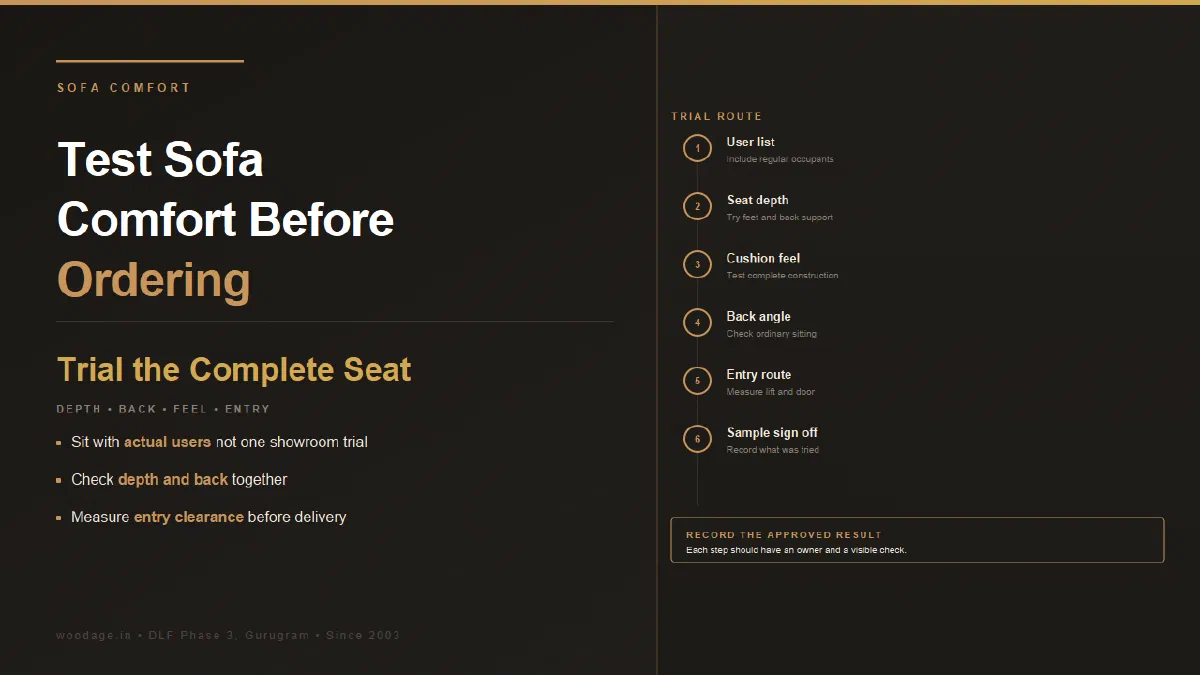
Quick answer: Test a sofa in the way its users actually sit: upright conversation, relaxed reading, feet on the floor and getting up again. Record usable seat depth, loaded seat height, back support and cushion construction. A standard dimension or a quick showroom sit cannot determine comfort for every person.
WoodAge is a factory-direct furniture and interiors manufacturer in Gurugram, working since 2003. A comfort brief should be kept separate from a room-fit drawing. A sofa can fit the wall and still feel too deep, too low or poorly supported for its regular users.
Measure the usable seat
Overall depth includes the back structure. Usable seat depth is the available sitting space in front of the back cushion in the configuration being assessed. Seat height changes when the cushion compresses, so note whether a measurement is unloaded or taken during a trial.
Measure horizontally from the front sitting edge to the face of the back cushion in the tested arrangement, then record how that space changes when the user sits and compresses the back cushion. Measure empty seat height from floor to cushion top; during the trial, have another person measure beside the seated user at a comparable loaded point and record where that point was taken. CHITA Living’s measurement guide distinguishes seat depth from overall depth and describes an unloaded height measurement and a seated comparison. The loaded observation is a separate trial record, not a catalogue dimension.
The Polyurethane Foam Association’s glossary distinguishes foam properties relevant to how a cushion responds. Density alone is not a comfort prescription. Keep the cushion specification attached to the trial record so an approved feel is not replaced by an unrelated foam label.
The PFA performance guide separates surface firmness, deeper support and resilience. These are different foam measurements, so a trial record should not say only “40 density, medium firm”. Write down the actual cushion layers and supporting seat construction used in the trial. If the factory sample changes any of those, repeat the sit test before approving the order.

Run a two-user trial
Use the shortest and tallest regular users where practical. Each person should try the positions they commonly use, without a salesperson telling them what they ought to find comfortable.
| Trial | Observe | Possible design question |
|---|---|---|
| Upright sitting | Feet, back contact and pressure at the seat edge | Is the usable seat too deep or high for this user? |
| Relaxed sitting | Back support and preferred leg position | Is a loose back cushion or different depth useful? |
| Standing up | Whether the user struggles or needs assistance | Is height, firmness or arm support unsuitable? |
| Shared seat | Whether one user’s movement disturbs another | Does the cushion arrangement fit the household? |
| Armrest use | Elbow position, reading and side support | Is the arm form suited to the intended use? |
No single result makes the sofa universally ergonomic. Where a user has a mobility or medical requirement, obtain the appropriate professional advice instead of relying on a furniture comfort claim.
Record two answers for each person: whether the feet rest comfortably in the intended upright position, and whether the back contacts the support without forcing an awkward forward perch. Repeat after the cushion has compressed under normal sitting. A showroom dimension taken with nobody seated cannot substitute for this loaded observation. Note the tested footwear and any loose back cushion because both can change the comparison when the delivered sofa is assessed.
Use a short trial record rather than a single “comfortable” tick: user A or B, tested seat or module, upright or relaxed posture, feet supported, back contact, pressure point, ease of rising, and one requested change. For example, if one user reaches the back only by lifting their feet, trial a different back-cushion position before changing the frame depth. If a user rises comfortably but dislikes the edge pressure, record that as a separate issue. The record tells the maker which variable to change and gives both users a way to judge the revised sample.
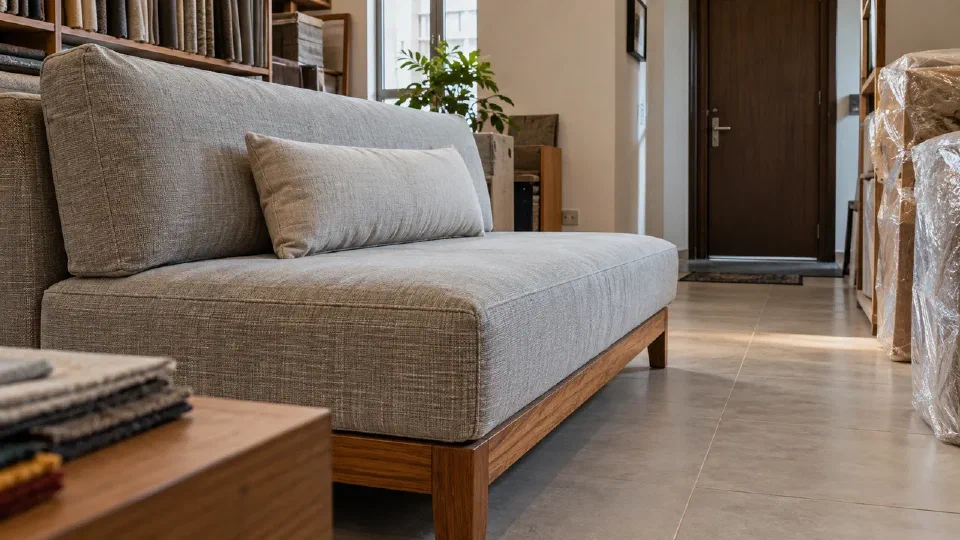
Change one variable at a time
If the seat feels too deep, first test a different back-cushion position or a representative alternative. Do not simultaneously change depth, foam and back angle, then assume you know which change helped.
Illustrative comparison: two sofas can both be 950 mm deep overall while offering 560 mm and 650 mm of usable seat depth. The difference can come from back construction and cushions. These are examples of why the measurement matters, not recommended dimensions.
For a custom order, use a representative sample or mock-up that reproduces the important geometry and cushion support. A loose foam square held in the hand does not reproduce the final cover tension, layers or suspension.
What to record before approving comfort
Write down sample ID, seat and back arrangement, foam grade, layers, upholstery, dimensions and each user’s observations. Photographs can document posture only with consent; they should not become promotional evidence without separate permission.
Confirm whether the final sofa uses the approved configuration throughout. A chaise, corner seat or recliner can feel different from a straight seat, even within the same order. Trial the most important seating position rather than assuming every module behaves identically.
Write a conditional approval: “Sample ID __, tested by __, acceptable in __ position with back cushion __ and cover __; change __ and repeat the trial.” Leave approval pending if the production cushion or support differs from the tested build. At delivery, try the same positions and compare the same observations before signing a comfort acceptance record. This checks whether the agreed sample was reproduced; it does not promise a particular medical outcome or long-term feel.
Keep comfort and delivery checks connected
Once comfort is agreed, check the room layout, doorway and carry route. Removable legs or modular connections must be recorded in the order if needed for access. Do not reduce the approved seat dimensions late in production just to solve an unmeasured doorway.
If a change is necessary, revisit the comfort decision. A smaller outside dimension can reduce usable seating space rather than merely changing appearance.
Turn body measurements into seat dimensions
Chair-fitting guidance from the UK’s Disabled Living Foundation, published as essential measurements for a new chair, gives a simple method that also helps with sofas:
| Dimension | How to measure the user | What it sets |
|---|---|---|
| Seat height | Floor to the crease behind the knee, with feet flat and hips and knees at about right angles | The loaded seat height that lets feet rest flat |
| Seat depth | Back of the hips along the thigh to about 3 cm behind the knee | A depth that supports the thighs and leaves roughly a two-finger gap behind the knee |
| Seat width | Hip width plus a clenched fist on each side | Room to sit without pressure on the hips |
The same guidance notes that a higher seat makes standing up and sitting down easier, especially for anyone with weak legs, while a seat that is too high leaves the feet off the floor. That is why the two-user trial matters most when one regular user is much taller or older than the other. Indian body-measurement data, such as the IIT Guwahati ergonomics reference datasheet, are a reminder that a seat height copied from an imported catalogue may not suit a household’s shorter members.
Allow for cushion compression. Illustrative arithmetic: if a user’s knee-crease height is 440 mm and the seat cushion compresses about 40 mm under their weight, an uncompressed seat height near 480 mm brings the loaded seat close to 440 mm. Measure the compression on the trial sofa rather than assuming it; foam grade, layers and suspension all change it.
Two users, two answers. If one user measures 430 mm to the knee crease and another 480 mm, no single seat height suits both. A seat set for the taller user plus a footstool, or a seat set for the shorter user with a firmer front edge for the taller one, are both reasonable compromises to test in the trial.
Evidence and Verification Notes
The measuring method is quoted from the Disabled Living Foundation’s published chair guidance, checked in September 2026; it was written for chairs and is used here as a starting point for sofa trials. The compression and two-user figures are illustrative arithmetic, not measurements of any product. WoodAge delivers made-to-order sofa projects against a written specification; trial seat heights and foam layers can be compared on a WoodAge factory visit, and cover fabrics in the sofa fabric guide.
Frequently Asked Questions
What usable seat depth should I choose?
Choose the depth that lets the regular user sit in the intended posture with back contact, supported feet where upright sitting matters, and a comfortable rise. A deeper seat may suit lounging while making upright sitting difficult for a shorter user. Measure the usable depth of the successful trial, including the tested back cushion, rather than ordering from an overall-depth label or a universal number.
Is firm foam always better for getting up?
No single foam label establishes ease of use. Seat height, compression, arm support and the person’s abilities interact. Test the complete seat and seek specialist advice where needed.
How long should the showroom trial last?
Long enough to try the intended positions and compare options meaningfully. There is no verified universal duration that certifies comfort or predicts long-term satisfaction.
Can two sofas with the same dimensions feel different?
Yes. Usable depth, back shape, cushion compression, seat support and cover tension can change the loaded position. Record the full trial build, not dimensions alone.
How can the delivered sofa be compared with the approved trial?
Keep the sample ID, cushion layers, support construction and key dimensions with the order. Repeat the same user checks at delivery and record any change.
Who should join the comfort trial?
The shortest and tallest regular users are useful where practical, along with anyone who has a specific mobility need. Individual medical requirements should be addressed by an appropriate professional.
What is a comfortable sofa seat height?
One that lets each regular user sit with feet flat and knees at about hip level once the cushion has compressed. Measure from the floor to the crease behind the knee, then test the loaded seat height on a trial sofa. A higher seat is easier to stand up from, especially for older users.
How do I measure the right sofa seat depth for me?
Measure from the back of your hips along your thigh to about 3 cm behind the knee. Disabled Living Foundation guidance for chairs uses that figure so the seat supports the thighs while leaving roughly a two-finger gap behind the knee. Lounging sofas are often deeper, which back cushions or scatter cushions can adjust.
For a project in Gurugram or Delhi NCR, use WoodAge’s custom furniture service to discuss the measured requirement and written scope. Product suitability and the final BOQ must be confirmed for the actual order.
Related Guides From WoodAge
- Sofa size and configuration - for the sofa footprint and seating layout.
- Sofa fabric guide - for selecting and specifying the upholstery.
- Furniture wood species - for solid timber selection and identification.
- Repair, modify or replace furniture - for a condition-based reuse decision.
- Sofa Foam Density vs Firmness: Read the Cushion Specification - Useful next reading on furniture planning, costs, materials, or execution.
- Bathroom Mirror Cabinets: Depth, Door Swing and Tap Clearance - Useful next reading on furniture planning, costs, materials, or execution.