

Interior Quote Review Gurgaon: How to Decode Per-Sqft Rates, Civil Items, Electrical Lump Sums and Loose Furniture
How to review a Gurgaon interior quote line by line: decode per-sqft woodwork rates, spot vague civil and electrical lump sums, and normalise quotes before paying.

- Kautuk Sahni
- 12 min read
Interior Quote Review Gurgaon: How to Decode Per-Sqft Rates, Civil Items, Electrical Lump Sums and Loose Furniture
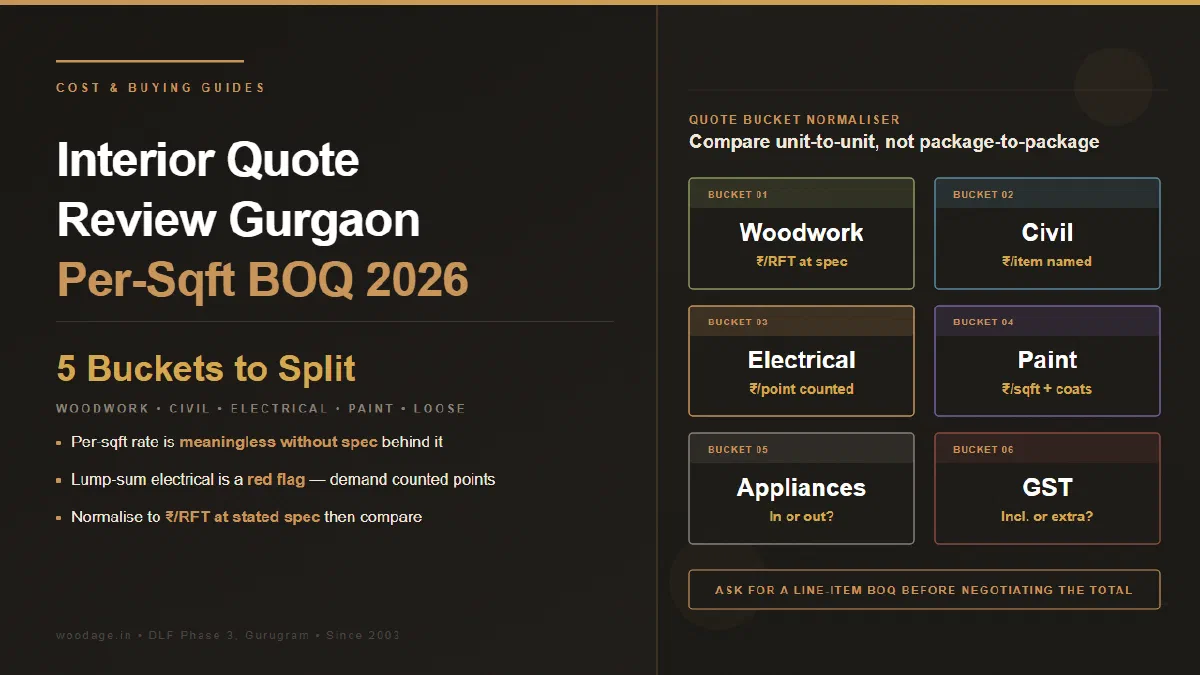
A Gurgaon interior quote can only be reviewed once you split it into five buckets — woodwork, civil, electrical, paint and loose furniture — and check each against its own unit of measure. A per-sqft woodwork rate is meaningless without the board, laminate and hardware spec behind it. The single most useful move is to normalise every quote to “₹ per running foot of finished woodwork at a stated spec” before you compare.
WoodAge (woodage.in) is a factory-direct modular kitchen and custom furniture manufacturer in Gurugram (Gurgaon), serving Delhi NCR since 2003.
The catch: two quotes for the same flat can differ substantially when one bundles civil and appliances and the other leaves them as extras. This guide is a teardown method for reading each bucket, checking the stated unit and specification, and identifying what is missing. It is a comparison framework, not a claim about a particular vendor’s rate.
Why You Can’t Compare Two Interior Quotes As-Is
Interior quotes are not standardised. One vendor may quote woodwork per sqft of carpet area, another per running foot of cabinetry, and a third as a lump sum such as “kitchen + 3 wardrobes.” Civil, electrical and paint may be in one quote and absent from another. Comparing bottom-line figures without matching the scope compares different things.
The fix is to stop reading the total and start reading the buckets and their units:
| Bucket | Correct unit of measure | What makes the rate real |
|---|---|---|
| Woodwork (modular + storage) | ₹ per running foot (or sqft of shutter), at a stated spec | Board grade, laminate, edge banding, hardware brand |
| Civil | ₹ per item / per sqft of work | Demolition, waterproofing, tiling, plaster named |
| Electrical | ₹ per point + per item | Count of points, wire brand, switch brand |
| Paint | ₹ per sqft of wall area | Brand, finish (emulsion/enamel), number of coats |
| Loose furniture & appliances | ₹ per item (or excluded) | Make/model, or clearly out-of-scope |
The pattern is: a number is only reviewable next to its unit and its spec. “₹1,800 per sqft” is not high or low until you know per sqft of what, in what material.
Bucket 1: Woodwork — The Per-Sqft Trap
Woodwork is often a substantial bucket and needs careful comparison. A sqft of cabinetry in BWP plywood with Hettich hardware and a sqft in MR-grade particle board with local hinges are different products at the same “rate.”
To make a woodwork rate reviewable, demand the spec behind the sqft:
- Carcass board: BWP IS 710 / HDHMR / MR ply IS 303 / particle board — named brand
- Shutter: material + finish + thickness (e.g. 18 mm, 1 mm laminate)
- Edge banding: type + thickness (2 mm PUR vs 0.8 mm PVC)
- Hardware: brand + line + soft-close or not + counted
- What’s counted in the sqft: carcass + shutter + standard hardware, or just the box?
Without these, a per-sqft rate is not reviewable. If a quote uses a number such as “₹1,800/sqft,” label it as an illustrative figure until the measure and specification are written down; different scopes can produce very different totals. For the kitchen-specific version of this read, see how to read a modular kitchen quotation in Gurgaon, and for comparing competing kitchen quotes, compare modular kitchen quotations in India.
Bucket 2: Civil — The “Included or Extra?” Question
Civil work is where the quote total quietly swells after signing. The review question is simple: is each civil item named and priced, or is it absent (to be billed later) or lumped into a vague “civil — ₹X”?
Civil items to look for explicitly:
- Demolition / dismantling of existing work
- Wall building / plaster
- Waterproofing of wet zones (kitchen, bath, utility)
- Tiling and flooring
- Plumbing line shifting (vs existing points)
- Chimney core cutting / duct opening
A quote that omits civil isn’t cheaper — it’s incomplete. Either the vendor expects you to arrange civil separately (fine, if stated) or it arrives as an “extra” mid-project (not fine). Decide who owns each civil item before paying.
Bucket 3: Electrical — Lump Sum Is a Red Flag
“Electrical — ₹X lump sum” is unreviewable. Electrical should be quoted as points (counted) plus named items, because a point is a unit you can verify:
| Electrical line | What to demand |
|---|---|
| Power/light points | Count, by room |
| Dedicated appliance circuits | 16A points for hob/oven/microwave/washer named |
| Wire | Brand + gauge (e.g. named brand, 1.5/2.5/4 sq mm) |
| Switches/sockets | Brand + module count |
| DB / MCB changes | Named, if any |
| Conduiting / chasing | Per point or per running metre |
A counted electrical scope protects you twice: you can verify it was done, and you can price the inevitable additions fairly. A lump sum hides both the scope and the additions.
Bucket 4: Paint — Easy to Normalise, Easy to Skimp
Paint is easier to compare when the quote states the unit and preparation scope. Demand:
- Area: per sqft of wall/ceiling area (not “per room”)
- Brand and product: named emulsion/enamel range
- Finish: matte / satin / enamel, interior vs exterior
- Coats: primer + number of top coats
- Surface prep: putty coats, sanding — included or not
Two paint quotes diverge mostly on coats and prep, which you can’t see after the fact. A “2 coats over 2 putty coats, named brand emulsion, per sqft” line is reviewable; “painting — ₹X” is not.
Bucket 5: Loose Furniture and Appliances — Check the Scope
This bucket can be omitted from a headline “interior package,” so check whether it includes:
- Appliances: chimney, hob, oven, microwave, dishwasher, sink, tap — supply vs only the cut-out/installation
- Loose furniture: sofa, dining set, beds (vs fitted/fixed furniture), TV unit if free-standing
- Soft furnishings: curtains, blinds, rugs
- Décor: lights/fixtures beyond basic points
None of these are wrong to exclude — but they must be flagged so you budget for them. A “full-home interior” quote with no appliance line isn’t a complete picture of your spend.
The Quote-Normalisation Matrix
Lay both quotes side by side in this structure before you decide. Fill what’s stated; flag what’s blank.
| Bucket | Quote A | Quote B | Same spec? | Missing in either? |
|---|---|---|---|---|
| Woodwork (₹/RFT at stated board+hardware) | ||||
| Civil (named items) | ||||
| Electrical (points + brands) | ||||
| Paint (₹/sqft, coats, brand) | ||||
| Appliances (in/out) | ||||
| Loose furniture (in/out) | ||||
| Society charges (NOC/lift/debris) | ||||
| Taxes (GST in/out) | ||||
| Payment milestones |
Once the buckets and specs match, the totals become more comparable; a higher figure may simply contain more scope, but the BOQ should show that difference. For the broader cost picture this sits inside, see home interior design cost in Gurgaon 2026.
How should you compare an interior quotation when a line is blank? Do not enter zero for an unanswered item. Label it “included with a named scope,” “excluded and buyer-arranged,” or “awaiting a written quote.” Keep unresolved items visible beside the compared totals; otherwise the less detailed quotation can appear cheaper simply because it leaves more work unpriced. WoodAge’s Interior BOQ Specification Library provides non-price fields for recording the specification and responsibility behind each line.
For a revised quotation, retain the original item reference and record what changed in quantity, material, finish, hardware or responsibility. Ask for the price difference and any timing effect against that revision. Keep requested changes separate from approved changes so the comparison sheet does not become an accidental instruction to manufacture a different scope.
On Per-Sqft Figures Like “₹1,800”: How to Judge Them
Buyers constantly ask whether a quoted per-sqft number is high. The honest answer: a per-sqft figure is a planning band, not a verdict, until you attach the spec and the measure. We don’t publish fixed WoodAge prices here (every layout and finish differs — get a measured quote), but the review logic is fixed:
- Ask per sqft of what — shutter area, carpet area, or cabinetry footprint? These give wildly different totals for the same kitchen.
- Ask at what spec — the same rate is cheap for BWP + Hettich and expensive for particle board + local.
- Convert to ₹ per running foot of finished woodwork at a named spec, then compare. That’s the only apples-to-apples unit.
A rate that looks high at a premium spec may be appropriate; a rate that looks low at an unstated spec cannot be assessed. Judge the stated spec, not the slogan.
NCR Context: Gurgaon-Specific Line Items Quotes Forget
Reviewing a Gurgaon quote means checking for access and site items that may be relevant to an NCR high-rise and may be omitted:
- Society charges: NOC deposit, service-lift fees and debris disposal may apply; confirm whose bucket they are in.
- Waterproofing in wet zones: ask whether the scope needs waterproofing, what preparation is included and who will test or warrant it; do not infer the answer from climate alone.
- Moisture-grade selection: ask the vendor to name the board and applicable standard for each wet-zone carcass, such as BWP to IS 710 where appropriate, rather than assuming a default.
- Access constraints: measure the service lift, lobby turns and largest piece in the relevant tower; ask whether knock-down fabrication, extra handling or a second visit is included.
- Point shifting: compare the plan with existing electrical and plumbing points, then price any shifting as a named line rather than assuming it is free.
The local takeaway: a Gurgaon quote is easier to compare when it names society charges, any wet-zone work and point-shifting instead of leaving those decisions to site day.
TL;DR — Reviewing a Gurgaon Interior Quote
- Split every quote into five buckets: woodwork, civil, electrical, paint, loose furniture/appliances.
- A per-sqft woodwork rate is meaningless without board grade, laminate, edge banding and hardware spec.
- Lump-sum electrical is a red flag — demand counted points plus wire and switch brands.
- Civil, appliances and loose furniture can become scope gaps — confirm in/out before paying.
- Normalise both quotes to ₹ per running foot of finished woodwork at a stated spec, then compare totals.
- For Gurgaon, check society charges, wet-zone waterproofing and point-shifting are priced, not assumed.
See also: For per-running-foot ranges and a sample BOQ, see WoodAge’s kitchen pricing guide for Gurgaon.
Frequently Asked Questions
Can a per-sq-ft rate be judged for a modular kitchen in Gurgaon?
It cannot be judged without two missing facts: per sq ft of what (shutter area, cabinetry footprint or carpet area) and at what specification (board grade, laminate and hardware model). Treat any per-sq-ft figure as an illustrative planning input until it is converted to ₹ per running foot at a named specification and compared like with like.
Should loose furniture be included in an interior quote?
It can be either way, but it must be clearly stated. A “full-home interior” package may exclude loose furniture (sofa, dining set, free-standing beds) and appliances while including fitted woodwork. Check whether each loose item and appliance is in-scope, out-of-scope, or supply-vs-installation only, so you budget for the gap before signing.
How do I compare two interior quotations with different scopes?
Normalise them. Break each into the same buckets — woodwork, civil, electrical, paint, appliances, loose furniture — and attach the unit and spec to each (₹ per running foot at a stated board/hardware, ₹ per point for electrical, ₹ per sqft for paint). Flag anything missing in either quote. Once the specs match and the gaps are filled, the totals become more comparable; any remaining difference should be traceable to a named scope or specification.
What should be excluded from a woodwork quote?
Nothing should be silently excluded — possible out-of-scope items include appliances, loose furniture, soft furnishings, civil work, point shifting and society charges. The review test isn’t whether these are included; it’s whether the quote names them as in or out. A clear exclusions list lets you decide and budget; silence is what turns excluded items into surprise “extras.”
How much advance should I pay before final drawings?
Avoid paying a large share before drawings and material specs are frozen. A reasonable structure ties a minority booking advance to design freeze, then links further payments to delivered milestones (pre-dispatch, installation, handover) rather than to the calendar. Paying a big advance against an un-frozen design hands the vendor leverage and removes yours — freeze the drawings, BOQ and material schedule first.
Why do two quotes for the same flat differ by lakhs?
Often the explanation is scope and specification rather than a simple “cheaper” label. One quote may bundle civil, electrical and appliances while the other lists them as extras; one may specify BWP and Hettich while the other leaves the spec open. Normalise both to the same buckets and specifications, then ask the vendor to explain any remaining difference.
Should electrical work be a lump sum or itemised?
Itemised is easier to review. A lump-sum electrical line is difficult to verify, so ask for counted points by room, any dedicated appliance circuits, wire brand and gauge, and switch/socket brand. A counted scope lets you confirm the work and price additions fairly, while a lump sum leaves the scope and later changes unclear.
Is GST included in interior quotations?
It varies, so confirm it explicitly. Some quotes present the figure inclusive of tax and others add GST separately at the end, which changes your real outlay. Ask whether the quoted total is tax-inclusive and what rate applies, and get it stated in writing — an “exclusive of taxes” line discovered at the final bill is a common source of the quote-to-bill gap.
Related Guides From WoodAge
- Compare Modular Kitchen Quotations in India — how to line up competing kitchen quotes apples-to-apples.
- Home Interior Design Cost in Gurgaon 2026 — the broader cost picture this review sits inside.
- How to Read a Modular Kitchen Quotation in Gurgaon — the kitchen-specific line-by-line read.
- What to Ask Before Paying Interior Advance: 25 Questions for Gurgaon Homeowners - Related guide for planning the costs, materials and execution of the same project.
- Interior Work Sequence for a New Gurgaon Flat: 14-Stage Master Plan From Civil to Final Handover - Useful next reading on furniture planning, costs, materials, or execution.
- Complete Home Interior Planning Checklist for Gurgaon Apartments 2026: 47 Decisions to Make Before You Sign Anything - Useful next reading on furniture planning, costs, materials, or execution.
Get a Factory-Direct Quote
If you request a WoodAge quote review, include the existing quote and flat layout and ask for the same bucket-by-bucket breakdown: woodwork at a stated specification, civil, electrical, paint, appliances and loose furniture. The comparison should make inclusions, exclusions and questions visible before an advance is paid.
WoodAge
16 SCO, Saraswati Vihar, Chakkarpur, Gurugram 122002
Phone: +91-9910318044
Email: info@woodage.in
Website: woodage.in