

Interior Work Sequence for a New Gurgaon Flat: 14-Stage Master Plan From Civil to Final Handover
Interior work in the wrong sequence costs months and lakhs. This 14-stage master plan covers civil work, electrical, plumbing, false ceiling, painting, flooring, modular furniture, and final installation - with co-ordination tips for Gurgaon high-rises.

- Kautuk Sahni
- 12 min read
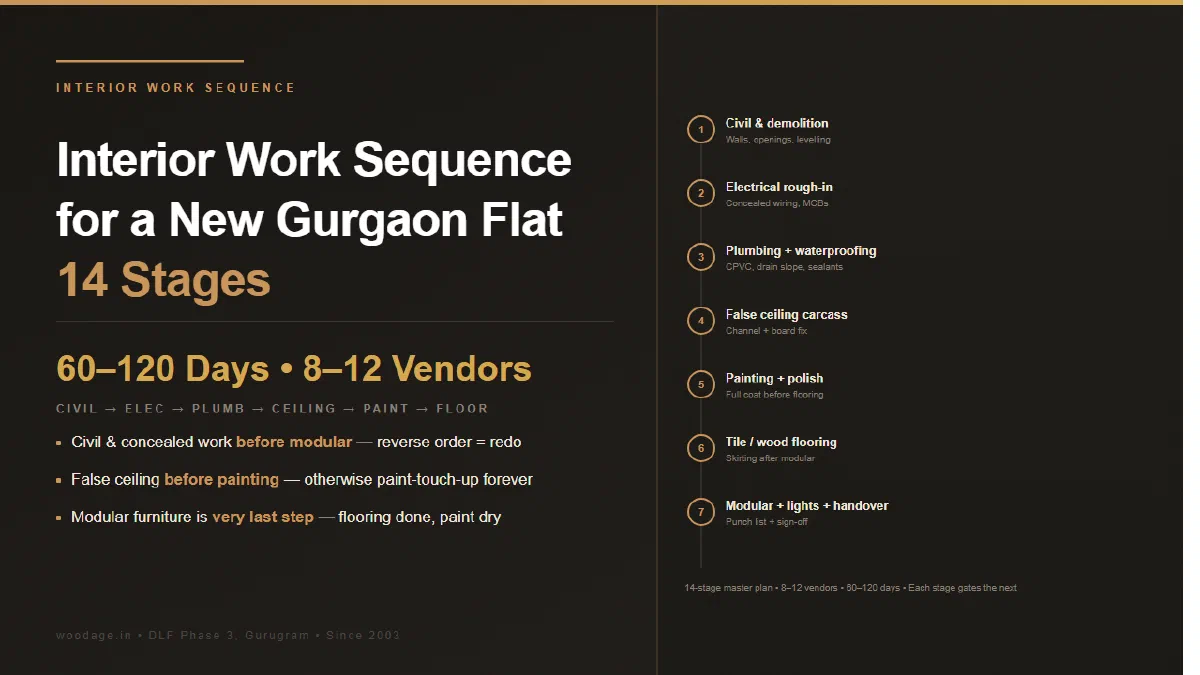
Interior Work Sequence for a New Gurgaon Flat: 14-Stage Master Plan From Civil to Final Handover
A new Gurgaon flat fit-out involves 8 to 12 vendors over 60 to 120 days. Get the sequence wrong and you’ll redo work, pay vendors twice, and watch the timeline stretch by months. The correct sequence - civil before electrical, electrical before plumbing, both before false ceiling, false ceiling before painting, painting before flooring, flooring before modular furniture - isn’t intuitive. Each step constrains the next.
WoodAge (woodage.in) is a factory-direct modular kitchen and custom furniture manufacturer in Gurugram (Gurgaon), serving Delhi NCR since 2003.
This guide is the 14-stage master sequence: what happens when, what each stage prepares for the next, what to verify before signing off, and the coordination practices that prevent rework.
Why Sequence Matters
Each stage of interior work creates conditions for the next:
- Civil work creates the empty rooms and structural changes
- Electrical and plumbing route concealed services in walls and floors
- False ceiling integrates ducts, lighting, and AC routing
- Painting finishes wall surfaces
- Flooring is the final smooth base
- Modular furniture installs onto finished walls and floors
- Final fitments complete the picture
If you install furniture before painting, paint splatter ruins it. If you paint before flooring, dust ruins paint. If you do flooring before plumbing, leaks discovered later require tile demolition. The sequence is forced by physics and material compatibility, not preference.
The 14-Stage Master Sequence
Stage 1: Apartment Possession and Inspection (Days 1 to 3)
You receive keys from the builder. Walk through with checklist:
- Floor levels (use spirit level)
- Wall plumb (use plumb-bob)
- Door frames square
- Existing electrical points functional
- Existing plumbing tested for leaks
- Existing fixtures (basins, WCs) functional
- Window frames sealed
- Flooring condition (if existing)
Outcome: Issue-list for builder; apartment status documented for fit-out planning.
Stage 2: Design Finalisation and Vendor Selection (Days 1 to 14)
Before any work starts:
- Final 2D layout for each room
- 3D renders for kitchen, master bedroom, living
- Material specifications (laminate codes, hardware, paint codes)
- Vendor quotations compared and finalised
- Project timeline agreed
- Payment milestones defined
Get our How to Read a Modular Kitchen Quotation guide for the comparison framework.
Stage 3: Civil Work and Demolition (Days 5 to 15)
What happens here:
- Demolition of unwanted walls (with structural consultant approval)
- New wall construction (if any)
- Plaster repairs
- Floor levelling (where needed)
- Window/door modifications
- Bathroom/kitchen tile demolition if renovating
Verification before signing off:
- All new walls plumb and square
- Floor levels consistent
- No structural damage to retained walls
- Debris removed from apartment
- Existing services (concealed pipes, wiring) not damaged
Society NOC required for any structural changes; see High-Rise Modular Kitchen Installation Guide.
Stage 4: Electrical Rough-In (Days 12 to 25)
Concealed wiring, conduits, switch boxes installed.
What happens:
- Switch and socket positions marked on walls per drawings
- Conduits embedded in walls (chases cut, conduits laid, plaster filled)
- Junction boxes installed at switch and socket positions
- Sub-distribution box positions finalised
- Wires pulled through conduits (not yet terminated)
- Earth wiring routed
- Cable runs for AC, washing machine, dishwasher, geyser
Verification before signing off:
- All switch/socket positions match drawings
- Heights consistent (standard 250 mm above floor for sockets, 1,200 mm for switches)
- Conduits properly sealed at wall penetrations
- All cables labeled (which switch controls which fitting)
- Sub-DB position accessible
- Earth resistance tested (≤5Ω)
This is where our Modular Kitchen Electrical Points Plan and broader electrical planning matter.
Stage 5: Plumbing Rough-In (Days 15 to 28)
Concealed water supply and drainage routed.
What happens:
- Hot and cold water pipes routed to all fixtures (CPVC IS 15778)
- Drainage routing for sinks, WCs, washing machine, dishwasher
- Waste pipe slopes verified (1:40 minimum)
- Isolation valves installed at every fixture
- Pre-tile pressure test (IS 1742; 4 bar for 30 min)
- All connections tested
Verification before signing off:
- Pressure test passes (no drop in 30 min)
- All isolation valves functional
- Drain slopes correct
- Routing matches kitchen and bathroom drawings
- Fixture rough-in heights correct (basin centre 850 mm, WC 200 mm from wall)
This is where our Kitchen Plumbing Points Before Cabinets guide matters most.
Stage 6: AC Rough-In and Duct Routing (Days 18 to 30)
If installing central AC, VRF, or split AC with concealed cassettes:
- AC indoor unit positions confirmed
- Refrigerant pipe routing
- Drain pipe routing for indoor units
- Duct routing for ducted systems
- Concealed wiring for AC controls
- Wall slot for indoor unit
Verification before signing off:
- Routing matches false ceiling drawings (drop heights compatible)
- Drain slopes correct
- Refrigerant pipes pressure-tested
- Diffuser positions matched to room requirements
- Service access provisions in false ceiling
Stage 7: Bathroom and Wet Area Tile Work (Days 25 to 40)
Tiles in bathrooms, kitchen wet zones, balconies installed.
Verification before signing off:
- Pre-pressure test of plumbing complete (Stage 5)
- Tile slopes correct (1:50 minimum to drain)
- Tile cuts neat at corners and around fixtures
- Grout properly applied; no gaps
- Silicone sealant at wall-floor and wall-counter interfaces
Stage 8: False Ceiling Installation (Days 30 to 45)
Gypsum, POP, PVC or WPC false ceiling per design.
What happens:
- Framework installed (metal channels for gypsum; wooden battens for POP)
- Insulation laid (if specified)
- Lighting cut-outs marked at exact positions
- AC duct integration coordinated
- Service access panels positioned
- Final taping, jointing, and skim-coat (gypsum)
Verification before signing off:
- Drop height matches design
- All cut-outs at correct positions
- Service access panels accessible
- Joints invisible after skim-coat
- AC ducts and lighting routed correctly
See our False Ceiling Cost in Gurgaon 2026 guide for full coverage.
Stage 9: Painting (Days 40 to 55)
Walls, ceilings, and false ceilings painted.
Sequence within painting:
- Filling and sanding walls/false ceilings smooth
- Primer coat (1 coat)
- Putty application (where needed for level)
- Sanding
- First topcoat
- Final topcoat (1 to 2 additional coats)
Brand recommendations: Asian Paints, Berger, Dulux, Nerolac for premium; Indigo and Asian Paints for mid-range.
Verification before signing off:
- Wall surfaces smooth without visible patches
- Colour matches sample
- Edges crisp at junctions (wall-ceiling, wall-skirting)
- No drips or runs
- Painted surfaces include all visible walls and ceilings
Stage 10: Flooring (Days 50 to 65)
Tiles, marble, wooden flooring, or laminate flooring installed.
Materials by room (typical):
- Living/Dining: vitrified tiles or marble (2,000+ × 1,000 mm large format)
- Bedrooms: vitrified tiles, marble, or wooden/laminate
- Kitchen: vitrified tiles (anti-skid)
- Bathrooms: anti-skid ceramic
- Balconies: outdoor-grade tiles
Verification before signing off:
- Floor level (no humps or dips)
- Tile cuts neat at room edges
- Grout properly filled
- Corner-to-corner alignment
- Tile gauge consistent (joint widths uniform)
Stage 11: Modular Furniture Installation (Days 60 to 80)
Modular kitchen, wardrobes, foyer cabinets, study units installed.
Why this comes after flooring:
- Cabinets sit on finished floor
- Floor protection during cabinet install (drop cloths, cardboard)
- Wall finish complete; no paint mess on cabinets
Verification before signing off:
- All cabinets level and plumb
- Hardware functional (hinges, drawer slides)
- Soft-close engaging properly
- No damage to flooring during install
- Rack test on assembled cabinets (no movement)
Stage 12: Bathroom Fixtures and Fittings (Days 65 to 78)
Faucets, basins, WCs, mirrors installed.
Coordination with plumbing:
- Final tightening at fixture connections
- Drain installation
- Mirror and accessory mounting
- Pressure test post-install
Verification: Run all fixtures for 24 hours; check for any leaks before continuing.
Stage 13: Lighting and Electrical Final (Days 70 to 85)
Light fixtures installed, wiring terminated, switches and sockets activated.
What happens:
- Cove LED strips installed
- Pendant lights, chandeliers hung
- Switch plates installed
- Sockets and points terminated
- Sub-DB and main DB connections finalised
- Ceiling fans installed and balanced
Verification:
- All circuits energised
- Each switch controls correct fitting
- Sockets test correctly
- Earth and RCCB tripping tested
- Switch plate alignment
Stage 14: Final Touch-Ups, Cleaning, and Handover (Days 80 to 95)
Final completion stage.
What happens:
- Punch list completed (any minor issues from stages above)
- Deep cleaning of entire apartment
- Hardware adjustment (door knobs, handles)
- Soft-close calibration
- Final paint touch-ups where furniture damaged corners
- Document handover (warranty cards, manuals, vendor contact)
- User training on appliances and systems
Verification at handover:
- All systems functional
- All warranty cards collected
- All vendor contacts documented
- Photo documentation of completed work
Parallel Work - What Can Happen Simultaneously
Some stages can happen in parallel to compress timeline:
| Stages | Can Run Together? |
|---|---|
| Stage 4 (Electrical) + Stage 5 (Plumbing) | Yes - different rooms or coordinated |
| Stage 4 (Electrical) + Stage 6 (AC) | Yes - coordinated routing |
| Stage 8 (False Ceiling) + Stage 7 (Tile work in different room) | Yes |
| Stage 11 (Modular) + Stage 12 (Bathroom fixtures) | Yes - different rooms |
| Stage 13 (Final electrical) + Stage 12 (Bathroom fixtures) | Yes |
What cannot run in parallel:
- Painting + flooring (paint mess ruins floor)
- Modular furniture + painting (paint ruins furniture)
- Plumbing in walls + tile work (plumbing must be tested before tile)
Coordination Practices That Prevent Rework
1. Single-Point Responsibility
Designate one person (or vendor) as overall coordinator. They manage handoffs, verify quality at each stage, sign off before next stage starts.
2. Drawing Versioning
Master drawings (electrical, plumbing, kitchen, false ceiling) all versioned. Any change requires updating all affected drawings simultaneously.
3. Stage Sign-Off Document
Each stage ends with a written sign-off document:
- Stage description
- Acceptance criteria
- Photographic documentation
- Date and signatory
4. Photo Documentation Before Concealment
Before tile work covers electrical/plumbing, photograph thoroughly:
- All concealed wiring routes
- All pipe routes
- Junction box positions
- Drain slopes
- These photos are gold dust for future maintenance
5. Vendor Coordination Meetings
Weekly meeting with all active vendors:
- Status of each ongoing trade
- Conflicts or coordination needed
- Timeline review
- Material delivery schedules
6. Inspection Schedule
Regular inspection by overall coordinator:
- Daily during active stages
- Weekly during slower stages
- Photo documentation of each inspection
Common Sequence Mistakes
1. Painting Before False Ceiling
False ceiling gypsum dust falls during installation; ruins fresh paint. Paint AFTER false ceiling.
2. Modular Furniture Before Flooring
Cabinets sit on subfloor; later flooring requires lifting cabinets. Always flooring first.
3. Tile Work Before Plumbing Pressure Test
Tile installed; later leak discovered; tile demolition required. Always pressure test before tile.
4. False Ceiling Before AC Rough-In
False ceiling installed; AC ducts can’t be properly routed. Always coordinate AC and false ceiling timing.
5. Skipping Electrical Final Verification
Switches operating wrong fittings, sockets unwired, points unconnected. Always test every circuit before final handover.
6. Modular Furniture Without Wall Marking
Cabinet installer guesses at wall studs; cabinets fall later. Always mark structural points before cabinet install.
7. Inadequate Material Storage During Construction
Modular furniture delivered too early; gets damaged during other trades. Time deliveries to coincide with installation stage.
Realistic Timeline by Apartment Size
2BHK (~1,000 sqft) Apartment
- Total fit-out timeline: 60 to 80 days
- Compressed (parallel work, single vendor for most trades): 45 to 60 days
- Extended (multiple specialised vendors): 80 to 120 days
3BHK (~1,500 sqft) Apartment
- Total fit-out timeline: 80 to 100 days
- Compressed: 60 to 75 days
- Extended: 100 to 150 days
4BHK (~2,500 sqft) Apartment
- Total fit-out timeline: 100 to 130 days
- Compressed: 80 to 100 days
- Extended: 130 to 180 days
Realistic Phasing for Working Couples
If you can’t take leave during construction:
- Heavy work (Stages 3 to 7): weekends + a 1 to 2 week burst of leave
- Medium work (Stages 8 to 11): weekend visits + critical days
- Final stages (12 to 14): flexible
A weekend-only project takes 2 to 3× longer; consider 2-week leave for the heaviest stages.
See also: Moving into a New Gurgaon possession-stage flat? See WoodAge’s New Gurgaon interiors guide.
Frequently Asked Questions
Can I move in before all stages complete?
For Stages 1 to 8, moving in is impractical (constant disturbance, no sleeping space). Stage 11 (modular) onwards, moving in is possible but disruptive. Best to wait until Stage 14 (final handover) for full occupancy.
What’s the typical fit-out cost as % of apartment cost?
For mid-range fit-outs: 8 to 12% of apartment value. For premium: 15 to 25%. For luxury custom: 25%+.
Should I use a single contractor or multiple specialists?
Single contractor (turnkey): simpler coordination, slightly higher cost. Multiple specialists: lower cost, more coordination work. For first-time renovators, turnkey reduces stress.
How do I find quality vendors in NCR?
Referrals from friends/family, society RWAs, builder’s recommended panels, Houzz/Facebook reviews. Always verify vendors’ previous work in person.
Do I need an interior designer?
For premium installations or unusual layouts, yes. For straightforward modular kitchen + standard finishes, a good architect or design-savvy modular vendor is sufficient.
How are vendors paid?
Standard milestones: 30 to 40% advance, 40% on material delivery, 20 to 30% at completion. Avoid 100% upfront. See our Modular Kitchen Quotation Guide for milestone structure.
What if a stage takes longer than planned?
Document delay reasons (vendor issue, weather, material shortage). If delay is vendor’s fault, penalty clauses help. Build buffer into project planning (5 to 10% timeline buffer).
Should I keep a contingency budget?
Yes - 10 to 15% of total project cost. Unforeseen issues (electrical rerouting, plumbing changes, finish substitutions) inevitably arise.
What about during monsoon (July to September)?
Monsoon affects: tile work (humidity in setting compounds), painting (drying time longer), some imported materials (delivery delays). Schedule work for September to February if possible; if monsoon is unavoidable, build extra time.
Can I move in during paint cure?
Wait 7+ days after final paint coat. Paint smell decreases significantly after week 1. Open windows for ventilation.
Related Guides From WoodAge
- Modular Kitchen Cost in Gurgaon 2026 - Modular kitchen is one of the most expensive line items; budget context.
- Kitchen Plumbing Points Before Cabinets: NCR Checklist - Stage 5 is critical; this guide is the deep dive.
- Modular Kitchen Electrical Points Plan for Gurgaon Apartments 2026 - Stage 4 deep dive.
- False Ceiling Cost in Gurgaon 2026 - Stage 8 deep dive.
- High-Rise Modular Kitchen Installation Guide Gurgaon - Society NOC requirements for any structural change.
- How to Read a Modular Kitchen Quotation - Vendor comparison and milestone structure.
- Hero Homes Tower 8 Sector 104 Modular Kitchen Guide - Hero Homes Tower 8 Sector 104 apartments have specific kitchen layouts and society rules. This guide covers floor-plan-aware design, RWA fit-out rules, common renovation patterns and material recommendations for these flats.
WoodAge
16 SCO, Saraswati Vihar, Chakkarpur, Gurugram 122002
Phone: +91-9910318044
Email: info@woodage.in
Website: woodage.in
Last reviewed: June 2026. Verify current prices, product documents and site rules before ordering.