

IS Standards for Modular Kitchen Materials: BIS Codes Every Buyer Should Quote (IS 710, IS 303, IS 12823, IS 14587)
Indian Standards (IS codes) define what 'BWP plywood' or 'HDHMR' actually means. This guide decodes IS 710, IS 303, IS 12823, IS 14587 and IS 15778 - the BIS specifications you should quote on every kitchen contract for legal protection.

- Kautuk Sahni
- 14 min read
IS Standards for Modular Kitchen Materials: BIS Codes Every Buyer Should Quote (IS 710, IS 303, IS 12823, IS 14587)
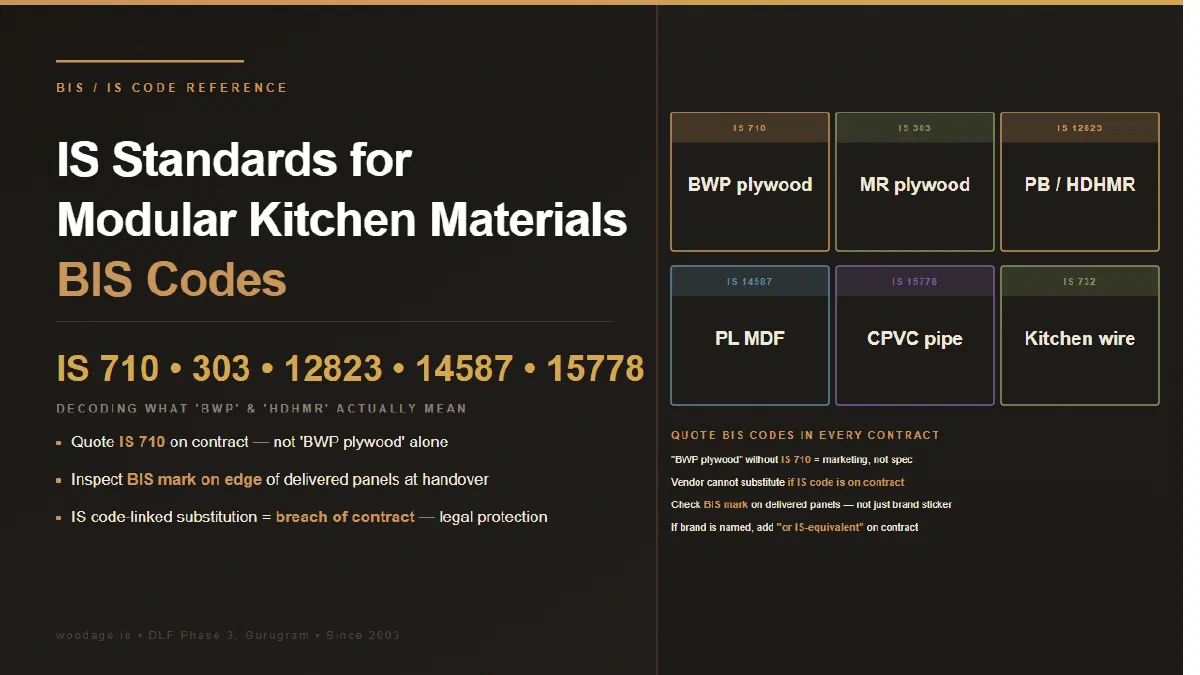
When a vendor quotes “BWP plywood,” “marine plywood,” or “HDHMR,” what they actually mean is defined by the Bureau of Indian Standards (BIS) through specific IS codes. IS 710 defines what marine/BWP plywood must be; IS 303 defines moisture-resistant plywood; IS 12823 defines pre-laminated particle board (HDHMR only where that exact product is certified to it); IS 14587 defines pre-laminated MDF; IS 15778 defines CPVC pipes. Without the IS code on your contract, “BWP plywood” is marketing language - not a specification you can enforce.
WoodAge (woodage.in) is a factory-direct modular kitchen and custom furniture manufacturer in Gurugram (Gurgaon), serving Delhi NCR since 2003.
This is the BIS-code reference that transforms a vague kitchen quote into a legally enforceable contract. Quote these codes correctly and a vendor cannot substitute lower-grade material without breaching specification.
Quick IS Code Map for Kitchen Buyers
| Component | IS code to ask for | Practical use |
|---|---|---|
| Wet zone kitchen carcass | IS 710 | Sink base, dishwasher zone and moisture exposed cabinets |
| Dry zone plywood | IS 303 | Wardrobes and storage away from water exposure |
| HDHMR or pre laminated board | IS 12823 for prelaminated particle board; for HDHMR, the standard on the product’s own certificate | Moisture resistant engineered board applications |
| MDF shutters or decorative panels | IS 14587 | Shutters, membrane doors and wall panels |
| CPVC kitchen plumbing | IS 15778 | Hot and cold water lines for sink, RO and dishwasher |
| Kitchen electrical wiring practice | IS 732 | Socket placement, circuit safety and protection planning |
Why IS Codes Matter on Your Contract
The Bureau of Indian Standards is the national standards body of India under the Ministry of Consumer Affairs. The BIS issues IS (Indian Standard) specifications for every category of construction and consumer material - including the materials in your kitchen.
Practical implications:
Specification clarity: “BWP plywood IS 710” means a specific test-passing material. “BWP plywood” alone means whatever the vendor wants it to mean.
Brand verification: Manufacturers stamp the IS code along with their brand name on the panel. A panel without an IS marking is, by definition, untested against any standard.
Legal enforceability: A contract specifying “Century Sainik 710 BWP plywood, IS 710 marine grade” gives you grounds for breach if a different grade is delivered.
Warranty alignment: Material manufacturers’ warranties typically reference the IS code. Without that on your invoice, claim becomes harder.
GST and tax compliance: Properly graded materials carry HSN codes tied to IS specifications.
The Core IS Codes for Kitchen Materials
IS 710:2024 - Marine Plywood / BWP Plywood (Replaces IS 710:2010)
Full title: “Marine Plywood - Specification”
What it specifies:
- Veneer construction with phenol-formaldehyde resin
- Boil-water-proof (BWP) bonding
- Tested for water-boiling cycles, dimensional stability, glue shear strength
- Defined density, weight, surface finish requirements
- Tested for resistance to micro-organisms (fungi, bacteria)
Where it applies:
- Kitchen carcasses, especially under-sink and wet-zone cabinets
- Bathroom vanities
- Utility balcony cabinets
- Outdoor / semi-outdoor furniture
- Any cabinet with sustained moisture exposure
Common brands certified to IS 710:
- Century Plyboards (Sainik 710)
- Greenply (Greenpanelmax 710)
- Kitply (Marine grade)
- Archid Ply
How to verify: Look for the BIS standard mark and CM/L number stamped on every panel. Reject any “BWP plywood” without the IS 710 marking.
IS 303:2024 - Plywood for General Purposes (Fourth Revision; Replaces IS 303:1989, Reaffirmed 2019)
Full title: “Plywood for General Purposes - Specification”
What it specifies:
- Plywood with urea-formaldehyde resin (interior grade)
- Grades: BWR (Boiling Water Resistant) and MR (Moisture Resistant) in the superseded 1989 edition; the current IS 303:2024 adds BWP. “Commercial” is a trade term, not a grade in either edition
- Defines minimum glue shear strength, moisture content, dimensional tolerance
Where it applies:
- Wardrobes (where moisture exposure is limited)
- Storage units away from wet zones
- Bedroom and living room furniture
- General interior applications
Important distinction:
- IS 303 BWR is suitable for kitchens where moisture is occasional but not constant
- IS 303 MR is suitable only for dry zones
- IS 710 BWP is suitable for any wet zone (the highest grade)
Common brands: Greenply (Ecotec), Century Club Prime, Greenlam Carving
IS 12823:2025 - Pre-Laminated Particle Board (Replaces IS 12823:2015; HDHMR Only With Product Evidence)
Full title: “Pre-Laminated Particle Board - Specification”
What it specifies:
- Particle board with pre-laminated decorative surface
- Three grades: Grade I (interior dry), Grade II (interior moist), Grade III (interior wet)
- HDHMR (High-Density High-Moisture Resistant) is sometimes described as falling under Grade III, but that is a product claim to check on the board’s certificate, not a rule of the standard
- Surface scratch resistance, abrasion resistance, formaldehyde emission
Where it applies:
- HDHMR cabinets (Action Tesa, Greenpanelmax HDHMR)
- Particle board carcasses with pre-bonded laminate
- Furniture in moderate-moisture environments
HDHMR vs Standard Particle Board: HDHMR is denser (700 to 900 kg/m³ vs ~600 kg/m³ for standard particle board), giving it better screw-holding and moisture resistance. Treat an “IS 12823 Grade III” label on an HDHMR board as a product claim to verify on its certificate, not as a formal definition of HDHMR.
Common brands: Action Tesa (HDHMR), Greenpanelmax (HDHMR variants), Bharti Tesco
IS 14587 - Pre-Laminated Medium Density Fibreboard (MDF): Current Edition 2025, Not 2015
Full title: “Pre-Laminated Medium Density Fibreboard - Specification”
What it specifies:
- MDF with pre-laminated surface
- Density ranges, internal bond strength, edge swelling resistance
- Formaldehyde classes E1 and E2 only; the E0, E1, E2 trio often quoted includes an E0 class this standard does not define
- Surface scratch and abrasion resistance
Where it applies:
- MDF shutters with pre-applied laminate
- Membrane-finish doors (MDF substrate vacuum-pressed with PVC membrane)
- Decorative wall panels
E-Classifications (Formaldehyde Emission):
- E0: not a class in IS 14587; the ≤0.07 mg/m³ figure often quoted for E0 has no basis in the Indian standard, so ask which standard and test method a supplier’s “E0” claim refers to
- E1: up to 8 mg/100 g formaldehyde content in oven-dry board, or up to 0.124 mg/m³ in the optional steady-state chamber test, under IS 14587:2023; the range 0.07 to 0.124 mg/m³ sometimes quoted for E1 adds a lower bound the class does not have
- E2: 0.124+ mg/m³ in the optional chamber test, or more than 8 and up to 30 mg/100 g formaldehyde content - restricted use; the EU, for example, limits furniture to 0.062 mg/m³ from 6 August 2026
For NCR homes with infants, asthma, or sensitive occupants, E0 or E1-certified MDF is non-negotiable. See our Low-VOC Kitchen Materials guide for deeper coverage.
Common brands: Greenpanel, Action Tesa, Greenply, Kitply (premium MDF lines)
IS 1659:2004 - Block Boards
Full title: “Block Boards and Flush Doors - Specification”
What it specifies:
- Construction with softwood/hardwood core (block board) covered with veneer or plywood faces
- Bonding grades: BWP, BWR, MR
- Dimensional and moisture tolerances
Where it applies:
- Solid-core flush doors (kitchen entry doors, bedroom doors)
- Some heavy-duty cabinet construction
- Built-in furniture with high screw retention
Less common in modern modular kitchens - most modern designs use plywood or HDHMR carcasses, not block boards.
IS 15778:2007 - CPVC Pipes for Hot and Cold Water Supplies
Full title: “Chlorinated Polyvinyl Chloride (CPVC) Pipes for Potable Hot and Cold Water Distribution Supplies - Specification”
What it specifies:
- CPVC pipe materials, dimensions, pressure ratings, temperature ratings
- NSF-style hygiene certification for potable water
- Thermal expansion and contraction tolerances
Where it applies:
- All hot and cold water plumbing in your kitchen
- Connections to dishwasher, RO, instant geyser
Common brands: Astral, Ashirvad, Supreme, Prince, Finolex
See our Kitchen Plumbing Points Before Cabinets guide for plumbing-specific application.
IS 732:2019 - Code of Practice for Electrical Wiring Installations
Full title: “Code of Practice for Electrical Wiring Installations”
What it specifies:
- Wiring methods, conduit systems, earthing, MCB sizing, RCCB protection
- Voltage drop calculations, circuit protection
- Earth resistance requirements
Where it applies:
- All electrical work in your kitchen including socket placement, MCB sub-DB, dedicated circuits
See our Modular Kitchen Electrical Points Plan guide for application.
Other Relevant IS Codes
IS 9537:1980 - PVC Conduits for Electrical Wiring
PVC conduits used for concealed wiring. Insist on ISI-marked IS 9537 conduit, not generic plastic pipe.
IS 401:2001 - Preservation of Timber (Not IS 4905:1968)
Defines treatment standards for borer-resistant and termite-resistant wood. Some plywood is treated to this standard.
IS 5509:2021 - Fire Retardant Plywood (Replaces IS 5509:2000)
For installations requiring fire-retardant boards (kitchens above commercial spaces, certain society bylaws).
IS 10262:2019 - Concrete Mix Proportioning Guidelines (Replaces IS 10262:2009; Indirectly Relevant)
For RCC walls where you’ll drill anchors for wardrobes and lofts. Defines concrete grade, which determines anchor pull-out strength.
IS 3087:2025 - Particleboard (Not IS 1597:2018; IS 1597 Is the Stone-Masonry Code)
The base specification for particle board (without lamination) is IS 3087, current edition 2025 (BIS catalogue). HDHMR is sometimes documented as IS 12823 with additional density specifications; check the exact product’s certificate rather than assuming either standard applies.
How to Specify IS Codes on Your Quotation
Replace vague language with specific specifications:
Carcass Material - Vague vs Specific
Vague: “BWP plywood for under-sink cabinet”
Specific:
“Under-sink cabinet carcass: 18 mm BWP plywood, IS 710 marine grade, manufactured by Century Plyboards (Sainik 710) or equivalent BIS-certified manufacturer. BIS standard mark and CM/L number visible on each panel.”
Shutter Material
Vague: “Laminated MDF shutters”
Specific:
“Shutter substrate: 18 mm pre-laminated MDF, IS 14587 grade, E1 formaldehyde emission certification, manufactured by Greenpanel/Action Tesa or equivalent BIS-certified manufacturer.”
Plumbing Pipe Material
Vague: “CPVC piping”
Specific:
“Hot and cold water supply: CPVC pipes IS 15778-certified, manufactured by Astral/Ashirvad/Supreme. NSF-certified for potable water.”
Electrical Wiring
Vague: “Standard electrical work”
Specific:
“All electrical wiring as per IS 732:2019. FRLS copper wire IS 694-certified, manufactured by Havells/Polycab/Finolex/RR Kabel. PVC conduits IS 9537-certified.”
How Manufacturers Mark IS Compliance
Every BIS-certified material carries:
- The BIS Standard Mark - the ISI logo with the IS code
- The CM/L Number - Certificate of Marking and Licence number, unique to the manufacturer
- The Brand Name - manufacturer’s trademark
- The Grade - within the IS code, the specific grade (e.g., “IS 710 Marine Grade”)
- Manufacturing Date - batch/lot information
A panel without these markings is, by definition, uncertified. Verify at material delivery - photograph the markings as evidence.
What “ISI Mark” Actually Means
The ISI mark (Indian Standards Institute, the predecessor name to BIS) is a guarantee that the manufacturer has been inspected and certified by BIS to produce material meeting that IS standard.
The mark guarantees:
- The manufacturer’s facility was audited
- Production samples were tested against the IS code
- Periodic surveillance audits continue
- Failure to maintain quality can result in license cancellation
The mark does not guarantee:
- Every individual panel passed the test (it’s a system-level certification)
- The product cannot be counterfeited (which is why brand verification matters too)
- The material is of premium quality (just that it meets the IS minimum)
Verifying Authenticity
Counterfeit “ISI-marked” materials exist. To verify:
- Cross-check the CM/L number at the BIS website (bis.gov.in)
- Buy from authorised dealers of named brands (Century, Greenply, Action Tesa)
- Request the manufacturer’s invoice and warranty card at delivery
- Photograph the BIS marking before installation
- Be skeptical of unrealistic prices - premium IS-certified material has a market price; significantly below market suggests substitution
What to Reject at Material Delivery
If material arrives at your apartment without:
- Visible BIS standard mark
- Brand name and CM/L number
- Manufacturer’s batch/lot identifier
- Original invoice from a recognised dealer
Reject the delivery. Your contract specifies certified material; uncertified material is breach.
Common Vendor Tactics and How to Defend Against Them
Tactic 1: “Branded Plywood” without IS code
Some vendors quote “Greenply plywood” without specifying the grade. Greenply makes both IS 710 BWP and IS 303 MR - wildly different in moisture resistance. Always specify the IS code.
Tactic 2: BIS-marked panel for visible cabinets, unmarked for hidden
Quotation specifies IS 710; vendor uses it for the under-sink cabinet (visible at delivery) but uses cheaper non-IS material for back panels and internal divisions (hidden after assembly). Insist on IS-marked material throughout.
Tactic 3: Generic “marine grade” labeling
Some local manufacturers stamp “marine grade” without IS 710 certification. The label means nothing without BIS standard mark.
Tactic 4: Counterfeit branded panels
Imitation panels carrying recognised brand names but without BIS authentication. Always cross-check CM/L numbers; buy through brand-authorised channels.
Tactic 5: Mixing grades within a single cabinet
Vendor uses IS 710 for the visible side panels and lower-grade IS 303 MR for the bottom panel. Specify the grade for every cabinet component.
The Specification Paragraph Template
For a complete kitchen contract, the materials specification should read approximately:
“All cabinet carcasses in wet zones (under-sink, dishwasher, hob area) shall be 18 mm BWP plywood, IS 710 marine-grade, manufactured by Century Plyboards Sainik 710 or equivalent BIS-certified manufacturer. All cabinet carcasses in dry zones shall be 18 mm BWP plywood (IS 710) or 18 mm HDHMR (IS 12823 Grade III) at the manufacturer’s choice. All MDF shutters and substrates shall be IS 14587 certified with E1 or better formaldehyde emission rating. All CPVC pipes for hot and cold water shall be IS 15778 certified, NSF-listed. All electrical work shall comply with IS 732:2019, with FRLS copper wire IS 694 certified. All BIS standard marks, brand stamps, and CM/L numbers shall be visible on materials at delivery. Each material’s manufacturer’s invoice, warranty card and certificate of authenticity shall be handed over to the customer at completion.”
This single paragraph protects you against substitution at every layer.
See also: To see how each board and finish lasts in Delhi NCR humidity, read WoodAge’s NCR material lifespan guide.
Frequently Asked Questions
Why don’t vendors specify IS codes by default?
Specifying IS codes constrains them. Without the code, they have flexibility to substitute material based on supply, cost, or convenience. Specifying the code transfers that constraint to them.
Is “marine grade” the same as IS 710?
Only if the IS 710 marking is present. “Marine grade” without IS 710 certification is a marketing claim, not a specification.
What’s the difference between IS 710 BWP and IS 303 BWR?
IS 710 BWP uses phenol-formaldehyde resin, has higher density and moisture resistance, and is the standard for marine and wet-zone applications. IS 303 BWR uses urea-formaldehyde with additives, is moisture-resistant for moderate exposure but not continuous wet conditions. For under-sink and wet-zone cabinets, always specify IS 710.
Why is HDHMR not its own IS code?
HDHMR (High-Density High-Moisture-Resistant) is a manufacturer category, not a separate IS code. It is often described as falling under IS 12823 Grade III (pre-laminated particle board with high moisture resistance) with additional density specifications, but IS 12823 covers prelaminated particle board, so rely on the exact product’s certificate. Where a manufacturer documents its HDHMR product against IS 12823 with its own internal density and moisture-resistance specifications, ask for that product certificate.
Should I demand BIS certification for every kitchen component?
Yes for structural materials (carcass, shutters, pipes, wires). Imported components (Hettich hardware, Bosch appliances) carry their own international certifications (CE, IEC, ISO) - these are also acceptable.
What if a vendor refuses to specify IS codes?
That’s a red flag. A vendor who can’t or won’t commit to specific certified materials is effectively saying “trust me.” Decline the quotation; choose a vendor who specifies IS codes openly.
Are IS codes legally binding?
On your contract, yes. If you specify “IS 710 BWP plywood, Century Sainik 710” and a different material is delivered, you have grounds for breach. Without the specification, you have nothing to enforce.
How do I verify CM/L numbers?
Visit the BIS website (bis.gov.in) and search for the manufacturer or use their certified products lookup. Each brand-authorised CM/L number can be cross-referenced.
What is the HSN code for a modular kitchen?
Wooden kitchen furniture falls under heading 94.03 of the Harmonized System, subheading 9403.40, “Wooden furniture of a kind used in the kitchen”, while bedroom wardrobes and beds fall under 9403.50 (WCO HS 2022, Chapter 94). The chapter notes keep wall-hung cupboards and unit furniture in these headings. An HSN code classifies a product for tax and trade, separately from its IS standard, so check both on the invoice.
How to Use This Guide Before You Decide
Use this guide to verify material claims in a quotation. Ask for the relevant IS grade, brand invoice, board thickness, manufacturer mark, and written specification so the quote can be checked against what is actually delivered.
Related Guides From WoodAge
- How to Read a Modular Kitchen Quotation - Apply IS-code specification language to every line item of your quote.
- Kitchen Plumbing Points Before Cabinets: NCR Checklist - IS 15778 CPVC application in residential plumbing.
- Modular Kitchen Electrical Points Plan for Gurgaon Apartments 2026 - IS 732 wiring standards in residential electrical installation.
- Modular Kitchen Warranty in India 2026 - IS-certified materials carry manufacturer warranties; uncertified materials don’t.
- Edge Banding for Modular Kitchens - Edge banding chemistry and bonding standards.
- Best Modular Kitchen Manufacturer in Gurgaon 2026: 15-Point Checklist Before You Buy - Related guide for planning the costs, materials and execution of the same project.
- commercial plywood grade guide - understand MR, BWR, BWP and commercial ply labels before accepting a material quote.
WoodAge
16 SCO, Saraswati Vihar, Chakkarpur, Gurugram 122002
Phone: +91-9910318044
Email: info@woodage.in
Website: woodage.in
Last reviewed: May 2026. Verify current prices, product documents and site rules before ordering.