

Joinery Methods in Indian Modular Kitchens: Dowel, Cam Lock, Minifix, Pocket Screw and What Each Means for Your Kitchen's Lifespan
How cabinet panels join determines whether your kitchen lasts 10 or 25 years. This guide compares dowel-and-glue, cam-lock (minifix), pocket screw and traditional carpentry joinery, with brand recommendations and quality verification tests.

- Kautuk Sahni
- 12 min read
Joinery Methods in Indian Modular Kitchens: Dowel, Cam Lock, Minifix, Pocket Screw and What Each Means for Your Kitchen’s Lifespan
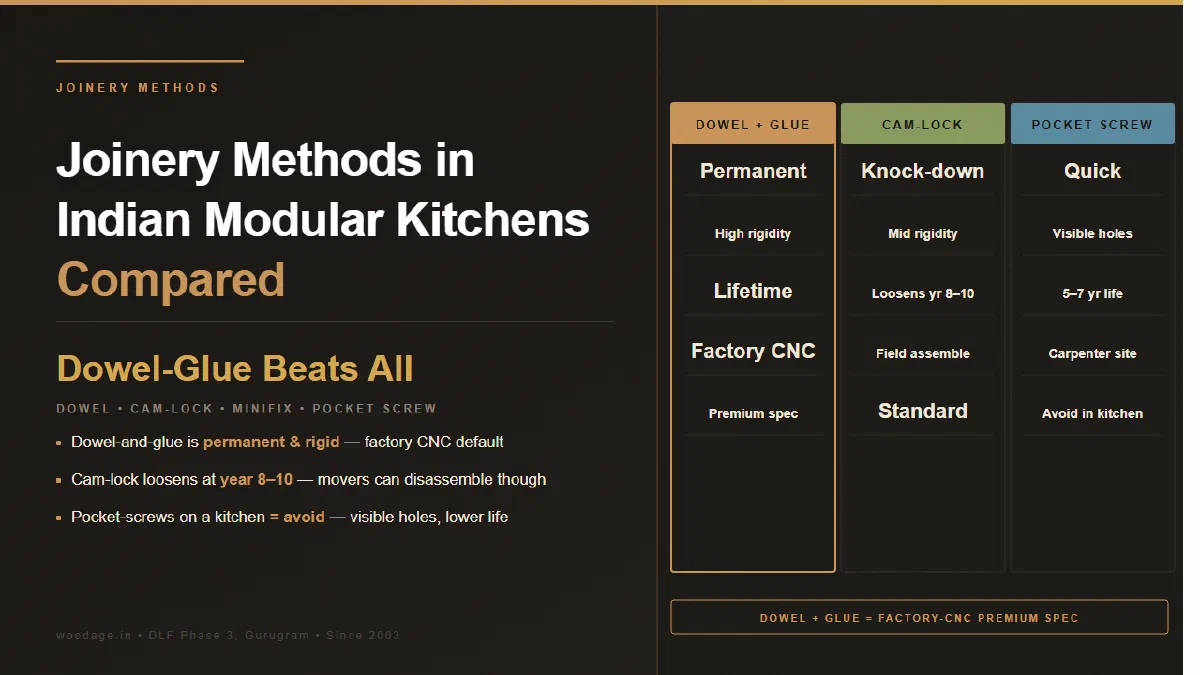
How a cabinet’s panels are joined together determines its long-term structural integrity. A dowel-and-glue joint, properly executed, is permanent and rigid for the cabinet’s life. A cam-lock (minifix) joint allows knock-down and reassembly but loosens over years. A pocket-screw joint is quick but visually inferior. Traditional mortise-and-tenon joinery is unmatched for strength but rarely used in modular kitchens because it requires hand fitting. Most modular vendors use a mix; the question is whether they’re using the right method in the right places.
WoodAge (woodage.in) is a factory-direct modular kitchen and custom furniture manufacturer in Gurugram (Gurgaon), serving Delhi NCR since 2003.
This guide breaks down every joinery method you’ll encounter in a Gurgaon kitchen, where each belongs, and the quality tests you can apply at delivery to verify good workmanship.
Why Joinery Choice Matters
The visible details of a kitchen - laminate finish, hardware brand, countertop - get the attention. The invisible joinery is what determines:
- Carcass rigidity - does the cabinet rack (twist) under load?
- Long-term integrity - will the joints loosen by year 10?
- Disassembly capacity - can the cabinet be taken apart for service or moving?
- Warranty cost to vendor - bad joints mean callbacks
- Stress points - under-sink cabinets carry plumbing weight; joints there matter most
A kitchen with premium hardware and laminate but poor joinery will start failing structurally well before its cosmetic life ends. A kitchen with simpler hardware but excellent joinery will outlast its visible finish.
The Five Joinery Methods Used in Indian Modular Kitchens
1. Dowel-and-Glue Joinery
The most common premium method in NCR factory-made cabinets.
How it works:
- Wooden dowels (typically 8 mm hardwood) are inserted into matching holes in two panels
- PVA wood glue or D3-rated waterproof glue is applied
- Panels are pressed together; glue cures in 4 to 24 hours; joint becomes permanent
Pros:
- Strong, rigid joint (when glue cures fully)
- Aesthetically clean (no visible fasteners)
- Standard machinery (boring machine + assembly press)
- Suitable for both visible and hidden joints
Cons:
- Permanent - cabinet cannot be disassembled for moving or service
- Requires precise drilling (5 to 10 mm offset can ruin alignment)
- Glue cure time delays final assembly
Best for: Premium cabinet construction; cabinets that won’t be moved later; structural joinery where rigidity matters most.
2. Cam Lock / Minifix / Bedi Hardware Joinery
The “knock-down” (KD) joint that allows assembly and disassembly. The most common in IKEA-style flat-pack and many Indian budget kitchens.
How it works:
- A cam (rotating disc) sits in a mortise on one panel
- A bolt threads into a hole in the matching panel
- When assembled, rotating the cam pulls the bolt and clamps the panels together
Pros:
- Allows knock-down for shipping (cabinets ship flat)
- Can be disassembled and reassembled (moving, service)
- Quick site assembly (no glue cure time)
- Standard in factory-built cabinets
Cons:
- Joint is mechanical, not chemical - can loosen over years
- Visible cam-housing on cabinet face (some designs hide this with covers)
- Less rigid than dowel-and-glue
- Quality varies enormously: Hettich, Hafele and similar premium brands have cam locks that hold for 25 years; generic local hardware loosens within 5 to 7 years
Brand recommendations:
- Hettich Rastex, Hettich VB36
- Hafele Minifix
- Blum (less common in residential kitchens; more in furniture)
- Avoid: unbranded local cam hardware
Best for: Factory-built cabinets shipped to site; budget installations; cabinets that may need to be moved.
3. Pocket-Screw Joinery
Quick, mechanical joint using angled screws.
How it works:
- A pocket-hole jig drills an angled hole into one panel (typically 15° angle)
- A self-tapping screw drives through the angled hole into the adjacent panel
- The screw head sits inside the pocket, hidden from external view
Pros:
- Fast (no glue cure time)
- Strong mechanical bond
- Reasonable rigidity
- Field-repairable
Cons:
- Pocket holes visible from inside the cabinet (some vendors plug them with wood plugs)
- Site-built cabinets often use this method; quality depends on the carpenter’s skill
- Less elegant than dowel-and-glue
- Not standard for visible cabinet faces
Best for: Site-built or partially site-built cabinets; service-friendly construction; carcass-internal joints (not visible faces).
4. Traditional Mortise-and-Tenon Joinery
The historical wood-craftsman’s joint. Rare in modern modular kitchens but unmatched for strength.
How it works:
- One panel has a tongue (tenon) cut into its edge
- The matching panel has a slot (mortise) sized to receive the tenon
- The two interlock with a tight friction fit, often with glue and/or pegs
Pros:
- Strongest joinery for solid wood
- Can be invisible (hidden tenon) or visible (through-tenon as decorative feature)
- Long lifespan - 100+ year life is documented in Indian colonial-era furniture
Cons:
- Hand-fitting required - slow and skill-intensive
- Best on solid wood; doesn’t translate well to engineered panels (plywood, HDHMR)
- Very expensive in modern manufacturing context
Best for: Bespoke solid-wood furniture; traditional Indian carving and joinery; not standard in modern modular kitchens.
5. Biscuit Joinery
A specialised joint using wooden “biscuits” inserted into matching slots.
How it works:
- A biscuit jointer cuts crescent-shaped slots into mating panels
- Compressed wooden biscuits (oval-shaped, ~50 mm long) are inserted with glue
- When glue absorbs moisture, biscuits swell and lock the joint
Pros:
- Strong, gap-filling joint
- Faster than mortise-and-tenon
- Hidden completely after assembly
Cons:
- Specialised tool needed
- Less rigid than dowels for purely structural joints
- Niche in Indian modular kitchens
Best for: Edge-to-edge panel joining; some custom furniture work.
Where Each Joinery Method Belongs
| Cabinet Joint | Recommended Joinery | Alternative |
|---|---|---|
| Cabinet side to bottom (carcass corner) | Dowel-and-glue | Cam-lock (Hettich/Hafele) |
| Cabinet side to top | Dowel-and-glue | Cam-lock (Hettich/Hafele) |
| Cabinet back to sides | Dado groove + nail or screw | Pocket screw |
| Cabinet shelves to sides | Adjustable shelf pin | Dowel-and-glue (fixed) |
| Cabinet face frame | Pocket screw | Mortise-and-tenon (premium) |
| Drawer corners | Box joint or dovetail | Pocket screw |
| Cabinet to wall mounting | Wall anchors and screws | Hidden cleat |
| Tall unit assembly (multiple panels) | Cam-lock + dowel hybrid | All cam-lock |
Quality Tests You Can Run at Delivery
Before signing off on a delivered kitchen, run these tests:
Test 1: Rack Test
Place your hand on opposite corners of an empty wall cabinet. Push gently in opposing directions (twist motion).
- Quality: No visible movement; cabinet holds rigid
- Acceptable: Slight flex but no creaking
- Failure: Visible movement, audible creaking, joint visibly opening - this cabinet will fail within 2 to 5 years
Test 2: Drawer Slide Test
Pull a drawer out fully. Push it back. Repeat 10 times.
- Quality: Smooth, silent, soft-close engages reliably
- Acceptable: Slight rubbing sound, soft-close inconsistent
- Failure: Drawer drops, derails, or makes loud noise - slide is misinstalled or hardware is generic
Test 3: Shutter Hinge Test
Open a shutter to 90°. Let go. Open to full 110°. Let go.
- Quality: Soft-close engages smoothly; shutter doesn’t slam shut or stay open
- Acceptable: Soft-close engages but shutter drifts slightly
- Failure: Shutter slams or stays open - hinge tension is wrong, or hinge model is wrong size for shutter weight
Test 4: Panel Joint Inspection
Look at internal corners of cabinets where panels meet.
- Quality: Tight joint, no visible gap, no glue squeeze-out, no fastener visible
- Acceptable: Hairline gap that’s not loose
- Failure: Visible gap (>1 mm), glue smear, exposed fastener heads - joint is poorly executed
Test 5: Sound Test
Tap the cabinet face firmly with a knuckle.
- Quality plywood/HDHMR: Solid, dense thud
- Quality construction: Sound is contained within the panel
- Hollow particle board or poor join: Hollow drum-like resonance - material or joint is substandard
What’s Inside Different Quality Tiers
Premium Tier (Factory-Built, Quality Manufacturer)
- All structural joints: dowel-and-glue with D3-rated waterproof glue, OR Hettich/Hafele cam-lock
- All joinery on visible panels: invisible (no exposed fasteners)
- Drawer corners: box joint or dovetail
- Shelf supports: branded adjustable shelf pins (Hettich, Hafele)
Mid Tier (Standard Factory or Hybrid Site-Built)
- Structural joints: cam-lock (good brand) + minimal dowel
- Visible panel joints: pocket-screw with plugs
- Drawer corners: pocket-screw
- Shelf supports: standard shelf pins
Budget Tier (Site-Built or Quick-Assembly)
- Structural joints: pocket-screw or generic cam-lock
- Visible panel joints: pocket-screw without plugs (visible)
- Drawer corners: nail-and-glue or simple butt joint
- Shelf supports: basic shelf pins
The price difference between tiers reflects manufacturing time and skill, not just material - and the lifespan difference is significant.
Why Some Vendors Avoid Dowel-and-Glue
The dowel-and-glue joint is structurally superior, but it requires:
- Boring machine - the machine that drills precise dowel holes ($30,000 - $80,000 for industrial-grade)
- Glue application station - automated glue dispenser
- Assembly press - clamping the panels together while glue cures
- Cure-time inventory - cabinets can’t ship until glue cures fully (typically 4 to 8 hours)
Smaller vendors who don’t have this machinery default to cam-lock joinery (which only requires drilling and assembly) or pocket-screw. The result is structurally inferior but operationally faster.
WoodAge’s manufacturing facility in Gurugram operates dowel-and-glue assembly for premium kitchens with full automation, including dedicated cure stations.
How Joinery Determines Cabinet Lifespan
Years 1 to 5
All joinery types appear to perform well. Differences are subtle.
Years 5 to 10
Cam-lock joints (especially generic brands) start to loosen slightly with weight cycling. Drawer slides creak. Hinges may need adjustment. Properly dowelled-and-glued cabinets show no degradation.
Years 10 to 15
Generic cam-lock joints visibly loosen. Dovetailed and dowelled cabinets continue to perform well. Pocket-screw cabinets are often still tight if good fasteners were used.
Years 15 to 25
Premium dowel-and-glue cabinets remain structurally sound. The cabinets typically need cosmetic refresh (laminate replacement, hardware upgrade) but the underlying carcass is still rigid. This is when cabinet-only renovation becomes a sensible option - see our Cabinet-Only Renovation Guide.
Specifying Joinery on Your Quotation
Insert this language into the cabinet specification line of your contract:
“All cabinet carcass corner joints (side-to-bottom, side-to-top) shall use 8 mm hardwood dowel-and-glue joinery with D3-rated waterproof PVA glue, OR Hettich/Hafele branded cam-lock fasteners. All joints visible from outside the cabinet shall be invisible (no exposed fasteners or visible glue). Drawer corners shall be box-joint or dovetail. All exposed pocket-screws (if any) shall be plugged with matching wood plugs. Manufacturer’s quality control shall include the rack test (no visible movement under hand torque) for all assembled cabinets prior to delivery.”
This protects you against shortcut joinery substitutions.
Common Joinery Mistakes
1. Generic Cam-Lock Hardware
Hettich Rastex and Hafele Minifix cam-locks are designed to hold tightly for the cabinet’s life. Generic local cam-locks often loosen within 5 years - and you can hear it as a faint clicking when you open shutters.
2. Skipped Glue in Dowel Joints
Some vendors drill dowels but skip the glue (faster assembly). The mechanical fit is initially tight but loosens over years as the dowels work in their holes. Insist on visible glue evidence.
3. Improper Glue Cure Time
If a vendor delivers cabinets within 2 hours of assembly, the glue hasn’t cured. The joint will work loose during transit. Premium vendors maintain cure stations and don’t ship until 8+ hours of cure.
4. Pocket-Screws on Visible Faces
Pocket-screw is structurally fine but aesthetically inferior on visible faces. If you can see screw plugs on cabinet exteriors, the manufacturer was rushing.
5. Inadequate Shelf Support
Cheap installations use only adhesive-backed shelf pins on flush-mounted shelves. Adhesive fails. Insist on screw-anchored shelf pins or dado-groove construction.
6. Wall-Mounting Failures
A cabinet’s joinery is only as good as its wall anchor. Generic plastic anchors in plywood walls fail; M8/M10 expansion anchors in RCC walls hold. See our Wardrobe With Loft Cost Guide for wall anchor depth.
See also: To see how each board and finish lasts in Delhi NCR humidity, read WoodAge’s interior material durability guide.
Frequently Asked Questions
Dowel-and-glue or cam-lock - which is better?
For permanent kitchens that won’t be moved: dowel-and-glue is more rigid and longer-lasting. For kitchens that may be moved later or for budget installations: branded cam-lock (Hettich, Hafele) is acceptable. Avoid generic cam-lock at any cost.
How can I tell if my old kitchen has loose joints?
Open and close shutters slowly. Click-clack sounds, drawers that derail, slight wobble in tall units, or visible gaps at corner joints all indicate loose joinery. By year 10, this is often the trigger for cabinet renovation.
Can a kitchen with cam-lock joinery be repaired?
Yes - cam-locks can be re-tightened (rotate the cam fully). For extensively loosened joints, replacement cam-locks of the same model are available. Hettich and Hafele have NCR service support for this.
What’s a “knock-down” cabinet?
A cabinet that ships flat (panels disassembled) and is assembled on-site, typically with cam-lock or screw fasteners. Most factory-built modern modular cabinets are knock-down to reduce shipping costs and accommodate apartment lifts.
Is site-built furniture with mortise-and-tenon better than factory-built dowel?
Skill-dependent. A skilled site carpenter using mortise-and-tenon produces excellent furniture, but it’s slow and expensive. Factory-built dowel-and-glue with quality machinery is more consistent and predictable. For most NCR homes, factory-built premium is the right balance.
Why don’t more Indian kitchens use dovetail drawer corners?
Dovetail joinery requires either skilled hand-cutting or specialised CNC routing. Most Indian modular vendors use simpler box joints or pocket-screws on drawer corners. Dovetail is a premium upgrade worth specifying for premium kitchens.
Does joinery quality affect resale value?
Indirectly. Buyers don’t ask about joinery, but they notice slamming drawers, sagging shelves, and loose tall units. A structurally sound kitchen with refreshed laminate often outsells a cosmetically-better but structurally-loose competitor.
What if my installed cabinets fail the rack test?
Document with photos, contact your modular vendor immediately. If the cabinet is within installation/workmanship warranty (typically 12 to 24 months), they should rectify free of charge. See our Modular Kitchen Warranty Guide.
Related Guides From WoodAge
- Edge Banding for Modular Kitchens - Joinery and edge-banding together determine the structural and aesthetic integrity of any cabinet.
- How to Read a Modular Kitchen Quotation - Joinery is rarely specified in quotations; this guide tells you how to demand specifics.
- Modular Kitchen Warranty in India 2026 - Joinery failures fall under installation/workmanship warranty.
- Storage Bed & Headboard Manufacturer Gurgaon 2026 - Bed frames need exceptional joinery; the same principles apply.
- Modular Kitchen Renovation in Gurgaon 2026 - Joinery quality determines whether a cabinet-only renovation is viable; loose old joints may need full carcass replacement.
- Plywood Thickness for Modular Kitchen Cabinets: 6 mm vs 12 mm vs 18 mm vs 25 mm - Where Each Belongs - Useful next reading on hardware planning, costs, materials, or execution.
- Open-Ecosystem Smart Lighting for Gurgaon Apartments - Pick the right smart lighting ecosystem for your Gurgaon flat. Zigbee vs Matter vs Wi-Fi, Aqara vs SmartThings vs Home Assistant, what works in NCR in 2026.
WoodAge
16 SCO, Saraswati Vihar, Chakkarpur, Gurugram 122002
Phone: +91-9910318044
Email: info@woodage.in
Website: woodage.in
Last reviewed: May 2026. Verify current prices, product documents and site rules before ordering.