

Kitchen Chimney Buying & Ducting Guide 2026: CFM, Society Core-Cutting Rules and Common Installation Mistakes
Gurgaon chimney and ducting guide: compare CFM, filters, duct routes, core-cutting permissions and installation checks with appliance and building requirements.

- Kautuk Sahni
- 18 min read
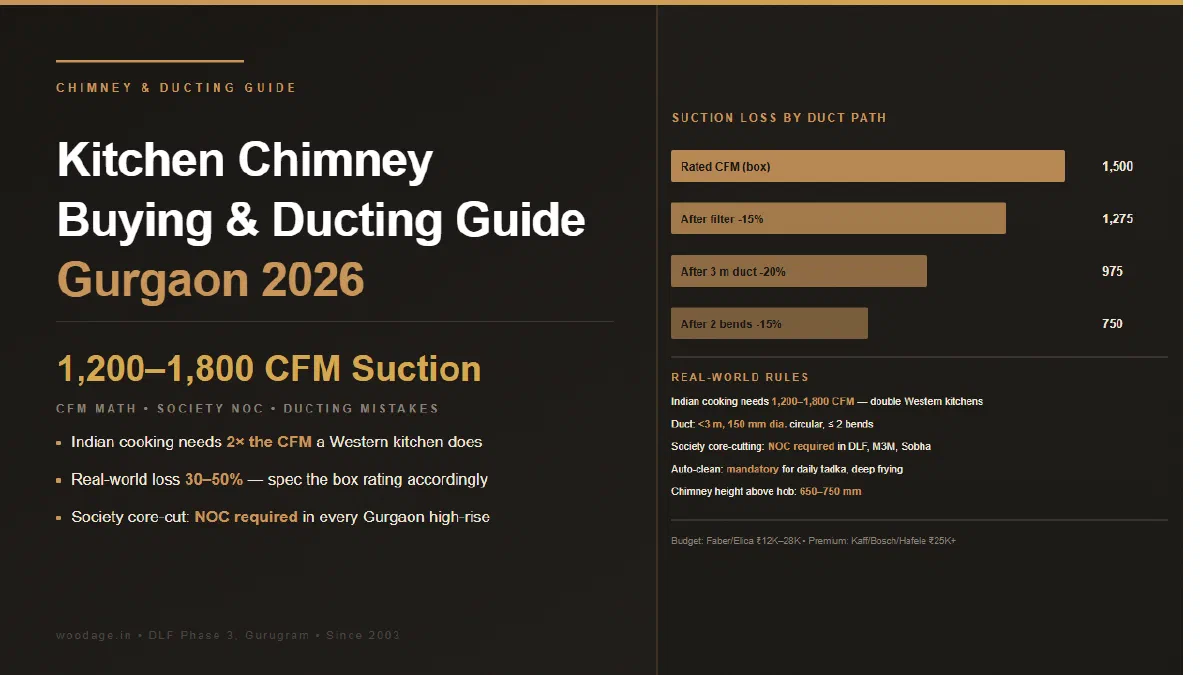
Kitchen Chimney Buying & Ducting Guide 2026: CFM, Society Core-Cutting Rules and Common Installation Mistakes
Chimney selection should match cooking style, kitchen volume, hob width, manufacturer specifications and the resistance of the proposed duct route. Indian cooking with frequent frying or high heat may need more extraction than lighter cooking, but there is no universal CFM minimum; compare the model’s tested performance and have the route checked before buying.
WoodAge (woodage.in) is a factory-direct modular kitchen and custom furniture manufacturer in Gurugram (Gurgaon), serving Delhi NCR since 2003.
Equally critical is the duct route from chimney to outside wall. Diameter, length, bends, terminations and static pressure can reduce useful extraction, so compare the chimney’s performance data with the proposed route rather than relying on the headline CFM alone. This guide covers both decisions.
How to Calculate the CFM You Actually Need
The standard formula:
CFM = (Kitchen Volume in cubic feet) × (Air Changes per Hour) ÷ 60
Air-change assumptions vary by design guidance and cooking pattern. Use the formula as a planning illustration, then confirm the target with the appliance documentation and a qualified installer.
Example - typical Gurgaon 2BHK kitchen:
- Floor area: 80 sq ft (8’ × 10')
- Ceiling height: 10 ft
- Volume: 800 cubic ft
- Illustrative CFM: (800 × 30) ÷ 60 = 400 CFM before route and cooking adjustments
The unit trap: CFM on the formula, m³/hr on the box
Almost every chimney sold in India is rated in m³/hr, while the sizing formula above produces CFM. They are not interchangeable, and mixing them is a common sizing error on Gurgaon quotes.
The conversion is 1 CFM ≈ 1.7 m³/hr, so the 400 CFM illustration above is roughly 680 m³/hr.
Indian manufacturers usually present the same calculation directly in metric: take the kitchen volume in cubic metres, multiply by 10–12 air changes per hour, then add a buffer for Indian cooking. The commonly published buffer is 25–40%.
Now notice the gap. That same 8’ × 10’ × 10’ kitchen is about 22.6 m³. At 10 air changes an hour the formula asks for roughly 230 m³/hr. Yet published guidance for moderate Indian cooking typically recommends 800–1,000 m³/hr, and 1,200 m³/hr or more for heavy frying and high-flame cooking — three to four times what the air-change formula returns.
Both numbers are defensible, and understanding why they differ is what lets you buy sensibly:
| Why the numbers diverge | What it means for your purchase |
|---|---|
| Rated airflow is measured at or near free air, with little duct resistance | Your installed route — diameter, length, bends, termination — will deliver less than the label. Ask for airflow at a stated static pressure, not just the headline figure |
| Air changes per hour treat the whole room as the target | A hood’s real job is capture at the hob, before smoke disperses. Hood width, depth and mounting height matter more than room volume for that |
| Indian cooking is a short, intense load, not a steady one | Sizing for the average misses the tadka peak, which is why the buffer exists |
| Marketed figures compete on a single comparable number | A larger headline figure is easy to advertise and hard to verify on site |
How to use both. Treat the air-change result as the floor below which a chimney is definitely undersized, and the published cooking-load bands as the market’s practical range. Then decide on evidence: the model’s tested airflow at a stated static pressure, the hood width relative to your hob, and the installer’s written duct-route calculation. A 1,200 m³/hr rating through a long, bent, undersized duct can move less air than a 900 m³/hr unit on a short straight run.
The conversion and air-change method are standard arithmetic. The 800–1,000 and 1,200+ m³/hr cooking-load bands are figures published by Indian chimney manufacturers as general guidance — not a WoodAge recommendation and not a guarantee for any specific kitchen. Verify against the appliance documentation and your installer’s calculation.
But this illustration is not a universal minimum. Real-world factors to discuss with the installer include:
| Factor | What to check |
|---|---|
| Open kitchen layout (no separating wall) | Ask the installer to account for room volume and capture area |
| High-flame Indian cooking (frequent tadka, deep frying) | Compare the model’s tested airflow and cooking pattern |
| Hob with 4+ burners | Match hood width and extraction to the hob and manufacturer’s guidance |
| Long duct run | Check route length, diameter and static-pressure data |
| Multiple 90° bends in duct | Minimise bends where practical and ask how the route affects performance |
Practical Gurgaon recommendations:
| Kitchen Type | Selection check | Confirm before ordering |
|---|---|---|
| Closed kitchen, 2BHK, light Indian cooking | Compare room volume, cooking pattern and hood width | Model test data with the proposed duct route |
| Closed kitchen, 2BHK, heavy Indian cooking | Allow for higher cooking load and capture area | Manufacturer guidance and installer calculation |
| Open kitchen, 2BHK | Check the open volume and cross-drafts | Tested airflow at relevant static pressure |
| Open kitchen, 3BHK with island | Check island hood coverage and the full room volume | Duct route, make-up air and model documentation |
| Closed kitchen, builder floor with high ceiling | Include ceiling height and cooking load | Installer’s written sizing recommendation |
Chimney labels may quote a maximum airflow under a test condition that does not represent your installed route. Ask for the model’s test method or static-pressure data and have the installer confirm a suitable duct diameter, length and termination before comparing headline CFM figures.
Filter Type - Baffle vs Auto-Clean vs Filterless
This is the most-debated decision in Indian kitchen chimneys. Each technology has a specific best fit.
Baffle Filter Chimneys
The traditional Indian standard. Steel baffles redirect airflow at sharp angles, dropping oil into a collection tray.
- Best for: Heavy Indian cooking when the household can follow the manufacturer’s cleaning schedule
- Maintenance: Clean baffles at the frequency specified by the manufacturer and adjusted for cooking load (dishwasher-safe versions may be available)
- Suction: Best raw extraction - no clogging because the baffle design is non-blocking
- Lifespan: Depends on the model, use, cleaning and service support; check the manufacturer’s warranty and maintenance guidance
- Brands: Faber, Elica, Hindware, Glen, Kaff, Bosch (most brands offer baffle versions)
Auto-Clean (Heat / Thermal Auto-Clean)
The motor periodically heats up to vaporise collected oil, which then drips into a removable tray.
- Best for: Families that want low manual maintenance; moderate Indian cooking
- Maintenance: Empty and clean the oil collector tray as directed for the model and cooking load
- Suction: Good but slightly lower than baffle due to filter mesh
- Lifespan: Depends on the model, use and maintenance; the auto-clean cycle is not a substitute for the manufacturer’s service guidance
- Trade-off: Higher upfront cost; check replacement parts and service terms before buying
Filterless Chimneys
Use centrifugal force inside the motor housing to separate oil from air. No filter mesh at all.
- Best for: Open kitchens with island chimneys; modern aesthetic
- Maintenance: Least manual, but still requires the model’s interior-cleaning schedule
- Suction: Highest raw airflow (no filter resistance)
- Lifespan: Depends on the model, use and maintenance; verify service and replacement-part support
- Trade-off: Highest cost; the inner mechanism, if it fails, is expensive to repair
- Brands: Faber Zenith, Elica WD HAC TFL, Hindware Nadia, Bosch DWB series
Top Chimney Brands in 2026 NCR Market
These are the brands consistently available in Gurgaon’s electronics markets (Croma Sector 14, Vijay Sales Sector 31, Reliance Digital MGF) and online (Amazon, Flipkart, manufacturer sites).
| Brand | Strength | Typical Range | Notes |
|---|---|---|---|
| Faber | Italian heritage, widest model spread | Entry to premium | Strong service network in NCR |
| Elica | Italian, design-led, best for premium kitchens | Mid to premium | Top-tier filterless models |
| Hindware | Strongest Indian brand, value-for-money | Entry to mid | Wide retail availability |
| Glen | Tier-2 reliable | Entry to mid | Best after-sales among value brands |
| Kaff | Fast-growing, design-focused | Mid | Built-in oven and chimney combos |
| Bosch / Siemens | German engineering, premium | Premium | Best for built-in appliance suites |
| Whirlpool | Reliable but limited Indian-spec models | Entry to mid | Better for Western cooking |
| Inalsa | Budget | Entry | Limited service network |
Buying tip: Check whether the selected brand has accessible NCR service and replacement-part support. Ask about motor, filter and warranty terms so a fault does not leave the kitchen without a workable extraction plan.
Ducting - Where Performance Actually Lives
Do not treat the duct as an afterthought. A low-cost or poorly planned route can undermine an otherwise suitable chimney, so ask for a separate ducting scope covering diameter, material, bends, termination and installation.
Duct Diameter
| Duct Diameter | Selection check | Use Case |
|---|---|---|
| 100 mm (4 inch) | Confirm compatibility with the model and route | Use only where the appliance documentation and installer support it |
| 125 mm (5 inch) | Confirm compatibility with the model and route | May suit a lower-output model; do not infer performance from diameter alone |
| 150 mm (6 inch) | Compare with the model’s duct requirement and static-pressure data | Common residential option, subject to the specific installation |
| 175 mm (7 inch) | Confirm the model, termination and route can use the larger diameter | Consider when the appliance documentation calls for it |
| 200 mm (8 inch) | Obtain a written sizing recommendation | May suit specialist, commercial or very long routes |
Sizing check for a Gurgaon chimney: Use the model’s specified duct diameter and the installer’s written route calculation; choose flexible aluminium or rigid duct only after checking bends, termination and building permissions.
Duct Material
| Material | Pros | Cons | Recommendation |
|---|---|---|---|
| Aluminium flexible (corrugated) | Easy to bend around obstacles, widely available | Higher friction, harder to clean | Default for most installs |
| Rigid PVC | Lowest friction, easiest to clean | Inflexible - needs straight run or 90° bend fittings | Best where route allows |
| Galvanised steel (GI) | Most durable, fire-safe | Expensive, harder to install | Commercial / premium homes |
| Aluminium semi-rigid | Balance of flexibility and low friction | Limited brand availability | Good middle ground |
Bend Loss - The Hidden Killer
Every bend adds resistance, but the actual loss depends on the duct diameter, length, bend radius, termination and appliance test conditions. Keep the route as direct as practical and ask the installer to explain any expected performance trade-off.
Acceptable layouts:
- Chimney → straight up → through ceiling → out external wall (best)
- Chimney → up 600 mm → 45° offset → out external wall (acceptable)
- Chimney → up → 90° → 1 m horizontal → 90° → out wall (more resistance; confirm the route’s expected performance)
If your kitchen is on an inner wall with no direct external access, a long horizontal run with multiple bends may reduce performance. A ductless / recirculating chimney with carbon filters can be an option where external ducting is not permitted, but it does not remove heat or moisture; follow the model’s filter replacement and maintenance instructions.
Society Core-Cutting Rules - Gurgaon High-Rise Reality
This is the part nobody warns first-time apartment buyers about.
A chimney duct may need a circular opening through an external wall, often called a “core cut”. Whether written approval is required depends on the building’s current rules, the proposed location and any structural or façade restrictions; confirm with the RWA or management office before ordering work.
NOC Checks for a Core Cut (Building-Specific)
- Ask whether a written application is required and what lead time applies
- Provide a drawing or marked photograph showing the proposed core-cut location if requested
- Provide the contractor identity and documents requested by management
- Confirm any fee or refundable deposit in writing before work is booked
- Record the approved work window, quiet periods and holiday restrictions if applicable
- Confirm how the outside finish, weatherproofing and façade appearance must be restored
Requirements can be stricter in buildings with protected façades, structural constraints or detailed fit-out controls. The management office may request façade specifications, pre- and post-work photographs or structural review; confirm the current project-specific process instead of relying on a builder-name assumption.
Reference: The applicable society documents, management circulars and any relevant municipal or structural requirements control the work. Treat the building’s current written instructions as the source for the approval process.
Sectors and Project Types Where Core-Cutting Is Easier
- Builder floors or independent homes - confirm the owner, municipal and structural requirements that apply to the external wall
- Older apartments - do not assume a less formal process; ask the current RWA or management office
- Villas or homes without a shared external wall - confirm whether any façade, municipal or structural permission is still required
When You Cannot Core-Cut
Some buildings may restrict or prohibit external core cuts because of façade, structural or sustainability requirements. Ask the management office about the exact wall, elevation and route before signing the kitchen contract.
If your society blocks core-cutting:
- Use a recirculating ductless chimney
- Or duct horizontally to a utility balcony if the building’s written rule permits that route
- Or use the existing builder-provided exhaust point if one was designed in
Chimney Mounting and Cabinet Cutout
For the modular cabinet maker, three measurements matter:
| Measurement | Standard Range | Notes |
|---|---|---|
| Chimney width | 60 cm (24"), 75 cm (30"), 90 cm (36") | Match to hob width - chimney should equal or exceed |
| Mounting height above hob | 650 to 750 mm for gas hobs, 550 to 650 mm for induction | Below 650 mm risks flame contact with chimney; above 800 mm reduces capture efficiency |
| Hood overhang | 30 to 50 mm beyond hob front edge | For best capture of front-burner steam |
Cabinet cutout for built-in chimneys:
- Standard 60 cm chimney needs a 600 × 250 × 320 mm housing cabinet (W × H × D)
- The duct exit point on top of the chimney determines wall-unit configuration above
Hood type vs aesthetic match:
- Wall-mount pyramid - most common, traditional look
- Wall-mount straight-line / box - modern flat-faced design
- Built-in / integrated - hidden inside a cabinet, only visible bottom panel
- Island chimney - for hobs on a kitchen island (no wall behind)
Five Installation Mistakes That Ruin Performance
These are common installation checks:
1. Wrong duct diameter for chimney CFM. A duct that is too small for the selected chimney can restrict airflow. Match the route to the model’s documentation and the installer’s calculation instead of assuming a headline CFM will carry through a duct.
2. Excessive flexible-duct length. Aluminium flex duct should be installed without avoidable sag or coiling. Excess length adds resistance and makes cleaning harder; cut to the route and follow the duct manufacturer’s installation guidance.
3. Mounting height too high. A chimney 850 mm above the hob loses efficiency. The plume disperses before reaching the hood. 650 to 750 mm is the sweet spot for gas hobs.
4. No external weatherproof cap. A suitable termination and weatherproofing help manage rain entry and backdraft. Confirm the cap type and exterior finish with the installer and building rules.
5. Sealing the duct joints with insulation tape only. Ask the installer to use a sealant or foil tape suitable for the duct material and heat conditions, then inspect the joints for leaks before closing the false ceiling.
The Pre-Installation Chimney Checklist
Before your installer mounts the chimney:
| # | Verification | Done |
|---|---|---|
| 1 | CFM matches kitchen volume × cooking style calculation | ☐ |
| 2 | Society NOC obtained for external core cut (if needed) | ☐ |
| 3 | Any applicable fee/deposit and approved work-time slot confirmed in writing | ☐ |
| 4 | Duct diameter matches the chimney model’s documented requirement and route calculation | ☐ |
| 5 | Duct route mapped - straight where possible, max 1 bend if avoidable | ☐ |
| 6 | Mounting height set at 650 to 750 mm above hob top | ☐ |
| 7 | 6A power socket positioned inside chimney housing (covered in our Electrical Points Plan) | ☐ |
| 8 | External weatherproof cap with backdraft flap on order | ☐ |
| 9 | Chimney width matches hob width (60/75/90 cm) | ☐ |
| 10 | Cabinet cutout dimensions verified against chimney model | ☐ |
| 11 | Warranty card filled and stamped - original invoice retained | ☐ |
See also: For a factory-direct kitchen from the Gurugram unit, see WoodAge’s modular kitchen manufacturer in Gurgaon.
Chimney Installation: Buyer Verification Checklist for Model and Duct
Before a Gurgaon chimney is ordered, use this record to connect the selected model to the duct route, cabinet, power point and society permission. The sources describe bounded installation dependencies; they do not guarantee a model’s performance in a particular kitchen.
| Verification row | Exact evidence-backed proposition and direct source | Record before installation |
|---|---|---|
| Ducted or recirculating | Kaff’s installation guide distinguishes ducted chimneys that vent outside from ductless designs that filter and return air inside, and says external venting may depend on building rules. Chimney Installation Guide: What to Expect and How to Prepare Your Kitchen — HTML headings “Ducted vs Recirculating” and “Pre-Installation Decisions”. | Write the selected mode, external route and current society/RWA requirement into the purchase and fit-out sheet before drilling or cabinet fabrication. |
| Power, clearance and cabinet | Kaff’s installation guide treats the chimney power point, clearance and cabinetry as pre-installation coordination items rather than post-installation fixes. Chimney Installation Guide: What to Expect and How to Prepare Your Kitchen — HTML headings “The Power Point” and “Clearances and Cabinetry”. | Mark the power point, hood clearance and cabinet depth on the approved elevation, then keep that revision with the appliance model. |
| Route geometry | Kaff’s hob-and-chimney integration guide states that long duct routes and extra bends reduce airflow and that the duct outlet should not be reduced below the model outlet size. Gas Stove & Kitchen Chimney: The Ultimate Integration Guide — HTML section “Installation: Where Most Kitchens Lose Performance”, duct route and duct size. | Draw the proposed route, count bends and record the model outlet size so the installer can explain any deviation before work begins. |
| Four handover fields | Kaff’s smoke-free setup guide says hood width should cover the cooktop, the duct route should be direct, the duct size should match the exact model outlet and access should remain available for cleaning. Create a Smoke-Free Kitchen Setup With a Kaff Chimney — HTML section “A Quick Installation Checklist”, lines 135–145. | Check hood width, route, outlet match and cleaning access against the selected model at handover, with photographs of concealed access where possible. |
| Capture versus odour | Kaff’s smoke-free setup guide distinguishes capture near the hob from odour masking and states that poor installation cannot be fixed by the appliance alone. Create a Smoke-Free Kitchen Setup With a Kaff Chimney — HTML sections “What Makes a Home Feel Smoke-Free” and “What a Chimney Can and Cannot Do”. | Use the distinction when assessing a performance complaint: record cooking position, hood capture, ducting and installation conditions separately from the product label. |
| Electrical sign-off | BIS describes IS 732:2019 as covering design, selection, erection and verification of electrical installations in buildings. Indian Standards on Power and Energy sector — PDF pp. 30–31, Structure of IS 732:2019 and verification clause. | Attach the chimney circuit and verification record to the same drawing revision as the hood and cabinet elevation before final installation. |
Evidence boundary: These manufacturer guides and BIS references describe installation dependencies; they do not certify the selected chimney, supplier or installation, or establish WoodAge price, warranty or outcome.
Frequently Asked Questions
What CFM chimney do I need for Indian cooking in a Gurgaon 2BHK?
Choose a model using the cooking pattern, kitchen volume, hood width, manufacturer test data and the proposed duct route. Ask the installer to explain how the connected route affects expected performance instead of applying a universal percentage to the label CFM.
Do I need society NOC for installing a chimney?
An approval question normally arises when the work changes an external wall or shared building element; an internally mounted chimney may still be subject to the building’s fit-out rules. Confirm the current written requirements, lead time and any fee or deposit with the RWA or management office.
Auto-clean or baffle filter for Indian cooking?
Baffle filter for the heaviest Indian cooking - the open baffle design doesn’t clog. Auto-clean for moderate cooking with low manual maintenance preference. Filterless for the highest aesthetic and lowest maintenance, with a higher upfront cost.
How often should chimney filters be cleaned?
Baffle: clean at the frequency specified by the model and cooking load. Auto-clean: empty and clean the oil collection tray as directed. Filterless: follow the model’s interior-cleaning instructions.
Can I install a chimney without ducting?
Yes. Recirculating (ductless) chimneys use carbon filters to reduce odour but do not remove heat or moisture. They can suit a kitchen where an external route is not permitted; follow the model’s filter replacement and maintenance instructions.
What is the right chimney height above the hob?
650 to 750 mm above gas hobs. 550 to 650 mm above induction or electric hobs. Below this risks flame contact; above reduces capture efficiency.
Why is my chimney loud even though it’s a premium brand?
Two common reasons: (1) duct is undersized or has too many bends, forcing the motor to work harder; (2) duct joints aren’t properly sealed, creating turbulence. Both are duct issues, not chimney defects.
Related Guides From WoodAge
- Modular Kitchen Electrical Points Plan for Gurgaon Apartments 2026 - The chimney circuit and switch placement is one of 14 to 18 electrical points your kitchen needs.
- Kitchen Plumbing Points Before Cabinets: NCR Checklist - Plumbing and chimney pre-checks together complete the site readiness audit.
- Modular Kitchen Cost in Gurgaon 2026 - Where chimney and ducting sit in your overall kitchen budget.
- Kitchen Chimney Buying Guide India 2026: Suction Power, Auto-Clean vs Baffle, Brands and Delhi NCR Installation - Useful next reading on hardware planning, costs, materials, or execution.
- Kitchen and Wardrobe Lighting Plan: Profile Lights, Drawer Sensors and Under-Cabinet Lighting - Useful next reading on hardware planning, costs, materials, or execution.
- Modular Kitchen Accessories and Pull-Outs: Complete 2026 Guide to What’s Worth Buying and What’s Overpriced - Useful next reading on hardware planning, costs, materials, or execution.
- Godrej Aristocrat Sector 49 Modular Kitchen Guide - A floor-plan-aware guide to checking society fit-out rules, renovation constraints and material choices for this project.
WoodAge
16 SCO, Saraswati Vihar, Chakkarpur, Gurugram 122002
Phone: +91-9910318044
Email: info@woodage.in
Website: woodage.in
Last reviewed: May 2026. Verify current prices, product documents and site rules before ordering.