

Kitchen Hob Buying Guide for Indian Cooking: Brass vs Sabaf Burners, Built-In Cut-Outs, Warranty and Replacement Costs
How to choose a built-in hob for Indian cooking: brass vs Sabaf burners, the cut-out to freeze before the countertop, drawer clearance, gas routing and after-sales.

- Kautuk Sahni
- 13 min read
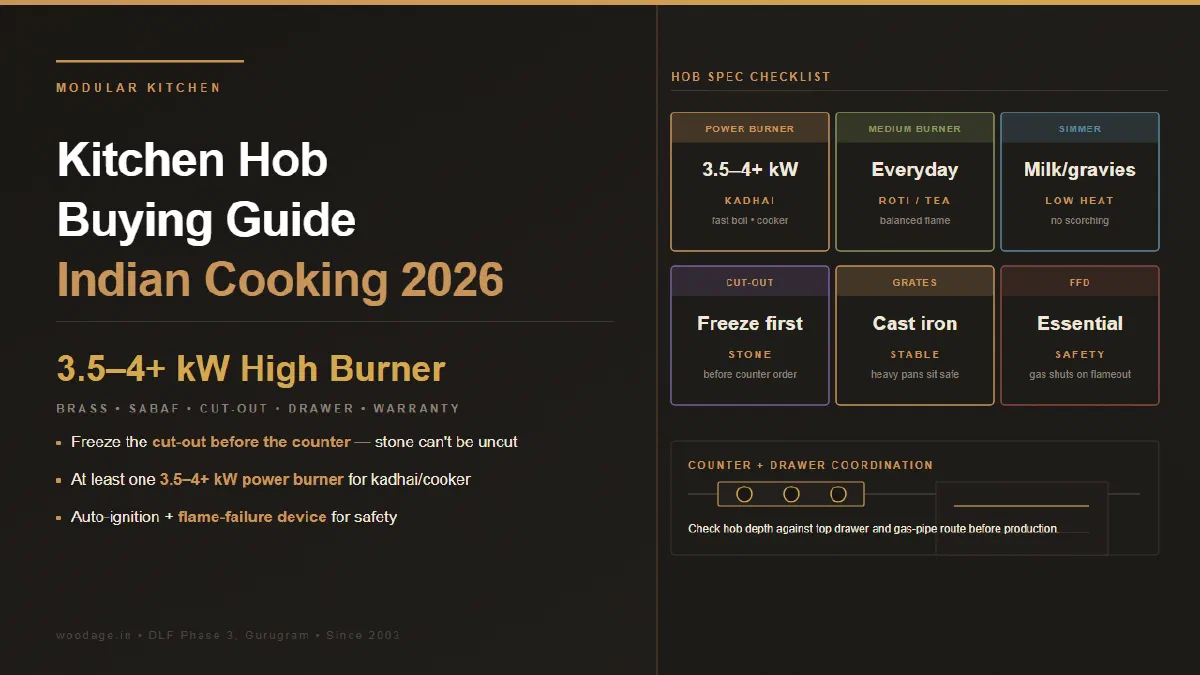
Kitchen Hob Buying Guide for Indian Cooking: Brass vs Sabaf Burners, Built-In Cut-Outs, Warranty and Replacement Costs
For Indian cooking, choose a built-in hob by the exact model’s documented burner output, pan layout, safety features and serviceability—not looks alone. Brass is a burner material and Sabaf is a burner manufacturer, so compare the current product documents rather than treating them as opposites. Freeze the model’s cut-out before the countertop is fabricated, because stone cut wrong cannot be uncut.
WoodAge (woodage.in) is a factory-direct modular kitchen and custom furniture manufacturer in Gurugram (Gurgaon), serving Delhi NCR since 2003.
The catch: the hob is usually treated as a last-minute appliance, but it dictates the countertop cut-out, the drawer below it, the gas routing and years of after-sales service. This guide ties the burner choice to the cabinet and the service reality, the way a factory has to plan it.
Brass vs Sabaf Burners: What Actually Matters for Indian Cooking
This is the comparison buyers fixate on, so let’s decode it honestly. “Brass” and “Sabaf” aren’t opposites — brass is a material, Sabaf is a burner maker (an Italian specialist whose burners many hob brands fit, in brass or alloy).
| Aspect | Forged brass burner | Sabaf burner |
|---|---|---|
| What it is | A burner machined from solid brass | A burner engineered by Sabaf (often available in brass) |
| Strength for Indian cooking | Compare the model’s output, grate and pan-support data | Review the named model’s flame and simmer specifications |
| Durability | Material and construction are product-specific; do not infer a service life | Confirm the exact model, components and maintenance terms |
| Spares/service | Verify current parts and service for the model and region | Confirm that the hob maker supplies compatible Sabaf spares |
| What to verify | Whether the product document says solid/forged brass or only coated | Whether the current brand document names Sabaf for that model |
For an Indian kitchen, what matters more than the brass-vs-Sabaf label is documented burner output and layout: choose a mix that matches the household’s pans and cooking tasks, and verify the grate, safety and service details. Treat a brass claim as incomplete until the current model documentation says whether the burner is solid, forged or coated.
Burner Configuration for an Indian Kitchen
Indian cooking is high-heat and pan-heavy, so the burner mix matters more than the burner count:
- Power/triple-ring burner: review the exact output in the current model document for fast boiling, deep-frying and large pans.
- Medium/semi-rapid burner: everyday sabzi, roti tawa.
- Auxiliary/simmer burner: milk, tea, slow gravies without scorching.
- Pan supports: compare the grate material, stability and stated load guidance with the pans used at home.
- Auto-ignition + flame-failure device (FFD): check the current model documentation and installation instructions; an FFD is designed to stop gas flow when the flame is extinguished.
Choose 3, 4 or 5 burners from actual pan count, simultaneous cooking and available counter space; apartment type alone does not determine the right size. Five-burner models may need a wider run, so check the measured layout and cut-out.
The Cut-Out: Freeze It Before the Countertop Is Cut
This is the moat point most appliance guides miss. A built-in hob drops into a rectangular cut-out in the countertop. That cut-out has a specified size from the hob maker, and the stone is cut to it during fabrication. Get the sequence wrong and you have an expensive problem:
- Stone cut wrong cannot be uncut. An oversized or mispositioned cut-out in granite or quartz means a new slab section or a visible patch.
- The hob model must be finalised before fabrication, because cut-out dimensions differ by model.
- Position matters as much as size: the cut-out must leave enough counter behind (toward the wall) and in front, and must sit centred over the cabinet below.
The correct order is: choose the exact hob → get its cut-out spec sheet → mark and fabricate the countertop to that spec → install. Never let the counter be templated before the hob model is locked. For how the hob sits within the wider appliance plan, see built-in kitchen appliances cost and integration in Gurgaon 2026.
Drawer Clearance and Gas Routing Below the Hob
A built-in hob isn’t just a counter event — it reshapes the cabinet beneath it.
| Below-hob factor | What to plan |
|---|---|
| Drawer vs shutter | The hob body and gas connection often reduce the top drawer’s depth; plan a shallow top drawer or a shutter, not a full-depth drawer |
| Gas pipe routing | The supply must reach the hob’s inlet safely — route it so it isn’t crushed by a drawer or pulled at the connection |
| Ventilation gap | Built-in hobs need an air gap below per the maker’s manual; don’t seal the cabinet airtight |
| Heat clearance | Keep the cabinet interior and contents clear of the burner underside per the spec |
| Cylinder vs PNG | Confirm the building’s actual gas supply; PNG and LPG need the correct approved routing, ventilation and clearances |
The practical failure: a beautiful full-height drawer stack designed before the hob, which then can’t open because the hob body and gas line occupy the top drawer’s space. Plan the hob and the cabinet together. For the Indian-cooking kitchen layout this fits into, see the modular kitchen Indian cooking design guide 2026.
Buy Through the Vendor or Separately? The Service Question
This decides who you call when the auto-ignition fails in year two.
| Route | Pros | Cons |
|---|---|---|
| Through the interior vendor | One point of accountability; cut-out coordinated | Possible markup; verify the model and warranty are genuine |
| Buy yourself (brand/dealer) | Direct brand warranty; you pick the exact model | You must hand the cut-out spec to the vendor in time |
Either route can work, but the written appliance, seller and interior-vendor terms must identify who supplies, registers and services the hob. Do not assume a kitchen warranty covers ignition or burner faults. Confirm the model, genuine-product invoice, brand registration and current exclusions; if you buy yourself, deliver the cut-out spec before the counter is templated.
Warranty and Replacement Reality
Hob warranties vary by brand and component — we won’t quote a fixed period (verify it on the brand’s current warranty card), but the structure is consistent:
- Body/burner warranty vs a longer or separate term on certain parts — read which is which.
- Auto-ignition and FFD are the parts that most often need service; confirm spares availability and local service in NCR.
- Replacement, not repair: a built-in hob can usually be lifted out and swapped without disturbing the countertop if the new model shares the cut-out size — another reason to keep your cut-out spec sheet.
- Service network matters more than the spec sheet. A slightly less fancy hob from a brand with strong NCR service beats a feature-packed one no technician will touch.
Service coverage is model-, region- and channel-specific. Verify the exact model’s current NCR service route, spares, response terms and warranty before buying; do not infer service quality from a brand name alone.
NCR Context: Gurgaon Kitchens and the Hob Decision
- PNG vs cylinder: gas supply varies by building and flat. Confirm PNG availability with the supplier or society; if using LPG, follow the cylinder, hose, ventilation and electrical-clearance requirements for the approved installation.
- Heavy-cooking households: if the household uses pressure cookers and large pans, prioritise the exact model’s documented output, stable supports and pan spacing over a burner count that does not fit the measured counter.
- Core cutting and chimney pairing: the hob and chimney are planned together; the chimney’s duct and core-cutting permission affect the hob position. See the kitchen chimney buying guide for India 2026.
- Service access: swapping a faulty hob in a high-rise is far simpler than swapping a counter — keep the cut-out size constant across replacements so you never re-cut stone.
The local takeaway: in Gurgaon, match the hob to your gas type and your real cooking load, freeze the cut-out before the stone is fabricated, and buy a model with proven NCR service.
The Model-Document Worksheet to Complete Before Cutting Stone
Do not compare hobs from headline labels alone. Fill this worksheet from the exact model plate, current manual, installation drawing and warranty card. BIS identifies IS 4246:2025 as the current standard for domestic gas stoves and built-in hobs for LPG; it is a reference for LPG appliances, not a substitute for the selected model’s instructions or for PNG-supplier requirements.
Decision Guide for This Question
- Intent cluster: brass versus Sabaf burners, Indian cooking output, built-in cut-out, FFD, gas routing, warranty and replacement planning.
- Deeper intent: select a model that fits the household’s pans, gas supply, cabinet and service route—not a burner label that sounds attractive in a listing.
- Use the map: lock the exact model and installation drawing before stone fabrication; leave any blank model field at “verify.”
| Field | Record from the selected model document | Why the field matters |
|---|---|---|
| Model and revision | Full model code, product version, gas type and date of the current manual. | Two hobs from the same brand can have different cut-outs, burners, ignition and warranty terms. |
| Burner construction | Whether the document says solid/forged brass, alloy, coated or another construction; do not infer it from a sales image. Sabaf’s HE full-brass page is an example of a manufacturer naming a specific burner series. | “Brass” and “Sabaf” answer different questions: material versus component maker/series. |
| Heat input and gas consumption | Each burner’s stated input, gas type/pressure and consumption from the manual or rating plate. | Match large-pan, simmer and simultaneous-use needs to documented output rather than burner count. |
| Pan supports and spacing | Grate material, support stability, burner spacing and the largest pans used at home. | A high burner count is not useful if pressure cookers or kadhais collide. |
| Ignition and flame safety | Auto-ignition type, battery/electrical requirement and whether the exact model has a flame-failure device (FFD). | FFD, ignition and maintenance are model-level features; never assume them from the product family name. |
| Product and cut-out dimensions | Overall width/depth/height plus the manufacturer’s exact cut-out width/depth/radius and underside clearance. Elica’s model page shows why a product page publishes model-specific dimensions. | The countertop fabricator needs the installation drawing, not a rounded “90 cm” label. |
| Counter and cabinet interface | Counter thickness, front/rear landing space, drawer/shutter below, ventilation gap and heat clearance required by the manual. | The hob body and gas connection can conflict with a full-depth drawer or sealed cabinet. |
| Gas and electrical route | LPG versus PNG, regulator/inlet requirement, approved hose/pipe route, socket position and earthing. Elica’s care guidance specifically warns about socket placement near a cylinder and requires a well-ventilated room. | Gas conversion and electrical work should follow the appliance maker and building/supplier instructions, not a generic carpenter assumption. |
| Warranty and service identity | Issuer, component term, exclusions, genuine invoice, registration route and NCR service contact. | A kitchen vendor’s workmanship terms and the appliance maker’s warranty are separate responsibilities unless the contract says otherwise. |
| Maintenance record | Cleaning method, burner-care instructions, replacement battery/part details and authorised-service route. Elica publishes separate cleaning and care intervals for built-in hobs; use the selected model’s manual where it differs. | Correct care protects the appliance without turning a manufacturer’s guidance into a universal lifespan claim. |
Save the completed worksheet with the final BOQ, countertop drawing and appliance invoice. If any field is blank, freeze the decision at “verify” rather than allowing the countertop or cabinet to be fabricated around an assumption.
TL;DR — Buying a Built-In Hob for Indian Cooking
- Choose by the exact model’s documented output and serviceability, not looks — match the burner mix to the household’s pans and cooking loads.
- Brass is a material, Sabaf is a burner maker; verify whether the selected model uses solid, forged or coated brass and whether spares are available.
- Verify auto-ignition + flame-failure device (FFD) and the selected grate’s current model documentation.
- Freeze the cut-out size before the countertop is fabricated — stone cut wrong can’t be uncut.
- Plan the drawer and gas routing below the hob together with the cabinet, not after.
- The hob warranty is the appliance maker’s, not the kitchen vendor’s — confirm genuine product and NCR service.
See also: For a factory-direct kitchen from the Gurugram unit, see WoodAge’s modular kitchen manufacturing guide.
Frequently Asked Questions
Are brass burners better for Indian cooking?
Solid or forged brass may be appropriate for a model, but material alone does not prove output, service life or suitability. Check the current product document for burner construction, output, grate, safety and maintenance. Match the burner mix to the household’s pans and cooking tasks; a Sabaf or brass label is not a substitute for the model specification.
What is a Sabaf burner in a hob?
Sabaf is a burner manufacturer whose components may be used in hobs from other brands. It is not the opposite of brass: the exact model may describe its burner material separately. Verify the current brand document, model number, output, safety features and spares channel instead of treating the Sabaf name as a performance or warranty guarantee.
Should I buy the hob through the interior vendor or separately?
Both routes can work, but confirm who supplies the appliance, who coordinates the cut-out, and whose written warranty applies. Buying through a vendor may simplify coordination; buying directly may give clearer control of the appliance invoice. In either case, keep the exact model, genuine invoice, current warranty terms and cut-out document, and confirm any exclusions.
Who repairs a built-in hob after installation?
Usually the appliance maker’s authorised service channel handles a hob’s burner, auto-ignition and flame-failure device, but the exact warranty and seller obligations must be checked in writing. Confirm the current NCR service route, response terms, warranty exclusions, warranty card and genuine-product invoice before buying.
What cut-out size should be frozen before countertop fabrication?
The exact cut-out specified on your chosen hob model’s spec sheet — and it must be locked before the stone is cut, because granite or quartz cut wrong cannot be uncut. Cut-out dimensions differ by model, so the hob has to be finalised first. Freeze the model, get its cut-out spec, mark and fabricate the counter to that spec, then install. Never let the counter be templated before the hob is chosen.
How many burners do I need for an Indian kitchen?
Choose the burner count from simultaneous pan use, counter width and the measured cut-out—not from a 2BHK or 3BHK label. A useful mix may include a higher-output, medium and simmer burner, but the exact outputs, pan spacing and grate design must be checked on the selected model.
Is a flame-failure device necessary on a hob?
An FFD is designed to stop gas flow when the flame is extinguished, but confirm the exact model’s certification, installation and maintenance instructions. Treat auto-ignition and FFD as model-level safety features to verify, not as a substitute for compliant gas routing and supervision.
Can I replace a built-in hob later without changing the countertop?
Yes, usually — a built-in hob lifts out and a new one drops in if the replacement shares the same cut-out size. That’s a key reason to keep your hob’s cut-out spec sheet. If you choose a future model with a different cut-out, you may have to re-cut or patch the stone, which is expensive. Keeping the cut-out dimension constant across replacements protects the countertop.
Related Guides From WoodAge
- Built-In Kitchen Appliances: Cost and Integration in Gurgaon 2026 — how the hob sits within the wider appliance plan.
- Modular Kitchen Indian Cooking Design Guide 2026 — the high-heat layout the hob fits into.
- Kitchen Chimney Buying Guide for India 2026 — the chimney that’s planned together with the hob.
- Hettich Is Not a Kitchen: How to Verify Hardware Brand, Model, Quantity and Warranty in Your Quote - Useful next reading on hardware planning, costs, materials, or execution.
- Under-Sink Dishwasher Layout: Beside-Sink Rules for Indian Modular Kitchens - Useful next reading on hardware planning, costs, materials, or execution.
- Under-Sink RO, Dustbin and Dishwasher Layout: The Small Zone That Makes or Breaks an Indian Kitchen - Useful next reading on hardware planning, costs, materials, or execution.
Get a Factory-Direct Quote
WoodAge plans the hob, the cut-out, the drawer below it and the gas routing as one — so the countertop is fabricated to the right cut-out and the cabinet actually works around the appliance. Tell us your hob model (or let us recommend one for your gas type and cooking load) and we’ll build the kitchen around it.
WoodAge
16 SCO, Saraswati Vihar, Chakkarpur, Gurugram 122002
Phone: +91-9910318044
Email: info@woodage.in
Website: woodage.in