

L-Shaped vs U-Shaped vs Parallel vs Island Kitchen: Which Layout Fits Your Gurgaon Home?
Compare L-shaped, U-shaped, parallel and island kitchens for Gurgaon homes with illustrative cost bands, measured-clearance checks and an Indian cooking workflow guide.

- Kautuk Sahni
- 14 min read
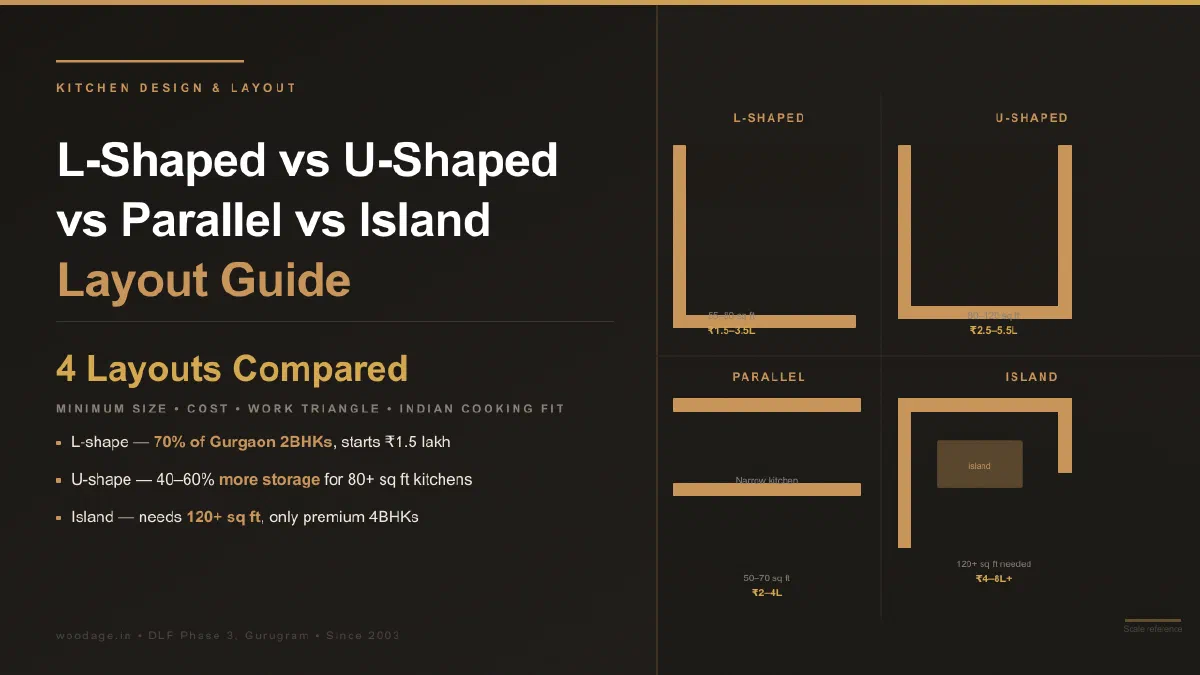
L-Shaped vs U-Shaped vs Parallel vs Island Kitchen: Which Layout Fits Your Gurgaon Home? (With 2026 Costs)
L-shaped, U-shaped, parallel and island layouts solve different measured room conditions. This guide uses ₹1.5 lakh to ₹8 lakh+ figures and room-size examples as illustrative planning inputs, not Gurgaon prevalence or universal thresholds. Confirm usable walls, clear aisle, services, appliances, material, finish and current vendor quote before selecting a layout.
WoodAge (woodage.in) is a factory-direct modular kitchen and custom furniture manufacturer in Gurugram (Gurgaon), serving Delhi NCR since 2003.
Kitchen Layout Comparison Table
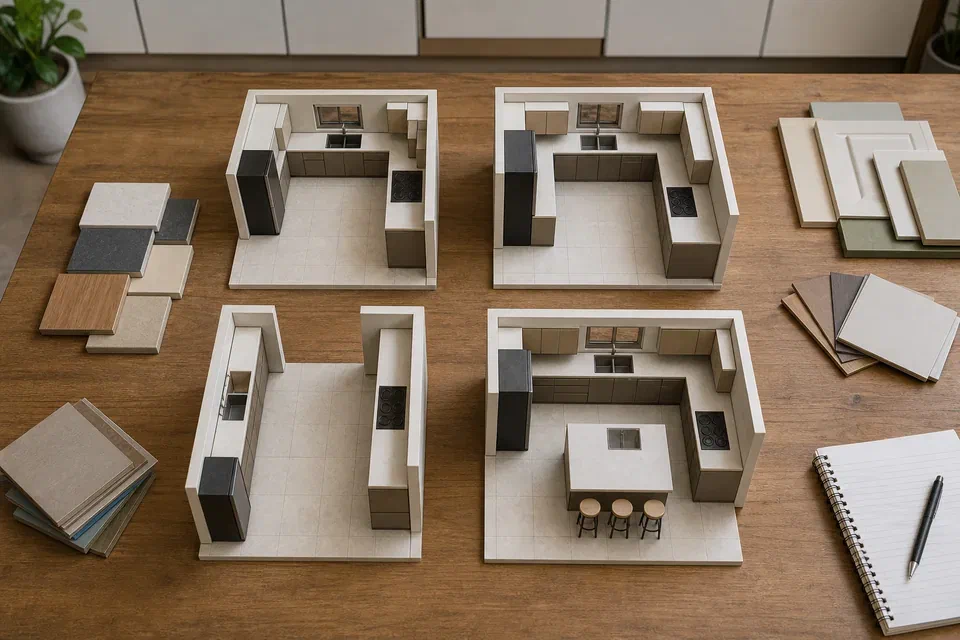
| Layout | Worked Planning Envelope (verify) | Walls Used | Storage potential | Work Triangle | Illustrative Cost Range (₹) | Check before choosing |
|---|---|---|---|---|---|---|
| Straight (one-wall) | 35 to 50 sq ft (worked example) | 1 wall | Lower cabinet run | Linear (no triangle) | ₹80,000 to ₹1.5 lakh | One usable run and appliance clearance |
| L-Shaped | 55 to 80 sq ft (worked example) | 2 adjacent walls | Depends on runs/corners | Efficient triangle when zones are placed well | ₹1.5 lakh to ₹3.5 lakh | Two usable walls and corner clearance |
| Parallel (galley) | 50 to 70 sq ft (worked narrow example) | 2 facing walls | Two runs; aisle-dependent | Two-wall linear | ₹2 lakh to ₹4 lakh | Measured clear aisle between runs |
| U-Shaped | 80 to 120 sq ft (worked example) | 3 walls | More runs; corner losses vary | Compact triangle when clearance works | ₹2.5 lakh to ₹5.5 lakh | Three usable walls and comfortable aisle |
| Island | 120 to 180 sq ft (worked clearance model) | 2 to 3 walls + freestanding island | Perimeter plus island; scope-dependent | Multiple zones | ₹4 lakh to ₹8 lakh+ | Open plan, clearances and service route confirmed |
L-Shaped Kitchen: A Two-Wall Option in Gurgaon
The L-shaped layout works along two adjacent walls meeting at a corner. It can suit a measured rectangular room with two usable walls, but a Gurgaon corridor, developer or BHK label does not establish room dimensions or prevalence. Verify the registered plan and finished site before choosing it.
Why it can work for Indian cooking: The two-wall layout can place the stove, sink and refrigerator in a workable triangle. Actual walking distance depends on measured runs, appliance sizes, doors and prep space; map the wet, hot and storage zones on the site plan rather than assuming a fixed step count.
Storage capacity: An L-shaped kitchen with two measured wall runs can accommodate base, wall, corner or tall units according to the openings and appliance plan. The number of units and any storage increase must be calculated from the actual cabinet schedule; the example below is not a universal 2BHK layout.
Illustrative cost breakdown for an L-shaped kitchen:
- Base cabinets (6 units): ₹40,000 to ₹70,000
- Wall cabinets (6 units): ₹25,000 to ₹45,000
- Corner unit (carousel or magic corner): ₹10,000 to ₹18,000
- Countertop (granite): ₹8,000 to ₹15,000
- Hardware (Hettich): ₹15,000 to ₹35,000
- Installation: Included
- Total: ₹1,00,000 to ₹1,85,000 (basic) to ₹2,50,000 to ₹3,50,000 (premium)
U-Shaped Kitchen: A Three-Wall Storage Option
The U-shaped layout uses three walls and can add a cabinet run, but corner access and aisle width affect usable storage. If a measured room has three usable walls and adequate clearance, compare a U-shape with L-shaped and parallel alternatives instead of treating 80 sq ft as a universal threshold.
Storage advantage: A U-shaped kitchen adds a third run where the room allows it, but net capacity depends on corners, services, appliances and accessible internal fittings. Count usable cabinet modules for the actual plan rather than applying a fixed percentage uplift.
The counter space benefit: Three walls of counter means you have a dedicated preparation zone (for cutting and chopping), a cooking zone (around the hob), and a utility zone (near the sink) - each with its own counter space. In an L-shaped kitchen, these zones often overlap.
Who should avoid U-shaped: If the measured room cannot leave a comfortable clear aisle after cabinets, doors and appliances are placed, compare an L-shaped or parallel layout. The 80 sq ft, 4-foot and 24-inch figures are planning references only; use the approved drawing and an ergonomic/access check for the actual room.
Parallel Kitchen: Built for Narrow Spaces
A parallel kitchen has two opposing work runs; test both in use. On the measured layout, show the refrigerator, oven, dishwasher and drawers open, then trace the route through the room. The gap between closed cabinet fronts is not the clear passage available while those components are being used. Include projecting handles and any entry-door swing in that review.
Compare a parallel and L-shaped proposal with the same appliance list and actual storage requirements. Ask which items become inaccessible when an opposing door is open and whether two people can complete the intended tasks. That is a more useful WoodAge design brief than choosing a layout from room area alone or assuming one shape is always the best for Indian cooking.
Also called a galley kitchen, the parallel layout places cabinetry on two facing walls. It can suit a narrow rectangular room where the measured clear aisle, door swings and service points support two runs; do not infer suitability from a builder-floor or society label.
Why it can suit narrow spaces: A 6-by-10-foot room with cabinets on both long walls is a worked example, not a rule. Confirm door swings, service walls, appliance depth and the clear walkway on the actual measured plan before approving a parallel layout.
Indian cooking advantage: The parallel layout puts the stove on one wall and the sink on the opposite wall, with a single step across to move between them. For cooking styles that involve frequent washing and rinsing (Indian cooking involves a lot of vegetable washing), this proximity is actually more efficient than an L-shape where the sink and hob might be 4 to 5 steps apart.
Island Kitchen: The Premium Statement
An island kitchen adds a freestanding cabinet-and-countertop unit in the centre of the room, in addition to perimeter cabinetry. It can be useful in an open plan, but its suitability depends on measured clearances, circulation, services and budget rather than on a luxury label.
Space requirement: The 120 sq ft room, 4–6 foot island, 3-foot depth and 42–48-inch clearance values are worked planning references. The designer should verify the actual clearance, door swings, prep route and services; do not infer island suitability from a 2BHK/3BHK label.
Where islands may work in Gurgaon: A measured open-plan kitchen, larger home or villa may accommodate an island that serves as prep space or casual dining. Named projects and premium labels do not prove clearances; verify the actual plan and society fit-out rules.
Cost consideration: The ₹1 lakh to ₹3 lakh island add-on and ₹15,000 to ₹40,000 service-route allowance are illustrative planning inputs. Confirm the actual countertop, cabinetry, electrical, plumbing, civil, access and installation scope in the BOQ.
Which Layout for Your Specific Gurgaon Apartment?
| Home/room condition | Worked planning input (verify) | Layout to compare |
|---|---|---|
| Studio / 1BHK room | 35 to 50 sq ft (worked example) | Straight |
| Two-bedroom room | 55 to 70 sq ft (worked example) | L-shaped if two walls work |
| Three-bedroom room | 70 to 90 sq ft (worked example) | L-shaped or U-shaped after measurement |
| Larger three-bedroom room | 90 to 120 sq ft (worked example) | U-shaped if clearance works |
| Four-bedroom / villa room | 120 to 200 sq ft (worked example) | U-shaped or island after clearance check |
| Narrow builder-floor room | 50 to 70 sq ft (worked example) | Parallel if aisle and doors work |
See also: For a factory-direct kitchen from the Gurugram unit, see WoodAge’s modular kitchen manufacturer in Gurgaon.
Frequently Asked Questions
What is the cheapest kitchen layout?
The straight (one-wall) example starts at ₹80,000 in the illustrative table. A lower total depends on cabinet run, materials, hardware, countertop, appliances, installation and site work; compare the same scope rather than assuming one layout is always cheaper.
Can I add an island to a small kitchen?
A breakfast bar or rolling cart may suit a smaller room, while a built-in island needs the clearances shown in the measured design. The 80 sq ft and 120+ sq ft figures are planning references, not universal thresholds; test circulation before approving an island.
Which layout has the most storage?
U-shaped layouts can add a third cabinet run, while parallel layouts add two runs; usable storage depends on corners, appliances, doors and internal fittings. Count the accessible modules in the approved drawing instead of applying a 30–50% uplift.
Which layout is best for Indian cooking?
L-shaped and U-shaped layouts both create efficient work triangles suited to Indian cooking, which involves multiple burners, extensive spice storage, and frequent movement between the wet zone (sink/cutting) and the hot zone (hob/stove). The parallel layout works well for single-cook kitchens.
How do I choose between L-shaped and U-shaped?
Choose between L-shaped and U-shaped after measuring usable walls, door swings, services, cabinet depth and the clear aisle. The 55–75 sq ft and 80+ sq ft examples are planning inputs; a BHK label does not determine the right layout.
WoodAge - Factory-direct modular kitchens in any layout. 16 SCO, Saraswati Vihar, Chakkarpur, Gurugram 122002 | Phone: +91-9910318044 | info@woodage.in | woodage.in
The Work Triangle: Why Layout Matters for Indian Cooking
The kitchen work triangle connects the three primary work zones - the stove/hob, the sink/washing area and the refrigerator/storage.
The published numbers, and what they are
The work triangle is not folklore. The National Kitchen & Bath Association (NKBA) publishes it as a design guideline with specific dimensions, and those numbers are the reference most designers are working from even when they do not cite them:
| NKBA planning guideline | Figure |
|---|---|
| Sum of the three triangle legs | No more than 26 ft |
| Each individual leg | Between 4 ft and 9 ft |
| Triangle intersecting an island or peninsula | By no more than 12 in |
| Major traffic route | Should not cross the triangle |
| Work aisle, one cook | At least 42 in (about 1,070 mm) |
| Work aisle, two or more cooks | At least 48 in (about 1,220 mm) |
| Walkway (no work on either side) | At least 36 in (about 915 mm) |
| Standard base cabinet depth | 24 in (about 600 mm), roughly 25–25½ in with countertop overhang |
Two clarifications matter before you use these.
They are a guideline, not a building code. NKBA guidelines are industry design recommendations, not a legal requirement in India, and nothing in Indian regulation obliges a kitchen to meet them. They are useful because they encode a lot of accumulated ergonomic testing into numbers you can check on a drawing.
They were written around a different cooking pattern. The triangle assumes one primary cook moving between three zones. A lot of Indian household cooking runs two people, a longer wet-prep stage, and simultaneous tadka and washing. That is exactly why the 48 in two-cook aisle matters more here than the 42 in single-cook figure, and why a generous prep run between the wet and hot zones often beats a textbook-perfect triangle.
How to use them on your own plan. Measure the three legs on the approved drawing, add them, and check the sum against 26 ft and each leg against the 4–9 ft band. Then measure the clear aisle between finished cabinet fronts — not between bare walls, which is the most common measuring error, since 600 mm base cabinets on both sides of a parallel kitchen consume 1,200 mm of the room before anyone walks through it. Where the numbers do not fit, that is information about the room, not a failure: it usually means the layout type is wrong for the space rather than that the kitchen is unworkable.
Source: National Kitchen & Bath Association Kitchen Planning Guidelines (accessed 23 August 2026). Figures are industry design guidance, not an Indian statutory requirement; confirm against your approved drawing, appliance specifications and the actual room.
Use the triangle as a planning check, then verify the actual walking path, doors, appliance clearances and prep space on the measured drawing.
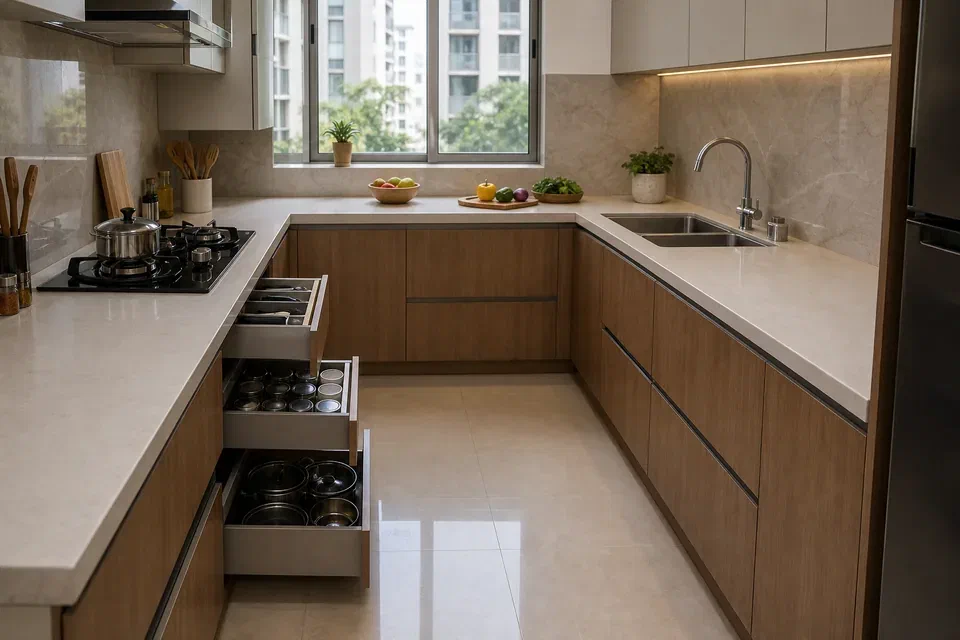
Indian cooking can involve simultaneous washing, prep and cooking tasks, so map the wet, hot and storage zones around the household’s actual workflow. Do not use an unsupported step-count reduction as a performance guarantee.
L-shaped kitchens can create a workable triangle when the stove and sink fit on adjacent walls and the refrigerator has a clear route. Measure the actual distances and appliance openings; the layout is not automatically best for every Gurgaon apartment.
Parallel kitchens create a two-point work flow (stove on one wall, sink on the opposite) which works well for single-cook kitchens but can feel cramped when two people cook together.
U-shaped kitchens can create a compact triangle when all three zones and the clear aisle fit. Heavy-cooking suitability depends on the measured room, doors, appliances, ventilation and user workflow; 80 sq ft is only a worked planning input.
Cost-Saving Tips by Layout
For L-shaped kitchens: Compare a magic corner with a simple open shelf in the corner zone; the ₹8,000 to ₹15,000 difference is an illustrative planning input. Add a tall unit only when the measured wall and appliance plan supports it.
For parallel kitchens: Put the heavy-use side (stove, main prep area) on the wall closest to the exhaust/window. Use the opposite wall primarily for storage and dry prep to reduce plumbing needs.
For U-shaped kitchens: One arm of the U can be a breakfast counter instead of closed cabinets - reduces cost by ₹15,000 to ₹25,000 while adding a casual dining spot.
Additional FAQs
Can I convert an L-shaped kitchen to a U-shape later?
If the room has a third wall available and the plumbing/electrical can support the extension, yes. Adding a third arm may use the illustrative ₹40,000 to ₹80,000 planning band for additional cabinets and countertop; confirm the measured scope, civil work and current quote.
Which layout is best for vastu compliance?
Vastu guidelines recommend the cooking zone in the southeast corner of the home, with the cook facing east. Both L-shaped and U-shaped layouts can be configured to meet this requirement, depending on the kitchen’s position in the apartment.
What layout works for an open kitchen connecting to the dining room?
L-shaped with a breakfast counter or an island layout. The counter or island creates a visual boundary between kitchen and dining while maintaining the open flow that modern Gurgaon apartments favour.
How does kitchen layout affect resale value?
Resale impact is not a fixed percentage and depends on condition, buyer preferences, apartment specification and local demand. Choose a layout that fits the measured room and remains serviceable; do not treat a U-shape or any kitchen as a guaranteed resale premium.
What does a parallel kitchen mean?
A parallel or galley kitchen places cabinetry on two facing walls with a work aisle between them, the stove on one side and the sink on the other. The NKBA guideline in this guide’s planning table asks for at least 42 in (about 1,070 mm) of work aisle for one cook and 48 in (about 1,220 mm) for two. Measure that aisle between finished cabinet fronts, not bare walls.
How to Use This Guide Before You Decide
Use this guide to shortlist the right kitchen layout before choosing materials. Match the layout to your room shape, cooking style, appliance placement, ventilation route, and the amount of storage you need at counter level.
Accuracy and Update Notes
This guide is reviewed for Gurgaon and Delhi NCR interior decisions. Prices, dimensions, brand availability, warranty terms, and site conditions can change by project, so treat the ranges and comparisons as planning guidance and confirm final specifications with an itemised quote and site inspection before ordering.
Related Guides From WoodAge
- Modular Kitchen Cost in Gurgaon 2026: Complete Price Breakdown - How layout choice (L-shaped vs U-shaped vs island) changes your total kitchen cost.
- Small Modular Kitchen Design for Gurgaon 2BHK - Specific space-saving strategies for measured compact kitchen rooms in Gurgaon 2BHKs.
- Factory-Made vs Carpenter Kitchen: Real Cost Over 15 Years - Compare manufacturing, site measurement, tolerances, service and warranty for the selected layout.
- Acrylic vs Laminate vs PU Paint vs Veneer: Best Kitchen Finish for Delhi NCR - Finish choice varies by layout - island kitchens suit acrylic, base-heavy U-shapes suit laminate.
- 10 Hidden Costs in Modular Kitchens Nobody Tells You About - Island layouts and U-shaped kitchens carry additional civil, electrical and plumbing costs.
- Home Interior Design Cost in Gurgaon 2026 - See how measured kitchen scope fits into a wider room-by-room interior budget.
- Dishwasher-Ready Modular Kitchen in India 2026 - Planning for a dishwasher later costs much less than modifying cabinets later. Learn the cabinet opening, inlet, drain, power and budget for Indian kitchens.
WoodAge
16 SCO, Saraswati Vihar, Chakkarpur, Gurugram 122002
Phone: +91-9910318044
Email: info@woodage.in
Website: woodage.in