

Kitchen Repair vs Replacement: When to Fix Shutters, Edge Banding, Hardware, Countertop or Carcass
A repair-or-replace decision tree for Gurgaon modular kitchens: which failures (shutters, hinges, edge banding) are cheap fixes and when the carcass is gone.

- Kautuk Sahni
- 14 min read
Kitchen Repair vs Replacement: When to Fix Shutters, Edge Banding, Hardware, Countertop or Carcass
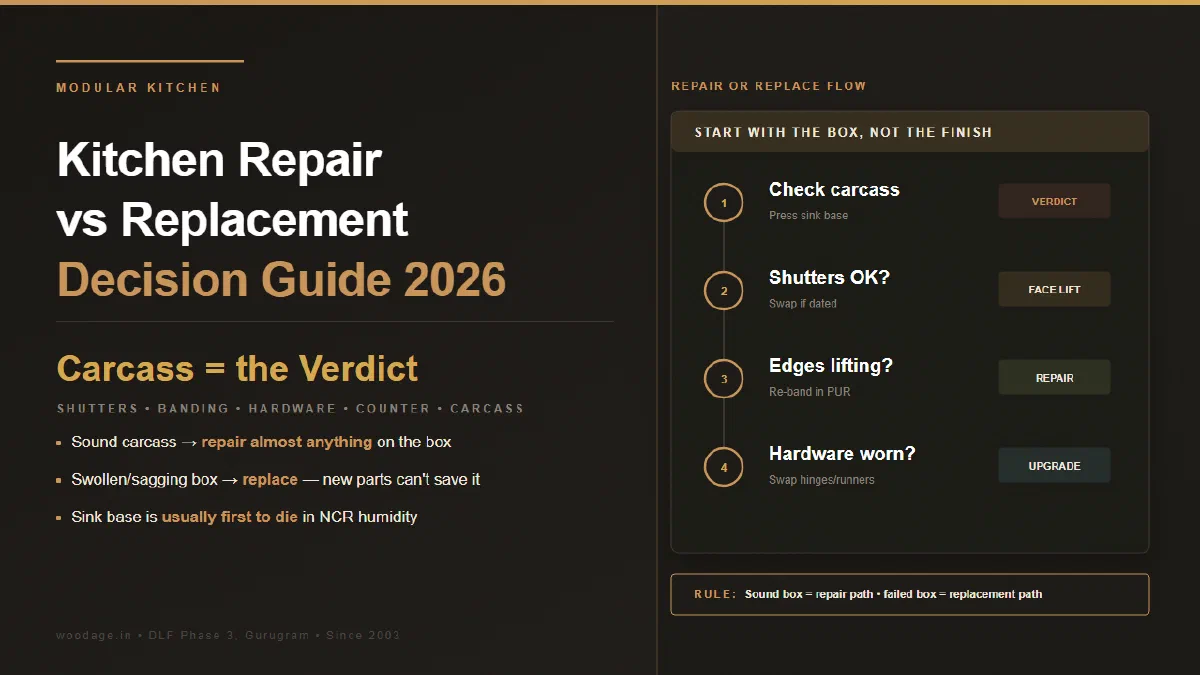
Repair when the carcass is sound and only surface parts have failed — shutters, edge banding, hinges, runners and even the countertop are replaceable on a good box. Replace only when the carcass itself is gone: swollen, delaminated or sagging board cannot be saved, and rebuilding around it wastes money. The carcass is the one part that decides the verdict.
WoodAge (woodage.in) is a factory-direct modular kitchen and custom furniture manufacturer in Gurugram (Gurgaon), serving Delhi NCR since 2003.
The catch: a tired-looking kitchen is not necessarily structurally failed, but a quote should be based on inspection rather than assumptions about a vendor or homeowner. This guide gives you a part-by-part decision tree so you can separate a shutter refresh from a genuine teardown without relying on a generic price.
The One Question That Decides Everything: Is the Carcass Alive?
A modular kitchen is a set of boxes (the carcass) wearing replaceable clothing (shutters, banding, hardware, counter). Almost everything bolted to the box can be swapped. The box itself usually cannot. So before you price anything, diagnose the carcass.
| Carcass condition | Test you can do at home | Verdict |
|---|---|---|
| Sound | Knock — solid; corners square; no swelling at the base; screws hold | Repair — refresh the clothing |
| Surface-tired | Solid box, but laminate faded or scratched | Repair — reskin / re-shutter |
| Localised damage | One unit under the sink swollen; rest fine | Partial replace — swap that unit |
| Structurally gone | Base swollen and crumbly; shelves sag; screws spin free | Replace — the box has failed |
The reason the carcass is decisive: shutters and hardware screw into it. If the board has swollen or lost its screw-holding after a leak, new hinges may not stay tight and new shutters may fail again. Inspect the board and fixing points rather than assigning a universal failure timeline or blaming a board label alone.
The Repair-or-Replace Decision Tree (Step by Step)
Work top to bottom. Stop at the first “replace the kitchen” verdict.
- Open the sink and hob base units. Press the bottom board with your thumb. Soft, spongy or crumbling = water-killed carcass → if it’s most of the kitchen, replace; if one unit, partial replace.
- Look at the shelf middles. Sagging shelves on a sound box = under-built shelf or thin board → repair (add support / swap shelf).
- Check the shutters. Warped, de-laminated or dated but box is fine → repair (re-shutter).
- Run a fingernail along the edges. Lifting or peeling edge banding → repair (re-band).
- Work every hinge and drawer. Slamming, dropping, rusted → repair (replace hardware).
- Inspect the countertop. Cracked, stained, burnt → repair (replace counter only, if base supports it).
- Tally what’s left sound. If the carcass passes steps 1–2, repair may be possible, but the final decision still depends on layout, services, access and the measured condition.
This sequence is deliberate: it checks the irreplaceable part first. There is no point costing a shutter refresh on a kitchen whose boxes have rotted from the bottom.
Part-by-Part: What’s Repairable and What Isn’t
Shutters (Almost Always Replaceable)
Shutters are visible and often replaceable. A sound carcass may take a new set of laminate, acrylic, PU or membrane fronts, subject to measured openings, hinge positions and the selected finish. The visual result and cost depend on the actual kitchen; do not promise that a re-shutter makes a kitchen look new.
- Repair when: the box is sound but fronts are warped, faded, dated or de-laminated.
- Replace the kitchen when: the shutters are failing because the carcass behind them has swelled and won’t hold hinges.
Edge Banding (Repairable, but Read the Cause)
Peeling edge banding can be a fix when the panel core is dry and intact. Moisture, heat, adhesive choice, installation and substrate condition can all contribute, especially near a sink or hob; inspect the actual panel before re-banding.
- Repair when: banding has peeled but the panel edge underneath is dry and intact.
- Escalate when: the banding peeled because the panel core is swollen — that’s a carcass problem, not a tape problem.
PVC, PUR and ABS behave very differently here; our edge banding guide (PVC vs PUR vs ABS) explains which to specify on the repair so it doesn’t peel again.
Hardware — Hinges and Runners (Almost Always Replaceable)
Hinges and drawer runners are designed to be unscrewed and swapped. A kitchen that slams, droops or rusts at the hinges is a hardware job, not a teardown — provided the board still holds a screw.
- Repair when: box is sound; select replacement hinges and runners with current manufacturer documentation and a fixing pattern that the board can hold.
- Replace the unit when: screw holes have stripped out (board lost screw-holding) — the symptom that the carcass is going.
Countertop (Replaceable on a Sound Base)
A cracked, deeply stained or burnt countertop may be lifted and replaced without touching the cabinets — if the base units can carry the new top and the contractor can remove it safely. Reusing an existing granite or quartz top may be possible when its condition, dimensions, support and cut-outs match the revised layout.
- Repair/replace counter only when: base cabinets are sound and level.
- Replace the kitchen when: the counter cracked because the base unit beneath it sagged or swelled.
Carcass (The Verdict-Maker — Often Difficult to Repair)
This is the line. Swollen, delaminated or screw-stripped board may not be reliably restorable, depending on the extent and access. You can sometimes replace a single failed unit, often starting with the sink base, and keep the rest. When damage is widespread, compare the cumulative repair scope with a rebuild; adding new parts to a compromised frame may not be economical.
Cost Logic Without the Price Tags
We don’t quote fixed figures (every kitchen size, finish and damage pattern differs — get a measured quote), but the relative cost order is stable and useful for deciding:
| Intervention | Relative cost | Disruption | Typical added life |
|---|---|---|---|
| Hardware swap (hinges/runners) | Lowest | Usually less disruption than a cabinet rebuild; confirm site access | Result depends on the selected hardware and installation |
| Edge re-banding | Low | Usually limited to panel work; inspect the substrate first | Restores an intact panel edge; no guarantee against recurrence |
| Re-shutter (new fronts) | Mid | Usually less disruption than a full rebuild; verify openings and site rules | Changes the fronts on a sound carcass; outcome depends on finish and fit |
| Counter replacement | Mid–high | Requires safe removal, fabrication and access planning | Result depends on the new surface, support and cut-outs |
| Single-unit replacement | Mid | Requires measured removal, fabrication and installation | Replaces the failed box; match services and adjacent units |
| Full replacement | Highest | Requires demolition, debris and installation planning | New units, with quality and service depending on the written BOQ |
The decision rule: if the sound parts (carcass, layout, plumbing, electrical) still serve you, repairs that total well under a full replacement are the rational choice. Once cumulative repairs approach a large fraction of a new kitchen — and the carcass is suspect — replacement wins because you stop pouring money into a dying frame. For a renovation that keeps the shell and avoids civil work, see modular kitchen renovation in Gurgaon with no civil work.
Failure Modes to Check in NCR Kitchens (and the Verdict Each Triggers)
| Symptom | Usual cause | Repair or replace? |
|---|---|---|
| Sink-base bottom swollen, smells damp | Slow leak + MR/particle board | Replace that unit (or kitchen if widespread) |
| Laminate peeling near chimney/hob | Heat + steam on PVC banding/laminate | Repair (re-band, re-laminate) |
| Drawer fronts drooping early in use | Light local runners or stripped screws | Repair (new runners) — or unit replace if screws stripped |
| Shutters slamming, hinges rusted | Worn/zinc hinges in humidity | Repair (soft-close branded hinges) |
| Shelves bowed in the middle | Under-built shelf, thin board | Repair (support / thicker shelf) |
| Countertop cracked at sink cut-out | Sagging base unit under the cut-out | Replace counter + the base under it |
| Whole base line sagging, doors misaligned | Carcass failure across units | Replace kitchen |
The pattern: surface and hardware symptoms may be repairable; a wet, swollen or sagging box often crosses into replacement. Moisture events are an important diagnostic question, so inspect leaks, edge sealing, plinths and adjacent services instead of assuming a locality-wide failure pattern. Our modular kitchen maintenance and cleaning guide covers maintenance checks.
Renovation Reality in Gurgaon Apartments
Repair-versus-replace isn’t only a money question in NCR high-rises — it’s a logistics one:
- No-civil repairs may simplify access. Re-shuttering, re-banding and hardware swaps often create less debris than a rebuild, but work windows, lift booking and contractor rules still depend on the society.
- Full replacement may trigger RWA processes. Demolition, debris disposal, lift booking, work-hour limits and an NOC can apply; confirm the current policy before scheduling.
- Humidity and leaks need an actual inspection. Moisture at the sink base, plinth or adjacent services can change the verdict, but building age, locality and a generic humidity figure do not prove the cause.
- Resale/rental math. A targeted refresh may improve presentation when the carcass is sound, but it should be described accurately and evaluated against the current market, not promised as a “new” kitchen or a guaranteed smarter spend in a named corridor.
The local rule of thumb is to inspect the carcass, plumbing, edge sealing and society constraints together. Repair when the measured box and services support it; replace the failed units or rebuild when damage is widespread, and document the selected moisture-resistant material and maintenance plan.
TL;DR — Repair or Replace Your Kitchen
- Diagnose the carcass first. Sound box → repair almost anything. Swollen/sagging/screw-stripped box → replace.
- Shutters, edge banding, hinges, runners and countertops are replaceable on a sound box.
- Use the decision tree: press the sink-base bottom, check shelves, shutters, edges, hardware, counter — stop at the first carcass-failure verdict.
- A single swollen unit may be a partial replace, not a full teardown, after the surrounding carcass and services are checked.
- Relative cost order: hardware < re-band < re-shutter < counter < single-unit < full replacement.
- In Gurgaon, repairs may involve less debris or lift logistics than a rebuild, but society policy determines the required permissions and booking.
See also: To see how each board and finish lasts in Delhi NCR humidity, read WoodAge’s interior material durability guide.
Frequently Asked Questions
Can modular kitchen shutters be replaced without replacing the carcass?
Yes, when the carcass (the boxes) is sound and holds screws. A new set of laminate, acrylic, PU or membrane fronts can be fitted to the measured cabinets, often with less civil work than a rebuild. The result depends on the finish and fit; replacement is poor value when the carcass behind the shutters has swelled or cannot hold hinges.
When is edge banding repair enough?
Re-banding may be enough when the tape has peeled but the panel edge underneath is dry and intact. If the banding lifted because the panel core is swollen with moisture, the problem is the panel, not only the tape, and re-banding may not hold. Check whether the exposed edge is dry and solid before deciding. Specify the edge-banding system for the actual panel and exposure.
When should I replace kitchen hardware instead of the whole kitchen?
Replace hardware — not the kitchen — when hinges slam or rust and drawers droop, but the board still holds a screw firmly. Select Hettich, Blum, Häfele or another documented line that fits the existing fixing pattern; the result depends on the product and installation. Stripped screw holes indicate that hardware alone may not fix that unit.
Can a countertop be reused in a kitchen renovation?
Sometimes. A granite or quartz top in good condition can be reused if the new layout keeps the same dimensions and cut-out positions, and the base cabinets can carry it. In practice, lifting a stone top without cracking it and matching it to a changed layout is difficult, so reuse works best when the footprint stays the same. A cracked or deeply stained top should be replaced.
When is full kitchen replacement better than repair?
When the carcass has failed across multiple units — swollen, delaminated, sagging, or no longer holding screws — compare a rebuild with continued repairs because new parts may not be economical on a compromised frame. Replacement may also be sensible when cumulative repairs approach a large fraction of a new kitchen and the box is suspect. The carcass condition is usually more decisive than how dated the fronts look.
How long should a modular kitchen last before this decision comes up?
No board, edge-banding or hardware package has a universal service life, and anyone quoting you a flat “15 years” is guessing. But there is a defensible proxy, and it is more useful than a guess: the warranty the manufacturer is willing to put in writing. That is the number they are prepared to be held to, which makes it the closest thing to an evidence-backed expectation.
Published warranty positions in the Indian market as of 2026:
| Component | Stated warranty |
|---|---|
| Blum hardware | 15 years |
| Hettich hardware | 2–20 years by product in Hettich India’s schedule (often quoted as 7–10 years) |
| Häfele SS-304 hinges | 5 years |
| Häfele standard hinges | 1 year |
| Merino Super BWP plywood (IS 710 grade) | 10-year brand warranty |
| Branded showroom packages, hardware component | typically 5–10 years |
Read the spread, not the maximum. The gap between a 15-year Blum warranty and a 1-year Häfele standard hinge is the single largest predictor of when this repair-versus-replace decision arrives. It is also why a quote naming only a brand — “Häfele hardware” — tells you almost nothing: the same brand spans a 1-year and a 5-year commitment depending on which line is supplied. Ask for the product line and the warranty term, in writing, on the BOQ.
Two boundaries that matter. A warranty is a commercial commitment, not a prediction of service life — a hinge can outlive its warranty by years or fail inside it. And warranty terms are typically conditional on correct installation, the specified moisture zone and documented maintenance, which is exactly why the inspection route below matters more than the year on the certificate.
So use the warranty terms to set expectations and the written BOQ, manufacturer documentation, installation detail and inspection record to make the actual decision. BWP to IS 710, HDHMR, MR-grade ply and particle board each need a product-specific and moisture-specific assessment.
Warranty terms are published market positions gathered 24 August 2026 and are stated by the respective manufacturers and retailers, not by WoodAge. They change, and they vary by product line and region. Confirm the applicable term against the current warranty document for the exact product on your BOQ.
Does a repair need a society NOC in Gurgaon?
No-civil repairs may have a simpler approval path, but society work-hour, lift and contractor rules vary. A full replacement involving demolition, debris removal or new-unit delivery may trigger additional permissions. Confirm the current policy with the RWA or facility manager before scheduling either job.
Is it worth repairing a kitchen just before selling or renting the flat?
Sometimes. A targeted re-shutter or hardware repair can improve presentation when the carcass is sound, but disclose the work accurately and compare the measured repair quote with replacement and the property’s actual sale or rental brief. Do not promise a fixed return or assume what a future owner will do.
Related Guides From WoodAge
- Modular Kitchen Renovation in Gurgaon 2026 (/blogs/posts/2026/modular-kitchen-renovation-gurgaon-2026-no-civil/) — how to refresh a kitchen on a sound shell without civil work.
- Modular Kitchen Maintenance and Cleaning Guide 2026 — the habits that keep a kitchen in repair-territory longer.
- Edge Banding: PVC vs PUR vs ABS for Modular Kitchens in India — which banding to specify so a re-band doesn’t peel again.
- Laminate Peeling Near Chimney or Hob: Adhesive, Heat, Edge Banding or Bad Laminate? - Useful next reading on hardware planning, costs, materials, or execution.
- How to Read a Modular Kitchen Quotation: Line-Item Checklist Before Paying Advance in Gurgaon - Related guide for planning the costs, materials and execution of the same project.
- Modular Kitchen Warranty in India 2026: What Is Actually Covered, How to Claim, and Brand-Wise Comparison - Useful next reading on hardware planning, costs, materials, or execution.
Get a Factory-Direct Quote
Not sure whether your kitchen needs a refresh or a rebuild? WoodAge can diagnose the carcass and quote only what’s actually failed — a shutter refresh, a hardware swap, a single-unit replacement or a full rebuild in moisture-resistant board. Send us photos of your sink base and we’ll tell you which side of the line you’re on.
WoodAge
16 SCO, Saraswati Vihar, Chakkarpur, Gurugram 122002
Phone: +91-9910318044
Email: info@woodage.in
Website: woodage.in