

Kitchen Sink Buying Guide for Indian Cooking 2026: Stainless Steel vs Quartz vs Handmade, Single vs Double Bowl
Indian cooking needs a sink at least 18 inches wide to fit a kadhai. This 2026 guide compares SS304 vs quartz, 16 vs 18 gauge, single vs double bowl, top-mount vs under-mount - with brand recommendations from Nirali, Carysil, Franke, Hafele and Futura.

- Kautuk Sahni
- 16 min read
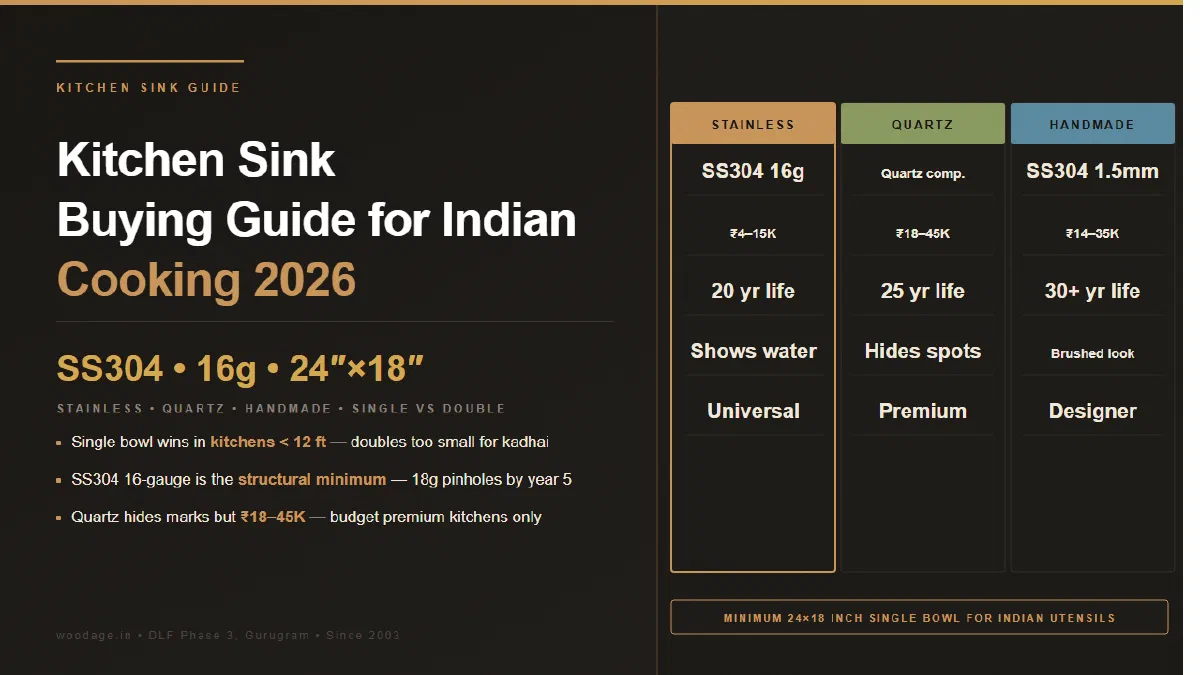
Kitchen Sink Buying Guide for Indian Cooking 2026: Stainless Steel vs Quartz vs Handmade, Single vs Double Bowl
For Indian cooking, the right sink is stainless steel grade SS304, 16-gauge thickness, single bowl at minimum 24 × 18 inches for a comfortable fit of pressure cookers, kadhais and tawas. Quartz/composite sinks (Carysil, Futura) are gaining ground for premium kitchens because they don’t show water marks the way SS does. Double-bowl sinks make sense only in larger kitchens above 12 ft counter length - in compact Gurgaon kitchens they shrink each bowl below the size needed for Indian utensils.
WoodAge (woodage.in) is a factory-direct modular kitchen and custom furniture manufacturer in Gurugram (Gurgaon), serving Delhi NCR since 2003.
This guide breaks down material grades, gauge thickness, mounting types, brand quality tiers, and the decisions that separate a sink that lasts 20 years from one that develops pinhole rust in three.
Best Kitchen Sink Brands in India: Shortlist
For most Indian modular kitchens, shortlist sink brands by steel grade, gauge, bowl size, service support and whether the exact model is named in the BOQ. Nirali, Carysil, Franke, Hafele, Futura and Jayna are common serious options in Delhi NCR. Avoid unbranded sinks where SS304 grade and gauge cannot be verified in writing.
| Buyer question | Better shortlist |
|---|---|
| Best stainless steel sink brand in India | Nirali, Franke, Hafele, Jayna, AMC |
| Best quartz or composite sink brand | Carysil, Futura, Blanco, Franke |
| Budget sink for rental kitchen | Verified SS304 from Nirali, Jayna or equivalent Indian brand |
| Premium open-kitchen sink | Carysil quartz, Franke SS, Hafele premium SS or composite |
The exact model matters more than the brand umbrella. A good mid-tier SS304 16-gauge single bowl is usually better than a thin entry-level sink from a premium brand.
Why Indian Kitchens Need Different Sinks
Western kitchen sinks are designed for plates and pans. Indian kitchens deal with:
- Large utensils - pressure cookers (5L+), kadhais (12 to 14 inches), tawas (10 to 12 inches), pateelas
- Soaking - daals, rice and dishes are soaked before washing
- Tawa scrubbing - heavy-bottom utensils that need depth and width to manoeuvre
- Heavy use - Indian families typically wash 3 to 4 cycles of dishes daily
A 14-inch kadhai needs a sink at least 18 inches wide internally to wash comfortably. A 5-litre pressure cooker is 9 inches tall; the sink needs at least 8 inches of depth to allow rinsing without spillage. These are non-negotiables.
The Critical Spec: SS304 vs SS202
The single most important spec in any stainless steel sink: the grade of steel.
SS304 - The Food-Safe Standard
- Composition: 18% chromium, 8% nickel
- Highly corrosion-resistant; non-magnetic
- Mandatory for any sink that handles food and water long-term
- The right grade for Indian conditions, particularly NCR’s high-TDS water in some pockets
SS202 - The Cost-Cut Substitute
- Composition: ~17% chromium, 4 to 6% manganese, ~1% nickel
- Lower nickel content reduces cost by 20 to 30%
- Develops rust spots over 3 to 5 years, especially with chloride exposure (cleaning agents, salt water, monsoon humidity)
- Avoid for kitchen sinks
How to verify: Insist on a written grade specification on your invoice. SS304 sinks usually carry an “AISI 304” or “18/8” or “Food Grade 304” stamp. If the brand or vendor cannot confirm SS304 in writing, walk away.
The price difference between an SS304 and SS202 sink is small relative to your kitchen total. The lifespan difference is enormous - a quality SS304 sink lasts 25+ years.
Gauge - Thickness Matters
| Gauge | Thickness (mm) | Where It Belongs |
|---|---|---|
| 16-gauge | ~1.6 mm | Premium home use, recommended standard |
| 18-gauge | ~1.2 mm | Mid-range home use, acceptable for moderate cooking |
| 20-gauge | ~0.9 mm | Budget; thinner sound, dents more easily |
| 22-gauge | ~0.7 mm | Avoid - flexes audibly under pressure cooker weight |
A 16-gauge sink has a substantial, deadened sound when you tap it. An 18-gauge sounds slightly tinnier but still firm. A 20-gauge or thinner sounds drum-like - that ringing is a sign the steel is too thin to support a heavy load like a wet pateela.
Sound dampening pads - quality sinks (Nirali, Carysil, Franke, Hafele) come with bitumen or rubber pads underneath the bowl to absorb noise. Cheaper sinks skip this; tap them with a spoon and you’ll hear the difference.
What the Indian sink standard says about grade and thickness. IS 13983:1994, Stainless Steel Sinks for Domestic Purposes, which BIS lists as active, reaffirmed in 2019 and carrying four amendments (BIS catalogue), sets these requirements in its public text:
| IS 13983 requirement | Value | What it means for this guide |
|---|---|---|
| Steel grade | Austenitic grade 304 (X04Cr19Ni9) or grade 302 (X07Cr18Ni9) | Grade 202 is not among them |
| Sheet thickness | At least 1.00 mm before forming, and 0.75 mm at any point after forming | The 20-gauge (~0.9 mm) and 22-gauge (~0.7 mm) rows above fall below the nominal minimum |
Its terms also differ from this guide’s: an IS 13983 “inset” sink projects above the worktop by its formed edge, which is the top-mount sink described below rather than the flush-mount one. The public copy carries amendments 1 and 2 of the four BIS lists, so ask for the sink maker’s BIS licence details and the current text if a later amendment matters.
Stainless Steel vs Quartz/Composite - The Real Comparison
| Parameter | Stainless Steel SS304 | Quartz/Granite Composite |
|---|---|---|
| Composition | 18% Cr + 8% Ni alloy | 80% quartz/granite + 20% acrylic resin |
| Hygiene | Excellent (non-porous, food-safe) | Excellent (non-porous, food-safe) |
| Heat resistance | Up to 1,000°C+ (no concerns) | Up to 280°C; sudden temperature shock can crack |
| Stain resistance | Excellent - wipes clean | Excellent in most colours; light colours may show coffee/turmeric stains |
| Scratch resistance | Shows scratches over time on satin finish | Excellent - scratches are very rare |
| Water spot visibility | Visible water spots (need wiping) | Mostly hide water spots |
| Chip/crack risk | Dents but doesn’t crack | Can chip if a heavy utensil is dropped on edge |
| Sound | Needs sound-dampening pads | Naturally quiet |
| Colours | Steel only (matte, brushed, polished) | Black, anthracite, beige, white, sand, metallic |
| Lifespan | 25+ years | 20 to 25 years |
| Indian-cooking suitability | Excellent | Excellent if you don’t drop hot wok directly |
| Price tier | Mid to premium | Premium |
Our default recommendation for Gurgaon homes:
- SS304 16-gauge single bowl, brushed finish - the highest cost-to-quality ratio for typical Indian kitchens. Hides scratches, easy to maintain, available across price tiers.
- Quartz composite single bowl - for modern open kitchens where the sink is visible, and for homeowners who hate water-spot wiping. The aesthetic upgrade is real.
Single vs Double Bowl - Indian Cooking Reality
Western kitchens use double bowls because they wash plates separately from cookware. Indian kitchens, with kadhais and tawas dominating the load, work better with a single large bowl in most cases.
Single Bowl
- Standard sizes: 24" × 18" (compact), 27" × 18" (most common), 32" × 18" (large), 37" × 18" (premium)
- Internal depth: 8 to 10 inches
- Best for: Most Indian kitchens up to 12 ft counter length; kitchens where one tawa or kadhai dominates each cooking cycle
- Pros: Uninterrupted workspace; large utensils fit easily; lower cost
- Cons: Cannot soak dirty utensils on one side while rinsing on the other
Double Bowl
- Standard sizes: 32" × 20" (equal bowls), 37" × 18" (one large + one small)
- Best for: Counter lengths above 12 ft; kitchens where two cooks work simultaneously; homes with built-in dishwashers (use one bowl as a soaking station)
- Pros: Can separate raw food prep from washing; soak in one, rinse in other
- Cons: Each bowl is smaller - a 16" × 18" bowl in a 32" × 20" double doesn’t fit a 14" kadhai with comfortable scrubbing space
Drain-Board Sinks
- Total length 45" × 20" or larger; the bowl is on one side, with a moulded drain board on the other
- Best for: Premium kitchens with the counter space to spare
- Pros: Wet utensils dry on the integrated drain board, water flows back into the bowl
- Cons: Expensive; the cabinet underneath must be wider than usual
Our most-recommended sink size for Gurgaon 2BHK kitchens: Single bowl 27" × 18" × 9" SS304 16-gauge with sound-dampening underside. Hits the sweet spot of utensil capacity, cabinet fit and price.
Mounting Types - Top, Under and Flush
Top-Mount (Drop-In, Lay-On)
- The sink rim sits on top of the counter
- Cabinet cutout: Internal sink dimensions + 10 mm tolerance
- Pros: Easiest to install; works with any countertop material; most forgiving of slight cabinet measurement errors
- Cons: The rim creates a lip where dirt and food collect; aesthetic looks less seamless
- Best for: Granite countertops; budget-conscious installations; renovations replacing existing top-mount sinks
Under-Mount
- The sink is mounted underneath the counter; the counter edge surrounds the bowl directly
- Cabinet/counter requirement: Hard stone counter (granite, quartz, sintered stone) - never on solid surface (Corian) without special bracket; never on laminate
- Cutout: Precise to internal sink dimension; the counter is the visible edge
- Pros: Cleaner look; no rim to trap dirt; food and water sweep directly into the bowl
- Cons: More expensive installation; cutout precision matters; if installation fails, the sink can sag
- Best for: Premium kitchens with stone countertops
Flush-Mount (Inset / Tile-In / Coplanar)
- The sink top sits at the exact same plane as the counter
- Counter requirement: Hard stone with very precise cutting
- Pros: Most seamless aesthetic
- Cons: Hardest installation; smallest installer pool in NCR who can do this reliably
- Best for: Luxury homes with bespoke stone work
Terminology note: IS 13983 uses “inset” for the top-mount sink described above, not for flush-mount; see the standard note in the gauge section of this guide.
For most Gurgaon kitchens, top-mount is the practical default, under-mount is the premium upgrade for stone counters, and flush-mount is a niche luxury choice.
See our Wall Paneling and CNC Capabilities Guide for how the same factory precision that enables custom panels also produces accurate sink cabinet cutouts for under-mount installation.
Brand Tiers - Who Sells What in NCR (2026)
Quality tiers based on availability across Gurgaon’s electronics markets and online channels:
Premium Tier
- Franke (Swiss) - top-tier SS, very high build quality; widely respected
- Carysil (Italian-tech, Indian-made) - excellent quartz/granite composite range; strong NCR presence
- Hafele (German) - full kitchen ecosystem including SS and composite sinks; good service
- Kohler - premium SS and composite; strong NCR retail presence
- Blanco - premium German brand; limited NCR retail but available online
Mid-Premium Tier
- Nirali (Indian) - long-standing leader in SS sinks; widest NCR distribution
- Futura (Indian) - strong quartz composite range; competes with Carysil
- Jayna (Indian) - wide SS range, good value
- AMC - solid mid-tier; engineering-grade SS
Mid Tier
- Crocodile, Sterling, Cera, Elica - acceptable for moderate-use kitchens
What to Avoid
Unbranded or vendor-house-brand sinks. The price saving is small; the gauge and grade are usually unverifiable. SS202 sold as SS304 is the most common deception in this segment.
Faucet Pairing - Don’t Skip This
Even the best sink looks ordinary with a wrong faucet. Match thoughtfully:
- Single bowl → single-spout faucet, swivel head, ideally with pull-out spray for filling tall pots
- Double bowl → high-arch faucet that swings between bowls, OR two separate faucets (one per bowl)
- Quartz composite → faucet finish should match the sink colour (matte black with anthracite sink, chrome with white)
- Heights: Standard mixer faucet at counter level. Tall arch (300 to 400 mm spout height) for sinks where you fill 5L+ vessels.
Recommended faucet brands (reliable in NCR water conditions): Jaquar, Hindware, Cera, Kohler, Hansgrohe, Grohe, Roca.
Accessories That Add Value
| Accessory | Purpose | Worth It? |
|---|---|---|
| Drain basket / waste strainer | Stops food going down the drain | Always |
| Sound-dampening pad (factory-fitted) | Reduces drumming sound | Always - verify sink has this |
| Bottom protective grid | Protects sink bottom from heavy utensils | Yes for SS, optional for quartz |
| Cutting board (sliding) | Mounts over part of the sink | Useful in compact kitchens |
| Colander (sliding) | Drains washed vegetables directly | Yes for active home cooks |
| Pop-up waste plug | Replaces traditional rubber plug | Aesthetic upgrade |
| In-sink soap dispenser | Mounts through sink rim | Yes for under-mount where rim is hidden |
Bundle these at purchase - adding them later means matching finishes, which is fiddly.
Common Sink Buying Mistakes
1. Buying SS202 sold as “stainless steel”. Without grade verification on the invoice, “stainless steel” is meaningless. Insist on SS304 in writing.
2. Choosing double bowl in a small kitchen. A 32" × 20" double bowl in an 8 ft kitchen leaves each bowl too cramped for Indian utensils. Single bowl 27" × 18" is more practical.
3. Under-mount on the wrong counter. Under-mount on laminate or low-grade engineered stone means the sink sags within 18 months. Only granite, quartz or sintered stone should host an under-mount sink.
4. Skipping the gauge spec. An SS304 18-gauge sink is fine for moderate use but feels “tinny” with a heavy load. Pay the small premium for 16-gauge if you cook actively.
5. Buying without checking warranty. Tier-1 brands offer 10 to 30 years on the steel and lifetime against manufacturing defects. No-brand sinks have no warranty, period.
The Pre-Purchase Checklist
| # | Verification | Done |
|---|---|---|
| 1 | Material grade specified - SS304 or quartz composite | ☐ |
| 2 | Gauge specified - 16-gauge for active Indian cooking, 18-gauge minimum | ☐ |
| 3 | Bowl size adequate for largest utensil (kadhai, pressure cooker) - minimum 18" internal width | ☐ |
| 4 | Bowl depth at least 8 inches | ☐ |
| 5 | Mounting type matched to countertop material | ☐ |
| 6 | Sound-dampening pad confirmed (look underneath) | ☐ |
| 7 | Drain hole position matches plumbing waste stub-out (350 to 400 mm from FFL) | ☐ |
| 8 | Brand warranty terms in writing - minimum 10 years on steel | ☐ |
| 9 | Faucet finish coordinated with sink and overall kitchen palette | ☐ |
| 10 | Cabinet width can accommodate sink + traps + RO + dishwasher tee | ☐ |
See also: For a factory-direct kitchen from the Gurugram unit, see WoodAge’s Gurgaon modular kitchen factory.
Sink Specification: Buyer Verification Checklist and Batch Record
Use this sink evidence card alongside the countertop, cabinet and dishwasher drawings. The linked sources make specification fields and interface questions checkable; they do not make one brand, gauge or mounting method universally best.
| Sink decision | Exact evidence-backed proposition and direct source | Buyer record |
|---|---|---|
| Product inspection fields | BIS Product Manual PM/IS 13983/1/January 2019 covers stainless-steel sinks for domestic purposes and lists dimensions, tolerances, construction, workmanship and finish as test areas. Product Manual for Stainless Steel Sinks for Domestic Purposes — PDF p. 1, product title, scope and possible tests. | Compare the delivered sink against the approved dimensions, construction, workmanship and finish fields before the countertop cut-out is accepted. |
| Construction and type | The BIS sink manual groups licence coverage by sink construction and type, including sit-on or inset construction and the listed type families. Product Manual for Stainless Steel Sinks for Domestic Purposes — PDF p. 1, sampling and grouping guidelines. | Write the offered construction and type beside the cut-out drawing so “top-mount” or “inset” is a documented choice, not only a showroom description. |
| Lot evidence | The BIS sink manual states that sinks of the same construction and size made from one material lot in one day form a control unit for inspection. Product Manual for Stainless Steel Sinks for Domestic Purposes — PDF p. 3, Annex B Scheme of Inspection and Testing, control unit. | Ask the supplier to retain the model, size, construction and available lot/batch reference in the delivery record for the selected sink. |
| Countertop interface | Kohler distinguishes undermount sinks, whose rim sits below the countertop, from top-mount sinks, whose visible rim rests on top; it associates undermount use with stone or solid-surface counters. Undermount vs Top Mount Sinks: Best Pick for India — HTML headings “What’s the Real Difference” and “When undermount sinks work best”, lines 25–49. | Match the mounting choice to the actual countertop material, support detail and sealing responsibility on the approved drawing. |
| Stainless-steel comparison sheet | Kaff’s stainless-steel sink guide frames grade, gauge, depth and finish as separate specification fields for an Indian kitchen sink. Stainless Steel Kitchen Sink Buying Guide: Grade, Gauge, Depth and Finish — HTML heading and opening section, lines 21–30. | Require every comparable offer to fill grade, gauge, depth and finish in separate cells instead of using “premium steel” as a substitute for a specification. |
| Dishwasher coordination | The ICC plumbing errata lists air-gap or air-break and wye-branch alternatives for dishwasher waste discharge at the kitchen-sink tailpiece or disposer connection, subject to the code context. PlumbCR Inside Pages - Plumbing Code Errata — PDF p. 3, dishwasher waste-discharge correction. | Put the selected dishwasher waste route on the sink plumbing and cabinet drawing before choosing bowl position or closing the service void; this ICC example is U.S.-code-context guidance, not an Indian or NCR requirement. |
Evidence boundary: These sink, countertop and plumbing references define comparison fields; they do not certify the selected sink, supplier or installation, or establish WoodAge price, warranty or outcome.
Frequently Asked Questions
Single bowl or double bowl for Indian cooking?
Single bowl for kitchens up to 12 ft of counter length. Double bowl only when counter length exceeds 12 ft and you have separate prep/wash workflows. Indian utensils benefit from one large bowl over two cramped ones.
What size sink for a 2BHK kitchen?
Single bowl 27" × 18" × 9" with SS304 16-gauge and sound-dampening pad is the most-recommended size. Fits a 14-inch kadhai comfortably, accommodates a 5L pressure cooker, and fits standard 24-inch base cabinets.
SS304 or SS202 - does it really matter?
Yes - significantly. SS202 has lower nickel content and develops rust spots within 3 to 5 years in NCR conditions. The price difference is small relative to lifespan. Always specify SS304 on the invoice.
Quartz sink or stainless steel?
Stainless steel for traditional Indian kitchens with heavy-utensil washing - SS doesn’t crack and handles direct hot wok placement. Quartz for modern aesthetic kitchens where you want a colour-coordinated finish and don’t drop heavy iron skillets.
Top-mount or under-mount?
Top-mount for standard installations and budget-conscious kitchens. Under-mount only if your countertop is granite, quartz, or sintered stone; never on laminate or solid surface without specific brackets.
What gauge is best?
16-gauge (1.6 mm) for active Indian cooking. 18-gauge is acceptable for moderate use but feels less substantial under heavy utensils.
What about handmade sinks I see at Hafele showrooms?
Handmade sinks are SS304 with thicker walls (typically 1.8 to 2.2 mm), higher build quality, sharp 90° corners (vs the radiused corners of pressed sinks), and a higher price. Aesthetically premium and very durable. Worth the upgrade if budget allows.
Does IS 13983 allow SS202 sinks?
Not in its public text. IS 13983:1994, with amendments 1 and 2, lists only grade 304 (X04Cr19Ni9) and grade 302 (X07Cr18Ni9) austenitic stainless steel for domestic sinks, with sheet at least 1.00 mm thick before forming. BIS lists four amendments, so ask the sink maker for its BIS licence details and the current text before relying on a grade claim.
Related Guides From WoodAge
- Kitchen Plumbing Points Before Cabinets: NCR Checklist - Sink waste height and cabinet cutout planning before installation.
- Modular Kitchen Cost in Gurgaon 2026 - Where the sink and faucet sit in your overall kitchen budget.
- Acrylic vs Laminate vs PU Paint vs Veneer: Best Kitchen Finish for Delhi NCR Climate - Useful next reading on hardware planning, costs, materials, or execution.
- BWP Plywood vs HDHMR vs MDF: Which Kitchen Material Lasts Longest in Delhi NCR? - Useful next reading on hardware planning, costs, materials, or execution.
- Hettich vs Häfele vs Blum Kitchen Hardware: 2026 Price, Cycle Rating and Which to Buy - Useful next reading on hardware planning, costs, materials, or execution.
- Kitchen Chimney Buying Guide India 2026: Suction Power, Auto-Clean vs Baffle, Brands and Delhi NCR Installation - Useful next reading on hardware planning, costs, materials, or execution.
- How to Verify Genuine Hettich, Hafele and Blum Hardware Before Your Kitchen Is Installed - Premium hardware is easy to promise and easy to downgrade. Learn how to check packaging, model numbers, invoices, load rating and installed performance.
WoodAge
16 SCO, Saraswati Vihar, Chakkarpur, Gurugram 122002
Phone: +91-9910318044
Email: info@woodage.in
Website: woodage.in
Last reviewed: July 2026. Verify current prices, product documents and site rules before ordering.