

Kitchen and Wardrobe Lighting Plan: Profile Lights, Drawer Sensors and Under-Cabinet Lighting
Layered lighting plan for Gurgaon kitchens and wardrobes. Profile LED, motion sensors, under-cabinet strips. What to install, what to skip, realistic 2026 costs.

- Kautuk Sahni
- 13 min read
Kitchen and Wardrobe Lighting Plan: Profile Lights, Drawer Sensors and Under-Cabinet Lighting
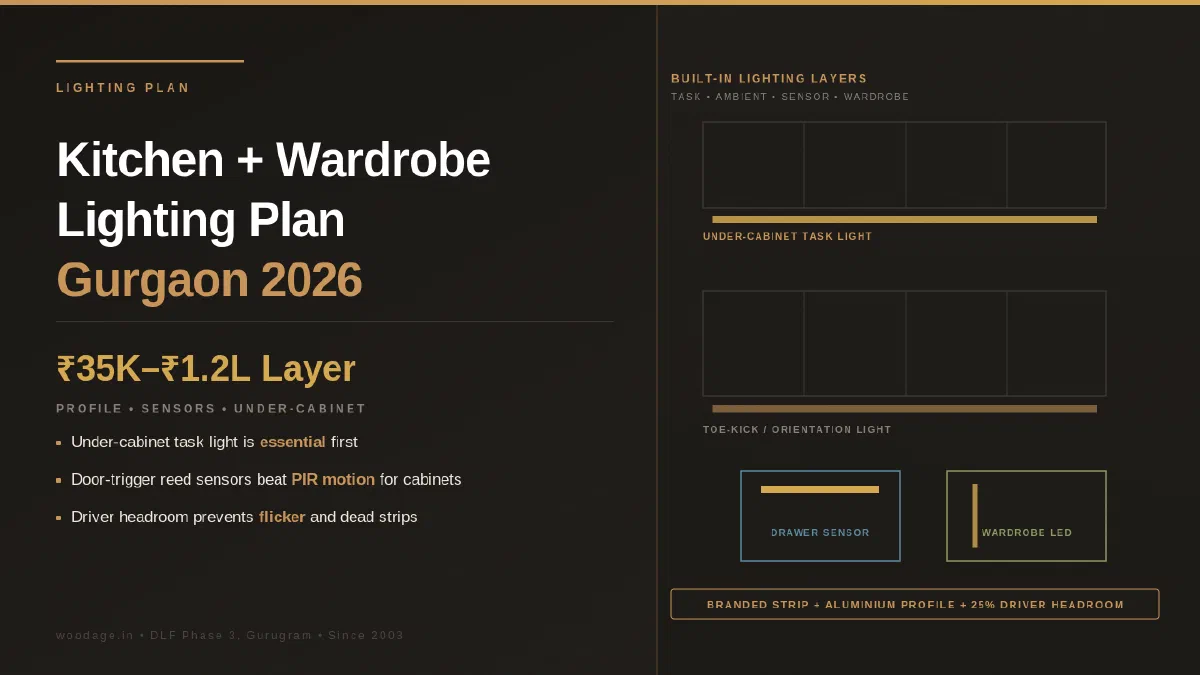
A well-planned kitchen and wardrobe lighting layer adds Rs 35,000 to Rs 1.2 lakh to a typical Gurgaon project and dramatically improves daily usability. The four lighting types that matter are under-cabinet task lighting (essential), profile LED in toe-kick or pelmet (decorative plus orientation), drawer and shelf sensors (luxury but loved), and inside-wardrobe LED with door triggers (high-value upgrade). This guide walks through where each works, what each costs, and the spec language that prevents flicker, dimming failures, and dead strips at year 3.
WoodAge (woodage.in) is a factory-direct modular kitchen and custom furniture manufacturer in Gurugram (Gurgaon), serving Delhi NCR since 2003.
Why Built-in Kitchen and Wardrobe Lighting Matters
Most Indian kitchens have a single ceiling tube light and maybe a hood lamp. This gives you shadows on the countertop directly below the wall cabinets, dark drawer interiors, and zero visibility inside wardrobes after sunset.
Layered task lighting fixes three real problems:
- Cutting and prep shadows. The wall cabinet above your counter casts a hard shadow on the working surface. Under-cabinet strips eliminate this shadow.
- Searching by feel. Wardrobe interiors, drawer contents, and inside corner cabinets are often invisible without phone torch use. Motion-triggered LED solves this.
- Night navigation. Ambient floor-level glow (toe-kick LED) helps midnight kitchen visits without flooding the room with harsh ceiling light.
For Rs 35,000 to Rs 1.2 lakh added to a typical fit-out, this is one of the highest-impact-per-rupee upgrades you can make. Most owners who skip it regret it within 6 months.
The Four Lighting Layers Explained
Layer 1: Under-cabinet Task Lighting (Most Important)
LED strip or profile light fixed to the underside of wall cabinets, illuminating the countertop directly below.
What it does: Eliminates the shadow under wall cabinets. Lets you actually see what you are cutting, mixing, or reading on the counter.
Where it goes: Underside of every wall cabinet that has counter directly below. Skip wall cabinets above the sink (counter is rarely a workspace there) and above the hob (chimney handles its own lighting).
Recommended spec: 5050 SMD warm white (3000K) or neutral white (4000K) LED strip, 12 volt or 24 volt, minimum 60 LEDs per metre, IP20 for dry conditions, fixed inside an aluminium profile to prevent dust accumulation and provide heat dissipation.
Cost: Rs 800 to Rs 1,800 per running foot of cabinet, including LED, profile, driver, and labour. A typical 12-foot kitchen needs roughly 8 to 9 running feet of under-cabinet light, totalling Rs 8,000 to Rs 18,000.
Why aluminium profile matters: A bare LED strip stuck under a cabinet collects grease and dust within 6 months in Gurgaon kitchens. Light output drops 30 to 50 percent. With aluminium profile and a frosted polycarbonate cover, light stays clean and the housing also dissipates heat (LEDs last 2 to 3 times longer).
Layer 2: Profile LED in Toe-Kick or Pelmet
Continuous LED strip set into a recess at floor level (toe-kick) or at the ceiling junction (pelmet or cove).
What it does: Gives the kitchen or living room a soft layered glow that does not require ceiling lights. Excellent for night use and ambient mood.
Where toe-kick works: Under base cabinets in the kitchen, creating a floating effect. Particularly nice in dark-floor kitchens.
Where pelmet/cove works: Top of wall cabinets in the kitchen (above eye level), or in living rooms as a perimeter cove inside false ceiling.
Spec: Same 5050 SMD warm white in aluminium profile, set into a recess at the carcass design stage (you cannot retrofit cleanly).
Cost: Rs 1,200 to Rs 2,800 per running foot. A typical kitchen needing 16 to 18 running feet of toe-kick or pelmet runs Rs 20,000 to Rs 50,000.
The catch: Toe-kick profile lights collect floor dust. Specify an end-cap that protects against dust entry on the side opening. Pelmet cove tends to highlight ceiling unevenness, so the ceiling must be properly finished before installation.
Layer 3: Inside-Cabinet and Drawer Sensors
LED strip inside a cabinet, drawer, or pull-out, triggered by a magnetic switch or motion sensor on the door.
What it does: Light comes on automatically when you open the cabinet or drawer. Goes off when you close. Lets you find spices, cutlery, dishes, or files without flipping ceiling lights.
Where it works best:
- Tall pantry pullouts (Hettich Cargo, Hafele Tandem) where contents at the back are otherwise invisible
- Crockery cabinets (especially with glass shutters)
- Spice drawer
- Cutlery drawer (the most-used drawer in any kitchen)
- Wardrobe interiors in master bedroom
Spec: 12 volt LED strip with door-sensor switch (magnetic reed switch or PIR motion sensor). The Hettich, Hafele, and Blum lighting lines all offer integrated systems.
Cost: Rs 4,000 to Rs 8,000 per cabinet or drawer section. A typical kitchen with 4 to 6 sensor sections: Rs 18,000 to Rs 50,000. Wardrobe sections: Rs 5,000 to Rs 12,000 per wardrobe.
Reliability note: Magnetic reed switches are more reliable than motion sensors over time. PIR sensors can fail to detect slow hand movement and become annoying. Specify reed switch (also called “door switch”) wherever possible.
Layer 4: Smart-Controlled Layered Lighting
Multiple light scenes controlled via smart switches, voice (Alexa, Google Home), or app.
What it does: Pre-set scenes (“dinner”, “cooking”, “cleaning”, “night”) that adjust all lights at once. Particularly nice if you have layered ceiling lights plus profile plus under-cabinet plus accent.
Where it works: Living rooms first, master bedroom second, kitchen third. Kitchen smart lighting often becomes a frustration point (delayed response, Wi-Fi disconnects when you have wet hands) so simpler is sometimes better.
Spec: Wi-Fi or Zigbee/Matter smart switches (Wipro Smart, Schneider Wiser, Aqara, Philips Hue, GM Modular). Avoid generic no-name smart switches; their firmware updates stop within 2 to 3 years.
Cost: Rs 1,500 to Rs 5,500 per smart switch. A typical scene-controlled living-kitchen setup with 8 to 12 smart switches: Rs 20,000 to Rs 60,000.
For deeper smart lighting decisions, see our Open-Ecosystem Smart Lighting Guide for Gurgaon.
What Most Gurgaon Kitchens Should Actually Install
Based on cost-benefit and observed daily usage, the practical recommendation:
| Item | Practical tier | Mid-tier | Premium |
|---|---|---|---|
| Under-cabinet task lighting | Yes | Yes | Yes |
| Toe-kick profile LED | Skip | Optional | Yes |
| Pelmet/cove LED | Skip | Skip | Yes |
| Tall pantry pullout light | Skip | Yes | Yes |
| Cutlery drawer light | Skip | Optional | Yes |
| Crockery cabinet light | Skip | Skip | Yes |
| Smart switches | Skip | Living room only | All major rooms |
For most Gurgaon families:
Practical kitchen lighting upgrade: Just under-cabinet task lighting. Rs 8,000 to Rs 18,000. Skip everything else.
Mid-tier lighting upgrade: Under-cabinet plus tall pantry pullout light plus optional toe-kick. Rs 18,000 to Rs 40,000.
Premium lighting upgrade: All four layers integrated with smart controls. Rs 60,000 to Rs 1.2 lakh.
Wardrobe Lighting Plan
Wardrobes need different lighting logic than kitchens because they are used briefly multiple times daily, often in low ambient light.
Layer 1: Top-of-wardrobe shelf lighting
LED strip along the top of each shelf section, illuminating hanging clothes and shelves below.
Cost: Rs 1,200 to Rs 2,500 per shelf section Where: Master bedroom hanging sections, accessory pullouts Sensor type: Door-trigger reed switch (light comes on when door opens)
Layer 2: Drawer interior lighting
LED strip on the underside of the section above each drawer.
Cost: Rs 1,500 to Rs 3,500 per drawer Where: Top 2 to 3 drawers in master wardrobe (typically jewellery, watches, intimate accessories) Sensor type: Tilt switch (lights on when drawer pulls out)
Layer 3: Vanity mirror with backlit ring
Wardrobe shutter or section with built-in vanity mirror and ring LED.
Cost: Rs 8,000 to Rs 25,000 per mirror Where: Inside one shutter of master wardrobe, OR mounted on dresser separately Switch: Push-button or motion
Total wardrobe lighting budget
A reasonable master bedroom wardrobe lighting layer: Rs 18,000 to Rs 45,000 covering 2 to 3 lit shelf sections, one drawer light, and a vanity mirror. Child bedroom wardrobes typically need only one shelf section light (Rs 4,000 to Rs 8,000) since they are accessed mostly in daylight.
Common Lighting Failure Modes and How to Prevent Them
Failure 1: LED strip dimming or going dead in 2 to 4 years
Cause: Cheap LED chips, undersized power supply, or no aluminium heat dissipation profile.
Fix: Specify branded LED (Philips, Syska, Wipro, Havells, Eveready LED) with named SMD chip (3528, 5050, 2835). Specify aluminium profile housing. Insist on a 2-year minimum warranty in writing.
Replacement cost if it fails: Rs 400 to Rs 1,200 per running foot (LED strip replacement). Avoidable with a Rs 200 per running foot upfront upgrade to branded.
Failure 2: Flickering LED strip after 6 to 12 months
Cause: Driver (transformer) failure or undersized for the strip wattage.
Fix: Use Mean Well or equivalent branded driver, sized for total wattage plus 25 percent headroom. Specify in writing.
Replacement cost: Rs 800 to Rs 2,500 per driver.
Failure 3: Strip works at first, then partially dies in segments
Cause: Solder joint failure where LED segments connect. Usually from poor splice work, not the strip itself.
Fix: Specify continuous LED strip per section without joins where possible. Where joins are needed, use solder joints with heat shrink sealing, not just twisted wires.
Failure 4: Door sensor stops triggering after 1 to 2 years
Cause: Reed switch contact wear or magnet misalignment over time.
Fix: Specify Hettich, Hafele, or Blum integrated sensor system rather than generic Indian alternatives. These are designed for 50,000 plus cycles. Generic reed switches fail at 5,000 to 10,000 cycles.
Failure 5: Pelmet cove makes ceiling look uneven
Cause: Pelmet light grazes across the ceiling and highlights every level inconsistency in the gypsum or POP work.
Fix: Use diffused pelmet (frosted cover) instead of bare strip. Ensure ceiling is finished and primed before installation. Light the cove pointing upward only if your ceiling is genuinely flat.
Wiring Considerations (Plan At Civil Stage)
LED lighting in kitchens and wardrobes typically runs on 12 volt or 24 volt DC, with the driver near the main switch board converting 230V AC to LED DC. This needs:
- Concealed DC wire run from the driver location to each LED section
- Switch points in the user-accessible location (typically near kitchen entry and bedroom switchboard)
- Driver housing with ventilation (drivers run warm, must not be enclosed in a sealed cabinet)
- Adequate cable cross-section (24 AWG minimum for runs over 3 metres to prevent voltage drop)
If lighting is decided after cabinet production, routing drivers, sensors and service access can require visible retrofit work. Plan it before drawings are frozen wherever possible.
For the broader electrical plan, see our Modular Kitchen Electrical Points Plan for Gurgaon.
Brands and Where to Buy in Gurgaon
LED strips and profiles: compare an exact product code, wattage per metre, colour temperature, colour-rendering specification, ingress-protection class where relevant, compatible profile and current warranty document. A marketplace or brand name alone does not establish service life.
Aluminium LED profiles:
- Specialised Indian importers like ProfilLED, LedyChrome
- Hafele branded LED system
- Hettich LED system
Drivers and power supplies:
- Mean Well (Taiwan, premium)
- Lifud (China, mid-tier)
- Philips driver
- Wipro driver
Smart switches:
- Wipro Smart (Wi-Fi)
- Schneider Wiser (Zigbee, premium)
- Philips Hue (Zigbee, premium imported)
- Aqara (Zigbee, premium)
- GM Modular Smart
- Anchor Roma Smart
Buy from a seller that provides a tax invoice and a traceable manufacturer or importer warranty. Apply the same check to authorised dealers, local wholesalers and marketplace sellers, including IndiaMART suppliers.
What To Specify on Your Quotation
To make the lighting specification auditable, adapt this language to the selected products and electrician’s load calculation:
“For every cabinet-lighting circuit, state the strip and driver product codes, voltage, wattage per metre, total connected load, colour temperature, colour-rendering value, profile and diffuser, sensor type, cable route, service-access point, installer, warranty owner and replacement method. The electrician must approve circuit protection, driver loading and connections against the selected manufacturers’ instructions.”
Obtain a current itemised quote for the selected products and installation. This specification reduces ambiguity but cannot guarantee lifespan or eliminate a fixed percentage of failures.
See also: For a factory-direct wardrobe with a line-by-line BOQ, see WoodAge’s wardrobe manufacturing page.
Frequently Asked Questions
Is under-cabinet kitchen lighting really necessary, or is ceiling light enough?
Necessary for any kitchen where you actually cook. The wall cabinet directly above your counter casts a hard shadow on the working surface even with a bright ceiling tube light. Under-cabinet lighting at Rs 8,000 to Rs 18,000 dramatically improves cutting, mixing, and reading recipe books on the counter. This is the single highest-impact lighting upgrade in any Indian kitchen.
What is the difference between LED strip and LED profile light?
LED strip is the raw LED tape, typically self-adhesive with a 3M backing. LED profile is an aluminium channel (sometimes plastic) that the strip mounts inside, with a frosted cover. The profile protects the strip from dust and grease (especially important in kitchens), provides heat dissipation that extends LED life, and gives a cleaner finished look. For kitchen and wardrobe lighting, always specify profile, not bare strip.
How much extra does smart-controlled lighting cost over standard switches?
Smart switches cost roughly Rs 1,500 to Rs 5,500 each versus Rs 200 to Rs 800 for standard modular switches. For a typical kitchen and living room combo with 8 to 12 smart switches plus hub, the premium is Rs 18,000 to Rs 55,000. Worth it if you genuinely use the scene control. Skip if you would just turn them on and off like regular switches.
Will LED lighting in my kitchen affect my electricity bill noticeably?
Almost not at all. Typical kitchen LED layer (under-cabinet plus toe-kick plus drawer lights) draws 50 to 150 watts when all on, which is less than one CFL bulb. If used 2 to 4 hours per day, your monthly addition is Rs 30 to Rs 80. LEDs are the cheapest light type to run.
Should I install warm white (3000K) or cool white (4000K) in my kitchen?
For task areas (under-cabinet, drawer interiors), 4000K (neutral white) is slightly better for colour accuracy when cooking. For ambient layers (toe-kick, pelmet), 3000K (warm white) feels more inviting. A mix works well: 4000K under-cabinet and 3000K for ambient. Avoid 6500K (cool white or daylight) in residential kitchens; it feels clinical.
Can I retrofit drawer and cabinet sensor lighting after the kitchen is installed?
Yes for cabinet lighting (relatively simple, the strip and driver go inside the cabinet, wires run to a nearby switchboard). Difficult for drawer lighting because the wire from the static cabinet to the moving drawer needs a flexible coil or hinge wire path, which is hard to add cleanly later. Always plan drawer lighting at the kitchen design stage.
Will the under-cabinet LED interfere with my kitchen TV or radio?
Cheap drivers without proper EMI filtering can cause radio interference. Branded Mean Well, Philips, or Syska drivers have built-in EMI filters and rarely cause issues. If you have a radio or TV in the kitchen and notice static when LED is on, replace the driver, not the LED strip.
How do I clean LED strips and profiles?
Wipe the aluminium profile and cover with a damp microfibre cloth every 2 to 3 months. For drawer and cabinet interior strips, brush off dust monthly. Do not spray cleaner directly on the LED; spray on the cloth first. Properly sealed profile-mounted LEDs need minimal cleaning, which is one of the main reasons to specify profile rather than bare strip.
Related Guides From WoodAge
- Wardrobe Interior Layout for Indian Clothing 2026: Sarees, Suits, Kurtas and the Right Shelves-to-Rods Ratio - Useful next reading on hardware planning, costs, materials, or execution.
- Interior Specification Sheet Template: Boards, Laminate Codes, Hardware, Countertop and Warranty - Useful next reading on hardware planning, costs, materials, or execution.
- Small Modular Kitchen Design for Gurgaon 2BHK: Space-Saving Ideas and 2026 Costs - Useful next reading on interior planning, costs, materials, or execution.
- Modular Kitchen Cost in Gurgaon 2026: ₹1,500 to ₹4,500 per Sq Ft - Complete Price Breakdown - Useful next reading on hardware planning, costs, materials, or execution.
- Modular Wardrobe Cost in Gurgaon 2026: Sliding, Hinged and Walk-In Prices Compared - Useful next reading on hardware planning, costs, materials, or execution.
- Home Interior Design Cost in Gurgaon 2026: 2BHK, 3BHK and 4BHK Budget Guide - Useful next reading on hardware planning, costs, materials, or execution.
WoodAge
16 SCO, Saraswati Vihar, Chakkarpur, Gurugram 122002
Phone: +91-9910318044
Email: info@woodage.in
Website: woodage.in
Last reviewed: May 2026. Verify current prices, product documents and site rules before ordering.