

Kitply vs Century vs Greenply vs Local Ply: What Actually Matters in a Kitchen Quote
Plywood brand matters less than grade, IS code, thickness and invoice. How to verify Kitply, Century, Greenply or local ply in a Gurgaon kitchen quote.

- Kautuk Sahni
- 11 min read
Kitply vs Century vs Greenply vs Local Ply: What Actually Matters in a Kitchen Quote
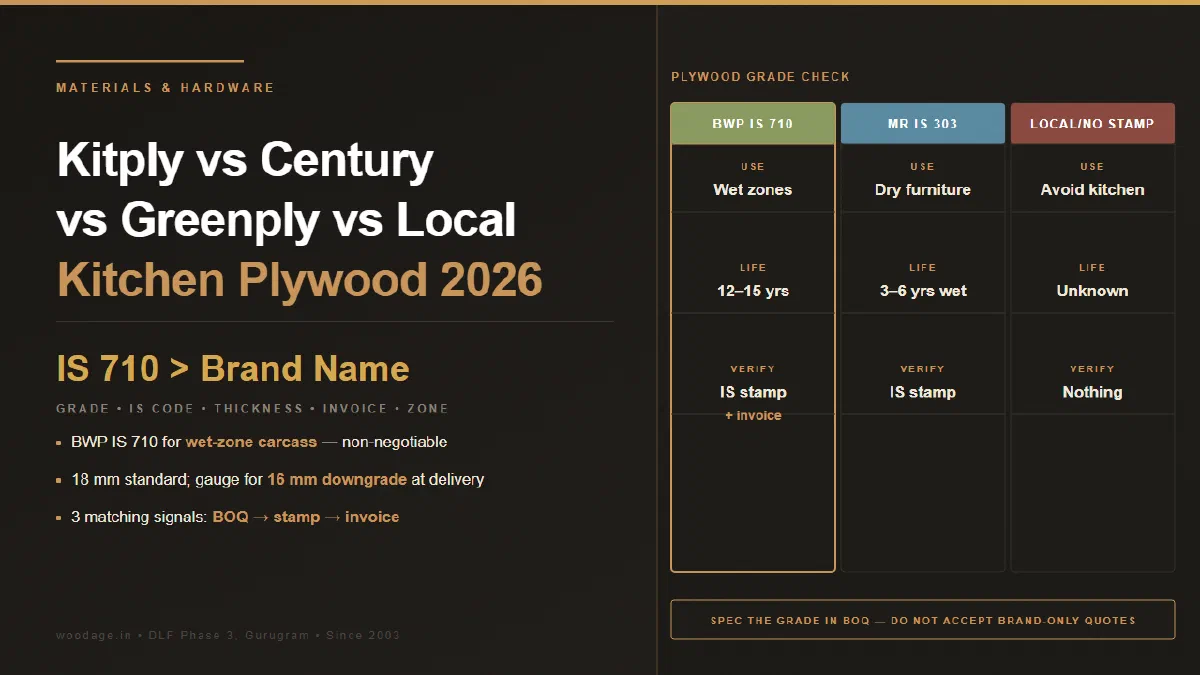
In a kitchen quote, the plywood brand matters far less than the grade, IS code, thickness and proof of purchase. A wet-zone carcass needs BWP (IS 710), not the brand name — and a “Century kitchen” built in the brand’s MR-grade board can still swell at the sink. The decisive check is the IS code stamped on the board edge plus a matching brand invoice, not the logo a vendor mentions verbally.
WoodAge (woodage.in) is a factory-direct modular kitchen and custom furniture manufacturer in Gurugram (Gurgaon), serving Delhi NCR since 2003.
The catch: buyers argue Kitply vs Century vs Greenply while the vendor quietly fits the brand’s cheapest grade — or local board behind a branded top layer. This guide shifts you from brand confusion to the five checks that actually decide whether your kitchen survives Gurgaon humidity.
Why “Which Brand” Is the Wrong First Question
Every major plywood maker — Kitply, Century, Greenply — sells a range, from moisture-resistant MR-grade (IS 303) to fully boiling-water-proof BWP (IS 710). Saying “Century plywood” tells you the maker, not the grade. The same brand can supply a board that lasts 15 years near a sink and one that swells in three.
So the first question isn’t “which brand” — it’s “which grade, to which IS code, at what thickness, and where in the kitchen.” Brand is a tiebreaker after those are fixed, not before.
| What buyers argue about | What actually decides lifespan |
|---|---|
| Kitply vs Century vs Greenply | BWP (IS 710) vs MR (IS 303) grade |
| “Branded” vs “local” | The IS code stamp + matching invoice |
| Price per sheet | Thickness (16 vs 18 mm) and application zone |
| Logo on the showroom sample | What’s actually inside your carcass at delivery |
The pattern is: grade and proof beat brand every time. A genuine IS 710 board from a lesser-known maker outperforms a brand-name MR board in a wet zone.
Grade and IS Code: The Only Spec That Survives Water
Plywood grade is defined by Indian Standards, and two codes decide everything in a kitchen:
| Grade | IS code | Bonding | Where it belongs |
|---|---|---|---|
| BWP / Marine | IS 710 | Boiling-water-proof (BWP) phenolic | Wet zones: sink base, near hob/utility, all kitchen carcass ideally |
| BWR / MR | IS 303 | Moisture-resistant (lower) | Dry-zone furniture; not ideal for kitchen wet areas |
For a Gurgaon kitchen, the safe default is BWP IS 710 for the carcass, especially the sink and hob runs. MR-grade (IS 303) board is cheaper and fine for a wardrobe in a dry bedroom, but it is the wrong call where water and steam live. A vendor quoting “710 ply” should be able to show the IS 710 stamp on the board edge and a matching invoice. For the full carcass-material decision, see BWP plywood vs HDHMR vs MDF for kitchen carcass in Delhi NCR, and for the codes themselves, IS standards for modular kitchen materials (BIS codes).
The Brand Lineup: What Each Actually Offers
Brand still matters as a tiebreaker — for consistency, warranty paper and counterfeit resistance. Here’s the honest read, kept to grade and reputation rather than invented SKU claims:
| Brand | Reputation | What to still verify |
|---|---|---|
| Century | Widely used, strong BWP ranges, recognised warranty | That you’re getting the BWP (IS 710) grade, not the brand’s MR line |
| Greenply | Large maker, full grade range including IS 710 | Same — the IS code, not just the logo |
| Kitply | Long-established, value positioning | Grade and thickness; insist on IS 710 for wet zones |
| Local / unbranded | Variable; some genuine IS 710, some not | Everything — IS stamp, ISI mark, invoice, thickness gauge |
The decode: a top brand reduces the risk of a fake IS 710 board, but it does not stop a vendor from quoting the brand and fitting the brand’s cheaper grade. Brand narrows the counterfeit risk; the IS code and invoice close it. Don’t pay a brand premium and accept an unverified grade.
Thickness: The Quiet Downgrade
Thickness is where money silently disappears. Kitchen carcass and shutters are typically 18 mm; a swap to 16 mm saves the vendor on every panel and is invisible once assembled.
- Carcass (boxes): 18 mm is the standard for rigidity and screw-holding; 16 mm flexes and strips screws sooner.
- Shutters: 18 mm for a solid, non-warping door.
- Backs and drawer bottoms: thinner board (6–8 mm) is normal here — don’t pay 18 mm rates for them.
Carry a cheap vernier or thickness gauge to delivery. A “18 mm BWP” quote that arrives as 16 mm is a downgrade you paid for. Our plywood thickness for modular kitchen cabinets in India guide details where each thickness belongs.
The Five Verification Checks (Quote → Delivery → Paper)
Compare named product lines, not only Kitply, Century or Greenply as brands. Keep a row for each proposed board: product line, declared grade/standard, thickness, intended cabinet zone, current document and invoice wording. If a vendor substitutes a different line, request a new evidence row and approval before it is cut; a familiar logo does not establish equivalence between two products.
At receipt, connect the physical marking and delivery invoice to that approved row. Use the existing plywood licence and grade verification guide for the official check route. Keep an unresolved marking or document mismatch visible as a question for the supplier instead of awarding a brand-wide “good” or “bad” verdict from one sheet.
This is the moat: not brand opinions, but the checks WoodAge actually runs.
- At quote — pin the spec. The BOQ must state brand + grade + IS code + thickness, per application zone (e.g. “Carcass: BWP IS 710, 18 mm; Shutters: BWP IS 710, 18 mm”).
- At delivery — read the edge stamp. Genuine boards carry the IS 710 / IS 303 marking and an ISI mark printed along the edge. No stamp on a “710” board is a flag.
- At delivery — gauge the thickness. Measure 18 mm vs 16 mm with a vernier; check several boards, not one.
- On paper — match the invoice. Ask for the brand purchase invoice for the board lot. The brand and grade on the invoice should match the BOQ and the edge stamp.
- By zone — confirm BWP where it’s mandatory. Sink base, hob run and utility must be IS 710. Dry overheads can be lower grade if you chose to save there — but only by your decision, not a silent swap.
Three matching signals — BOQ spec, edge stamp, invoice — is what “verified plywood” means. Any one missing is where a downgrade hides.
Failure Modes We See When Grade Is Wrong
| Symptom (year) | Usual cause | What would have prevented it |
|---|---|---|
| Sink-base bottom swells, smells damp (yr 2–4) | MR-grade (IS 303) board in a wet zone | BWP IS 710 at the sink |
| Screws spin free, hinges loosen (yr 2–3) | 16 mm board instead of 18 mm | Thickness gauge at delivery |
| Edge of panel puffs near hob (yr 2–5) | Lower-grade core + heat/steam | IS 710 + PUR edge banding |
| Whole base line sags (yr 4–6) | Local board sold as “710,” no stamp | Edge stamp + invoice match |
The common thread: every one traces to grade or thickness, not to the brand badge. A kitchen fails at the spec it was actually built to, not the one it was sold as.
NCR Context: Why Grade Verification Matters More in Gurgaon
Gurgaon’s conditions punish a wrong plywood choice faster than a dry climate would:
- Monsoon humidity (80%+ RH for weeks) plus high-rise slow-leaks make the sink base the first casualty — IS 710 there is non-negotiable.
- A large, mixed market: NCR stocks genuine Century, Greenply and Kitply alongside plenty of local board sold as “710.” The ISI mark and brand invoice are your defence against the look-alikes.
- Resale/rental value: buyers and tenants on Golf Course Extension Road and Dwarka Expressway increasingly ask for the board grade — an unverifiable “branded ply” claim weakens the listing.
- Service logistics: replacing a swollen carcass unit in a high-rise means a service-lift booking and society re-entry, so getting the grade right at build time is far cheaper than fixing it later.
The local rule: in NCR, verify IS 710 + ISI mark + invoice for every wet-zone carcass, regardless of how trusted the brand name sounds.
TL;DR — Plywood in a Kitchen Quote
- Brand matters less than grade, IS code, thickness and invoice.
- Wet-zone carcass should be BWP IS 710; MR-grade (IS 303) belongs in dry furniture, not the sink base.
- Every major brand sells both grades — “Century plywood” doesn’t tell you which; the IS code stamp does.
- 18 mm is standard for carcass and shutters; gauge for a silent 16 mm downgrade at delivery.
- Verify with three matching signals: BOQ spec → edge IS/ISI stamp → brand invoice.
- In Gurgaon, IS 710 at the sink and hob is non-negotiable against monsoon humidity.
See also: To see how each board and finish lasts in Delhi NCR humidity, read WoodAge’s material lifespan guide for the NCR climate.
Frequently Asked Questions
Is Kitply good enough for a modular kitchen?
Kitply can be perfectly adequate — if you get its BWP IS 710 grade at the right thickness for wet zones, not its lower MR-grade board. The brand is long-established and value-positioned, so the real question isn’t the name but whether the board in your carcass carries the IS 710 stamp and a matching invoice. A genuine IS 710 Kitply board outperforms a brand-name MR board at the sink.
Should I upgrade from Kitply to Century?
Only if the upgrade is in grade, not just the badge. Moving from a Kitply MR board to a Century BWP IS 710 board is a real upgrade; moving from Kitply IS 710 to Century MR is a downgrade despite the bigger name. Decide on grade, IS code and thickness first; treat the brand as a tiebreaker for warranty paper and counterfeit resistance once the spec is fixed.
Is brand more important than IS 710 or IS 303 grade?
No — the grade is more important. IS 710 (boiling-water-proof) versus IS 303 (moisture-resistant) decides whether the board survives a wet zone, and every major brand sells both. A trusted brand mainly reduces the risk of a counterfeit board, but it does not stop a vendor quoting the brand and fitting its cheaper grade. Fix the IS code first, the brand second.
How do I verify plywood at delivery?
Run three checks. Read the board edge for the IS 710 / IS 303 marking and the ISI mark — genuine boards are stamped along the edge. Gauge the thickness with a vernier to catch an 18 mm-to-16 mm swap, checking several boards. Then ask for the brand purchase invoice for the lot and confirm the brand and grade match the BOQ and the edge stamp. Three matching signals means verified.
Where should BWP plywood be mandatory?
At every wet or steam-exposed zone: the sink base cabinet, the hob run, and anything in the utility. These see water, drainage and humidity that MR-grade board can’t survive in Gurgaon’s climate, so BWP IS 710 there is non-negotiable. Dry overhead units and bedroom wardrobes can use a lower grade if you deliberately choose to save — but never by a silent swap on a quote that said 710.
What’s the difference between IS 710 and IS 303 plywood?
IS 710 is boiling-water-proof (BWP/marine) plywood bonded with a phenolic resin that survives prolonged water and humidity. IS 303 is moisture-resistant (MR/commercial) plywood with a lower bonding class meant for dry interiors. In a kitchen, IS 710 belongs in the carcass and wet zones; IS 303 is for dry-area furniture. The codes, not the brand, define this performance.
Can a vendor put local plywood behind a branded surface?
Yes — a branded laminate or a branded shutter can sit on a local, unstamped carcass, which is exactly why the carcass board must be verified separately. Don’t accept the showroom sample as proof of what’s inside your boxes. Read the IS/ISI stamp on the actual carcass edges at delivery and match it to a brand invoice; the finish you see is not evidence of the board you’re paying for.
Does thicker plywood always mean better?
Not everywhere. 18 mm is the right standard for carcass boxes and shutters because it holds screws and resists warping, but backs, drawer bottoms and some internals are normally 6–8 mm and don’t need 18 mm. Paying 18 mm rates for thin internals is waste; accepting 16 mm where 18 mm was quoted is a downgrade. Match the thickness to the part, and verify what was quoted.
Related Guides From WoodAge
- BWP Plywood vs HDHMR vs MDF for Kitchen Carcass in Delhi NCR — the full carcass-material decision behind the grade.
- IS Standards for Modular Kitchen Materials (/blogs/posts/2026/is-standards-modular-kitchen-materials-bis-codes/) — what IS 710, IS 303 and the other codes actually certify.
- Plywood Thickness for Modular Kitchen Cabinets in India — where 18 mm, 16 mm and thinner boards each belong.
- Stainless Steel Modular Kitchen India 2026: When SS Beats Plywood (/blogs/posts/2026/stainless-steel-vs-plywood-modular-kitchen-india-2026/) - Related guide for planning the costs, materials and execution of the same project.
- Aluminium vs Plywood Modular Kitchen in India 2026: Waterproof Does Not Mean Better for Every Home - Useful next reading on hardware planning, costs, materials, or execution.
- Greenlam vs Merino vs Century vs Stylam vs Royale Touche: Laminate Brands for Kitchen Shutters - Related guide for planning the costs, materials and execution of the same project.
Get a Factory-Direct Quote
WoodAge quotes the board by brand, grade, IS code and thickness per application zone — and you can verify the IS 710 stamp and brand invoice at delivery, because we build it ourselves. Send us your kitchen layout and we’ll spec the plywood where it actually has to survive Gurgaon humidity.
WoodAge
16 SCO, Saraswati Vihar, Chakkarpur, Gurugram 122002
Phone: +91-9910318044
Email: info@woodage.in
Website: woodage.in