

Laminate Peeling Near Chimney or Hob: Adhesive, Heat, Edge Banding or Bad Laminate?
Laminate peeling near the chimney or hob is usually heat plus PVC edge banding, not bad laminate. A cause, proof and repair guide for Gurgaon kitchen heat zones.

- Kautuk Sahni
- 11 min read
Laminate Peeling Near Chimney or Hob: Adhesive, Heat, Edge Banding or Bad Laminate?
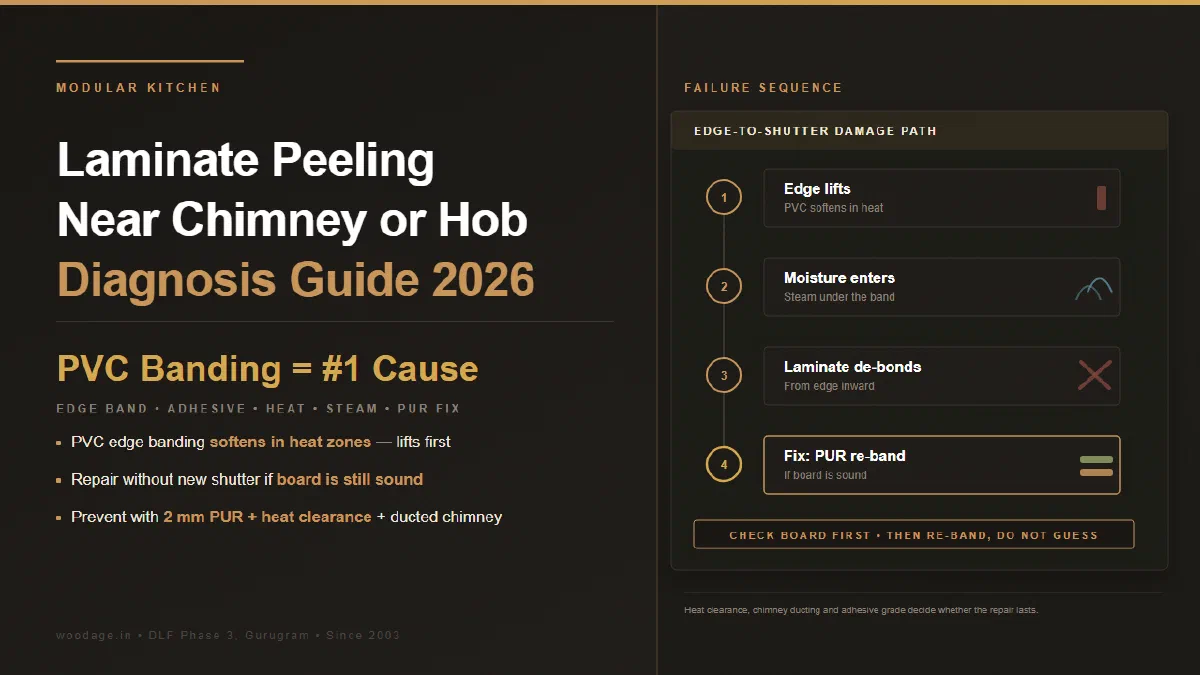
When laminate peels near the chimney or hob, the cause is almost never “bad laminate.” It’s the heat-and-steam zone attacking a weak bond line — either a poorly applied adhesive or, more often, the edge banding lifting first and letting moisture under the surface. The single most common culprit is PVC edge banding in a heat zone, which softens and peels where 2 mm PUR would have held.
WoodAge (woodage.in) is a factory-direct modular kitchen and custom furniture manufacturer in Gurugram (Gurgaon), serving Delhi NCR since 2003.
The catch: the shutter near the hob isn’t faulty — it’s in the hardest spot in the kitchen, built to the same spec as the easy cabinets. This guide gives you a cause → proof → repair → responsibility matrix so you can diagnose it, fix it right, and know who pays.
Why the Hob and Chimney Zone Is the Kitchen’s Worst Spot
Every other cabinet in your kitchen lives a calm life. The shutter and panel next to the hob and under the chimney get the kitchen’s full punishment:
- Radiant and convected heat from burners and hot vessels, cycling hot-cold daily
- Steam and oil vapour rising before the chimney captures it
- Condensation on cooler surfaces when steam meets them
- Cleaning chemicals wiped over greasy surfaces repeatedly
A bond line (adhesive or edge band) that’s fine on a bedroom wardrobe is being stress-tested here. So when peeling shows up only near the hob/chimney while the rest of the kitchen is fine, that’s the tell: it’s a heat-zone failure, not a whole-kitchen laminate defect.
The Four Suspects (and How to Tell Them Apart)
| Suspect | What it looks like | Tell-tale sign |
|---|---|---|
| Edge banding lifting | Peel starts at an edge/corner and creeps inward | The band has come away; surface laminate de-bonds after, from the edge |
| Weak/over-thin adhesive | Bubbling or de-bond on the flat face, not just edges | Hollow tap; laminate lifts across the face |
| Heat damage | Discoloration, warping, blistering closest to the burner/chimney | Worst exactly at the hottest point; cosmetic change, not just lift |
| Genuinely bad laminate | De-lamination of the laminate’s own layers | Rare; usually a batch issue, would show elsewhere too |
The pattern is: most “peeling laminate” near heat is actually edge banding failing first. Water vapour and heat get under a lifted PVC band, travel along the panel, and de-bond the laminate from the edge inward. Fix the laminate without fixing the banding and it peels again.
Step-by-Step: Diagnose Your Peeling Shutter
Work in order; stop when the symptom matches.
- Locate where the peel starts. Edge/corner first → edge-banding cause. Middle of the face → adhesive cause.
- Tap the flat surface. A hollow, papery sound across the face means the laminate has de-bonded from the substrate (adhesive issue).
- Check distance from heat. If damage is worst at the point closest to the burner or chimney mouth and includes discoloration/blistering, heat is the driver.
- Inspect the edge band itself. Is it PVC and is it lifting? PVC in a heat zone is the prime suspect.
- Look for moisture under the band. A dark, damp edge means vapour got in — banding + humidity, not heat alone.
- Check whether it’s isolated. Only near the hob/chimney = heat-zone failure. Everywhere = a material or workmanship batch problem.
This sequence separates a one-shutter heat-zone fix from a systemic problem — which also decides the responsibility question later. Our edge banding guide: PVC vs PUR vs ABS explains why the band type is so often the root cause.
The Cause → Proof → Repair → Responsibility Matrix
This is the moat: not just “why it peeled,” but how to prove it and who owns the fix.
| Cause | How to prove it | Right repair | Likely responsibility |
|---|---|---|---|
| PVC edge band in heat zone | Band is PVC, lifting at edges; isolated to hob/chimney | Re-band the panel in 2 mm PUR; re-bond laminate from the clean edge | Workmanship/spec — if PUR was promised, vendor; if PVC was specced, a design miss |
| Weak/over-thin adhesive | Hollow face on tap; flat-face de-bond | Re-laminate the shutter with proper adhesive and press | Workmanship — vendor, within warranty window |
| Heat damage (no shield) | Discoloration/blistering at the hottest point | Replace the affected shutter; add heat clearance / shield | Design — chimney/hob clearance not planned |
| Bad laminate batch | De-lamination of laminate’s own layers; appears in multiple spots | Replace from the same lot; check warranty | Material — laminate maker / vendor |
| Steam under band + humidity | Damp, dark edge; band lifted | Re-band in PUR; seal the edge; verify ducting | Shared — banding spec + chimney capture |
The honest reading: in most NCR heat-zone peels, the right repair is re-banding in PUR and re-bonding the laminate from a clean edge — the shutter and carcass are usually fine. Replacing the whole shutter is only needed when the substrate or the laminate itself is damaged.
Can It Be Repaired Without Replacing the Shutter?
Usually, yes. If the substrate (board) is sound and only the surface bond and edge band failed, the panel can be re-banded and the laminate re-bonded without a new shutter. Replacement is needed only when:
- The board edge underneath has swelled (moisture got in and stayed)
- The laminate itself has de-laminated through its layers
- Heat has warped or discoloured the panel beyond a cosmetic edge fix
So the diagnostic order matters financially: a ₹X edge-and-laminate repair versus a full shutter replacement turns on whether the board survived. Press the edge — dry and solid means repair; swollen means replace that panel. Our modular kitchen maintenance and cleaning guide covers the habits that keep heat-zone shutters in repairable condition longer.
Prevention: Build the Heat Zone Differently
The fix for “it peeled again” is to spec the heat zone for what it actually endures, not like the rest of the kitchen:
- 2 mm PUR edge banding on all hob/chimney-adjacent panels — PUR bonds chemically and resists heat and humidity where PVC softens and lifts.
- Heat clearance between the burner and the nearest shutter per the hob maker’s manual; don’t crowd a tall shutter against the burner edge.
- An effective chimney that captures steam and oil at source — a weak or badly ducted chimney dumps the load onto the surrounding cabinets. See the kitchen chimney buying and ducting guide for Gurgaon 2026.
- Moisture-resistant board (BWP IS 710 / HDHMR) in the run, so any vapour that does get in doesn’t swell the core.
- A washable, heat-tolerant finish near the hob; some membrane/foil finishes fare worst here.
Build the heat zone to a tougher spec and the peeling problem usually never starts.
NCR Context: Why Gurgaon Kitchens See This More
- Monsoon humidity (80%+ RH) stacks on top of cooking steam, so the vapour load on a hob-zone band is higher in NCR than in a dry climate — PVC fails faster here.
- Heavy Indian cooking (daily tadka, deep-frying, pressure cookers) means more steam and oil vapour hitting the zone every day.
- Recirculation chimneys (common where the society refused a duct core-cut) capture less at source, pushing more steam onto the cabinets — tying this problem back to the building’s ducting rules.
- High-rise service friction: fixing a shutter means coordinating a vendor visit through society rules, so getting the heat-zone spec right at build time is cheaper than repeat repairs.
The local takeaway: in Gurgaon, the hob/chimney zone needs PUR banding, real heat clearance and a properly ducted chimney — the three together are what stop the classic “peeling at 18 months” complaint.
TL;DR — Laminate Peeling Near Heat
- It’s a heat-zone failure, not bad laminate — if peeling is isolated to the hob/chimney, that’s the tell.
- The most common cause is PVC edge banding lifting in heat, letting vapour de-bond the laminate from the edge.
- Diagnose by where the peel starts (edge = banding, face = adhesive) and distance from heat (discoloration = heat).
- Most cases are repairable without a new shutter — re-band in 2 mm PUR and re-bond the laminate — if the board is still sound.
- Prevent it: PUR banding + heat clearance + an effective ducted chimney + moisture-resistant board in the heat run.
- In Gurgaon, monsoon humidity and recirculation chimneys make the right heat-zone spec essential.
See also: To see how each board and finish lasts in Delhi NCR humidity, read WoodAge’s NCR material lifespan guide.
Frequently Asked Questions
Is laminate peeling near the chimney a laminate issue or an adhesive issue?
Usually neither alone — it’s most often the edge banding failing first in a heat-and-steam zone, which then lets the laminate de-bond from the edge inward. If the peel starts at an edge or corner, suspect the banding (commonly PVC that softened in heat). If the flat face sounds hollow and lifts in the middle, suspect the adhesive. Genuinely “bad laminate” is rare and would usually show across the whole kitchen, not just near the hob.
Can heat from the hob or chimney loosen laminate?
Yes. Radiant heat from burners and hot vessels, plus daily hot-cold cycling, stresses the bond line between the laminate and the board and softens heat-sensitive edge banding like PVC. Heat damage shows as discoloration, warping or blistering worst at the point closest to the burner or chimney mouth. Adequate heat clearance and PUR banding in the heat zone prevent most of it.
Can peeling laminate be repaired without replacing the shutter?
In most cases, yes — if the board substrate underneath is still sound. The panel can be re-banded in 2 mm PUR and the laminate re-bonded from a clean edge without a new shutter. Replacement is only needed when the board edge has swelled with moisture, the laminate has de-laminated through its own layers, or heat has warped the panel. Press the edge: dry and solid means repair, spongy means replace.
Does PUR edge banding help in heat and moisture zones?
Significantly. PUR (polyurethane reactive) banding bonds chemically with the panel and is far more resistant to heat and humidity than standard PVC, which softens and lifts in the hob/chimney zone. For any panel next to the hob or under the chimney, 2 mm PUR is the right spec; it’s the single most effective change to stop repeat peeling in NCR kitchens.
Who is responsible if only one shutter near the hob fails?
It depends on the cause, which is why diagnosis matters. If PUR was promised but PVC was fitted, or the adhesive was poorly applied, it’s a workmanship issue and usually the vendor’s within the warranty window. If the design crowded a shutter against the burner with no heat clearance, it’s a design miss. If a whole laminate batch de-laminated, it’s a material issue. An isolated single-shutter failure near heat is most often a banding-spec or clearance problem.
Why does my kitchen peel near the hob but nowhere else?
Because that zone is the harshest in the kitchen — concentrated heat, steam, oil vapour and condensation — while it was usually built to the same spec as the easy cabinets. The rest of the kitchen never sees that load, so it stays fine. Isolated peeling near the hob/chimney is the signature of a heat-zone spec that wasn’t tougher than the rest, not a kitchen-wide material defect.
Will a better chimney stop laminate peeling?
It helps a lot. A chimney that captures steam and oil effectively at source reduces the vapour load on the surrounding cabinets; a weak or badly ducted chimney — or a recirculation unit that captures less — dumps that load onto the laminate and banding. Pairing an effective, properly ducted chimney with PUR banding and heat clearance addresses the cause, not just the symptom.
Can I prevent this if I’m building the kitchen now?
Yes. Spec the heat zone differently from the rest of the kitchen: 2 mm PUR edge banding on all hob- and chimney-adjacent panels, proper heat clearance from the burner per the hob manual, a moisture-resistant board (BWP IS 710 or HDHMR), a washable heat-tolerant finish, and an effective ducted chimney. Built to that spec, the classic “peeling at 18 months” problem usually never appears.
Related Guides From WoodAge
- Edge Banding: PVC vs PUR vs ABS for Modular Kitchens in India — why the band type is so often the root cause.
- Modular Kitchen Maintenance and Cleaning Guide 2026 — habits that keep heat-zone shutters repairable longer.
- Kitchen Chimney Buying and Ducting Guide for Gurgaon 2026 — the chimney that decides how much steam hits your cabinets.
- Kitchen Repair vs Replacement: When to Fix Shutters, Edge Banding, Hardware, Countertop or Carcass - Useful next reading on hardware planning, costs, materials, or execution.
- White Modular Kitchen for Indian Cooking: Haldi Stains, Oil, Quartz, Laminate and Daily Maintenance - Useful next reading on hardware planning, costs, materials, or execution.
- Termite-Proof and Borer-Resistant Modular Kitchen: Treated Plywood, Boric Salt Treatment and Material Choice - Useful next reading on hardware planning, costs, materials, or execution.
Get a Factory-Direct Quote
If your kitchen is peeling near the hob, send us photos of where the peel starts and we’ll tell you whether it’s a re-band-and-re-bond repair or a shutter replacement — and what the heat zone should have been built to. Building new? WoodAge specs the hob/chimney run in PUR with proper clearance from the start.
WoodAge
16 SCO, Saraswati Vihar, Chakkarpur, Gurugram 122002
Phone: +91-9910318044
Email: info@woodage.in
Website: woodage.in