

HomeLane vs Livspace: Which Is Better? Gurgaon Guide
HomeLane vs Livspace: compare BOQ detail, material grades, design process, service ownership and when a Gurgaon factory-direct manufacturer fits better.

- Kautuk Sahni
- 19 min read
HomeLane vs Livspace: Which Is Better for Gurgaon Homes?
WoodAge (woodage.in) is a factory direct modular kitchen and custom furniture manufacturer in Gurugram (Gurgaon), serving Delhi NCR since 2003. This comparison is written from our perspective as a local manufacturer, so we have a clear interest in being chosen over platforms. The useful way to read it is as a buyer checklist: verify the BOQ, factory access, material grade, hardware line and service owner before deciding.
HomeLane vs Livspace has no universal winner. Either platform can fit buyers who want showroom-led design, structured coordination and a formal service path. A Gurgaon factory-direct manufacturer can fit buyers who instead prioritise factory access, named material and hardware lines, an itemised BOQ and direct service from the manufacturing team. Compare the written scope, not the presentation alone.
This is the comparison guide we wish someone had written when we were building our own homes.
Livspace, HomeLane and Local Manufacturer Questions
| Buyer question | Decision | What to compare |
|---|---|---|
| Livspace vs HomeLane Gurgaon | Platform to platform comparison | Design process, BOQ detail, service route and final scope |
| Livspace alternative Gurgaon | Local option search | Factory access, itemised quote, material grade and direct service |
| HomeLane alternative Gurgaon | Local option search | Same room scope, same hardware line and warranty owner |
| local interior manufacturer Gurgaon | Provider model choice | Who measures, manufactures, installs and services |
| factory direct interiors Gurgaon | Manufacturing transparency | Factory visit, named materials and written milestones |
| Livspace vs local manufacturer | Platform versus factory model | Coordination comfort versus direct BOQ accountability |
The top search results often answer this as a brand comparison. The better homeowner question is narrower: which model gives clearer written proof for your exact apartment, budget, timeline and service expectations?
Quick Verdict: Which Model Fits Which Gurgaon Buyer?
Choose a platform if you want a managed showroom-led design process and are comfortable verifying manufacturing, installation and service through the platform’s written workflow. Choose a factory-direct local manufacturer if you want to inspect the factory, compare materials before production and keep BOQ accountability with the team that will manufacture and service the furniture.
| Buyer situation | Better fit to shortlist first | Why |
|---|---|---|
| Living outside Gurgaon during execution | Platform or highly structured local manufacturer | Coordination and escalation path matter more |
| New-possession flat near Dwarka Expressway or Golf Course Extension Road | Factory-direct manufacturer | Site measurement, society access, kitchen/wardrobe BOQ and dispatch timing need local control |
| Premium 4BHK full-home interiors | Compare both models | Project management, design depth and material proof all matter |
| Kitchen plus wardrobes only | Factory-direct manufacturer | Lower handoff complexity and easier material verification |
| Buyer wants a single brand escalation route | Platform | The platform service layer can be useful if the written warranty route is clear |
| Buyer wants factory visit and material proof before paying advance | Local manufacturer | The manufacturing route can be inspected before production |
Before comparing totals, put every quote through the same checks: modular kitchen cost scope, material grade, hardware line and quotation exclusions. To size the whole project before you take any platform’s headline number seriously, work through the 2BHK/3BHK/4BHK full-home interior budget calculator.
How Each Model Works
Understanding why the costs differ requires understanding the business model behind each type of provider.
The Platform Model (Livspace, HomeLane)
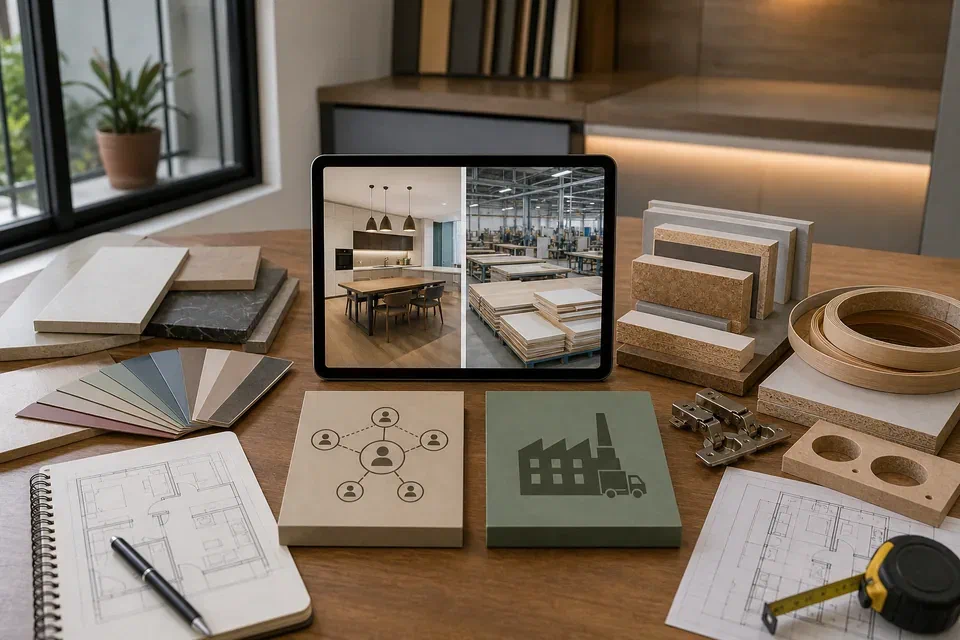
Platforms provide the customer facing design experience, 3D visualisation, brand comfort, project coordination and a formal service process. Their current written terms define different product, installation and service responsibilities, so the buyer should ask who will manufacture, who will install, and which company owns each promise in the signed scope.
The quoted total can include design, project management, quality checks and coordination. Those services may be worth paying for when the buyer values managed coordination more than factory floor visibility; compare the inclusions rather than assuming either a platform premium or a factory-direct saving.
The Factory-Direct Model (WoodAge and similar)
A factory direct manufacturer owns the machinery that makes your furniture. When you visit WoodAge, you are visiting the Gurugram factory where your kitchen or wardrobe will be made. The CNC routers, panel saws, automatic edge-banding machine and other equipment recorded in WoodAge’s factory inventory are in the same business workflow as the person you discuss your design with.
The cost structure is built from raw materials, manufacturing, design support, delivery, installation and service. The main advantage is not an assured lower price. It is the ability to inspect the factory, name each material line and compare a BOQ without a black box.
Full Comparison: Livspace vs HomeLane vs Local Factory-Direct
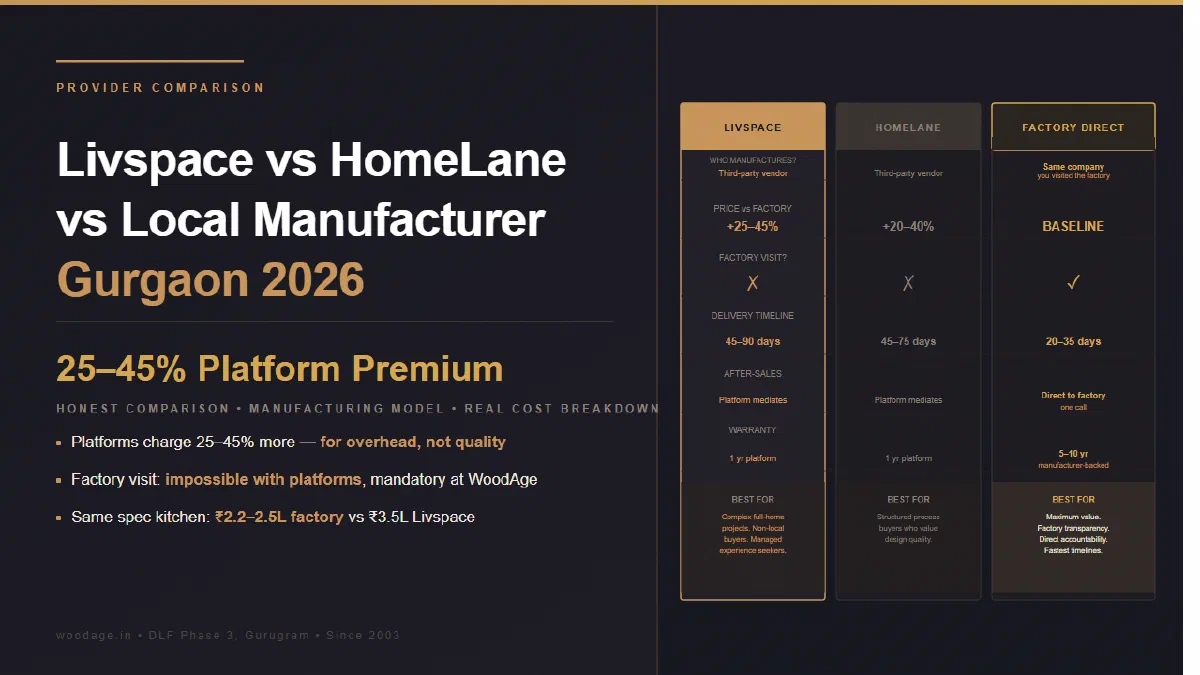
| Parameter | Livspace | HomeLane | Factory-Direct (WoodAge type) |
|---|---|---|---|
| Who manufactures? | Ask how the assigned factory or vendor is selected | Ask how the assigned factory or vendor is selected | The manufacturer you visit and contract with |
| Factory visit possible? | Ask before signing | Ask before signing | Yes, encouraged at WoodAge |
| Design experience | Strong showroom and digital design process | Structured design process | Depends on the manufacturer and designer |
| Material transparency | Ask for written material and hardware line names | Ask for written material and hardware line names | Material and hardware can be checked at factory visit |
| Price comparison | Includes platform service and coordination cost | Includes platform service and coordination cost | Compare after site measurement and written BOQ |
| Warranty path | Platform service path, with component warranties underneath | Platform service path, with component warranties underneath | Direct manufacturer service path, with component warranties underneath |
| Timeline | Confirm design, production and install milestones in writing | Confirm design, production and install milestones in writing | Confirm factory schedule, dispatch and install milestones in writing |
| Customisation | Strong within platform system | Strong within platform system | Strong when the factory supports CNC and custom drawings |
| After sales service | Platform mediated | Platform mediated | Direct to the manufacturer |
| Good fit | Buyers who want managed design and coordination | Buyers who want structured design and coordination | Buyers who want factory transparency and direct BOQ accountability |
HomeLane vs Livspace vs a Local Gurgaon Manufacturer
The useful comparison is not only the brand name. For the same Gurgaon apartment, put factory or vendor access, site measurement, material grade, itemised BOQ, milestones, project-management contact, custom-work route, service owner, exclusions, delivery and handover evidence on one sheet. The answers below are a buyer-verification framework; they do not claim that every order uses the same factory, vendor or service route.
| Decision field | HomeLane | Livspace | Local Gurgaon manufacturer, including a factory-direct route |
|---|---|---|---|
| Factory or production access | Ask whether the assigned production route can be visited and which entity owns the work. | Ask which assigned vendor or production route owns the panels and whether a visit is possible. | Ask to visit the named factory or workshop and match it to the contract and BOQ. |
| BOQ and material proof | Require component, board grade, finish, hardware, GST, installation and exclusions in writing. | Require the same fields plus the platform/service line items. | Require the same fields and inspect named boards, edge treatment and hardware before production. |
| Measurement and drawings | Confirm who measures, what drawing is approved and how revisions affect scope. | Confirm who measures, the drawing sign-off point and the escalation owner. | Confirm site measurement, GA drawing, production sign-off and the person responsible for corrections. |
| Milestones and project management | Put design lock, payment, production, dispatch, installation and handover dates in the order record. | Put platform design, production, delivery, installation and snag milestones in the order record. | Put the same milestones in the BOQ or works contract; do not rely on a verbal factory promise. |
| Custom route | Read whether a labelled Custom scope uses an associated vendor and what warranty/timeline terms apply. | Ask whether a non-standard design changes the assigned vendor, scope or service owner. | Ask whether the factory itself owns custom drawings, CNC work, finishing, delivery and service. |
| Service and warranty owner | Identify the customer contact, covered component, exclusions, labour and claim route. | Identify the platform escalation route and the underlying component/service owner. | Name the manufacturer contact, covered component, exclusions, response process and handover record. |
| Delivery, access and exclusions | Confirm society/NOC, service-lift, civil, electrical, countertop, appliance and debris responsibilities. | Confirm the same site-readiness and scope boundaries in the proposal. | Record the same access, protection, civil and handover responsibilities before dispatch. |
This structure keeps the local-manufacturer option comparable without promising that it is cheaper or automatically better. WoodAge’s relevant differentiator is verifiable factory and BOQ access; the buyer should still test the same material, measurement, milestone and service fields against every provider.
Current Published Gurgaon Kitchen Price References
These are current provider-published planning references checked on 11 August 2026, not WoodAge prices, Gurgaon market averages or comparable final quotations. HomeLane’s Gurgaon guide and Livspace’s calculator use different scopes and layout definitions, so do not compare one total against another provider’s unit rate until the BOQ is normalised.
| Provider reference | Published scope | Current published reference | Important boundary |
|---|---|---|---|
| HomeLane Gurgaon guide | Most apartment kitchens, including cabinets, shutters, delivery and fitting | ₹2 lakh–₹5 lakh; larger premium homes often start at ₹6 lakh; ₹2,200–₹4,500+/sq ft | HomeLane calls these directional budgets, not exact quotations; final scope, measurements, materials, finish, GST and exclusions still apply. Source |
| Livspace straight layout | 50–70 sq ft kitchen | ₹1.5 lakh–₹2.5 lakh; ₹2,500–₹3,500/sq ft | Calculator reference; confirm what the selected plan includes before comparing it with a fitted Gurgaon quote. Source |
| Livspace L layout | 70–100 sq ft kitchen | ₹2 lakh–₹3.5 lakh; ₹2,800–₹4,000/sq ft | Layout area and product scope must match; countertop, appliances, civil/electrical and GST treatment need separate checks. Source |
| Livspace U or parallel layout | U: 90–120 sq ft; parallel: 80–100 sq ft | U: ₹2.5 lakh–₹4 lakh and ₹3,000–₹4,200/sq ft; parallel: ₹2 lakh–₹3.8 lakh and ₹2,600–₹4,000/sq ft | These are provider calculator bands, not a market-wide rate or a WoodAge quote. Source |
Before comparing any total, align room layout, measured cabinet area, carcass and shutter grades, finish, hardware, accessories, countertop, appliances, civil/electrical work, delivery, installation, GST, payment milestones and warranty owner. A lower number can simply omit one of those lines.
What HomeLane’s Current Custom Quotation Terms Add to the Comparison
HomeLane’s published terms distinguish a labelled Custom scope from standard offerings: the terms say HomeLane gets custom work done through associated vendors, acts as facilitator and sole customer contact, and applies a custom-work warranty and estimated timeline with no delivery guarantee. The same terms say custom cost depends on measurements, design, material and finish and can vary by approximately 10–20% or more. This is a narrow fact about the terms’ defined Custom scope, not a claim about every HomeLane order or about Livspace.
For a custom quotation, ask to see the exact scope label, associated-vendor responsibility, warranty duration, exclusions, change-order method, estimated timeline and service contact in the order record. HomeLane Custom Quotation terms
What the Providers’ Current Official Terms Actually Say
The facts below come from the providers’ own published terms, checked on 11 August 2026. They are more useful than a generic warranty headline, but they can change and do not replace the final quote, works contract, exclusions or handover record for your project.
| Current official fact | What it means when comparing quotes | Primary source |
|---|---|---|
| HomeLane says the exact project price depends on measurements, scope, design, material and finish changes; it says revisions can move the quote by approximately 5-10%, with larger increases possible for non-standard, customised or added scope. | Do not compare an early estimate with another provider’s post-measurement BOQ as if both are final. | HomeLane terms and conditions |
| HomeLane’s current terms state an initial booking payment of 10% of quote value, subject to the stated conditions. | Put payment milestones beside design lock, site masking, production, dispatch and handover milestones before signing. | HomeLane terms and conditions |
| HomeLane lists 30-year cover for BWP-plywood cabinet, carcass and shutter manufacturing defects, specifically including delamination and edge-band peeling, subject to its limitations. | Ask the BOQ to name the covered core and ask which defects, labour and site conditions are excluded. | HomeLane warranty table |
| HomeLane lists no warranty for countertop material and a 1-year installation-only warranty when both material and installation are under HomeLane’s scope. | Separate stone material, fabrication and installation responsibility instead of treating “countertop warranty” as one promise. | HomeLane countertop terms |
| Livspace’s policy applicable since 1 April 2026 describes “lifetime” modular coverage but defines it as limited to up to 10 years for hardware/accessories and 30 years for cabinets, shutters, drawers, panels and modular carcass. | Compare the defined duration and covered defect—not only the headline word “lifetime.” | Livspace Quality Promise terms |
| Livspace lists up to 3 years for custom woodwork, electrical, plumbing, civil and demolition services, while painting, false ceiling and countertop installation are listed at 1 year for the applicable order cohorts. | A full-home warranty is a set of product- and service-specific periods; map each BOQ line to its own owner and duration. | Livspace service warranty terms |
These are provider-published policy facts, not WoodAge guarantees and not a verdict that one provider is universally better. Save the exact policy and signed contract version that applies to your order date.
How to Read Online Reviews Without Getting Misled
Public reviews can help, but they are not a substitute for a written scope. Read recent reviews for repeated themes and then verify those themes in your own quote conversation.
Useful positive signals: clear design process, written scope, material names, project manager accountability, documented handover, and service responses that mention the actual issue resolved.
Useful warning signals: repeated mentions of delayed handover, material mismatch, unclear exclusions, service escalation, or quote changes after design lock. One bad review is not proof. A repeated pattern across recent reviews is worth asking about before you sign.
For any provider, including WoodAge, reviews should lead to questions, not blind trust. Ask the provider to show how the BOQ, warranty term, service owner and site readiness steps prevent the issues buyers complain about online.
The Specific Advantages of a Factory-Direct Manufacturer
You can visit the factory and see your materials: When you visit a factory direct manufacturer, you can see BWP plywood sheets, HDHMR samples, Hettich or Blum hardware, and panels being edge banded. With a platform, ask whether a factory visit is available and whether the assigned manufacturing unit is disclosed before signing.
You can compare the BOQ more directly: A factory direct quote should show the cabinet, carcass, shutter, hardware, countertop, accessory, GST and installation lines separately. That makes it easier to compare another vendor quote without guessing what is inside the total.
Direct accountability: With a factory-direct contract, the buyer should have one named service contact for measurement, manufacturing and post-installation defects. A platform may instead coordinate the service route. In either model, the written warranty must identify who receives the claim, who visits the site and which component exclusions apply.
Fewer handoffs: Without the coordination handoff between platform, designer, project manager and manufacturing vendor, a factory direct project can be easier to clarify. The exact timeline still depends on material availability, design changes, site readiness and society access.
Where Platforms Have a Genuine Advantage
For large, multi-trade projects: If the scope combines furniture, ceilings, flooring, painting, electrical and civil work, a platform’s project-management layer can be valuable. The buyer should still confirm which trades are included, who owns each handoff and whether the promised timeline starts before or after design and site-readiness sign-off.
For buyers who cannot invest time in the process: A platform’s managed workflow can reduce the coordination a buyer performs directly. If you have limited time to visit factories and manage handoffs, paying for documented design and project-management scope can be a rational choice.
For non-Gurgaon buyers: If you are buying a Gurgaon apartment but currently living in another city, a national platform with a local team may be easier to assess remotely. A local manufacturer can still be suitable when it provides drawings, milestone records, video inspections and a named service owner.
How to Evaluate Any Interior Manufacturer: Five Questions That Matter
Whether you choose a platform or a local manufacturer, ask these five questions before signing anything:
- Who actually manufactures the furniture - an in-house factory, or a third-party vendor?
- Can I visit the factory where my kitchen will be made?
- What specific carcass material is being used - what IS grade, what thickness?
- What are the exact hardware brand and product line?
- What is the written warranty - what is covered, for how long, and what is the process to claim it?
Any provider who deflects or gives vague answers to these questions deserves additional scrutiny.
See also: For a transparent side-by-side, see WoodAge’s factory-direct alternative to Livspace in Gurgaon.
Frequently Asked Questions
Which is better, HomeLane or Livspace?
Neither is automatically better for every Gurgaon buyer. Compare the exact design scope, BOQ detail, material grade, hardware line, warranty owner, site timeline and service process. Choose the one that gives you clearer written answers for your project, not the one with the smoother presentation alone.
Is Livspace or HomeLane worth the price premium in Gurgaon?
Do not assume there is always a premium. Normalise each quote to the same room scope, material grade, hardware line, installation work, exclusions, payment milestones and warranty owner. A higher total can be rational when it buys documented design and project management that you need; a lower total can simply omit scope.
What are the common complaints about Livspace in Gurgaon?
When reading public reviews, look for repeated themes around delayed handover, after sales response, material mismatch or unclear exclusions. These are not universal experiences, and many customers may be satisfied, but repeated recent patterns are worth turning into questions before signing.
Can a local Gurgaon manufacturer match Livspace’s design quality?
A quality local manufacturer with a capable designer can match material specification and practical drawings if the BOQ is detailed. The gap is often the design presentation experience, because platforms invest in showrooms and 3D visualisation. Ask both sides for drawings, finish callouts and hardware line names before judging design quality.
How do I verify a local manufacturer is credible before ordering?
Ask for the factory address and visit it. Check whether the BOQ names material grade, hardware line, GST, install scope and warranty contact. Ask to see material samples with IS grade markings where relevant. A credible manufacturer should make the process clearer after your factory visit, not more confusing.
When is a platform brand the better choice?
A platform brand can be the better choice when you want one managed design experience, a structured escalation path and less personal involvement in day to day coordination. It is especially relevant for buyers living outside Gurgaon during execution. The decision should still be based on a written BOQ, material names, warranty owner and site timeline, not only on showroom comfort.
What should a local manufacturer prove for Dwarka Expressway or Golf Course Road homes?
For a new possession home on Dwarka Expressway or near Golf Course Road, ask the manufacturer to prove four things: factory access, site measurement discipline, society access planning and itemised material specifications. Lift booking, gate passes, delivery timing and final measurement matter as much as the cabinet finish.
What should I compare in the warranty route?
Compare who receives the service call, who visits the site, what parts are covered and what is excluded. A platform may own the customer relationship while a vendor owns manufacturing. A local manufacturer should state the service contact, component warranty and response process clearly in writing.
What should I ask ChatGPT before comparing Livspace and HomeLane?
Ask it to make a neutral BOQ comparison checklist for your apartment type, including kitchen, wardrobes, countertop, accessories, GST, installation, warranty route and site timeline. Then use the same checklist for Livspace, HomeLane and any local manufacturer.
What proof matters more than a showroom presentation?
Written proof matters most: material grade, hardware model, drawing, itemised BOQ, payment milestones, warranty owner, service contact and factory or production route. A showroom presentation is useful only when those details survive into the final quote.
Who are Livspace’s and HomeLane’s competitors?
Livspace and HomeLane are each other’s closest like-for-like competitors: both are design-and-build platforms, and comparison pages often add a third, DesignCafe. The other realistic alternative in Gurgaon is a local factory-direct manufacturer that makes and installs the furniture itself. Judge every option, WoodAge included, on the same sheet: itemised BOQ, named board and hardware lines, the warranty issuer and who services the kitchen after handover.
Accuracy and Update Notes
This guide is reviewed for Gurgaon and Delhi NCR interior decisions. Prices, dimensions, brand availability, warranty terms, and site conditions can change by project, so treat the ranges and comparisons as planning guidance and confirm final specifications with an itemised quote and site inspection before ordering.
Your next step: put all three quotes on the same sheet
Platform and manufacturer quotes are rarely comparable as issued, because they scope differently. Normalise them before you compare totals, or you will pick the one that simply excluded the most:
- Same unit list. Identical cabinet count, elevation area, loft treatment and accessory list. A lower total usually means fewer units, not a better rate.
- Same material grade per zone. Carcass grade, shutter finish and edge banding stated per zone rather than as a single adjective.
- Same hardware line. Brand and product line, with quantities — not “branded hardware”.
- Same exclusions. Civil work, electrical shifting, plumbing changes, chimney cut-outs, counter-top and transport are the usual silent exclusions.
- One named service owner for warranty and post-installation defects.
Whichever route you choose, that sheet is the deliverable to ask for. A vendor unwilling to produce it is telling you something.
Want your existing quotes normalised against a written BOQ? A WoodAge BOQ lists items line by line, naming carcass grade, shutter finish, and the hardware brand and line per cabinet, instead of a single lump sum, so you can compare quotes accurately. Send your current quotes or drawings, or read what factory-direct scope covers on the Gurgaon modular kitchen page.
Related Guides From WoodAge
- Best Modular Kitchen Manufacturer in Gurgaon 2026: 15-Point Checklist - Use this checklist to evaluate any modular kitchen manufacturer or platform provider before committing.
- How a Modular Kitchen Is Made: Inside a Gurgaon Factory - Understanding the 8 manufacturing stages helps you ask the right questions when evaluating any provider.
- Modular Kitchen Cost in Gurgaon 2026 - Use this to compare cabinet scope, exclusions and BOQ structure before accepting any quote.
- 10 Hidden Costs in Modular Kitchens Nobody Tells You About - Check countertop, backsplash, appliances and site work before comparing headline totals.
- Factory-Made Modular Kitchen vs Carpenter-Made Kitchen - The same manufacturing quality principles that separate a factory from a carpenter also distinguish a genuine factory-direct provider from a platform that outsources manufacturing.
- Home Interior Design Cost in Gurgaon 2026: 2BHK, 3BHK and 4BHK Budget Guide - Related guide for planning the costs, materials and execution of the same project.
- Golf Course Extension Road Interior Guide - Interior planning guide for Golf Course Extension Road Gurgaon, including Sector 58 to 69 apartments, premium woodwork budgets and where to spend first.
WoodAge
16 SCO, Saraswati Vihar, Chakkarpur, Gurugram 122002
Phone: +91-9910318044
Email: info@woodage.in
Website: woodage.in
Comparison reviewed 10 August 2026. Confirm each provider’s current scope, terms and service route in writing before ordering.