

Loose Furniture for Fit-Outs: Scope, Schedule, RFQ, Lead Times
How architects and contractors buy loose furniture for fit-outs in Delhi NCR: package split, schedule fields, RFQ lines, BIS furniture order checks and lead-time planning.

- Kautuk Sahni
- 11 min read
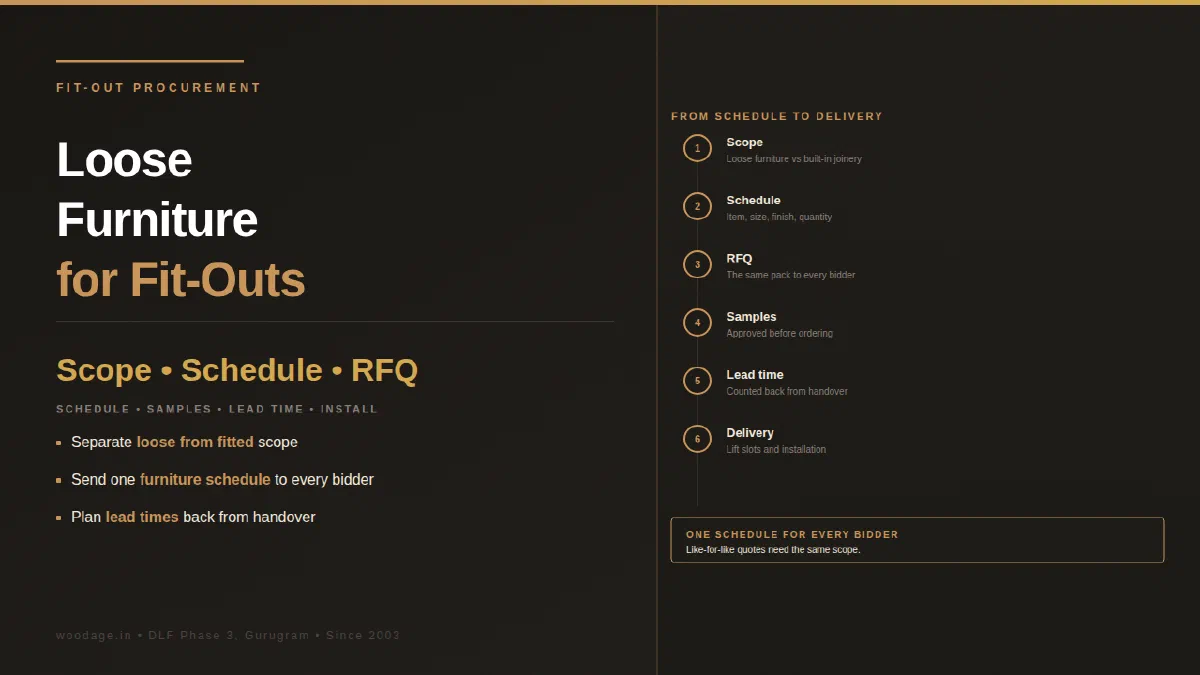
Loose Furniture for Fit-Outs: How Architects and Contractors Scope, Schedule and Buy It
Loose furniture is everything in a fit-out that is not fixed to the building: chairs, tables, movable storage, soft seating and beds. Buy it as a separate package with its own schedule. Decide per item between a catalogue brand and custom manufacture, write finish, fabric, hardware and compliance fields into the RFQ, check the BIS furniture order for chairs, tables, storage and beds, and plan lead times backwards from handover.
WoodAge is a factory-direct modular kitchen, wardrobe and custom furniture manufacturer operating since 2003 and based at 16 SCO, Saraswati Vihar, Chakkarpur, Gurugram 122002, and it makes office workstations and furniture for commercial projects as well as homes. In a fit-out, the loose package is usually tendered last and delivered last, so its mistakes land in the final fortnight before handover, when there is no time to remake anything.
This guide covers the package as a whole, for offices, co-working spaces, hotels, cafes, clinics and show flats. Workstation BOQ rows and bid normalisation for office projects are detailed in the office furniture BOQ template and RFQ guide; homeowners comparing “loose furniture” lines in a home quote should use the interior quote review checklist.
Quick answer: what is loose, what is fixed, and who usually supplies it
| Item | Loose or fixed | Usually supplied by | Why the split matters |
|---|---|---|---|
| Task and visitor chairs | Loose | Seating brand or specialist vendor | Tested catalogue products; BIS work-chair standard applies |
| Workstations and meeting tables | Loose, often with cabling | Furniture manufacturer | Custom sizes, power and data integration |
| Mobile pedestals and movable storage | Loose | Furniture manufacturer | Finish must match the joinery |
| Sofas, lounge and soft seating | Loose | Upholstery maker or brand | Fabric specification and fire requirements |
| Beds and bedside units in hotels | Loose | Furniture manufacturer | BIS bed standard; room-by-room delivery |
| Reception desk, pantry cabinets, wall storage | Fixed joinery | Fit-out contractor or joinery maker | Built to site dimensions and fixed to walls |
| Wall panelling and partitions | Fixed | Fit-out contractor | Part of the building works |
| Loose items fixed later for safety (tall storage) | Loose but anchored | Manufacturer, with the contractor’s wall fixing | Anti-tip fixing must be agreed |
Commercial design practice groups loose furniture with fixtures and equipment as FF&E, the items that move out with a tenant. Built-in joinery stays with the building. Keeping the two in separate, cross-referenced packages avoids a familiar fit-out problem: a reception desk priced by one party and its matching loose storage by another, in finishes that do not match.
What the loose package contains, by sector
| Sector | Typical loose items | Field to add to the RFQ |
|---|---|---|
| Office | Workstations, task chairs, meeting tables, pedestals, lockers | Power and data position on every desk |
| Co-working | Hot desks, phone-booth furniture, lounge seating, lockers | Durability of finishes under shared use |
| Hotel and serviced apartment | Beds, headboards, wardrobes (if loose), desks, lounge chairs | Room-type quantities and delivery by floor |
| Cafe and restaurant | Chairs, tables, banquettes, bar stools | Table-top material and base stability |
| Clinic | Consultation desks, waiting seating, storage | Cleanable surfaces and fabric |
| Show flat | Complete room sets | Return or buy-back terms after the sales phase |
Bulk supply for hotels, co-working spaces and developers is covered in the B2B bulk furniture guide, and hotel-specific construction in the hotel furniture guide.
Split the package: catalogue brand, custom manufacture or mixed
Not every item should go to the same kind of supplier.
| Criterion | Catalogue brand | Custom manufacture |
|---|---|---|
| Quantity and repeat orders | Strong for standard items | Strong for large runs of one design |
| Non-standard sizes | Limited to the catalogue | Made to the drawing |
| Finish matching with the joinery | Limited to the brand’s finishes | Matched to the joinery sample |
| Testing evidence | Published product tests | Needs a mock-up and a sample test plan |
| Lead time | Depends on stock and import | Depends on approvals and production slot |
| Spares and service | Brand service network | The maker’s written service terms |
A common, sensible split: task chairs from a seating brand, because ergonomic mechanisms and chair test evidence are specialist; tables, storage and workstations made to the drawing, because sizes, cable routes and finishes must match the space.
The loose furniture schedule: the columns that prevent errors
Every loose item needs one row in a schedule that the architect owns and every bidder prices against. The columns that matter:
- Item code, used on drawings, labels and invoices.
- Location: floor, zone and room, so delivery can be phased.
- Quantity, per room type for hotels and per zone for offices.
- Dimensions in mm, including heights for seating and tables.
- Material and grade for every board, top and frame.
- Finish codes: laminate decor, veneer species, paint shade, metal finish.
- Fabric: supplier, code, composition, rub-test result, fire requirement if any.
- Hardware: runner, hinge, lock and castor models.
- Power and data: grommet, box or tray position, and who wires it.
- Compliance: applicable Indian Standard and CM/L licence for items within the BIS furniture order.
- Approval step: sample, mock-up or catalogue approval.
- Warranty and spares: period, scope and attic stock.
A US federal furniture RFQ, published by the General Services Administration as a sample furniture RFQ, prices each line with the description, maker or specification, part number, quantity, unit, requested date, ship-to location, unit and extended price and freight. It is not an Indian template, but it shows how complete a priced line should be.
Check the BIS furniture order before you tender
The Furniture (Quality Control) Order, 2025 brings six furniture types under compulsory BIS certification: work chairs (IS 17631), general-purpose chairs and stools (IS 17632), tables and desks (IS 17633), storage units (IS 17634), beds (IS 17635) and bunk beds (IS 17636). Compliance trackers report it in force from 14 February 2026 for medium and large enterprises, with micro and small enterprises following from 13 August 2026. Read the order itself for its exemptions and scope.
For a fit-out tender this means three RFQ lines:
- Scope check per item: does the item fall within one of the six standards?
- Licence evidence: for items in scope, the maker’s CM/L number, verifiable in the BIS Care app, covering that product.
- Responsibility: who holds the licence when a contractor buys from a sub-supplier.
Lead times: plan backwards from handover
Loose furniture usually arrives last, so its programme should be planned first. Work backwards from the handover date:
| Stage | What must happen | Who signs |
|---|---|---|
| Schedule freeze | Quantities, sizes and locations fixed | Architect and client |
| Samples and finishes | Laminate, veneer, fabric and metal finishes approved | Architect |
| Mock-up | One of each repeated item built and tested in use | Client and architect |
| Production | Items made to the approved mock-up | Maker |
| Pre-dispatch check | Sample checked against the schedule at the factory | Architect or client representative |
| Delivery | By floor and zone, labelled with item codes | Contractor and maker |
| Installation and snag | Assembled, levelled, anchored where needed, snag list closed | All parties |
Long-lead items deserve their own dates in the schedule: imported fabric, stone tops, specialist chairs and anything that needs a mock-up. WoodAge’s stated timeline for a single custom piece is four to six weeks after sign-off; a fit-out package is programmed from its approved schedule, mock-ups and site readiness, not from a headline figure.
For a wider planning view, one Indian fit-out firm, AirBrick Infra, publishes these office furniture procurement ranges. They are third-party estimates only, useful for testing a programme, not commitments:
| Stage | Published planning range |
|---|---|
| Supplier shortlisting and RFQ | 5 to 10 days |
| Sample and mock-up approval | 2 to 4 weeks |
| Standard items, from order | 4 to 8 weeks |
| Custom casegoods | 8 to 14 weeks |
| Imported seating or systems | 10 to 16 weeks |
| QC, dispatch and domestic transport | About 1 to 2.5 weeks combined |
The same source notes that the clock starts at specification freeze, not at the purchase order, which is why sampling and RFQ rounds belong in the schedule.
Delivery and installation in NCR commercial buildings
Commercial towers in Gurugram and along the Golf Course Road and Cyber City belts typically control goods movement through building management: service-lift bookings, loading-bay windows, security passes for vehicles and workers, and rules on packaging waste. Put four things into the RFQ so bids include them:
- delivery windows and permitted hours;
- service-lift internal dimensions, which cap the largest assembled item;
- packaging removal and debris responsibility;
- labelling of every carton with item code, floor and zone.
Phased delivery and labelling for office projects are expanded in the office furniture BOQ guide.
Acceptance, spares and the attic stock
At handover, check each item against its schedule row: dimensions, finish code, fabric, hardware model, and anchoring for tall storage. Then collect the attic stock, the spares a facility team needs for the next five years of small repairs: extra fabric, laminate offcuts with codes, spare castors, locks and keys, and touch-up paint. Write the attic-stock list into the RFQ so it is priced, not requested as a favour at the end.
Before you issue the RFQ
- Separate loose furniture from fixed joinery in the drawings and the BOQ.
- Give every item a code that appears on the drawing, schedule, label and invoice.
- Decide catalogue or custom for each item, with the reason.
- Fill the twelve schedule columns for every row.
- Mark items within the BIS furniture order and ask for licence evidence.
- Set sample, mock-up and pre-dispatch approval steps with names and dates.
- State delivery windows, lift sizes and labelling rules.
- Price the attic stock and the warranty service terms.
Evidence and Verification Notes
The furniture order’s six standards come from the order text published by BIS; its in-force dates come from compliance trackers and should be confirmed against the order and any later notification before a tender is issued. The GSA document is a US federal sample used only to show a complete priced line; Indian tenders add GST treatment, BIS licence evidence and local delivery conditions. WoodAge is GST-registered and issues GST-compliant invoices; whether a buyer can claim input credit depends on the buyer’s own tax position.
The single-piece timeline is WoodAge’s stated figure; bulk lead times vary with approvals, quantities and site readiness, and none is stated here as a promise. For commercial loose furniture made to the drawing, see the office furniture manufacturer page for Gurugram, or inspect workstation and storage construction on a WoodAge factory visit.
Frequently Asked Questions
What is loose furniture in an office fit-out?
Loose furniture is everything that is not fixed to the building: task chairs, workstations, meeting tables, mobile pedestals, lounge seating and movable storage. It usually moves with the tenant. Fixed joinery, such as reception desks, pantry cabinets and wall storage, is built to site dimensions and stays with the building.
Is loose furniture part of the fit-out contractor’s scope?
It can be, but it is often better as a separate package with its own schedule. Contractors are strongest on fixed joinery and building works; seating brands and furniture manufacturers are stronger on tested chairs and made-to-drawing tables and storage. Whatever the split, one schedule should cover every loose item.
What should a loose furniture RFQ include?
Each item needs a code, location, quantity, dimensions, material and grade, finish codes, fabric details, hardware models, power and data positions, compliance evidence, the approval step, warranty and spares. Add delivery windows, lift sizes and labelling rules, so bids include logistics instead of adding them later as extras.
How long does loose furniture take to make for a fit-out?
It depends on the approvals, quantities and whether mock-ups are needed. WoodAge’s stated timeline for a single custom piece is four to six weeks after sign-off. A fit-out package should be programmed backwards from handover, with separate dates for samples, mock-ups, production, pre-dispatch checks and delivery.
Does the BIS furniture order apply to office chairs and tables?
The Furniture (Quality Control) Order, 2025 covers work chairs, general-purpose chairs and stools, tables and desks, storage units, beds and bunk beds under IS 17631 to IS 17636. Check whether each item falls within scope, and for items that do, ask for the maker’s CM/L licence and verify it in BIS Care.
What is FF&E in interior projects?
FF&E stands for furniture, fixtures and equipment: the movable items in a commercial interior, as opposed to the building and its fixed joinery. In hotels it covers beds, seating, desks and soft furnishings; in offices it covers workstations, chairs and movable storage. It is usually specified and bought as its own package.
Should chairs be bought from a brand or made to order?
Task chairs are usually better from a seating brand, because their mechanisms and test evidence are specialist. Tables, storage and workstations are often better made to the drawing, because sizes, cable routes and finishes must match the space. Decide item by item and record the reason in the schedule.
What is attic stock in furniture procurement?
Attic stock is the set of spares handed over with the furniture: extra fabric, laminate offcuts with their codes, spare castors, locks, keys and touch-up paint. It lets a facility team repair small damage without waiting for a new order. Price it in the RFQ rather than requesting it at handover.
Related Guides From WoodAge
- Office Furniture BOQ Template and RFQ Guide - Workstation rows, bid normalisation and acceptance.
- Office Workstation Dimensions - Desk sizes and layouts.
- B2B Bulk Furniture for Hotels, Co-Working and Developers - Sector packages.
- Hotel Furniture Manufacturer Guide - Hospitality construction and compliance.
- Office Workstation Cost in Gurgaon - Per-seat budgeting.
- Interior Quote Review Checklist - Loose furniture lines in a home quote.
Get a Factory-Direct Quote
If you are planning interiors in Gurgaon or Delhi NCR, WoodAge can help you convert the idea into a measurable BOQ: exact material grade, hardware model, finish code, timeline and warranty terms before production starts.
WoodAge
16 SCO, Saraswati Vihar, Chakkarpur, Gurugram 122002
Phone: +91-9910318044
Email: info@woodage.in
Website: woodage.in