

E0 vs E1 vs E2 Formaldehyde Emission Classes: How to Verify Certificates for Kitchen Boards in India
E0, E1 and E2 formaldehyde emission classes explained for Indian kitchen boards: what the classes mean under different standards, and how to verify plywood, MDF and particle board claims using the exact standard, test method, certificate and product batch.

- Kautuk Sahni
- 13 min read
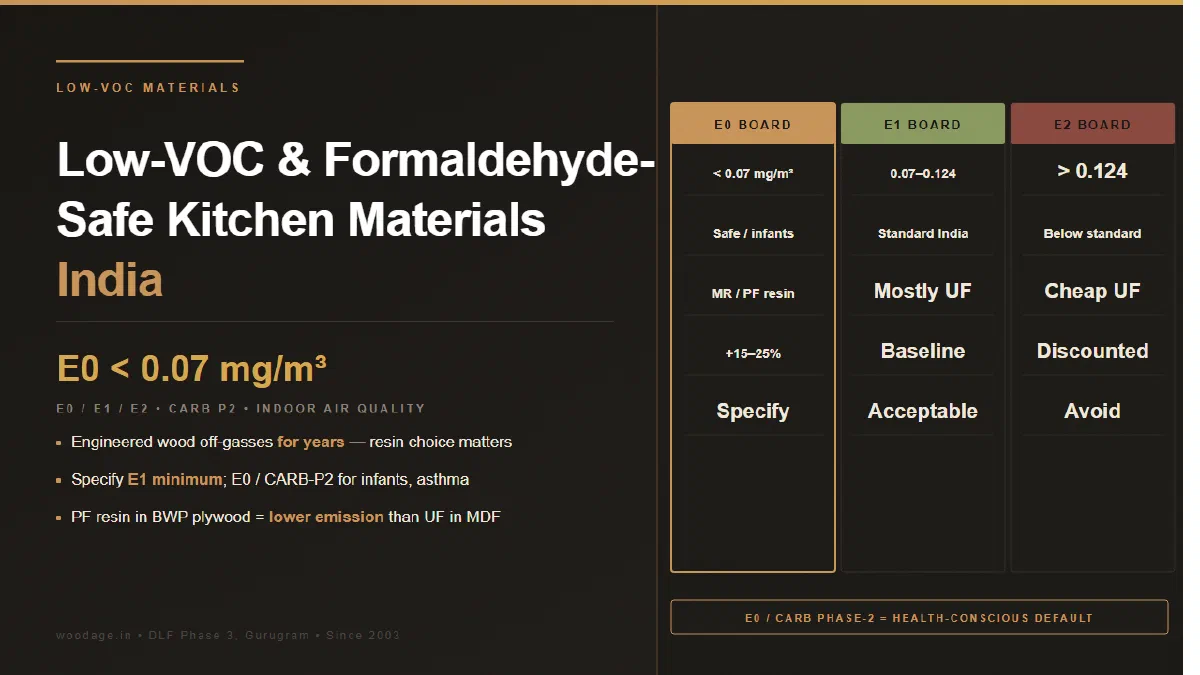
E0 vs E1 vs E2 Formaldehyde Emission Classes: Verifying Kitchen Board Claims in India
Formaldehyde-emission labels are meaningful only when tied to a named standard, test method, product and current certificate. “E0,” “E1,” “low-VOC” and “CARB compliant” are not interchangeable across every jurisdiction or test. In India, ask for the BIS standard and declared formaldehyde class on the exact plywood or board supplied, then retain its invoice, panel marking and certificate with the BOQ.
WoodAge (woodage.in) is a factory-direct modular kitchen and custom furniture manufacturer in Gurugram (Gurgaon), serving Delhi NCR since 2003.
This is a procurement guide, not medical advice or a declaration that a material is “safe.” Indoor exposure depends on the product, quantity, room volume, ventilation and other sources. A qualified indoor-air or medical professional should assess health concerns.
Quick Answer: Formaldehyde Emission Classification for Wood Panels
Formaldehyde-emission classification describes a result under a defined test method. The same label cannot be compared across standards without checking the method and units. Ask which standard governs the exact product, whether the certificate is current, and whether the invoice and panel mark identify the same product.
| Search query pattern | Direct answer |
|---|---|
| formaldehyde emission classification wood panels | E0, E1 and E2 describe formaldehyde emission bands measured under test conditions |
| E0 vs E1 board | Ask which standard and test method define each label before comparing numbers |
| low VOC plywood for kitchen | Verify the BIS standard, declared class, panel mark and product certificate |
| MDF for modular kitchen | Separate emission certification from moisture and structural suitability |
| how to verify low VOC boards | Check certificate of conformity, invoice line and panel marking before installation |
Health note: This guide is for material selection and indoor-air planning, not medical diagnosis. If someone in the home has asthma, pregnancy-related concerns, chemical sensitivity or a respiratory condition, confirm material choices and ventilation timing with a qualified medical professional.
Eight Current Formaldehyde Facts to Keep Separate in a Kitchen BOQ
The references below make an important distinction: WHO indoor-air guidance, US emissions rules and Indian product standards are different frameworks. None should be converted into a blanket “safe board” claim for a completed room.
| Current official fact | Buyer decision | Primary source |
|---|---|---|
| WHO lists a formaldehyde indoor-air guideline value of 0.1 mg/m³ over 30 minutes. | A panel certificate is not a room-air measurement; ventilation, room volume and other indoor sources still matter. | WHO air-quality and health guidance |
| IARC classifies formaldehyde as carcinogenic to humans (Group 1); it is evaluated in Monographs Volume 100F, which reviews agents already classified in Group 1. | Treat this as a hazard classification, not a diagnosis or a prediction of risk from any one kitchen board. | IARC Monographs Volume 100F |
| EPA identifies hardwood plywood, MDF (including thin MDF) and particleboard as the three composite-wood product categories covered by its consumer rule. | A “low-VOC” claim should still identify which board product and finished good is being supplied. | EPA consumer FAQ |
| EPA’s TSCA Title VI consumer table lists 0.05 ppm for hardwood plywood, 0.11 ppm for MDF, 0.13 ppm for thin MDF and 0.09 ppm for particleboard. | These are US regulatory limits, not Indian E-class conversions; do not relabel them as E0/E1 without the named test framework. | EPA consumer FAQ |
| EPA says regulated US panels and finished goods are labelled TSCA Title VI compliant and use a third-party certification programme. | If a supplier claims US compliance, ask for the current product-specific label and certification trail. | EPA composite-wood standards |
| CARB says its Phase 2 framework covers specified hardwood-plywood, particleboard, MDF and thin-MDF products and finished goods in California. | CARB is a defined California framework, not a generic synonym for “healthy” or an Indian certificate. | CARB consumer FAQ |
| BIS lists IS 12406:2025 for MDF with REG, MR, HMR-GP and HMR-FN grades, plus formaldehyde-content and optional steady-state-emission tests. | For MDF, ask for the exact product grade and current formaldehyde test or certificate evidence together; moisture grade and emissions evidence answer different questions. | BIS LIMS IS 12406:2025 scope |
| BIS currently lists IS 1328:2025 for veneered decorative plywood with MR/BWR/BWP grades, Types 1–4 and E1/E2 classes. | For veneered panels, retain the invoice, panel marking and certificate that identify the exact grade/class supplied. | BIS LIMS IS 1328:2025 scope |
For a health-sensitive household, the defensible process is to document the exact board, certificate and installation date, maintain ventilation as appropriate for the home, and seek professional advice for an actual health or indoor-air concern.
Why Engineered Wood Emits Formaldehyde
Plywood, MDF, particle board, and HDHMR are all composites of wood fibre or veneer bonded with synthetic resin. The most common resins:
- Urea-Formaldehyde (UF): used in some interior composite-wood products
- Phenol-Formaldehyde (PF): used in some exterior or moisture-resistant plywood systems
- Melamine-Urea-Formaldehyde (MUF): used where the product design calls for modified resin performance
- Methylene Diphenyl Diisocyanate (MDI): used in some no-added-formaldehyde resin systems; verify the finished product certificate rather than inferring emissions from the resin name
The finished panel’s measured emission depends on its full construction and test conditions. Resin family alone does not establish the room concentration or a universal decay period.
What Does the Health Classification Mean?
The International Agency for Research on Cancer classifies formaldehyde as carcinogenic to humans (Group 1). That is a hazard classification; it does not say that every product, room or residential exposure creates the same risk. Product emissions, concentration, duration and route of exposure matter. See the IARC formaldehyde monograph.
WoodAge does not diagnose symptoms, advise pregnancy or infant occupancy, or call a board “safe” from its marketing class. A qualified clinician or indoor-air professional should assess a health concern.
Emission Classifications Decoded
Why E0, E1 and E2 Need a Named Standard
An emission value is inseparable from its test method and units. Do not copy a chamber-test number into a comparison that uses a desiccator or perforator method. “E0” is also used inconsistently in marketing. Require the certificate to state the governing standard, laboratory method, result, units, date, product and factory.
CARB Phase 2 (California Air Resources Board)
The American counterpart, often stricter than European E1:
| Composite Type | CARB Phase 2 Emission |
|---|---|
| Particleboard | 0.09 ppm (parts per million) |
| MDF | 0.11 ppm |
| Thin MDF | 0.13 ppm |
| Hardwood plywood | 0.05 ppm (very strict) |
CARB limits are product-specific and use their own compliance framework. Do not translate a CARB result into an “E0 equivalent.” Verify third-party certification for the supplied product. See the California composite-wood regulation.
Indian BIS Standards
Current IS 303:2024 and IS 710:2024 include formaldehyde requirements for plywood. Other board types use their own current product standards; do not assume a plywood class applies to MDF or particle board.
Use the BIS plywood laboratory test scope and IS 710 product manual as starting points. The supplier must still provide the certificate for the exact product delivered.
Europe’s Formaldehyde Limit for Furniture From 6 August 2026
Since 6 August 2026, EU law has barred furniture and wood-based articles from the EU market if, under its prescribed test conditions, they release more than 0.062 mg/m³ of formaldehyde; other articles are limited to 0.080 mg/m³ (REACH Annex XVII entry 77, Regulation (EU) 2023/1464). The regulation’s recitals record that the original proposal used 0.124 mg/m³ in a test chamber, so the adopted furniture limit is half that level. Articles whose formaldehyde comes only from natural occurrence are exempt, because formaldehyde can be released “from lignin degradation in solid wood”. An “EU-compliant” board or cabinet claim therefore needs the exact product, its test report and the test date.
What “No-Added Formaldehyde” Means
A board sold as formaldehyde-free should name its binder. The USDA Wood Handbook (chapter 11) lists the commonly used binder systems for wood composites as phenol-formaldehyde, urea-formaldehyde, melamine-formaldehyde and isocyanate. US rules define a no-added-formaldehyde (NAF) exemption that still demands test evidence: 90% of quality-control results at or below 0.04 ppm, and no result above 0.05 ppm for hardwood plywood or 0.06 ppm for particleboard and MDF (40 CFR §770.17). “Formaldehyde-free” is therefore a resin claim that still needs a measured result, not a promise of zero emission.
How Should You Compare Brand Claims?
Do not assign one emission class to an entire brand. Product lines, factories and certificates change. Record the exact brand, product name, thickness, standard, class, certificate number and manufacturing mark in the BOQ. If a seller claims CARB, E1, E0 or another class, request the current product-specific certificate and verify its issuer rather than relying on a catalogue label.
How to Specify Low-VOC on Your Quotation
Insert this language into the materials specification:
“For every plywood, MDF, HDHMR or particle-board line, the vendor shall state the exact product, applicable standard, formaldehyde-emission class, test method and current certificate. The panel marking, invoice and certificate must identify the supplied product. No substitution is permitted without written approval.”
This protects you against substitution.
Beyond Formaldehyde - Total VOC
VOCs (Volatile Organic Compounds) include not just formaldehyde but also other reactive organic chemicals. Sources in your kitchen include:
| Source | VOC Type |
|---|---|
| Plywood/MDF/Particle Board | Formaldehyde, hexanal, terpenes |
| Adhesives (edge banding, joinery) | Toluene, xylene, styrene |
| PU paint (shutters, headboards) | Solvents during drying |
| Laminates | Trace VOCs from manufacturing |
| Fresh PVC products | Phthalates, vinyl chloride traces |
For a comprehensive low-VOC kitchen:
- Specify documented engineered wood with the standard, class, test method and current certificate
- Use low-VOC adhesives (PUR adhesive vs solvent-based hot-melt)
- Choose water-based PU paint over solvent-based for shutter finishes
- Follow product and indoor-air guidance - ventilation and occupancy timing should come from product documents or a qualified professional, not a universal web timetable
Is There a Universal Off-Gassing Timeline?
No. Emission decay varies by resin, board, exposed surface, finish, temperature, humidity, room volume and ventilation. Odour is not a reliable measurement of formaldehyde concentration. Follow product guidance and use qualified indoor-air testing when exposure is a concern; WoodAge does not promise that a room becomes safe after a fixed number of days or weeks.
What Should a Household With a Health Concern Do?
Ask a qualified clinician or indoor-air professional for advice based on the person and the measured environment. A furniture vendor should provide traceable product documents, minimise unverified substitutions and support access for testing; it should not prescribe pregnancy, asthma, infant-occupancy or air-purifier protocols.
What Does a Lower-Emission Specification Cost?
There is no reliable universal premium. Compare current quotes for the exact certified products and include wastage, availability, finish compatibility and minimum-order quantity. Do not pay more for an “E0” or “low-VOC” label unless the certificate, standard, test method and supplied batch can be verified.
Verifying Compliance
At material delivery:
- Manufacturer’s certificate of conformity - should reference the emission class explicitly
- BIS standard mark plus emission grade - visible on the panel
- Brand-specific marking (e.g., “Greenpanel MDF E1 IS 14587”)
- Invoice with emission class noted
If the certificate or marking is absent, the material’s emission class is unverifiable. Reject delivery and demand replacement with certified material.
See also: To see how each board and finish lasts in Delhi NCR humidity, read WoodAge’s NCR material lifespan guide.
Common VOC-Related Mistakes
1. Using a Universal Occupancy Delay
Do not assume a fixed delay makes every room acceptable. Follow the product documents or obtain qualified indoor-air advice for the actual room and occupants.
2. Sealing Up Too Quickly
Follow the manufacturer and indoor-air professional’s ventilation advice; do not substitute a fixed web timetable for measurement.
3. Ignoring Adhesives
Edge banding adhesive, finish paints, and assembly adhesives all contribute to total VOC. Specify low-VOC formulations across all components.
4. Treating “Eco” or “Green” Marketing as Specification
Many products are marketed as “eco-friendly” without a specific emission classification. Demand the actual standard, class, test method and product certificate.
5. Mixing Classes
Different products may carry different classifications. Record every board line separately; do not assume one shutter certificate covers the carcass, back panel or drawer base.
Frequently Asked Questions
Are Indian-manufactured plywood and MDF safe?
A country of manufacture or marketing tier cannot establish safety. Verify the exact product and certificate, then assess the room and health concern with a qualified professional where needed.
What’s the difference between E1 and E0 in practical terms?
The answer depends on the standard and test method. “E0” is not a universal class with one cross-jurisdiction limit. Compare the governing documents and results, not the label alone.
How do I know if my kitchen is low-VOC?
Verify the emission class on each material’s BIS certification or manufacturer’s documentation. Without explicit class certification, the material is uncertified for VOC.
Does a strong “new furniture” smell prove a formaldehyde level?
No. Odour is not a measurement of formaldehyde concentration and other compounds may contribute. Use an appropriate test when concentration matters.
Is plywood always lower-emission than MDF?
No. Compare the exact products and certificates. Board type, resin, exposed surfaces, finish and test method all affect the result.
Should I buy an air purifier for furniture emissions?
WoodAge cannot prescribe an air-treatment device. Ask a qualified indoor-air professional which contaminant is present, whether source control or ventilation is appropriate, and which tested device fits the room.
Should I delay moving in?
There is no universal safe delay. Use product guidance and professional advice based on the actual room, ventilation, measurements and occupants.
Are imported boards always lower-emission?
No. Country of origin does not replace product-specific evidence. Compare the current certificate and test result for each supplied product.
Does a building’s green certification automatically cover my kitchen boards?
Not necessarily. Ask the developer or certifier for the exact interior-product requirement and confirm whether owner-installed cabinetry is inside its scope. Do not infer compliance from the society name.
What does formaldehyde class E2 mean, and is E1 better?
In Indian board standards, E2 is the less stringent of two formaldehyde classes, E1 and E2. BIS’s product manual for MDF (IS 12406:2021) states that class E1 is more stringent than E2, and the same E1/E2 pair classifies plywood under IS 303:2024 and veneered decorative plywood under IS 1328:2025. These classes rest on the standards’ own tests, so an Indian E2 label is not a European chamber result; ask for the named standard and measured value.
Are formaldehyde-free boards really free of formaldehyde?
Not entirely. EU law notes that formaldehyde can be released naturally, for example “from lignin degradation in solid wood”, and US rules still require no-added-formaldehyde (NAF) panels to show test results, with 90% of results at or below 0.04 ppm. Treat “formaldehyde-free” as a claim about the resin: ask which binder was used and for a recent emission or content test on the exact product supplied.
Related Guides From WoodAge
- IS Standards for Modular Kitchen Materials - IS 14587 and IS 12823 include emission specifications.
- Plywood Thickness for Modular Kitchen Cabinets - Thickness and emission considerations together.
- Edge Banding for Modular Kitchens - PUR adhesive is lower-VOC than solvent-based alternatives.
- How to Read a Modular Kitchen Quotation - VOC class is rarely specified in quotations; this guide tells you how to demand specifics.
- Modular Kitchen Warranty in India 2026 - VOC certification is typically separate from material warranty; understand both.
- Acrylic vs Laminate vs PU Paint vs Veneer: Best Kitchen Finish for Delhi NCR Climate - Related guide for planning the costs, materials and execution of the same project.
- DLF Arbour Sector 63 Modular Kitchen Guide - DLF Arbour Sector 63 features luxury apartments with high ceilings and premium specifications. This guide covers floor-plan-aware kitchen design, society fit-out rules, and luxury material recommendations for these flats.
WoodAge
16 SCO, Saraswati Vihar, Chakkarpur, Gurugram 122002
Phone: +91-9910318044
Email: info@woodage.in
Website: woodage.in
Last reviewed: July 2026. Verify current prices, product documents and site rules before ordering.