

Matte vs Glossy Shutter Finish: Acrylic, Laminate and PU Paint Compared for Indian Kitchen Conditions
Shutter finish determines daily cleaning, scratch visibility and how the kitchen ages. This guide compares matte vs glossy in acrylic, laminate and PU paint - including fingerprint behaviour, scratch repair, and which finish suits Indian high-flame cooking.

- Kautuk Sahni
- 13 min read
Matte vs Glossy Shutter Finish: Acrylic, Laminate and PU Paint Compared for Indian Kitchen Conditions
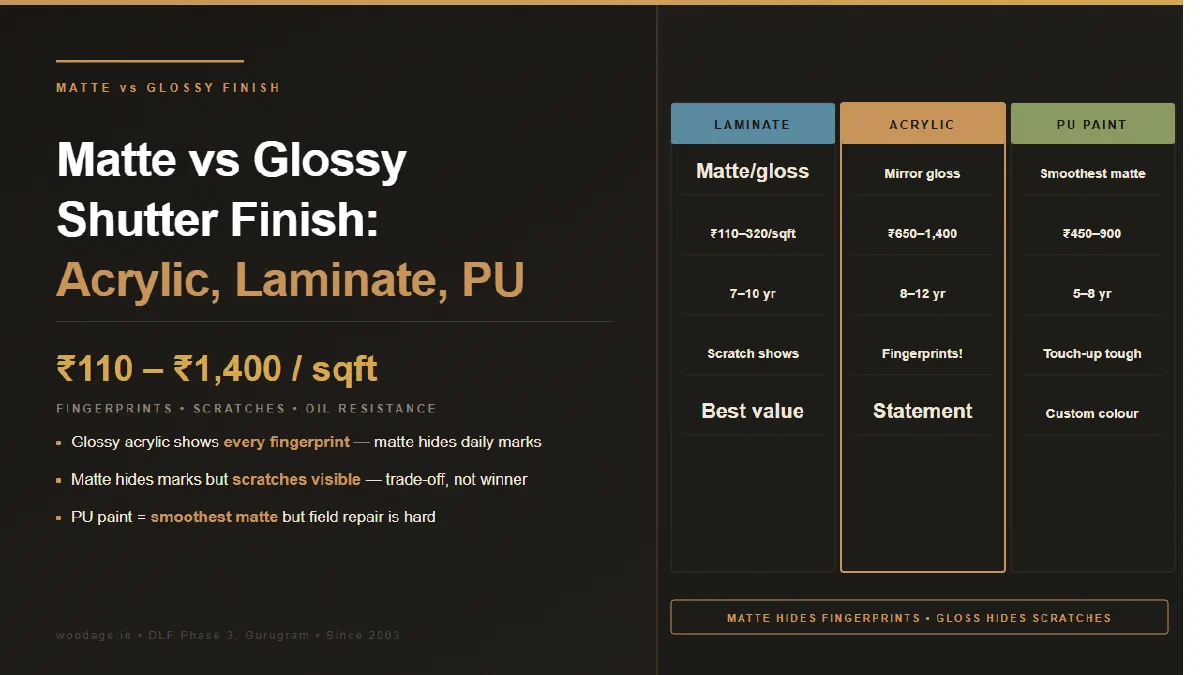
The matte-vs-glossy choice is rarely just aesthetic. Glossy finishes show fingerprints and water spots immediately; matte finishes hide them but show scratches more visibly. Acrylic offers the deepest gloss; PU paint offers the smoothest matte; laminate offers the widest range at the lowest cost. For Indian kitchens - where daily cleaning, oil splatter, and high-flame cooking are normal - finish choice has practical consequences that show up in years two through five.
WoodAge (woodage.in) is a factory-direct modular kitchen and custom furniture manufacturer in Gurugram (Gurgaon), serving Delhi NCR since 2003.
This guide compares each material in matte and gloss variants, covering fingerprint behaviour, scratch repairability, oil resistance, longevity, and which finish makes sense for which kitchen.
The Three Major Shutter Finish Materials
1. Laminate
The most common shutter finish in India.
Composition: Decorative paper impregnated with melamine resin, pressed onto kraft paper layers, bonded to the substrate (HDHMR, MDF or plywood).
Brands in NCR: Greenlam, Merino, Century, Sundek, Lamiwood, Decolam (premium); Royale, Sumitomo (mid); various local brands
Available finishes:
- High-gloss
- Matte (low-sheen)
- Suede / soft-touch
- Textured (woodgrain, stone, fabric)
- Anti-fingerprint matte (premium)
2. Acrylic
Premium glossy shutter material with depth and luminosity.
Composition: Acrylic film (PMMA - polymethyl methacrylate) bonded to MDF substrate, often with a clear top coat for additional gloss and protection.
Brands in NCR: Senosan, Rehau, Acrylux, Saviola; some Indian brands offering acrylic shutters
Available finishes:
- High-gloss (the standard offering)
- Super-gloss (with thicker clear coat)
- Matte acrylic (less common; growing in popularity)
3. PU Paint (Polyurethane Coating)
Premium custom-finished shutters with paint-grade smoothness.
Composition: Multi-layer PU paint (typically 5 to 7 coats) on MDF or HDHMR substrate; baked or air-dried; sometimes finished with clear topcoat.
Application: Site-painted by skilled finishers or factory-painted at quality manufacturers.
Available finishes:
- High-gloss (multiple polishing stages)
- Matte (sand-finished)
- Soft-touch / suede (specialised topcoat)
- Custom colours (pantone-matchable)
Matte vs Glossy in Each Material
Laminate Comparison
| Aspect | High-Gloss Laminate | Matte Laminate |
|---|---|---|
| Aesthetic | Modern, bright, reflective | Sophisticated, calm, hides flaws |
| Fingerprints | Highly visible | Largely invisible |
| Water spots | Show clearly | Hidden |
| Scratches | Less visible | More visible (catches light) |
| Cleaning | Streak-prone with cloths | Easier; doesn’t show streaks |
| Cost | Standard | Slightly higher (10 to 15%) for anti-fingerprint matte |
| Durability | High | Same |
Acrylic Comparison
| Aspect | High-Gloss Acrylic | Matte Acrylic |
|---|---|---|
| Aesthetic | Deep, mirror-like reflection | Soft, modern, premium |
| Fingerprints | Most visible of any finish | Less visible than gloss |
| Water spots | Show clearly | Less visible |
| Scratches | Clearly visible; difficult to repair | Less obvious |
| Cleaning | Microfibre cloth needed; streaks easily | Easier daily cleaning |
| Cost | Premium | Premium (similar) |
| Recoverability | Polishing can restore gloss | Scratches difficult to remove |
PU Paint Comparison
| Aspect | High-Gloss PU | Matte PU |
|---|---|---|
| Aesthetic | Lacquered, luxurious feel | Velvet-like; modern |
| Fingerprints | Visible | Largely invisible |
| Water spots | Visible | Hidden |
| Scratches | Visible; can be repaired by sanding & re-coating | Less visible; can be touched up |
| Cleaning | Soft cloth required | Easier |
| Cost | Premium-plus | Premium-plus |
| Repair | Re-coat possible (skill required) | Easier |
Real-World Behaviour in Indian Kitchens
Fingerprint and Hand Mark Behaviour
After 6 months of daily use, fingerprint visibility ranks:
- Most visible (worst): High-gloss acrylic, especially in dark colours
- Very visible: High-gloss laminate, dark colours
- Visible: High-gloss PU paint
- Less visible: Matte laminate
- Least visible: Matte PU paint, anti-fingerprint matte laminate (premium variants)
For Indian kitchens with frequent door opening and contact with cooking-stained hands, matte finishes show significantly less wear over time. Anti-fingerprint matte laminate (premium variants from Greenlam, Merino) is engineered specifically for this - molecular surface treatment that resists oil-based fingerprints.
Oil Splatter and Cooking Stains
| Finish | Behaviour |
|---|---|
| High-gloss laminate | Oil wipes off easily; staining minimal |
| Matte laminate | Oil wipes off; sometimes leaves slight gloss patch where wiped |
| High-gloss acrylic | Oil wipes off easily; no penetration |
| Matte acrylic | Oil wipes off; less streak-prone than glossy |
| High-gloss PU | Oil wipes off; can show slight haze in extended exposure |
| Matte PU | Oil wipes off; less visible patch effect |
For tadka and frying frequency in Indian cooking, all four finishes handle splatter adequately if cleaned regularly. Long-term sustained oil exposure (cabinet directly above hob without good chimney) ages all finishes.
Scratch Visibility
| Finish | Scratch Visibility |
|---|---|
| High-gloss acrylic | Most visible (catches reflected light) |
| High-gloss laminate | Visible |
| High-gloss PU | Visible |
| Matte laminate | Less visible |
| Matte acrylic | Less visible than glossy acrylic |
| Matte PU | Least visible |
Matte finishes diffuse light, making fine scratches less perceptible. For households with kids or pets, matte finishes age more gracefully.
Repair-ability
| Finish | Repair Possibility |
|---|---|
| Laminate (any) | Affected shutter must be replaced; can’t be re-coated |
| Acrylic | Polishing can remove fine scratches; deep scratches require shutter replacement |
| PU paint | Sanding + re-coating possible; matches well if same finisher |
PU paint is uniquely repairable. A scratched section can be sanded smooth and re-coated. Laminate has no repair option - replace the shutter.
Cost Hierarchy
From most economical to premium:
- Mid-range laminate (matte or gloss): Standard pricing
- Premium laminate (anti-fingerprint, suede): Modest premium
- Acrylic (matte or gloss): Premium tier
- PU paint (matte or gloss): Premium-plus tier
- Imported European laminate / acrylic: Highest premium
For most NCR kitchens, premium laminate offers the best value-to-aesthetic ratio. Acrylic is for premium installations seeking the depth of gloss; PU paint is for premium installations wanting custom colours and repair-ability.
When to Choose Each
Choose High-Gloss Laminate When
- You want the modern aesthetic without acrylic’s premium cost
- You’re committed to daily wiping
- Your kitchen has good lighting (gloss looks best with abundant light)
- You’re in a budget-conscious project but want the modern look
- You’re designing for resale (gloss laminate has wide appeal)
Choose Matte Laminate When
- You want easy maintenance (fewer visible fingerprints)
- Your household has small children
- Your kitchen has direct strong sunlight (gloss reflects harshly)
- You prefer the muted, sophisticated aesthetic
- You’re comfortable with slight scratch visibility over time
Choose High-Gloss Acrylic When
- You want the most premium glossy appearance
- You’re committed to careful daily cleaning
- Your budget allows premium pricing
- You want a striking visual statement
- The aesthetic justifies the higher maintenance
Choose Matte Acrylic When
- You want premium aesthetic with practical maintenance
- You prefer modern, soft visual character
- You’ve decided against laminate’s slightly less premium feel
- You want acrylic durability without high-gloss fingerprint issues
Choose High-Gloss PU When
- You want absolute premium with custom colour matching
- You value the ability to repair scratches
- You’re willing to invest in regular professional cleaning/polishing
- The kitchen is a statement piece in a luxury home
Choose Matte PU When
- You want top-tier aesthetic with practical maintenance
- You want custom colours (PU is fully colour-matchable)
- You value repair-ability for long-term ownership
- You want the velvet-like feel that distinguishes from laminate
Cleaning Practices by Finish
High-Gloss Surfaces (Any Material)
- Microfibre cloth daily
- Avoid abrasive cleaners or sponges
- Glass cleaner (ammonia-free) for water spots
- Periodic professional polishing for acrylic and PU
Matte Surfaces (Any Material)
- Damp microfibre cloth daily
- Mild soap water for stubborn marks
- Avoid heavy cleaners that can affect surface texture
- Less daily attention needed than gloss
Acrylic-Specific
- Never use ammonia-based cleaners (can yellow over time)
- Avoid abrasive pads (scratches show clearly)
- Microfibre with mild soap; rinse residue
PU-Specific
- Standard household cleaners safe
- For polished gloss, occasional polishing maintains depth
- For matte, dust daily; deep clean weekly
Failure Modes and Aging
Laminate Aging
- Year 1 to 5: minimal change with proper maintenance
- Year 5 to 10: high-gloss laminate may show minor scratching; matte holds up well
- Year 10 to 15: replacement of shutters becomes attractive option (cabinet renovation, see Renovation Guide)
- Year 15+: laminate quality variation; some panels still acceptable, others need replacement
Acrylic Aging
- Year 1 to 5: minimal aging; periodic polishing maintains depth
- Year 5 to 10: surface scratches accumulate; polishing required for premium look
- Year 10+: deeper scratches require shutter replacement
PU Paint Aging
- Year 1 to 5: excellent if maintained; touch-up coats restore aesthetic
- Year 5 to 10: re-coating an entire kitchen is feasible (premium service)
- Year 10 to 20: well-maintained PU kitchens can look new throughout
- Re-painting capability is significant advantage over laminate/acrylic
Common Finish Mistakes
1. High-Gloss in Bright-Sun Kitchens
Sunlight creates harsh glare on high-gloss surfaces. Plan kitchen orientation and light sources before committing to high-gloss.
2. Matte Without Care
Many matte finishes still need cleaning; “matte = low maintenance” is a misconception. Matte hides daily fingerprints but still requires periodic cleaning.
3. Mixing Finishes Carelessly
High-gloss upper cabinets + matte lower cabinets can look intentional or accidental. The visual transition needs design intent.
4. PU Paint Without Skilled Finisher
PU paint quality depends entirely on finisher skill. Cheap PU painting can show brush marks, drips, or uneven gloss. Hire factory-finished cabinets or experienced site finishers.
5. Acrylic in High-Traffic Touch Zones
Heavy contact areas (handles, edges) show wear faster on acrylic. Combine acrylic main surfaces with PU or laminate accent areas.
6. Custom Colour Matching Failure
PU paint claims to match any colour. Sometimes colour samples don’t match production colours. Always approve a finished sample piece before full kitchen production.
Specifying Finish on Your Quotation
Use a sample approval record when comparing acrylic matte finish with matte laminate or PU. Record the substrate, named surface/coating product, colour code, sheen description and edge finish on each sample. Compare them under the kitchen’s planned daylight and task lighting; do not compare a glossy catalogue photograph with a physical matte shutter and call the difference a material test.
Retain an approved sample reference with the drawing and ask how a later replacement shutter would be matched. A supplier’s cleaning demonstration should follow that product’s care instructions; improvised scratching, solvent or heat tests can damage a sample without establishing a useful durability result. This separates the appearance decision from evidence about the exact finish system.
Insert this into your contract:
“All shutter finishes shall be [specify: high-gloss laminate / matte laminate / high-gloss acrylic / matte PU / etc.] manufactured by [Greenlam / Merino / Senosan / etc.] in colour code [specific code]. For matte finishes, anti-fingerprint variant shall be specified where available. Shutter substrate: 18 mm BWP plywood or HDHMR. Edges: 2 mm PUR-bonded edge banding in colour-matched finish. Manufacturer’s warranty: 5 years on finish (no peeling, fading, delamination); 10 years on structural integrity.”
This protects you against shortcuts in finish quality.
Product-Data Facts That Make a PU Finish Brief More Precise
PU is a coating system, not one universal performance number. The following figures are from named Asian Paints product sheets; they help a buyer ask for a comparable process, but do not transfer automatically to another brand, substrate or jobsite.
| Named product-sheet fact | Practical quotation question |
|---|---|
| Asian Paints’ WoodTech Ingenio PU sheet lists a surface-dry time of 30 minutes. | Which exact coating system and dry-time sequence will be used before the next operation? |
| The same sheet lists 1.5 hours tack-free and 3 hours hard-dry under its stated conditions. | Is the factory/site schedule allowing the product-specific cure stages rather than rushing assembly? |
| It reports a matte gloss range of 16–26 at a 60° gloss head. | Put “matte” or the required sheen range in writing; visual words alone are ambiguous. |
| It reports 95–102 for its gloss version at the same measurement angle. | Ask for an approved physical sample, because a phone image cannot establish sheen. |
| Its stated application conditions are 20–40°C and relative humidity of 75% or less. | If finishing is planned on site, ask how temperature, humidity, dust and handling will be controlled. |
For a separate named system, Asian Paints’ WoodTech PU Interior sheet lists 25 minutes surface dry and three hours tack-free under its own conditions. That difference is why a quotation should state a product line and process, not merely “PU polish.”
See also: For a factory-direct kitchen from the Gurugram unit, see WoodAge’s Gurgaon modular kitchen factory.
Frequently Asked Questions
Which finish is most popular in NCR right now?
For premium installations, matte PU and matte acrylic are gaining popularity over high-gloss. For mid-range, premium laminate (matte or gloss) is the standard choice.
Does high-gloss show every fingerprint?
Yes, particularly on dark colours. White or light-coloured high-gloss is more forgiving. Anti-fingerprint matte laminate is engineered specifically to address this.
Can I mix matte and gloss in the same kitchen?
Yes - many premium kitchens do this intentionally. Common combination: matte uppers + high-gloss base; or high-gloss island + matte cabinets.
What about for resale value?
For mid-range markets, classic laminate (white, beige, wood-tone) is most universally acceptable. For premium markets, matte PU paint or matte acrylic in classic colours appeals to discerning buyers.
Can scratches in laminate be repaired?
Generally no - replace the affected shutter. For minor scratches, polish compounds may improve appearance but don’t restore the original surface.
Are anti-fingerprint matte laminates worth the premium?
Yes, particularly for households with children. The molecular surface treatment is engineered specifically for daily oil-based fingerprint resistance. The 10 to 15% cost premium is justified.
How does PU paint hold up to NCR humidity?
Quality PU paint handles humidity well; cheap PU paints can yellow or peel in humid conditions. Premium PU brands (high solids, polyester-based) handle NCR’s seasonal humidity properly.
Can I have a different colour on the inside vs outside of the shutter?
Yes - many kitchens use one colour outside and a contrasting (or coordinating) colour inside. This adds visual interest when shutters open.
Should I worry about colour fading over years?
Quality laminates and acrylics resist UV fading well. PU paint holds colour. Cheap variants can yellow or fade with sun exposure. For heavy sun exposure, specify UV-resistant finish.
What if my finish gets damaged in transit or installation?
Damage during installation should be vendor-covered (workmanship warranty). For laminate damage: shutter replacement. For PU paint: re-coating possible. Document damage immediately and demand rectification.
Is an acrylic finish always glossy?
No. High gloss is acrylic’s standard offering, and super-gloss adds a thicker clear coat, but matte acrylic is also made, although it is less common. Matte acrylic shows fingerprints and water spots less than gloss acrylic and is easier to clean day to day, but its scratches are difficult to remove, whereas gloss acrylic can be polished to restore its shine.
What is the difference between high-gloss laminate and acrylic?
They are different materials. High-gloss laminate is decorative paper impregnated with melamine resin and pressed onto kraft paper layers, while acrylic is a PMMA (polymethyl methacrylate) film bonded to an MDF substrate, often with a clear top coat, which gives a deeper, mirror-like reflection. Acrylic sits in a higher cost tier than laminate, and gloss acrylic shows fingerprints more than any other finish.
Related Guides From WoodAge
- How to Read a Modular Kitchen Quotation - Finish specifications are often vague; this guide tells you how to specify clearly.
- Edge Banding for Modular Kitchens - Edge banding must coordinate with shutter finish.
- Modular Kitchen Renovation in Gurgaon 2026 - Shutter replacement is one of the most common renovation upgrades.
- Modular Kitchen Warranty in India 2026 - Finish-specific warranty terms.
- Modular Kitchen Cost in Gurgaon 2026 - Finish choice is one of the largest cost drivers.
- Acrylic vs Laminate vs PU Paint vs Veneer: Best Kitchen Finish for Delhi NCR Climate - Useful next reading on hardware planning, costs, materials, or execution.
- ATS Marigold Sector 89A Modular Kitchen Guide - ATS Marigold Sector 89A is a mature residential community where many owners are renovating original kitchens. This guide covers floor-plan-aware design, RWA fit-out rules, common renovation patterns, and material specifications for these flats.
WoodAge
16 SCO, Saraswati Vihar, Chakkarpur, Gurugram 122002
Phone: +91-9910318044
Email: info@woodage.in
Website: woodage.in
Last reviewed: June 2026. Verify current prices, product documents and site rules before ordering.