

Mattress and Bed Base: Slats, Platforms and Centre Support
Match a mattress to its bed base using the exact manufacturer's requirements. Check slats, platform support, centre legs and ventilation before ordering.

- Kautuk Sahni
- 8 min read
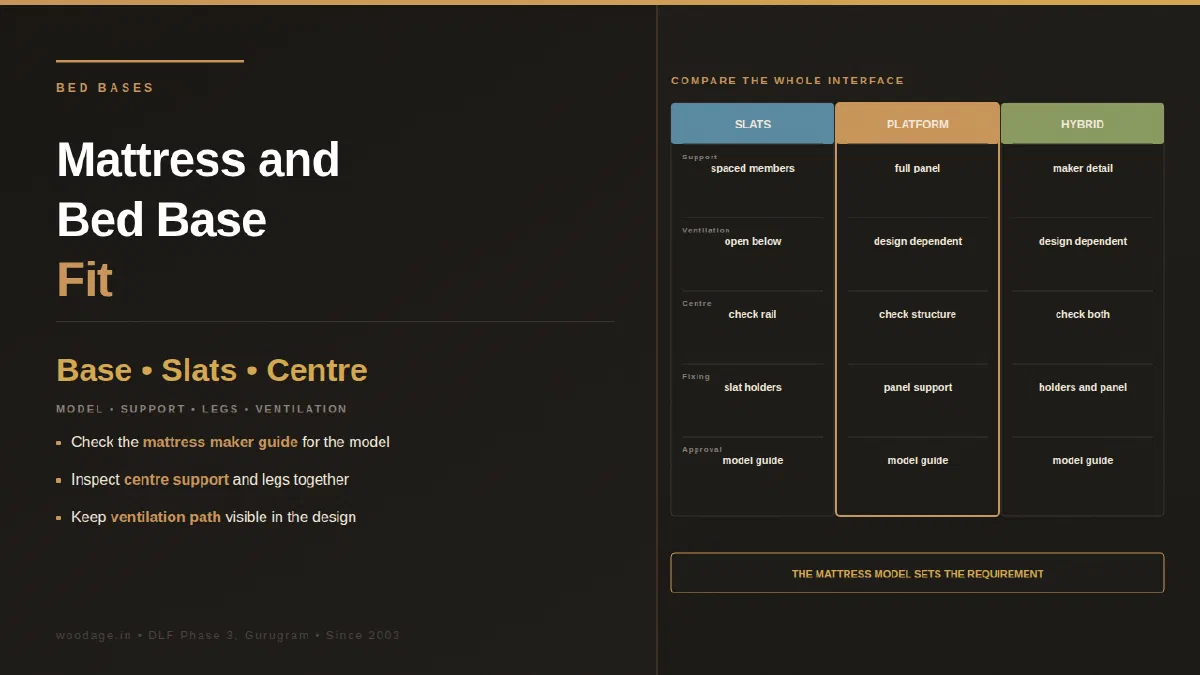
Quick answer: Choose the bed base from the mattress manufacturer’s support requirements, then check the complete frame, slats or platform, centre support and ventilation. “Slatted” and “solid” describe broad arrangements, not guaranteed compatibility. A mattress that fits the bed’s length and width may still sit on an unsuitable support system.
WoodAge is a factory-direct furniture and interiors manufacturer in Gurugram, working since 2003. The safest starting point for a custom bed is the exact mattress model and its installation or warranty instructions, before the support arrangement is finalised.
Ask the mattress supplier first
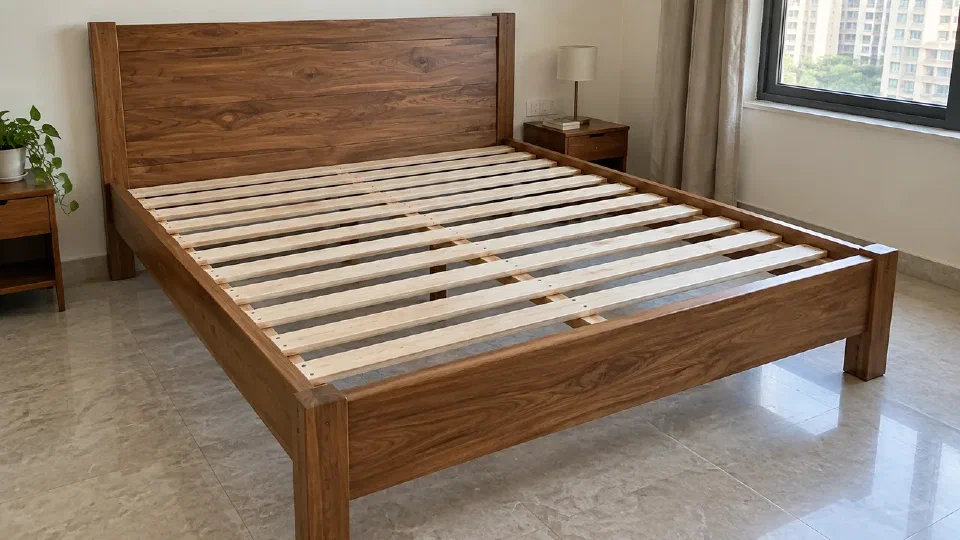
Record whether the mattress allows a solid platform, rigid slats, sprung slats or another base. Obtain any specified limits for gaps, support spacing and centre support. Check whether the requirements change with mattress size.
IKEA India’s bed-slat range shows that slatted bases are separate products with their own construction and compatibility information. The identified LONSET product describes its own supporting and ventilation arrangement. Neither source establishes a universal permitted gap for a different mattress.
For a concrete example of model dependence, Tempur-Pedic’s US support guidance permits a structurally sound slatted frame only when its slats are at least 3 inches wide and no more than 4 inches apart, and warns that plywood is not a recommended substitute for its mattress. Those figures and warranty conditions belong to that manufacturer and market; obtain the Indian supplier’s instructions for the exact mattress being purchased.
The maker-specific rules genuinely differ. Serta’s foundation guidance recommends slats no more than 2 inches apart and describes a finished-wood platform over wider-spaced slats; Titan Mattress’s warranty guidance allows slats up to 5 inches apart. These US examples are not three competing Indian standards. They show why the buyer should attach the chosen mattress’s current written rule to the bed drawing instead of selecting an internet average or automatically adding plywood.
An Indian warranty may state the issue without supplying drawing dimensions. Wakefit’s warranty excludes a mattress used on a bed that is not structurally capable of supporting it or over two separate beds. That clause does not specify a universal slat gap. For a custom frame, send the mattress supplier the proposed slat, platform and centre-support drawing and ask for written confirmation for that model, instead of treating the absence of a published number as approval.
| Base feature | Question to answer |
|---|---|
| Slat or panel arrangement | Is it permitted for the selected mattress? |
| Unsupported spans | How is the base supported by rails or beams? |
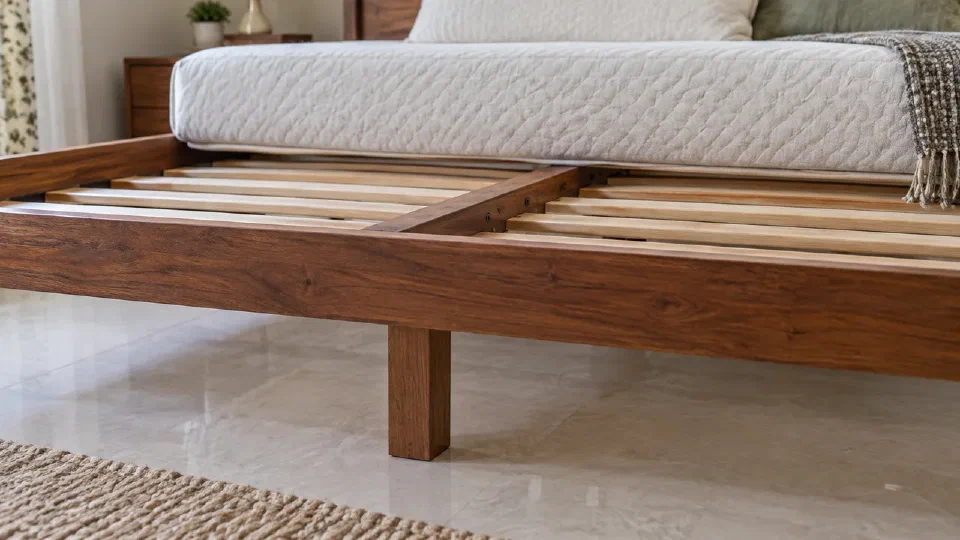
| Centre support | What does this bed size and system require? |
| Slat retention | How are components prevented from shifting? |
| Frame connections | Are all specified connectors present and sound? |
| Ventilation | What does the mattress/base maker require? |
| Storage lift | Does the mechanism suit the complete moving assembly? |
Do not mix dimensions and performance
Measure the actual support area and mattress, not only the advertised size name. “Queen” does not identify one universal dimension across all suppliers. Also check the surrounding frame and the finished mattress-top height.
Illustrative calculation: a 300 mm-high base with a 250 mm-thick mattress gives a nominal unloaded top height of 550 mm. The user’s sitting height will differ when the mattress compresses. This is a planning example, not an ergonomic recommendation.
A thicker support panel is not automatically adequate for a longer unsupported span. Slat material, section, support and connections all matter. Obtain the bed maker’s design specification rather than improvising a thickness from an unrelated internet guide.
Ventilation is a design requirement, not a sales label
The mattress and its environment need to be considered together. Follow the manufacturer’s advice for airflow, care and moisture management. Do not assume drilling random holes into a load-bearing panel creates an approved ventilated base; it changes the panel and may affect its performance.
In a storage bed, keep the intended ventilation paths and service access clear. The storage compartment is not a reason to ignore the mattress’s required support. Check the mechanism separately before changing the mattress to a much heavier or lighter one.
What to check before ordering the bed base
Verify the mattress model and dimensions against the order. Compare the installed support arrangement with the approved drawing, including central members, legs, slat holders and connections. Check for damaged parts, rocking and unusual movement during ordinary use.
Keep the assembly instructions, mattress requirements and written product warranties together. If two suppliers are involved, get their compatibility confirmation before delivery rather than after a problem develops.
Write one approval line on the drawing: mattress make, model and size; permitted base type; stated slat width and maximum clear gap, if any; required centre support; and who confirmed the proposed frame. Measure a clear gap between adjacent slats, not a centre-to-centre pitch. If the supplier gives no published rule, request one in writing before the bed base is made.
The Indian standard and the BIS mark for beds
India’s standard for adult beds, IS 17635:2022, covers the performance and safety of beds for domestic and non-domestic use, and excludes types such as bunk beds, water beds and medical beds. Beds are one of six furniture categories brought under compulsory BIS certification by the Furniture (Quality Control) Order, 2025, which came into force on 14 February 2026, with an extension to 14 August 2026 for micro and small enterprises. For a ready-made bed, ask whether it falls within the order and, if it does, for the ISI mark and a CM/L number that verifies in the BIS Care app. For a custom bed, the same standard is a useful reference for what a performance specification covers.
Convert the mattress maker’s rule into a drawing check. The maker-specific slat rules above are in inches; for a metric drawing, 2 inches is 50.8 mm, 3 inches is 76.2 mm and 4 inches is 101.6 mm. A rule of “slats at least 3 inches wide and no more than 4 inches apart” therefore means slats of at least 76 mm with clear gaps of no more than about 101 mm. Measure the clear gap between adjacent slats, not the centre-to-centre pitch.
If the bed must go up a Gurugram tower’s service lift, a one-piece platform larger than the lift car may need a split design, so confirm the lift dimensions with the society before the base is drawn.
Evidence and Verification Notes
IS 17635:2022 was checked by title and edition, and the quality control order’s dates are as notified in February 2025. The inch-to-millimetre conversions are exact; the slat rules belong to the named mattress makers and apply only to their products, checked in September 2026. Frames and slat holders can be seen on a WoodAge factory visit.
Frequently Asked Questions
Is a platform better than slats?
Neither is universally better. The selected mattress’s instructions and the complete bed design decide compatibility. Compare the actual systems rather than the category names.
Can any mattress go on a slatted base?
No. Mattress makers may specify particular support conditions. Ask for the requirements for the exact model, size and warranty.
Can plywood be placed over the slats?
Only if the resulting arrangement is accepted by the relevant manufacturers and the frame design. The extra panel changes weight, airflow, height and support behaviour; it is not a universal correction.
Whose slat-spacing rule should be followed?
Follow the exact mattress manufacturer’s current installation and warranty instructions for the selected model. A number from another brand or market is only an example.
When is centre support needed?
Use the requirements for the actual mattress and bed size, then design the rail, legs and floor contact as one support arrangement. Do not infer it from width alone.
Does a solid platform remove the need for ventilation?
Not automatically. The mattress instructions may require airflow or a particular support surface. Confirm the complete base and room moisture conditions.
Do beds in India need BIS certification?
Adult beds are covered by IS 17635:2022 and are among the six categories under the Furniture (Quality Control) Order, 2025, in force from 14 February 2026, with micro and small enterprises given until 14 August 2026. Ask whether your bed falls within the order and check any CM/L number in the BIS Care app.
What slat gap is right for my mattress?
The gap your mattress maker states for that model. Published rules differ: one US maker asks for slats at least 3 inches (76 mm) wide and no more than 4 inches (about 101 mm) apart, another for gaps of no more than 2 inches (about 51 mm). Measure the clear gap between slats against the rule for your mattress.
For a project in Gurugram or Delhi NCR, use WoodAge’s custom furniture service to discuss the measured requirement and written scope. Product suitability and the final BOQ must be confirmed for the actual order.
Related Guides From WoodAge
- Storage bed mechanisms - for comparing hydraulic, box and drawer arrangements.
- Bed size guide - for matching the base to the mattress and room.
- Storage bed and headboard guide - for the complete bed specification.
- Solid wood versus plywood - for substrate and frame material decisions.
- Wall-Hung Vanities: Wall Support and Installation Checks - Useful next reading on furniture planning, costs, materials, or execution.
- Best Modular Kitchen Manufacturer in Gurgaon 2026: 15-Point Checklist Before You Buy - Useful next reading on furniture planning, costs, materials, or execution.