

Membrane Shutters: Uses, Limits and Buying Checks
Understand membrane shutters for Indian kitchens and wardrobes: vacuum pressing, substrate, heat and steam risks, edge-free profiles, repair limits and BOQ checks.

- Arpit Sahni
- 13 min read

Membrane Shutters: The Finish Indian Quotes Name Without Explaining
A membrane shutter uses a thermoplastic decorative foil formed over a routed fibreboard face and edges in a heated vacuum or membrane press. It can create a profile without a face-side edge-band joint. Performance depends on the core, foil, adhesive, press cycle, reverse-face balance, appliance clearance and exposure after installation.
WoodAge is a factory-direct modular kitchen and custom furniture manufacturer operating since 2003 and based at 16 SCO, Saraswati Vihar, Chakkarpur, Gurugram 122002. This page turns the word “membrane” into a core, foil, adhesive, process and exposure specification a buyer can verify.
This is a cabinet-shutter guide for kitchens and wardrobes. The live flush vs membrane vs laminate door guide remains the owner for room-door construction and door-use queries; a cabinet shutter and a passage door are not interchangeable assemblies.
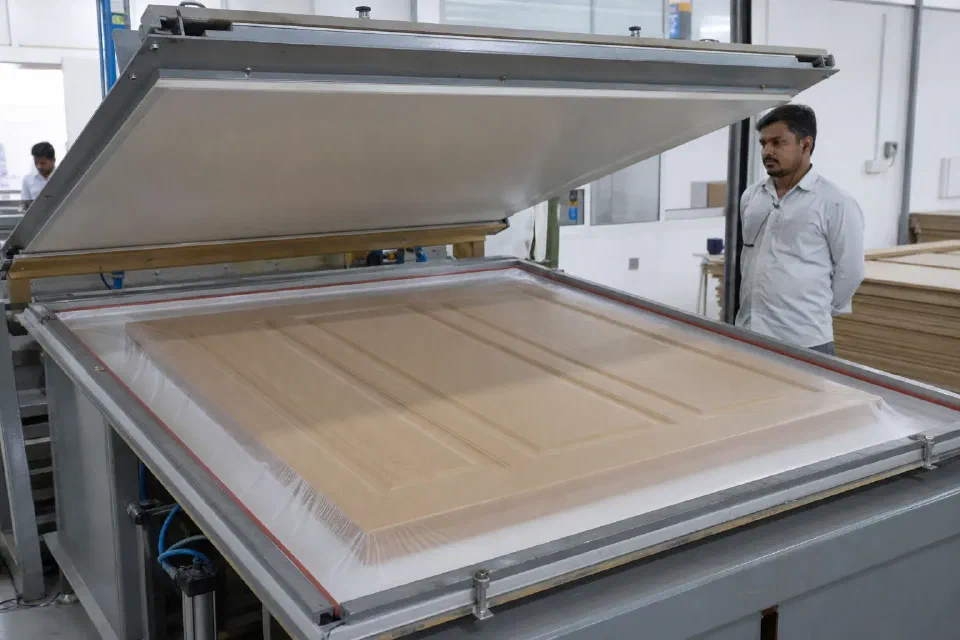
How a membrane shutter is actually made
- An MDF or HDHMR panel is cut to size.
- A profile is routed into the face, if a shaker or moulded look is wanted.
- Adhesive is applied.
- A thin PVC foil is laid over the panel and pressed down in a heated vacuum press, which pulls the foil into every routed groove and wraps it around the edges.
- The excess is trimmed at the back.
The key structural fact: the finish is one continuous skin over the face and edges, with the only join at the rear. No edge banding is applied, because the foil is the edge.
This is why membrane can produce a moulded, classic, shaker or profiled door without the same workshop process as a sprayed coating. The delivered price must still be compared for the same core, profile, foil, reverse face and hardware.
Where membrane genuinely wins
- Profiled and shaker-style doors. Thermoplastic foil can follow routed detail, while a flat laminate sheet is not designed for the same three-dimensional wrap.
- Seamless edges. No black edge-band line, no edge lifting at the corner, no separate edge material to peel.
- Uniform colour into the grooves. Routed detail comes out fully covered.
- Potential process economy. Compare the complete delivered shutter price because core, foil, profile and quantity can reverse a generic cost ranking.
- Wardrobe shutters in a verified dry bedroom. Lower steam and appliance exposure can make the profiled finish easier to specify, while direct sun, room heaters, damp walls and panel weight still need checks.
Where membrane fails, and why
One important failure mode is local foil lift or delamination, especially where heat, steam, moisture, contamination or an incomplete original bond affects the adhesive interface. Inspection can identify the location, but it cannot assign a cause from appearance alone.
The European Panel Federation’s MDF membrane-pressing guide describes PVC foil heated to about 85 degrees Celsius so it can be formed over profiled MDF, and recommends reverse-side balancing to keep the panel flat. This manufacturing temperature is not an installed-shutter warranty threshold.
Heat is relevant because the surface is thermoplastic and the bond is system-specific, but household risk cannot be calculated from the press temperature. Use the foil and adhesive supplier’s limit plus the appliance manufacturer’s ventilation, heat-shield and clearance instructions.
A lifted area should be assessed by the fabricator. A local rebond may be visible or unreliable, while larger or contaminated failures often lead to shutter replacement. Do not state that repair is universally impossible without the system supplier’s guidance.
Foil type is worth asking about too. PET and PVC foils can have different supplier specifications, but the material name alone does not prove heat, scratch or bond performance. Record the exact foil brand, code, thickness and technical limits.
The high-risk locations in an Indian kitchen:
| Location | Risk | Why |
|---|---|---|
| Shutter beside and above the hob | Inspect first | Heat, steam and grease can affect the surface and bond system |
| Shutter above a built-in oven | Inspect first | Appliance ventilation and radiated heat need the model-specific cabinet detail |
| Around the dishwasher opening | Inspect early | Door-opening steam path and installation instructions matter |
| Sink base front | Inspect for wetting | Splash, leaks and cleaning expose the lower edge and reverse face |
| Tall unit near a chimney duct | Verify the actual condition | Duct insulation, leakage and surface temperature are project-specific |
| Bedroom wardrobe | Usually lower appliance exposure | Direct sun, room heater, damp wall and panel balance still apply |
Two design rules follow, and they are worth insisting on:
- Map every heat and steam source before finalising the finish. Check the appliance manual for cabinet material, ventilation and clearance constraints.
- Use the specified heat-shield or deflector detail where the appliance manufacturer requires one. If the membrane supplier cannot accept the condition in writing, select another finish for that location.
The related adhesive and edge investigation for laminate doors is covered in laminate peeling near the chimney or hob. Do not transfer a threshold from laminate to membrane; the systems differ.
What you can and cannot verify on a membrane shutter
Membrane sits awkwardly for specification, and it is worth being clear about why.
The core is verifiable. General-purpose MDF is now covered by IS 12406:2025, and prelaminated MDF by IS 14587:2025. BIS extended implementation of these revised editions to 9 August 2026 in its official circular. A membrane-wrapped shutter is not automatically a prelaminated-MDF product, so verify which standard and licence apply to the supplied core.
The foil is not standardised in the same consumer-facing way. Decorative PVC and PET foils for membrane pressing are supplied against manufacturer specifications rather than a single Indian buyer-facing standard, and foil suppliers publish thickness and decor data rather than a conformity mark you can look up.
The practical consequence is asymmetric. Compare it against the alternatives:
| Element | Can you check it against a published standard? |
|---|---|
| MDF core | Yes, current IS 12406:2025 where applicable |
| Prelaminated MDF product | Yes, current IS 14587:2025 where applicable |
| High-pressure decorative laminate | Yes, IS 2046, harmonised with EN 438 |
| Membrane foil | No single Indian consumer standard; supplier specification only |
| Workshop-applied PU coating system | No single mark on the finished shutter; verify named products, batches, sample and process schedule |
So on a membrane shutter you can specify and verify the substrate, and you must rely on supplier documentation for the surface. Record the foil brand, decor code and thickness in the interior specification sheet, because that record is the only traceability the finish will have.
Membrane against the alternatives
| Membrane | Laminate | Acrylic | PU paint | |
|---|---|---|---|---|
| Substrate | MDF or HDHMR | Ply, MDF or HDHMR | Ply or MDF | Ply, MDF or HDHMR |
| Edges | Wrapped, seamless | Separate edge band | Separate edge band | Sprayed, seamless |
| Profiled and shaker looks | Excellent | Not possible | Not possible | Excellent |
| Flat modern looks | Good | Excellent | Excellent, high gloss | Excellent |
| Heat tolerance | System-specific; verify foil, adhesive and appliance clearances | System-specific | System-specific | Coating-system-specific |
| Scratch resistance | Moderate | Good | Good, but shows marks on gloss | Moderate, repairable |
| Repair route | Inspect bond and decor availability; replacement may be needed | Edge or panel repair depends on damage | Panel replacement is common | Local or full respray may be possible after inspection |
| Relative cost | Low to mid | Low to mid | Mid to high | High |
| Water tolerance at edges | Good while intact, poor once lifted | Depends on edge band quality | Depends on edge band | Good |
The honest summary: membrane can create a profiled finish efficiently, but every heat or steam interface needs written compatibility with the named foil, adhesive and appliance detail.
For the full flat-finish comparison, see acrylic vs laminate vs PU vs veneer, and for the sheen decision matte vs glossy shutter finish.
What to ask before accepting membrane in a quote
| Question | Why it matters |
|---|---|
| What is the core, MDF or HDHMR? | Determines weight, screw holding and moisture behaviour |
| What is the foil thickness and brand? | Thin foils conform well but tolerate less handling |
| Is the back face laminated or foiled? | An unbalanced panel is more likely to bow |
| Which shutters sit next to heat sources? | Cross-check foil limits and appliance clearance or heat-shield instructions |
| Is there a warranty specifically covering delamination? | Ask what is excluded, especially heat |
| Can a single shutter be replaced later in the same shade? | Foil decors get discontinued; ask about availability |
Decor discontinuation can complicate a matching replacement, so ask the vendor to note the exact foil code in the interior specification sheet and state the repair or replacement route in writing.
How to make a membrane kitchen last
Membrane is not fragile in general use. It is specifically vulnerable at edges under heat. That makes its care routine narrow and easy to follow.
Do:
- Run the chimney whenever the hob is on, including for short cooking. Extraction removes the warm, greasy air that attacks adhesive lines.
- Wipe grease off shutter edges near the hob weekly. Grease holds heat against the surface.
- Keep appliance ventilation paths unobstructed and follow the appliance manual. Do not improvise an open-shutter cooling method unless the manufacturer instructs it.
- Check the top edge of shutters near heat sources every few months, since lift starts there and is easiest to catch early.
- Keep a spare shutter, or at minimum the recorded foil code, from day one.
Do not:
- Use steam cleaners on membrane surfaces.
- Leave a kettle or rice cooker venting directly at a shutter face.
- Use abrasive pads, which dull the foil surface irreversibly.
- Ignore a small edge lift. Photograph it, keep it dry and ask the fabricator to assess the bond before contamination spreads.
The general maintenance routine by finish type is in how to maintain a modular kitchen, and the chimney sizing that governs extraction is in the kitchen chimney buying and ducting guide.
Map the heat and steam path in a Delhi NCR apartment
This check matters in compact kitchens from Dwarka Expressway and Golf Course Road to Vasant Kunj and Greater Kailash:
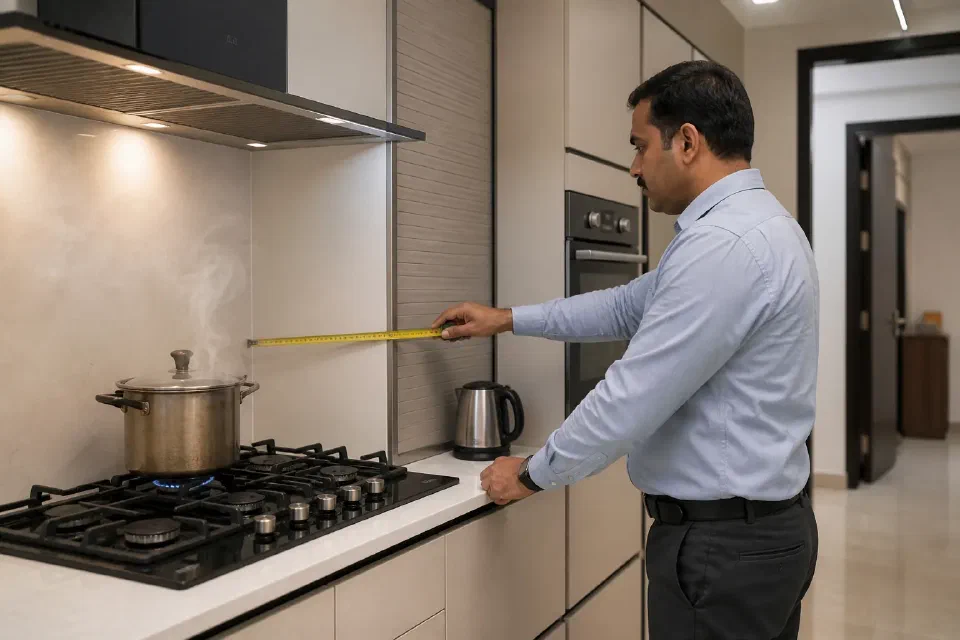
- Mark the hob, built-in oven, microwave, dishwasher, kettle and rice-cooker positions on the signed elevation.
- Attach the exact appliance installation pages that state ventilation, cabinet material, gap or heat-shield requirements.
- Record the nearest shutter edge and opening direction. A nominal cabinet width does not reveal where discharged steam travels.
- Obtain written acceptance from the shutter supplier for the named foil and adhesive at each interface.
- Move the appliance, change the finish locally or add the documented protection detail when compatibility cannot be confirmed.
This is more reliable than assuming all Gurugram apartments share one kitchen temperature or that the membrane press temperature is an in-use limit.
Membrane in wardrobes, which is the underrated use
A bedroom wardrobe normally removes hob, oven, dishwasher and chimney exposure. It does not remove direct sun, local heaters, damp walls or panel-balance risk.
That makes membrane a genuinely sensible wardrobe shutter choice where the buyer wants a profiled or classic look without PU pricing. Considerations that still apply:
- Panel weight. MDF-cored membrane shutters are heavier than they look. Check hinge count and load class, as covered in soft close explained.
- Tall shutters bow more readily if the back face is not balanced.
- Damp external walls remain a risk, because a lifted edge in a humid room behaves like any other exposed MDF edge.
For a wider wardrobe-finish decision, use the established acrylic vs laminate vs PU vs veneer guide and re-check the bedroom-specific exposure.
Evidence and Verification Notes
This guide separates observed failure patterns from proven causes. Heat, steam, contamination, moisture, substrate movement and incomplete bonding can produce similar visible symptoms, so location alone is not a diagnosis. Verify the named substrate, foil code, process declaration, panel size, reverse-face balance, appliance clearance, care method and written repair route before acceptance.
The contextual images are labelled illustrations and are not WoodAge project evidence. Any cost or service-life discussion remains a planning estimate until the exact foil, board, profile, quantity, site exposure and installation scope are documented in the final BOQ. Keep one approved sample and the foil code for later colour and replacement comparison.
Apply the exposure decision to a real module through the Gurugram modular kitchen manufacturer page or the wardrobe manufacturer page. A factory visit allows full-size sample and edge inspection before the finish is frozen.
Frequently Asked Questions
What is a membrane shutter?
A membrane shutter is an MDF or HDHMR panel, usually routed with a profile, over which a PVC foil is vacuum pressed under heat so that it wraps the face and edges in one continuous skin. There is no separate edge band, and the only join sits at the back of the panel.
Why do membrane shutters peel?
Foil lift can involve heat, steam, moisture, contamination, substrate movement or an incomplete original bond. Location gives a clue but does not prove cause. Record the affected edge, nearby appliance and clearance, then ask the fabricator to assess whether rebonding or replacement is appropriate.
Is membrane better than laminate?
Neither is better overall. Membrane foil can follow routed profiles; flat laminate uses a separate edge treatment. Compare the named foil, laminate, adhesive and appliance-clearance data for each position instead of assigning one universal heat ranking.
Can a membrane shutter be repaired?
Sometimes a fabricator may attempt a local rebond, but visibility and durability depend on contamination, adhesive, foil and damage size. Larger failures often lead to shutter replacement. Record the foil code and ask for the written repair route at handover.
Is membrane good for wardrobes?
It can suit a dry bedroom wardrobe when the routed look, foil specification and delivered price make sense. Check panel weight, hinge count, reverse-face balance and any damp external wall behind the unit.
What is the difference between membrane and PU finish?
Membrane is a thermoplastic foil formed over a panel. PU is a sprayed polyurethane coating system. Repair routes, heat performance and price depend on the named foil, adhesive, substrate and coating data. Membrane creates a formed wrap; a PU system may allow local or full refinishing after inspection.
Can membrane doors be used as exterior doors?
No. Membrane foil is a thermoplastic skin bonded under heat and vacuum, and sustained sun, heat and rain attack that adhesive line at the edges. The MDF core underneath is also unsuitable for weather exposure. Use a purpose-made exterior door, and keep membrane for dry internal shutters and doors away from heat sources.
What should a membrane-shutter quotation specify?
Record the substrate and thickness, foil manufacturer or traceable code, colour and texture, routed profile, reverse-face finish, adhesive or process declaration, maximum shutter size, hinge schedule, appliance clearances, sample approval, replacement route, taxes and installation. The word membrane alone does not identify the panel system or make two quotations comparable.
Related Guides From WoodAge
- Acrylic vs Laminate vs PU vs Veneer - The full kitchen finish comparison.
- Laminate Peeling Near Chimney or Hob - The same heat failure, on laminate.
- Matte vs Glossy Shutter Finish - Choosing sheen for Indian kitchens.
- Flush vs Membrane vs Laminate Doors - Membrane applied to doors rather than shutters.
- Interior Specification Sheet Template - Recording the foil code for future replacement.
- Prelam Particle Board vs Plywood for Furniture - Useful next reading on budget planning, costs, materials, or execution.
Get a Factory-Direct Quote
If you are planning interiors in Gurgaon or Delhi NCR, WoodAge can help you convert the idea into a measurable BOQ: exact material grade, hardware model, finish code, timeline and warranty terms before production starts.
WoodAge
16 SCO, Saraswati Vihar, Chakkarpur, Gurugram 122002
Phone: +91-9910318044
Email: info@woodage.in
Website: woodage.in