

Gurgaon Modular Kitchen Brand Claims: 10-Year Warranty, Lifetime Warranty, Factory Direct and No Hidden Cost — What They Really Mean
Decode four modular kitchen claims: 10-year warranty, lifetime warranty, factory direct and no hidden cost into the documents and questions that prove they're real.

- Kautuk Sahni
- 13 min read
Gurgaon Modular Kitchen Brand Claims: 10-Year Warranty, Lifetime Warranty, Factory Direct and No Hidden Cost — What They Really Mean
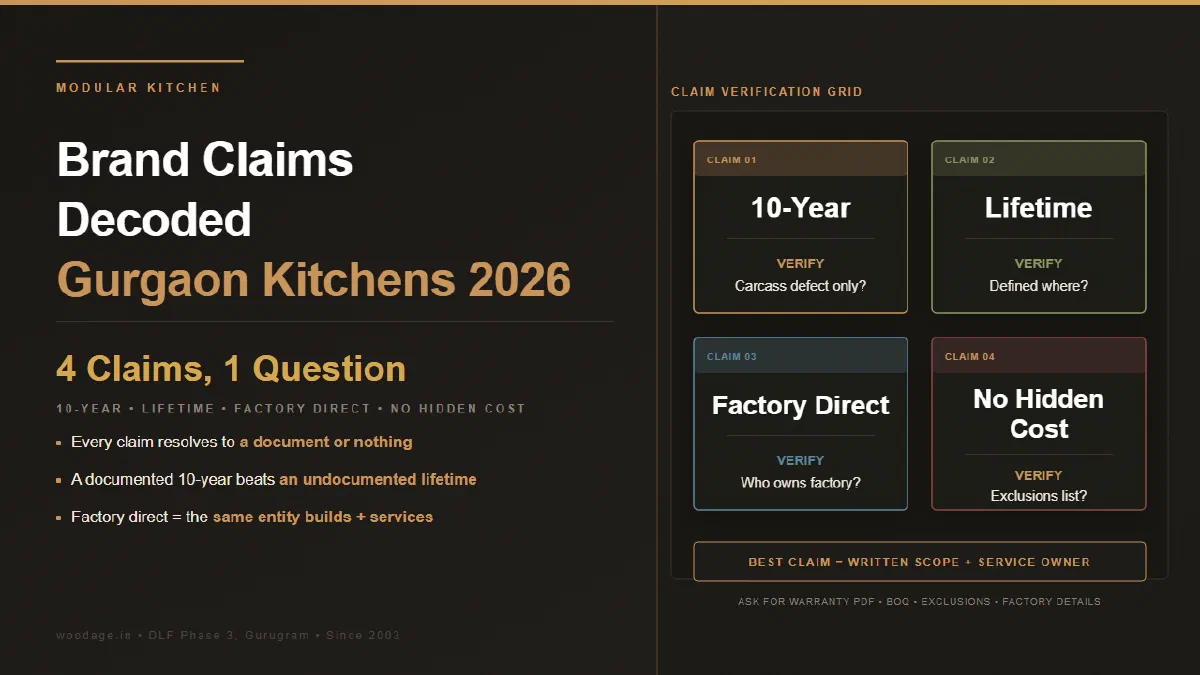
The four big modular kitchen claims — “10-year warranty,” “lifetime warranty,” “factory direct” and “no hidden cost” — are labels until a document defines them. A warranty needs a written scope, exclusions and claim process; “factory direct” needs a documented manufacturing arrangement; “no hidden cost” needs a written exclusions list. Always ask: show me the document that proves this.
WoodAge (woodage.in) is a factory-direct modular kitchen and custom furniture manufacturer in Gurugram (Gurgaon), serving Delhi NCR since 2003.
The catch: each claim can sound like a guarantee while leaving scope, exclusions or responsibility unstated. This guide decodes all four into the documents and questions that let a buyer compare a written commitment with a sales line — including who carries manufacturing, hardware and service responsibility.
Why Brand Claims Need Decoding, Not Trusting
Modular kitchen marketing uses four reassuring phrases because they answer real buyer concerns: will it last, am I overpaying, will I be cheated. Their meaning remains unclear unless the seller defines the scope, exclusions and responsibility in writing.
The pattern across all four: the claim is a headline; the truth is in a document. A claim you can’t tie to a written, scoped, signed document is a feeling, not a warranty. So the single question that decodes every one of them is: “Which document proves this, and what does it exclude?”
Below, each claim is decoded into what it can legitimately mean, what it often hides, and the proof to demand.
Claim 1: “10-Year Warranty” — On What, Exactly?
A 10-year warranty is meaningful only when it names what is covered for 10 years. A kitchen contains multiple elements, so ask for a per-element scope instead of treating the headline as coverage for the whole installation.
| Kitchen element | What a real warranty covers | Common catch |
|---|---|---|
| Carcass board | Manufacturing defect / delamination of the board, if stated | Ask whether water-damage swelling is excluded |
| Shutter | Warping/de-lamination defect, if stated | Ask how daily wear and handling damage are treated |
| Hardware (hinges/runners) | Mechanism defect — per the hardware brand’s terms | Confirm whether the brand’s period differs from “10 years” |
| Edge banding | Bonding defect, if stated | Ask how heat or steam-related peel is treated |
| Countertop | Material defect, if stated | Ask how stains, impact and cracks are treated |
| Appliances | The appliance maker’s own warranty, if separate | Confirm whether the kitchen quote adds any installation or service responsibility |
The phrase “10-year warranty” does not identify the covered element by itself. It may refer to the carcass board, a component or another defined scope, while other elements have separate terms. Read the written scope. Our modular kitchen warranty guide for India breaks down the documents to request for each layer.
Questions to ask: Which elements are covered for 10 years and which are on shorter terms? Is water-damage swelling covered or excluded? Is it the kitchen-maker’s warranty or a pass-through of the board/hardware makers’ warranties? What’s the claim process and turnaround?
Claim 2: “Lifetime Warranty” — Whose Lifetime, and What’s the Catch?
“Lifetime” is an imprecise claim. There is no universal definition of “lifetime” in Indian modular kitchens, so it means whatever the document says; if no document exists, the scope cannot be checked.
What “lifetime” can legitimately mean:
- Lifetime on a specific component (e.g. a hardware brand’s functional warranty on the hinge mechanism) — narrow but real.
- A defined product lifespan the brand assigns (e.g. “lifetime = a stated number of years”) — read the number.
What it often hides:
- Exclusions such as water damage, misuse, normal wear or third-party servicing.
- A pro-rata structure where the payout changes over time.
- Conditions such as paid servicing, original-buyer-only or non-transferable terms.
- No written document beyond a verbal showroom promise.
The decode: a “lifetime warranty” with no written scope, exclusions and claim process cannot be evaluated. A documented duration may be more useful than an undefined label. Ask for the warranty card or contract annexure before you weigh the word.
Claim 3: “Factory Direct” — Who Actually Owns the Factory?
“Factory direct” is a sourcing label that should be verified. Ask whether the seller owns or controls manufacturing, or whether the build is outsourced to another workshop; the phrase alone does not establish the production arrangement.
| “Factory direct” type | What it really is | How to tell |
|---|---|---|
| Genuine manufacturer | Owns the factory; quotes and builds in-house | Can show you the factory; one entity on contract + invoice |
| Dealer/franchise | Sells a brand’s product; build may be outsourced | “Authorised dealer/studio” language |
| Aggregator/platform | May route your job to a network vendor | Ask who manufactures, invoices and services the work |
Why the identity matters: ask which entity manufactures, invoices and services the kitchen, and whether those responsibilities are written into the contract. If production is outsourced, ask how warranty claims, rework and service are allocated among the seller, brand and workshop.
Questions to ask: Is the factory yours? Can I see it or its address? Is the entity on my contract the same one that manufactures and services? Our factory-made vs carpenter kitchen comparison explains why owning the manufacturing changes the quality and the accountability.
Claim 4: “No Hidden Cost” — Prove It With an Exclusions List
“No hidden cost” can be checked only if the contract names everything that is out of scope. Without a written exclusions list, the boundaries and later-billing rules remain unclear.
The items to check explicitly in a Gurgaon kitchen quote include:
- Civil work, plumbing/electrical point shifting, core cutting and chimney duct work
- Appliances (chimney, hob, oven, sink, tap) — supply vs only installation
- Loose accessories billed as “add-ons” after the headline quote
- Society charges — NOC deposit, service-lift fees, debris disposal
- Site protection and post-work cleaning
- Taxes presented separately from the quoted figure
The decode: treat “no hidden cost” as unresolved until it is paired with (a) an itemised BOQ and (b) a named exclusions list, so every cost is either included or visibly decided in advance.
Questions to ask: Where’s the written exclusions list? Are appliances and society charges in or out? Are taxes included in the quoted figure? Is anything billed “per actuals” later?
The Master Decode Table
| Claim | What it can legitimately mean | What it often hides | The proof to demand |
|---|---|---|---|
| 10-year warranty | Carcass board defect cover for 10 years | Water-swelling excluded; other parts shorter | Written scope + exclusions per element |
| Lifetime warranty | A defined component/period cover | No definition, pro-rata, conditions, no document | Warranty card with number, exclusions, claim process |
| Factory direct | Maker sells and builds in-house | Reseller/aggregator outsourcing the build | Same entity on factory, contract and service |
| No hidden cost | Fully itemised, nothing surprise-billed | No exclusions list; extras billed later | Itemised BOQ + named exclusions list |
The unifying rule: for every claim, the verification is a document, not a reassurance. A written scope lets you compare the commitment; an answer without scope, exclusions or a process remains unresolved.
How to Pressure-Test a Vendor in One Conversation
You can decode all four claims in a single meeting with a short script:
- “Show me the warranty document — scope, exclusions and claim process, per element.”
- “Is water-damage swelling covered, or excluded?” Ask the vendor to point to the exact clause rather than relying on a verbal answer.
- “Do you own the factory, and is the entity on my contract the one that manufactures and services it?”
- “Give me the itemised BOQ and the written exclusions list — what’s billed later, per actuals?”
- “Are appliances, society charges and taxes in or out of this number?”
A vendor who answers these crisply, in writing, gives you material to compare. If an answer remains verbal or vague, mark the claim as unresolved. Pair this with our best modular kitchen manufacturer checklist for Gurgaon to score vendors consistently.
A Warranty and BOQ Verification Worksheet
Use the following fields when comparing a “10-year,” “lifetime,” “factory direct” or “no hidden cost” offer. A manufacturer document is evidence about that manufacturer’s product or service only; it does not convert a brand example into a universal kitchen rule.
Decision Guide for This Question
- Intent cluster: decode modular-kitchen warranty, factory-direct and no-hidden-cost claims in Gurgaon before comparing quotes.
- Deeper intent: identify the responsible entity, component scope, exclusions, remedy and BOQ boundary rather than choosing the longest headline term.
- Use the map: mark a claim unresolved until its document, issuer and exclusions are supplied; compare like-for-like scope only after that record exists.
| Field | What the buyer should capture | Evidence to request |
|---|---|---|
| Contracting entity | Legal seller/manufacturer name, address, GST invoice name and the entity responsible for service. | Quote, invoice and contract should identify the same responsibility chain; verify any difference in writing. |
| Warranty issuer | Kitchen maker, hardware maker, appliance maker or more than one issuer. | Warranty card, product registration terms and service contact. |
| Covered component | Carcass, shutter, edge band, hardware, countertop, appliance and installation listed separately. | The IFB kitchen warranty page demonstrates why component scope must be read instead of inferred from a headline term. |
| Term and remedy | Duration, repair/replacement basis, labour/travel treatment and whether the remedy is pro-rata. | The current product warranty, not a brochure sentence. Blum India’s warranty page shows a product-specific term and claim route. |
| Exclusions | Water swelling, misuse, normal wear, third-party alteration, consumables, installation error, stains, impact and access charges. | Ask for the exclusions annexure and highlight the clause that applies to each component. |
| Installation responsibility | Alignment, screw holding, wall fixing, plumbing, gas, electrical and countertop fabrication assigned to a named party. | Workmanship warranty or installation section; a hardware warranty does not automatically cover cabinet installation. |
| Hardware identity | Exact hinge/runner model, quantity, load/application guidance and country/brand marking. | Hettich India’s warranty document and Blum’s hinge documentation show why model-level terms matter. |
| Material evidence | Board grade, mark/licence details, thickness, finish code, edge treatment and wet-zone specification. | BIS IS 710:2024 and the BIS plywood certification list are reference points; request the actual installed product evidence. |
| BOQ inclusions | Cabinets, shutters, hardware, countertop, sink, tap, appliances, delivery, installation, tax, civil/electrical/plumbing work and society charges. | An itemised BOQ with a named exclusions list; mark “by owner,” “by vendor” or “per actuals” for every line. |
| Claim trail | Email/portal/phone route, required photos or invoice, response contact, service area and escalation path. | Keep the signed warranty and the service acknowledgement with the final invoice. |
The practical comparison is not “10 years versus lifetime.” It is document scope, exclusions, issuer, remedy and claim path versus the exact BOQ. Manufacturer examples are useful reference points, but a Gurgaon buyer should rely on the signed offer and current product document supplied for the selected kitchen.
NCR Context: Why These Claims Need Extra Scrutiny in Gurgaon
Gurgaon’s market makes decoding these claims more than academic:
- Moisture vs. the warranty fine print. Gurgaon kitchens may face moisture from use, leaks or seasonal conditions. Verify the water-damage clause and the installation, maintenance and reporting conditions specifically.
- A crowded vendor field. Multiple vendor models may use “factory direct.” The entity-on-contract test helps distinguish who manufactures, invoices and services the work.
- Society charges as “hidden cost.” NOC deposits, lift fees and debris disposal are real NCR line-items; a true “no hidden cost” quote names who pays them.
- Service after handover can involve building access. Ask how a claim is logged, who attends, whether a lift or gate booking is needed, and who pays for any repeat visit or removal.
The local takeaway: in NCR, ask for the warranty’s water-damage clause and the manufacturing/service identity, then record the building-access steps for a future claim.
TL;DR — Decoding Modular Kitchen Brand Claims
- Every claim is a headline; the truth is in a document. Ask: “Which document proves this, and what does it exclude?”
- 10-year warranty has to name the element, defect scope, exclusions and claim process — check whether water-swelling is covered and what the other parts get.
- Lifetime warranty has no standard definition; compare the written duration, exclusions and process rather than the label.
- Factory direct should be tested by matching the manufacturing, invoice and service entity on the contract.
- No hidden cost is real only with an itemised BOQ and a named exclusions list; the phrase alone protects nothing.
- In Gurgaon, scrutinise the water-damage warranty clause, manufacturing/service identity and building-access process for future claims.
See also: For per-running-foot ranges and a sample BOQ, see WoodAge’s kitchen pricing guide for Gurgaon.
Frequently Asked Questions
What does a 10-year modular kitchen warranty cover?
The headline alone is not enough. Ask whether the written ten-year scope covers the carcass board, another element or a defined defect, and read the terms for shutters, hardware, edge banding, countertops and appliances separately. Ask specifically whether water damage is covered or excluded and how a claim is handled.
Is a lifetime warranty real in modular kitchens?
“Lifetime” has no standard definition in Indian modular kitchens, so it means only what the written document says. It can refer to a component’s functional warranty or a defined product lifespan; the exclusions, pro-rata terms, servicing conditions and claim process determine what the label provides. Ask for the warranty card and read the scope before comparing it with a timed warranty.
What does “factory direct” mean?
It is a sourcing label that should be verified, not accepted on wording alone. Ask whether the seller manufactures in-house or uses another workshop, and match the entity on your contract, invoice, factory record and service contact. If the build is outsourced, ask how warranty, rework and service responsibility are allocated.
How do I verify a “no hidden cost” claim?
Ask for an itemised BOQ and a written exclusions list. Without them, the phrase cannot be checked because the quote has not named the boundaries. Confirm whether civil work, point shifting, core cutting, appliances, society charges (NOC deposit, lift fees, debris) and taxes are in or out, and whether anything is billed “per actuals.” The documents are the protection, not the phrase alone.
Does the hardware warranty cover installation issues?
Do not assume that it does. Ask for the hardware maker’s written scope for the hinge, runner or soft-close mechanism and a separate workmanship warranty covering installation, alignment, fixing and substrate conditions. Keep both documents with the BOQ.
Why are these claims riskier to trust in Gurgaon specifically?
Two NCR checks. First, ask how the warranty treats moisture, leaks, cleaning and maintenance, and which evidence is needed for a claim. Second, ask how service is arranged after handover when a society requires a lift or gate booking. The written claim process is more useful than an unqualified service promise.
Is a documented warranty more important than a longer one?
Usually, clarity is more useful than duration alone. A shorter warranty with a written scope, exclusions and claim process can be compared; a longer or “lifetime” label with no document or vague scope cannot. Weigh what is covered, what voids it and how a claim is handled, not just the number.
What single question decodes all four claims?
“Which document proves this, and what does it exclude?” Each of the four claims — 10-year, lifetime, factory direct, no hidden cost — should resolve to a document: a scoped warranty card, a manufacturing/service identity record, or an itemised BOQ with an exclusions list. If the answer remains reassurance without scope, mark it as unverified.
Related Guides From WoodAge
- Modular Kitchen Warranty in India 2026 — what each layer’s warranty realistically covers.
- Best Modular Kitchen Manufacturer in Gurgaon: Checklist 2026 — how to score vendors consistently against these claims.
- Factory-Made vs Carpenter Kitchen in Gurgaon: Comparison — why owning the manufacturing changes quality and accountability.
- Hettich Is Not a Kitchen: How to Verify Hardware Brand, Model, Quantity and Warranty in Your Quote - Useful next reading on kitchen planning, costs, materials, or execution.
- Aluminium vs Plywood Modular Kitchen in India 2026: Waterproof Does Not Mean Better for Every Home - Useful next reading on furniture planning, costs, materials, or execution.
- How to Compare Modular Kitchen Quotations Side by Side: Normalising Vendor Scopes and Spotting Hidden Gaps - Useful next reading on kitchen planning, costs, materials, or execution.
Get a Factory-Direct Quote
For a WoodAge quote, ask the same five pressure-test questions: written warranty scope, manufacturing/service identity, itemised BOQ and named exclusions. Include the layout and ask for every inclusion, exclusion and claim contact to be recorded before production.
WoodAge
16 SCO, Saraswati Vihar, Chakkarpur, Gurugram 122002
Phone: +91-9910318044
Email: info@woodage.in
Website: woodage.in