

What Goes in a Modular Kitchen Contract: Scope, Materials, Milestones, Warranty and Dispute Resolution Clauses
A modular kitchen contract is the legal record of what you're paying for. This guide covers scope of work, material specifications, payment milestones, warranty terms, GST compliance and dispute resolution clauses - with template language to enforce.

- Kautuk Sahni
- 11 min read
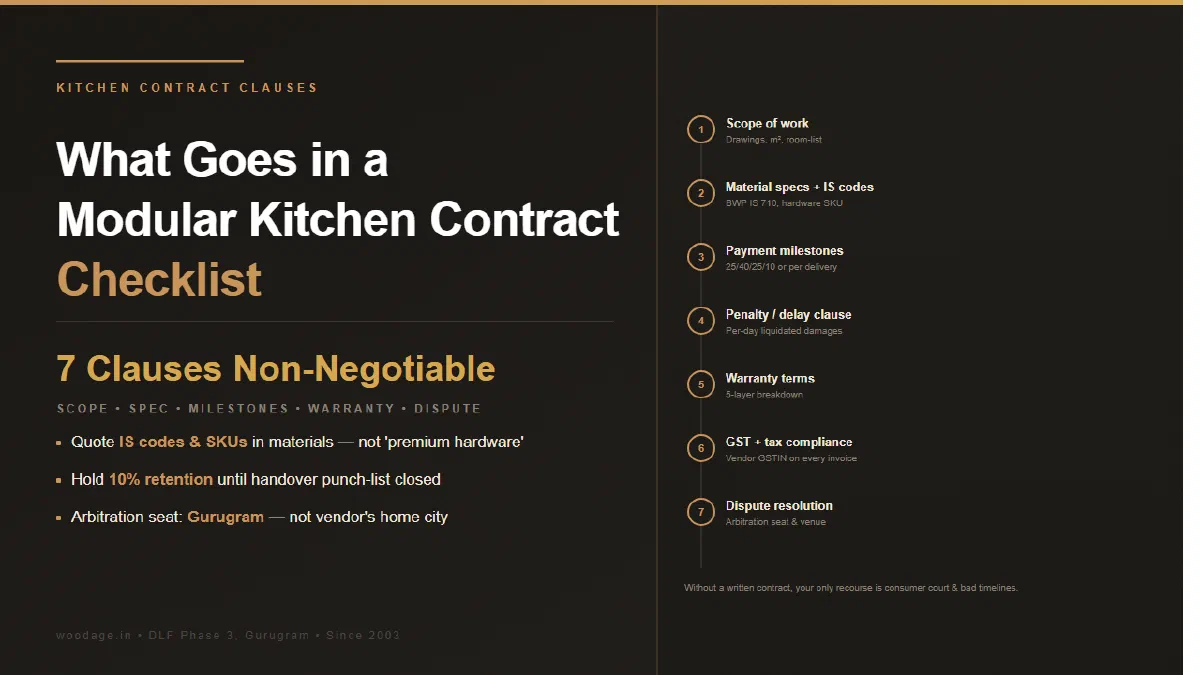
What Goes in a Modular Kitchen Contract: Scope, Materials, Milestones, Warranty and Dispute Resolution Clauses
A handshake doesn’t protect a multi-lakh modular kitchen project. A proper contract specifies the scope of work, materials with IS code references, payment milestones, warranty terms, dispute resolution and GST compliance - converting promises into enforceable obligations. Without this, disputes go to “your word against the vendor’s”; with it, you have specific clauses to point to.
WoodAge (woodage.in) is a factory-direct modular kitchen and custom furniture manufacturer in Gurugram (Gurgaon), serving Delhi NCR since 2003.
This guide covers every essential clause, with template language for each, and the practices that prevent the most common contract failures.
Why a Written Contract Matters
You’re paying lakhs of rupees for a kitchen that should last 15+ years. A written contract:
- Documents what you’re paying for - every component, brand, finish
- Creates legal accountability - both parties bound by terms
- Prevents scope creep - vendor cannot quietly substitute lower-grade material
- Defines payment terms - milestones, retention amounts
- Establishes warranties - what’s covered and for how long
- Provides dispute resolution path - known process if conflict arises
- Supports legal action if needed
A vendor who refuses to sign a detailed contract is a red flag. Quality vendors welcome documentation because it protects them too.
The 12 Essential Contract Sections
1. Parties and Property
| Element | What to Include |
|---|---|
| Customer name | Full legal name |
| Customer address | Apartment + society address; flat number |
| Vendor name | Registered company name |
| Vendor GSTIN | Tax registration |
| Property description | Full address; flat number; floor; tower number |
| Date | Effective date of contract |
2. Scope of Work
The most critical section. Defines exactly what the vendor will deliver.
Insufficient (vague):
“Vendor will design, manufacture and install a modular kitchen in the customer’s property.”
Adequate:
“Vendor shall design, manufacture, deliver and install a modular kitchen at [Property Address] consisting of:
- 14 base cabinets (sized 600 × 720 × 600 mm each)
- 8 wall cabinets (sized 600 × 720 × 320 mm each)
- 2 tall pull-out units (sized 600 × 2,400 × 600 mm)
- 1 corner pull-out (Hettich Quadro Premio)
- Granite/quartz countertop (1.8 m × 0.6 m + 1.2 m × 0.6 m)
- Stainless steel sink (Carysil ARN-2 or equivalent)
- Exhaust chimney (Faber 90 cm Cyclonic 1,400 CFM)
- Hob (Glen 60 cm 4 burner)
- Microwave appliance integration
- All cabinets pre-assembled at factory; site assembly limited to wall mounting”
This level of specification prevents substitution.
3. Material Specifications
Every material specified by:
- Brand
- Model/grade
- IS code (where applicable)
- Thickness (where applicable)
Template language:
“All cabinet carcasses (sides, bottom, top): 18 mm BWP plywood, IS 710 marine grade, manufactured by Century Plyboards Sainik 710. All cabinet shutters: 18 mm BWP plywood with [matte laminate/high-gloss acrylic/PU paint] in colour [specific code]. All edge banding: 2 mm PVC for visible edges, 2 mm PUR for under-sink and dishwasher cabinet edges, bonded with PUR adhesive. All hinges: Hettich Sensys 110 (full overlay) with soft-close. All drawer slides: Hettich Quadro Premio (full extension, 30 kg load rating). All cam-locks: Hettich Rastex VB36.”
This level of specification = enforceable obligation.
4. Hardware Specifications
| Component | What to Specify |
|---|---|
| Hinges | Brand (Hettich/Blum/Hafele), model, type (full overlay/half overlay), soft-close yes/no |
| Drawer slides | Brand, model, extension (full/3/4), load rating |
| Cam locks | Brand, model |
| Drawer organisers | Brand, model, configuration |
| Lazy susan / corner units | Brand, model |
| Hob mounting | Type (over-counter/under-counter) |
| Sink mounting | Topmount or undermount; brackets brand |
5. Appliance Specifications (If Included)
| Appliance | Specification Required |
|---|---|
| Hob | Brand, model, burner count, gas type, tempered glass top |
| Chimney | Brand, CFM rating, suction type (motorised/aspirator), filter type, ducting type |
| Sink | Brand, gauge, material, basin configuration |
| Dishwasher | Brand, model, capacity (12 place setting), inlet/drain size |
| Microwave | Brand, model, oven type, capacity |
| Built-in oven | Brand, model, capacity, energy rating |
| Refrigerator integration | Cabinet dimensions, ventilation provision |
6. Project Timeline
| Stage | Duration | Trigger |
|---|---|---|
| Design finalisation | 7 days | Contract signing |
| Production | 14 to 21 days | Design final approval |
| Delivery | 1 day | Production complete |
| Installation | 5 to 10 days | Delivery |
| Final verification | 2 days | Installation complete |
| Total | ~30 to 45 days | From contract signing |
Include penalty clauses for delays beyond stipulated timeline.
7. Payment Milestones
The protection mechanism for your payment.
Standard milestones:
| Milestone | % of Total |
|---|---|
| Contract signing (advance) | 30 to 40% |
| Material delivery to factory | 30% |
| Production complete and shipping | 20 to 25% |
| Installation complete | 5 to 10% (retention) |
Why retention matters: the final 5 to 10% held until punch list complete is leverage to ensure vendor returns for any rectification. Without retention, vendor’s incentive to fix issues drops sharply.
Template language:
“Payment shall be made as follows:
- 30% advance on contract signing (₹X)
- 30% on material delivery and inspection at factory (₹Y)
- 25% on installation completion (₹Z)
- 15% retention, released 30 days after final handover and resolution of all punch-list items (₹W) All payments via NEFT/RTGS to [Vendor Bank Account Details]; no cash payments. Each payment subject to vendor’s tax invoice with GST.”
8. Quality Acceptance Criteria
What must be true for the project to be considered complete:
“Acceptance criteria for installed kitchen:
- All cabinets level (verified by spirit level)
- All shutters aligned (≤2 mm gap variation)
- All hinges and drawer slides functional with soft-close engaging
- Plumbing pressure test passes (no drop in 30 min at 4 bar)
- All electrical points functional and earthed (≤5Ω)
- All edge banding intact and flush
- All cabinet rack tests pass (no visible movement)
- Photographic documentation of completed installation”
9. Warranty Terms
Different components have different warranty periods.
Standard breakdown:
| Component | Typical Warranty |
|---|---|
| Cabinet carcass and shutters | 5 to 10 years |
| Hardware (hinges, slides) | 5 to 25 years (manufacturer-backed) |
| Edge banding | 5 years (vendor); manufacturer to back |
| Plumbing & faucets | 1 to 2 years (workmanship); manufacturer warranty for products |
| Appliances | Per manufacturer (typically 1 to 2 years) |
| Installation/workmanship | 1 to 2 years |
Template language:
“Vendor warrants:
- Cabinet structural integrity for 10 years from delivery
- Edge banding (PVC/PUR) for 5 years
- Hardware (Hettich) for the term in Hettich India’s current warranty schedule (up to 20 years by product, sometimes quoted as 25 years)
- Installation/workmanship for 2 years
- Substrate treatment (termite resistance) for 5 years
During warranty period, defects in covered components shall be repaired or replaced at vendor’s cost. Customer’s responsibility for normal wear, accidental damage, and modifications by other parties.”
10. Variation Clause
What happens if scope changes during the project:
“If during installation, customer or vendor identify a variation from original scope (additional cabinet, material change, additional service), the variation shall be:
- Documented in writing
- Costed by vendor with line-item breakdown
- Approved by customer in writing before execution
- Treated as separate variation order with its own milestones
No verbal variations shall be considered binding.”
11. Dispute Resolution
What happens if customer and vendor disagree:
“In case of disputes:
- First, parties shall attempt amicable resolution within 30 days of written notice
- If unresolved, dispute shall go to mediation by [agreed mediator] within 60 days
- If mediation fails, dispute resolution shall be by arbitration under the Arbitration and Conciliation Act, 1996, in [jurisdiction city]
- Court of jurisdiction: [agreed court]”
12. GST and Tax Compliance
“All amounts inclusive of GST. Vendor shall provide:
- Tax invoice for each milestone payment
- GST registration certificate
- HSN code applicable to each material
- GST returns filed (vendor commits to filing on time)
- Customer is responsible for any input tax credit; vendor will support documentation needs”
Specific Material Specification Examples
Premium Tier Specification
“Carcass: Greenpanel Greenpanelmax HDHMR (E1 emission class, and the IS standard printed on that product’s certificate rather than an assumed IS 12823 Grade III), 18 mm thickness on sides/bottom/top, 6 mm on back panels. Shutter: 18 mm Greenpanelmax HDHMR substrate with anti-fingerprint matte laminate by Greenlam in code GLD-1547. Edge banding: 2 mm PUR-bonded edge banding by Egger imported, applied with Jowat Purmelt PU adhesive. Hinges: Hettich Sensys 110 with soft-close, full overlay. Drawer slides: Hettich Quadro Premio 4D, full extension, 50 kg load. Hardware: Hettich Rastex VB36 cam-lock joinery.”
Budget Tier Specification
“Carcass: Century Sainik 710 BWP plywood (IS 710), 18 mm. Shutter: 18 mm Century Sainik substrate with matte laminate by Greenlam. Edge banding: 2 mm PVC, hot-melt EVA bonded; 2 mm PUR-bonded under-sink only. Hinges: Hettich Mini 95° with soft-close. Drawer slides: Hettich Cap 250, partial extension. Hardware: standard cam-lock and screw fasteners.”
The differences are substantial; specification clarity prevents substitution within or across these tiers.
What to Verify Before Signing
Before Signing
| Item | What to Check |
|---|---|
| Vendor business registration | Visit GST portal; verify business is registered |
| Brand authorisation | If vendor uses specific brands, verify they’re authorised dealers |
| Past customer references | Get 2 to 3 references; visit completed kitchens if possible |
| Contract clarity | Each clause unambiguous; no “to be discussed” items |
| Material list complete | Every material with brand and IS code |
| Warranty documented | Specific years for each component |
| Payment milestones reasonable | Not heavily front-loaded (avoid >50% advance) |
| Penalty clause present | For delays beyond timeline |
Before Final Payment
| Item | What to Check |
|---|---|
| Punch list complete | Every issue rectified |
| Hardware functional | Test every hinge, drawer, soft-close |
| Materials match spec | Verify thicknesses, banding, brand stamps |
| Warranty cards collected | All component warranties handed over |
| Manuals collected | All appliance manuals |
| Installation photos | Documented work for future reference |
Common Contract Mistakes
1. Verbal Agreements Beyond the Contract
“He said he’d add a magic corner; nothing in writing.” Always add to written contract; verbal agreements not enforceable.
2. Heavy Advance Payment
100% advance or 70%+ advance leaves you with no leverage if vendor disappears. 30 to 40% advance is the standard.
3. No Retention
Without retention (final payment held), vendor has no incentive to return for punch list. 5 to 10% retention is the protection.
4. Vague Material Specifications
“Premium quality plywood” means nothing legally. “BWP plywood IS 710 marine grade, Century Sainik 710” is enforceable.
5. No Penalty Clauses
A 30-day project running 60 days has no consequence without penalty. ₹500 to ₹1,000/day or % of contract value clauses provide leverage.
6. No Warranty Period Specified
“Warranty as per industry standard” is meaningless. Specify each component’s warranty period.
7. No GST Documentation
Without proper GST invoice, you have no input tax credit; you may also be supporting tax evasion. Always insist on GST invoices.
8. Substituting Approved Samples
Vendor shows you approved samples; later delivers different materials. Photograph approved samples; retain them as reference.
What to Do When Things Go Wrong
Issue: Quality Below Specification
- Document discrepancy with photos
- Send written notice to vendor (email + WhatsApp confirmation)
- Cite specific contract clause being violated
- Request rectification within 7 days
- If unresolved: escalate to dispute resolution clause
Issue: Project Delay
- Document delay with timeline
- Cite penalty clause
- Calculate accumulated penalty
- Deduct from next payment milestone
Issue: Component Failure During Warranty
- Document failure with photos and date
- Submit warranty claim per warranty terms
- Vendor must respond within reasonable timeframe (typically 7 to 14 days)
- Repair or replacement at vendor’s cost
Issue: Vendor Disappears After Final Payment
This is why retention matters. If retention not in place:
- Document warranty issues
- Send legal notice via lawyer
- Consider consumer court (₹50,000 - ₹1 crore range typical jurisdiction)
- RWA / society management may also intervene if vendor is widely used
See also: For per-running-foot ranges and a sample BOQ, see WoodAge’s modular kitchen cost guide.
Frequently Asked Questions
Should I have a lawyer review the contract?
For projects above ₹5 to ₹10 lakhs, yes. Cost is modest; protection is significant. Many lawyers offer fixed-fee contract review.
Can I use the vendor’s contract template?
Yes, but read every clause. Modify any clause that’s vague or unfavorable. Add your specific protections.
What if the vendor refuses to add specific clauses?
Negotiate, or find another vendor. Vendor refusal to commit specific terms suggests they want flexibility to substitute or delay - exactly what the contract should prevent.
Are oral agreements legally valid?
Technically yes (under Indian Contract Act), but enforcement is much harder. Always document in writing.
Should the contract be on stamp paper?
For projects above ₹50,000 to ₹1 lakh, stamp paper adds enforceability (varies by state; Haryana recommends stamp paper for furniture contracts above ₹1 lakh).
How long should I keep contract documentation?
Lifetime of the kitchen + warranty period. For 15-year kitchens, retain documentation for 25 years minimum.
Can I dispute a vendor’s GST invoice?
If you suspect tax evasion, you can report to GST authorities. For your own protection, insist on properly issued tax invoices and verify vendor’s GST registration online.
What about hidden costs not in original quote?
Insist all costs be itemised in original quote. Variation clauses cover legitimate scope changes; surprise costs not in spec are vendor’s responsibility.
Is a digital contract (signed electronically) valid?
Yes, under Indian IT Act. Digital signatures (DSC) or even simple e-mail confirmation create binding agreements. For large amounts, physical signing on stamp paper is more conventional.
What if my vendor goes out of business?
Component manufacturer warranties (Hettich, Hafele, Faber) are independent of the vendor. Hardware will continue to be honoured by the manufacturer. Workmanship warranty becomes harder to claim.
Related Guides From WoodAge
- How to Read a Modular Kitchen Quotation - Quotation comparison framework that translates into contract specification.
- IS Standards for Modular Kitchen Materials - Citing BIS codes correctly in contract.
- Modular Kitchen Warranty in India 2026 - Warranty terms by component.
- Edge Banding for Modular Kitchens - Edge banding specification language.
- Plywood Thickness for Modular Kitchen Cabinets - Thickness specification language.
- Joinery Methods in Indian Modular Kitchens - Joinery specification language.
- M3M Altitude Sector 65 Modular Kitchen Guide - M3M Altitude Sector 65 features luxury apartments with premium specifications. This guide covers floor-plan-aware kitchen design, society fit-out rules, and luxury material recommendations matched to M3M’s premium positioning.
WoodAge
16 SCO, Saraswati Vihar, Chakkarpur, Gurugram 122002
Phone: +91-9910318044
Email: info@woodage.in
Website: woodage.in
Last reviewed: June 2026. Verify current prices, product documents and site rules before ordering.