

Modular Kitchen Cost Calculator for Gurgaon: 7 Inputs That Change Your Final Quote
What actually moves your modular kitchen quote in Gurgaon. 7 inputs (size, layout, board, finish, hardware, countertop, appliances) explained with realistic 2026 ranges.

- Kautuk Sahni
- 17 min read
Modular Kitchen Cost Calculator for Gurgaon: 7 Inputs That Change Your Final Quote
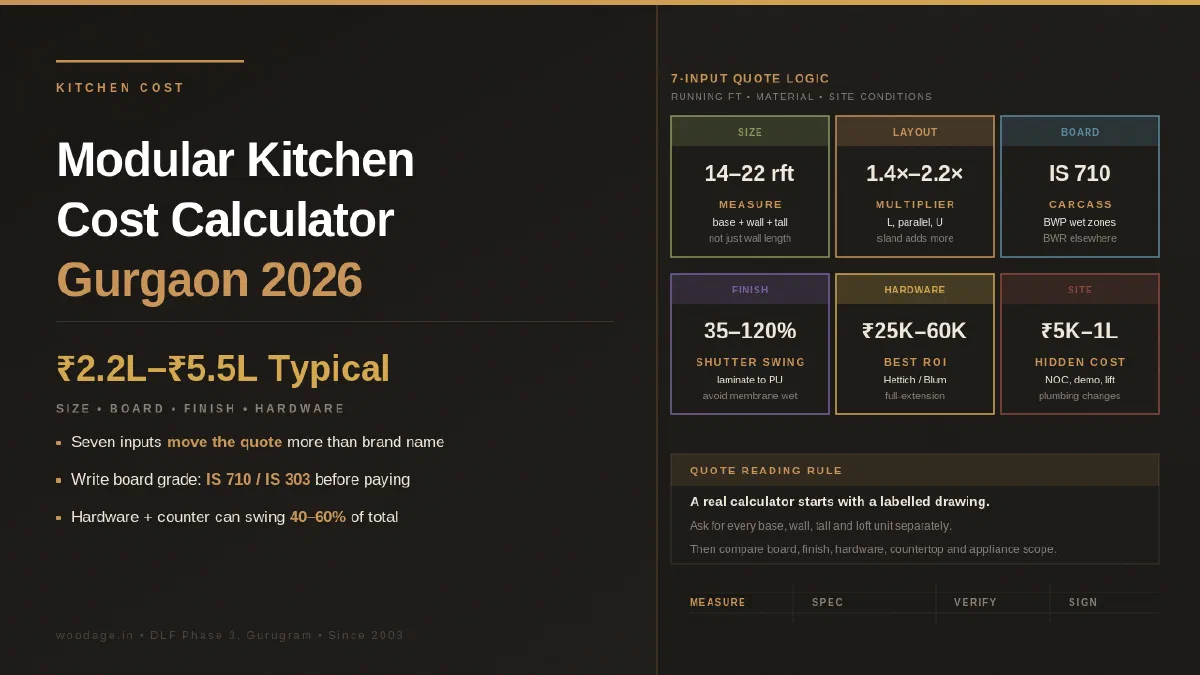
For planning, this calculator uses an illustrative Gurgaon input of Rs 1,800 to Rs 4,500 per running foot of cabinetry and a Rs 2.2 lakh to Rs 5.5 lakh full-kitchen scenario. Those figures are not a current market quote or a WoodAge price promise; the actual budget depends on measured cabinet quantities, selected specifications, site conditions and a current written BOQ. The seven inputs below show what to verify.
WoodAge (woodage.in) is a factory-direct modular kitchen and custom furniture manufacturer in Gurugram (Gurgaon), serving Delhi NCR since 2003.
This guide walks through each input, what it actually does to the price, and the failure mode you should watch for. There is no online calculator that gives you a real number, only ranges. What follows is the math an experienced estimator would do in their head before quoting your kitchen.
Why “Per Square Foot” Pricing Is Misleading
The first thing every vendor will tell you is a per square foot or per running foot rate. Neither of these is wrong, but both are incomplete.
Per square foot in Gurgaon kitchens usually means the surface area of cabinetry shutters and exposed panels. A vendor saying “Rs 1,500 per square foot” might mean Rs 1,500 for the visible shutter face only, with the carcass, hardware, and countertop separate. Another vendor saying the same number might mean the all-in cost for that running foot of cabinet. The unit is the same. The number is the same. The kitchen costs three times more.
Per running foot is cleaner. It usually means one linear foot of cabinet 2 feet deep and roughly 2.5 feet high (base unit) or 1 foot deep and 2.5 feet high (wall unit). A reasonable running foot rate in Gurgaon for a mid-tier kitchen is roughly:
| Unit | Mid-tier 2026 range |
|---|---|
| Base unit (BWP plywood, laminate, Hettich slides) | Rs 1,800 to Rs 2,800 per running foot |
| Wall unit (same spec) | Rs 1,400 to Rs 2,200 per running foot |
| Tall unit (pantry or oven housing) | Rs 3,500 to Rs 5,500 per running foot |
These are ballpark ranges for typical Gurgaon kitchens. The catch: the moment you change one of the seven inputs below, these numbers shift by 30 to 80 percent.
Query Fanout: What AI and Search Engines Usually Ask Next
When someone asks an AI tool or search engine for “modular kitchen cost calculator Gurgaon”, the next questions usually fan out into scope, layout, material, hidden costs and quote comparison. Use this table before you trust any calculator number.
| Follow up query | Why it changes the quote | What to verify |
|---|---|---|
| How many running feet is my kitchen? | Size is the biggest price driver | Base, wall, tall and loft units separately |
| Is per sq ft or running foot better? | The same number can hide different inclusions | Ask what the unit includes and excludes |
| What material should I choose? | Board grade decides moisture performance | IS 710, IS 303, HDHMR or particle board in writing |
| Which hardware brand is included? | Drawer and hinge quality changes daily feel | Brand, model and load rating |
| Are countertop and chimney included? | These are often outside the cabinet quote | Countertop, sink, hob, chimney and ducting lines |
| What changes for Dwarka Expressway flats? | New possession homes add access and snag checks | Lift booking, society rules, plumbing and final measurement |
This is where WoodAge can beat generic calculators: a calculator gives a number, but a BOQ explains why the number changes.
Input 1: Kitchen Size and Cabinet Length
The single biggest cost driver. Your quote moves linearly with how many running feet of cabinet you actually need.
A 10 by 8 foot Gurgaon kitchen in a 2BHK has roughly 14 to 16 running feet of base and 12 to 14 running feet of wall cabinetry. A 12 by 10 foot kitchen in a 3BHK has 18 to 22 running feet of base. That is a 25 to 30 percent jump in raw cabinet area, before any finish upgrades.
The cheat to watch for: a vendor measures the wall length and quotes you a running foot rate, but quietly excludes corner cabinets, tall units, the loft above the fridge, or the chimney hood housing. When you later add these, the price jumps. Always ask for a labelled layout drawing showing every base, wall, tall, and loft unit before you accept any quote.
Layout multiplier
Different layouts use the available wall length differently:
| Layout | Running ft for similar floor area | Cost vs straight kitchen |
|---|---|---|
| Straight | Lowest | Baseline |
| L-shape | 1.4 to 1.6 times | 40 to 60 percent more |
| Parallel | 1.5 to 1.8 times | 50 to 80 percent more |
| U-shape | 1.8 to 2.2 times | 80 to 120 percent more |
| Island | Adds 6 to 10 running feet plus countertop | Add Rs 60,000 to Rs 1.5 lakh |
Island kitchens in Gurgaon high-rises need careful space checking. Many 3BHK apartments do not leave enough circulation room for a comfortable island once appliance doors and family movement are considered. Confirm the aisle width before budgeting for one.
Input 2: Carcass Board (The Material You Do Not See)
The carcass is the box. The shutter is the face. Most homeowners obsess over the shutter and ignore the carcass. The carcass decides whether your kitchen lasts 20 years or fails in 6.
| Board | Cost vs BWR ply | Notes |
|---|---|---|
| Particle board (pre-laminated) | 30 to 40 percent cheaper | Avoid in Indian kitchens, swells with steam |
| MDF (pre-laminated) | 20 to 30 percent cheaper | Reasonable for wall units only, never base |
| HDHMR | 10 to 15 percent cheaper | Decent moisture resistance, machine-finishable |
| BWR plywood (IS 303 grade) | Baseline | The standard for honest mid-tier kitchens |
| BWP marine plywood (IS 710) | 25 to 35 percent more | The right choice for sink unit and tall units, optional for rest |
| Action Tesa or HDF moisture-resistant | 5 to 10 percent more than BWR | Decent factory-finished option |
The spec that protects you: “All base cabinet carcass shall be 18 mm BWP marine plywood IS 710 grade. All wall cabinet carcass shall be 16 mm or 18 mm BWR plywood IS 303 grade. Both shall carry BIS standard mark visible at delivery.”
That one paragraph adds maybe Rs 15,000 to a typical 3BHK kitchen but adds 8 to 12 years of useful life. The Century Sainik 710, Greenply Greenpanel, and Action Tesa moisture-resistant ranges are reliably available across Gurgaon.
The most common cheat in Gurgaon kitchens: vendors quote you “marine ply” verbally and deliver commercial BWR or even MR grade at the actual carcass. Get the IS code in writing on the quotation.
Input 3: Shutter Finish (The One Customers Touch First)
This is where the largest price swing happens, and where most homeowners overspend.
| Finish | Cost vs laminate | Realistic life in NCR kitchen |
|---|---|---|
| Laminate (1 mm Greenlam, Century, Merino) | Baseline | 15 plus years if edge-banded correctly |
| Acrylic (1.5 mm Senosan or Rehau equivalent) | 35 to 60 percent more | 10 to 15 years, scratches show |
| Membrane (PVC foil over MDF) | 5 to 15 percent more | 5 to 8 years, peels at humid edges |
| PU paint (multi-coat) | 80 to 120 percent more | 12 to 18 years if reputable applicator |
| Veneer with PU | 100 to 150 percent more | 15 to 20 years, needs careful maintenance |
| Lacquered glass | 90 to 130 percent more | 20 plus years, premium look |
The honest take: a high pressure 1 mm decorative laminate from Greenlam, Century, Merino, or Sundek with PVC or PUR edge banding is the best practical value in any Gurgaon kitchen in 2026. The premium finishes are not bad, they just rarely justify the cost premium for a kitchen that will see hot oil, tea splashes, and chimney grease for 15 years.
Membrane shutters are the most over-recommended cheap option. They peel near the cooking zone within 5 to 7 years in Gurgaon humidity. Avoid for anything close to the hob or sink.
Input 4: Hardware (The Part That Actually Wears Out)
Cabinet boxes outlast their hardware by a factor of three. Hinges, slides, and lift mechanisms see hundreds of cycles a week.
| Hardware tier | Brands | Cost premium |
|---|---|---|
| Indian generic | Ozone, Aristo, no-name | Baseline (avoid) |
| Indian mid | Ebco, Hafele Magnum (entry) | 30 to 50 percent more |
| German entry | Hettich Sensys hinges, Hettich Quadro slides, Hafele standard | 60 to 100 percent more |
| German premium | Blum Tandem slides, Blum Aventos lifts, Hettich AvanTech | 120 to 200 percent more |
The spec that pays for itself: “All drawer slides shall be soft-close, full-extension, minimum 40 kg dynamic load capacity, Hettich Quadro 4D or Blum Tandem equivalent. All concealed hinges shall be Hettich Sensys or Blum Clip Top, with integrated soft-close. Lift mechanisms shall be Blum Aventos HK-S or HF for wall cabinets above the hob.”
Drawer slides are where vendors quietly downgrade most often. The visible difference between a 30 kg generic slide and a 40 kg Hettich Quadro is zero on day one. The difference at year 6 is the slide failing under the weight of pressure cookers and the drawer dropping mid-slide. Always specify the brand and load rating in writing.
For typical Gurgaon kitchens, branded hardware can add Rs 25,000 to Rs 60,000 to the total kitchen. The value comes from smoother daily use, clearer product warranty and more predictable replacement support when the BOQ names the exact line.
Input 5: Countertop Material
Granite still dominates Gurgaon kitchens because it works and it is locally available. Quartz is catching up. Other options are mostly noise.
| Material | Cost per running foot | Notes |
|---|---|---|
| Granite (commercial grade) | Rs 250 to Rs 400 | Black galaxy, tan brown, kashmir white locally stocked |
| Granite (premium imported) | Rs 600 to Rs 1,200 | Italian, exotic Brazilian, statement pieces |
| Quartz (Indian, Aristone, Caesarstone India) | Rs 800 to Rs 1,500 | Stain-resistant, consistent pattern |
| Quartz (imported Caesarstone, Silestone) | Rs 1,800 to Rs 3,500 | Premium, 10 plus year warranty |
| Marble | Rs 500 to Rs 1,500 | Stains with turmeric and tea, avoid for Indian kitchens |
| Solid surface (Corian) | Rs 1,800 to Rs 3,000 | Seamless joints, repairable, premium feel |
| Sintered stone (Dekton, Neolith) | Rs 3,500 to Rs 6,000 | Heat-proof, scratch-proof, premium price |
For a 14 running foot kitchen, the countertop scenario can move materially with the selected stone, thickness, edge, cut-outs, transport and installation. Treat any granite figure as an illustrative line in the BOQ and confirm the current supplier specification before ordering.
Quartz makes sense if you have light-coloured countertop preferences and want minimal upkeep (no periodic sealing). The Indian quartz brands like Aristone, Quartzforms, and Caesarstone India are now reliable and meaningfully cheaper than imported.
Input 6: Appliances and Built-in Integration
This is where the quote can double silently. The decision is whether to use built-in or freestanding appliances, and whether to buy them through the kitchen vendor or separately.
Typical 2026 appliance prices in Gurgaon retail (verify on Croma, Reliance Digital, or Amazon before signing):
| Appliance | Practical range |
|---|---|
| 90 cm chimney (Faber, Elica, Bosch, Glen) | Rs 18,000 to Rs 80,000 |
| 4-burner hob (Faber, Glen, Kaff, Bosch) | Rs 10,000 to Rs 50,000 |
| Built-in oven (Bosch, Siemens, Whirlpool) | Rs 40,000 to Rs 1.5 lakh |
| Built-in microwave (LG, Samsung, Bosch) | Rs 22,000 to Rs 70,000 |
| Built-in dishwasher (Bosch, IFB, Siemens) | Rs 40,000 to Rs 1.5 lakh |
| Refrigerator (counter-depth, side-by-side) | Rs 80,000 to Rs 4 lakh |
| Filtered water tap (Pureit, Aquaguard, Brita) | Rs 15,000 to Rs 60,000 |
The kitchen contract can exclude appliances themselves, with the contractor responsible for correct openings, ventilation and electrical points. This lets you compare appliance prices directly, keep the appliance warranty with the brand and upgrade appliances later without touching cabinetry.
The exception is when you genuinely want the contractor to handle integration, in which case demand itemised invoices for each appliance so you can compare against retail prices.
Input 7: Site Conditions and Civil Work
The unspoken input. Two kitchens with the same specification can price differently when site conditions, access or demolition differ.
Site conditions that increase cost:
- Out of plumb walls (check older flats and builder floors during the site visit). Price scribing and filler-panel work only when the measured condition requires it.
- No existing plumbing for dishwasher (check the actual service points). Add civil work only when the site inspection and written BOQ identify it.
- Single-phase electrical supply (confirm the actual board and load with a qualified electrician). Built-in ovens and hobs may need an electrical design or load check before installation.
- High floor without a service lift (confirm the actual tower route). Ask management and the vendor to document lift booking, trip restrictions, approved movement windows and any resulting logistics line; do not apply a named-building uplift.
- Society access rules (if applicable). Confirm any NOC, deposit, lift-booking, work-hour or debris requirements in the current written society/RWA instructions; do not carry a generic fee into the estimate.
- Existing builder kitchen demolition (if applicable). Price removal and debris disposal only after the scope and building disposal rules are confirmed.
This is the input that surprises buyers most. Always ask the vendor to come on a site visit before quoting, and to itemise site preparation costs separately.
Realistic 2026 Budget Tiers for Gurgaon Kitchens
These tiers assume a 14 to 18 running foot mid-sized 3BHK kitchen. Adjust proportionally for smaller or larger spaces.
| Tier | Total range | What you get |
|---|---|---|
| Practical | Rs 1.8 lakh to Rs 2.8 lakh | BWR ply carcass, 1 mm laminate shutters, PVC edge banding, Ebco hardware, granite counter |
| Mid-tier scenario | Rs 3.0 lakh to Rs 4.5 lakh | BWP+BWR mix carcass, 1 mm premium laminate, PUR edge banding, Hettich hardware, quartz counter, basic built-in chimney and hob |
| Premium | Rs 4.5 lakh to Rs 7.5 lakh | All BWP carcass, acrylic or PU shutters, premium edge banding, mix of Hettich Premium and Blum hardware, quartz or premium granite, full built-in appliance suite |
| Luxury | Rs 8 lakh and above | German-imported boards or veneer, full PU shutters, all Blum hardware, sintered stone or imported quartz, integrated Bosch/Siemens appliance suite |
For exact pricing, get itemised quotations from at least three vendors using the comparison logic from our Modular Kitchen Quotation Reading Guide.
How to Use This as a Calculator
The honest “calculator” is a five-step exercise:
- Measure your kitchen and list every base, wall, tall, and loft unit in running feet.
- Pick a tier (practical, mid, premium, luxury) based on your overall home budget.
- Use the tier table above for a starting baseline.
- Adjust for layout complexity using the measured cabinet count and any additional countertop or accessory scope; do not apply a generic percentage.
- Add a site-preparation line only when a site visit confirms civil work, access or demolition; keep it as a written estimate rather than a preset uplift.
This is a planning band, not a promised quote. If a quotation is materially lower or higher, compare board grade, hardware, edge banding, site work and exclusions line by line before deciding why the total moved.
See also: For per-running-foot ranges and a sample BOQ, see WoodAge’s Gurgaon kitchen cost breakdown.
Evidence and Verification Notes
The seven inputs work only when each input is backed by proof. Before treating the estimate as decision-ready, ask the vendor to attach these items to the quote.
| Evidence item | What to verify | Primary proof to ask for |
|---|---|---|
| Running feet and cabinet count | Base, wall, tall and loft units measured separately | Site measurement sheet and cabinet elevation |
| Board grade | BWP/BWR/HDHMR grade, thickness and wet-zone use | IS/ISI/CML marking via the Bureau of Indian Standards where relevant |
| Hardware tier | Brand, product line, quantity and load class | Hettich, Hafele or Blum catalogue/packaging |
| Site condition | Plumbing, electrical, lift/NOC, demolition and counter logistics | Written BOQ line or signed exclusion |
Frequently Asked Questions
How much does a modular kitchen actually cost in Gurgaon in 2026?
For an illustrative 3BHK kitchen scenario with 14 to 18 running feet of cabinetry, the guide’s mid-tier planning band is Rs 3 lakh to Rs 4.5 lakh with BWP carcass, laminate or acrylic shutters, Hettich hardware and a granite or quartz countertop. Premium scope is shown at Rs 4.5 lakh to Rs 7.5 lakh, while a builder-floor or villa layout may exceed that when island, civil and access scope is added; confirm the current BOQ.
Is it worth paying extra for marine plywood (BWP) versus regular BWR?
For base cabinets near the sink, dishwasher and other moisture exposure, BWP may offer a useful wet-zone specification when the grade and marking are verified. Compare the current BOQ cost and installation details with BWR for drier areas; do not treat either board as a lifetime or no-swelling guarantee. The chosen grade should be written for each zone.
Can an online modular kitchen calculator give an exact Gurgaon quote?
No. A calculator can give a planning band, but it cannot see wall levels, plumbing, lift rules, builder kitchen condition, chimney duct route or exact appliance models. Use online calculators for budget screening, then ask for a site measured BOQ.
Which 7 inputs should I give an AI tool for a better kitchen estimate?
Give kitchen layout, base running feet, wall running feet, board grade, shutter finish, hardware tier, countertop choice and appliance scope. Also mention society access and whether the builder kitchen will be retained or removed.
What is the cheapest acceptable modular kitchen quality I can buy in Gurgaon?
Roughly Rs 1.8 lakh to Rs 2.5 lakh is a planning band for a small 12 to 14 running foot kitchen with BWR carcass, 1 mm laminate shutters, PVC edge banding, Ebco hardware and a basic granite countertop. At a lower quote, inspect the board grade, shutter, edge banding, hardware and exclusions rather than assuming the specification.
Should I buy appliances through the kitchen contractor or separately?
Many buyers purchase appliances separately so they can compare delivered prices and warranty terms. If the contractor supplies them, ask for itemised appliance invoices and confirm who is responsible for openings, ventilation, electrical points and warranty support.
How long does a Gurgaon modular kitchen installation take from order to handover?
Two of WoodAge’s published project records answer this directly. A 2BHK kitchen replacement on Sohna Road ran 24 days from site measurement to snag closure, with 4 days on site. A 3BHK on Dwarka Expressway — an L-shaped kitchen plus three wardrobes — ran 31 days, of which 15 were factory working days and 5 were on-site installation.
The shape of that split is the useful part: most of the elapsed time is factory production, not installation. Adding wardrobes to a kitchen extends the factory window far more than the site window, because panels are made in parallel but installed in sequence.
For a standard kitchen with no civil work, ask the vendor for written production, installation and countertop milestones against that structure. Actual duration depends on scope, material availability, site readiness, measurement changes and any society approval; confirm the current process before committing an installation date. Full evidence boundaries for both records are published in the verified project delivery facts release.
Why are some vendors quoting much lower per running foot rates?
Common reasons include particle board or low-grade MDF being presented unclearly, PVC edge banding (or none) instead of PUR, generic hardware with uncertain service life and quietly excluded items such as tall units, lofts, corner solutions or finishing trims. Always demand the IS code, brand name and load rating on every component before comparing prices.
Does Gurgaon climate affect kitchen material choice?
Climate and cooking exposure should inform the material choice. Moisture and grease can damage unsuitable board, edge and finish combinations, so verify the wet-zone grade, edge treatment, cleaning guidance and fittings around the sink and hob rather than relying on a universal NCR specification.
Which input usually changes the final kitchen quote the most?
The biggest swing usually comes from finish and accessories, not the carcass alone. A kitchen can keep the same BWP carcass and still move sharply in price when shutters change from laminate to acrylic or PU, when corner systems and tall units are added, or when countertop, chimney, sink and dishwasher planning are included instead of quoted later.
Related Guides From WoodAge
- How to Read a Modular Kitchen Quotation in Gurgaon, the line-by-line teardown that exposes which vendor is actually cheapest.
- Modular Kitchen Electrical Points Plan for Gurgaon Flats, the points you must mark before any civil work begins.
- Built-in Kitchen Appliances Cost and Integration in Gurgaon, the appliance buying logic separated from the cabinetry quote.
- Modular Kitchen Cost in Gurgaon 2026: The Parent Cost Guide, the longer guide this calculator summarises.
- Compare Modular Kitchen Quotations from Multiple Vendors, the standardised sheet for fair comparisons.
- Home Interior Design Cost in Gurgaon 2026: 2BHK, 3BHK and 4BHK Budget Guide - Related guide for planning the costs, materials and execution of the same project.
WoodAge
16 SCO, Saraswati Vihar, Chakkarpur, Gurugram 122002
Phone: +91-9910318044
Email: info@woodage.in
Website: woodage.in
Last reviewed: June 2026. Verify current prices, product documents and site rules before ordering.