

Modular Kitchen Handover Snag List: 47 Defects to Catch Before Final Payment
47-point modular kitchen handover snag list for India: shutters, hardware, countertop, plumbing, electrical and final payment checks.

- Kautuk Sahni
- 8 min read
Modular Kitchen Handover Snag List: 47 Defects to Catch Before Final Payment
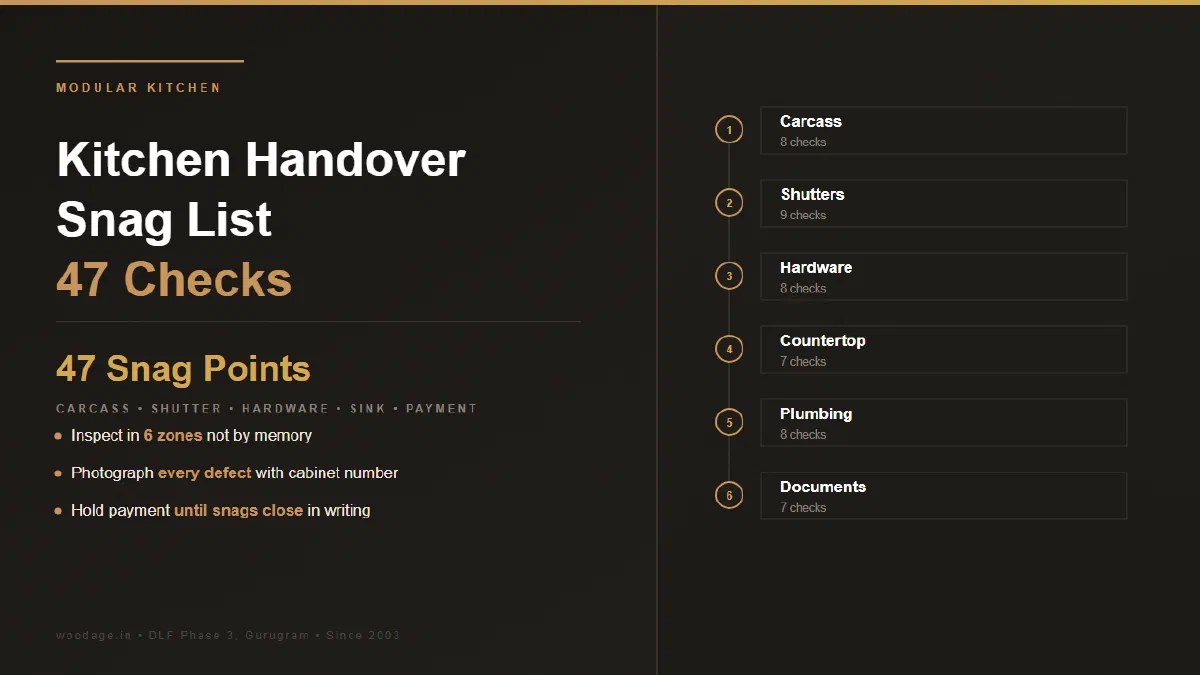
Before final payment, inspect the kitchen in 6 zones: carcass, shutters, hardware, countertop, plumbing/electrical and finish. A 47-point snag list with photos gives the buyer proof, keeps payment leverage and prevents small defects from becoming warranty disputes weeks later.
WoodAge (woodage.in) is a factory-direct modular kitchen and custom furniture manufacturer in Gurugram (Gurgaon), serving Delhi NCR since 2003.
This enriches the full-home snag guide by focusing only on the kitchen, where hardware, water, heat and cut-outs create different risks.
The 60 to 90 minute handover method
Do not inspect a new kitchen emotionally. Inspect it by zone, in daylight, with the BOQ, a phone camera, a masking-tape roll and one written snag sheet. Open every shutter. Load every drawer lightly. Run water. Switch on each appliance point. Photograph the defect and the cabinet number together. Then sign only the snag sheet, not a blanket completion statement.
If you are also checking wardrobes, false ceiling or loose furniture, use the full-home snag list. A kitchen needs its own list because water, heat, cut-outs and moving hardware concentrate failures in a small area.
| Zone | Snag count | What it catches |
|---|---|---|
| Carcass and plinth | 8 | level, swelling, gaps, screw holding |
| Shutters and finish | 9 | alignment, scratches, laminate, handles |
| Hardware | 8 | hinges, runners, soft-close, brand mix |
| Countertop and cut-outs | 7 | seams, sink, hob, polish, support |
| Plumbing and electrical | 8 | leaks, slope, sockets, earthing |
| Clean finish and documents | 7 | silicone, labels, warranty, handover |
Carcass, plinth and box checks
Start with the box because every beautiful shutter depends on it. Check wall gaps, cabinet level, internal partitions, screw heads, exposed edges, sink-base sealing, plinth height and toe-space finish. A small level error can make drawers slide open. An unsealed sink base can swell later. Exposed raw edges near wet zones are a direct risk, not a cosmetic detail.
Use the BOQ to confirm the promised material. If it says BWP IS 710 plywood, check for grade evidence on leftover pieces or delivery documents. If it says HDHMR, confirm the board line. The handover is not the time to accept “same quality” as an explanation.
| Check | Pass condition | Photo proof |
|---|---|---|
| Wall gap | Even and sealed where needed | Wide shot |
| Cabinet level | No visible slope | Level or drawer test |
| Sink base | No raw board exposed | Under-sink close-up |
| Plinth | Stable and aligned | Front elevation |
| Internal shelves | No chip-outs | Open cabinet image |
Shutters, finish and edge-band checks
Shutter snags are easy to miss because the kitchen looks new from a distance. Stand at normal eye level and then inspect at a low angle. Look for mismatched laminate shade, bubbles, edge-band lift, handle misalignment, uneven gaps, scratches, chipped corners and door clash at corners. Mark each issue on masking tape rather than relying on memory.
The fastest practical test is the reveal line. If the vertical and horizontal gaps look uneven across 3 or 4 adjacent shutters, adjustment is needed before handover. If the edge band is lifting or sharp, adjustment will not solve it; the part may need factory correction.
Hardware and movement checks
Hardware is where the buyer can verify the promise. Use the modular kitchen handover checklist to compare installed hinges, runners and lift-up fittings with the BOQ. Open random cabinets, not only the ones the installer demonstrates. Hettich, Blum and Hafele fittings should match the written brand line, type and quantity.
Test soft-close in the final travel, not from a dramatic push. A drawer should not grind, drop or rub the side. A lift-up fitting should hold position without falling. If one drawer feels different from the others, photograph the runner and ask whether a different product line was installed.
| Hardware item | Test | Fail signal |
|---|---|---|
| Hinge | Open and close 5 times | Door drops or rubs |
| Drawer runner | Pull full extension | Droop or grinding |
| Soft-close | Release gently | Slams or stops short |
| Lift-up | Hold half-open | Falls down |
| Pull-out | Load lightly | Frame twists |
Countertop, sink, hob and service checks
Countertop and service defects become expensive after final payment because they involve plumbers, fabricators and sometimes civil repair. Check countertop seam, edge polish, support brackets, sink cut-out, hob cut-out, silicone bead, drain slope, trap leak, RO inlet, dishwasher provision and chimney point. Pour water in the sink and watch the trap for 2 minutes. Do not accept a dry verbal assurance.
Warranty questions belong on paper. The modular kitchen warranty guide helps separate product warranty, hardware warranty and installer workmanship warranty so a leak or alignment defect does not become a blame game.
Final payment and the 7-day snag-fix clause
Write the snag sheet with 4 columns: item number, defect, photo reference and agreed fix date. The cleanest clause is: final payment releases only after listed handover snags are cleared or a written retention amount is agreed for pending items. For minor adjustment snags, a 7-day fix window is practical. For factory rework, the date should match the vendor’s production reality.
Do not use the snag sheet as a fight document. Use it as a closeout document. A good installer wants the same thing: a precise list, a realistic fix plan and a clear sign-off once the kitchen is genuinely complete.
See also: For per-running-foot ranges and a sample BOQ, see WoodAge’s modular kitchen cost guide.
Modular-Kitchen Handover: Evidence and Verification Buyer Checklist
| Decision field | Exact fact + adjacent direct source/locator | Buyer application |
|---|---|---|
| Site inspection record | The CPWD Works Manual says the Site Order Book records defects or contract non-compliance, dated compliance with instructions and review before contractor payment. CPWD Works Manual — printed pp.117–118, Section 24.1 “Maintenance of Site Order Books,” clauses 4(e), 4(h) and 4(i). | Adapt that institutional control into a dated kitchen snag register with photo, location, responsible party, target closure and sign-off rather than relying on a verbal walkthrough. |
| Drawing and material check | CPWD’s quality-assurance report checklist asks whether shop drawings, manufacturer drawings or technical submittals are approved and whether lists of ISI-marked or approved materials and inspection reports are available. CPWD Report of the Committee for Quality Assurance — “Quality Assurance Policy for E&M Works,” checklist items 2.2 and 4.1. | Compare cabinet dimensions, finish, hardware and material claims against the approved BOQ, drawing and delivery evidence before marking the item accepted. |
| Utility handover | The nobilia kitchen checklist includes appliance choices, preparatory work, available electricity/gas and sink/dishwasher/waste fields. nobilia Checklist for buying a kitchen — PDF pp.1–3, “PREPARATORY WORK AND CONNECTIONS,” “COOKING AND BAKING,” and “SINKS I/II,” lines 28–80. | Test appliance interfaces, sink, dishwasher, waste separation and service access while the installer is still responsible for corrections. |
| Alignment and services | The NIMI/BharatSkills assembly lesson says to note utility connections and use a spirit level to mark cabinet positions on the wall. NIMI/BharatSkills Wood & Carpentry textbook — PDF p.196, “Modular kitchen assemble procedure,” lines 10649–10666; spirit-level use p.187, lines 10218–10231. | Check cabinet lines, level, plinth, service openings and utility connections before accepting alignment as complete. |
| Plywood test evidence | The BIS plywood compendium lists test methods including bending strength, panel shear strength, impact resistance and nail/screw holding power. BIS Compendium of Indian Standards on Plywood — PDF pp.6–7, “Methods of Test for Plywood,” entries for Parts 11, 13, 18 and 19, lines 177–206. | If a plywood property is material to the order, request the relevant board evidence; do not infer a finished kitchen result from a test-method list. |
| Escalation record | National Consumer Helpline provides government grievance routes through an online portal, app, UMANG and WhatsApp. National Consumer Helpline 2.0 — Official portal “Multiple Ways to Lodge Grievances,” lines 92–103. | Preserve the signed snag list, photos, invoices and correspondence if a documented issue remains unresolved after the agreed correction window. |
Evidence boundary: These sources support inspection records, material/utility checks and an escalation route; they do not create a statutory kitchen-handover rule, guarantee a payment holdback, establish warranty coverage or prove that a defect will be fixed within a particular period.
Frequently Asked Questions
What should I check at modular kitchen handover?
Check carcass level, shutter alignment, edge banding, hardware movement, countertop cut-outs, sink sealing, plumbing leaks, electrical points, finish scratches and warranty documents. Work by zone and photograph every defect before signing completion.
How do I make a modular kitchen snag list?
Use a table with item number, cabinet location, defect, photo reference and agreed fix date. Mark defects physically with masking tape and keep the same numbering in photos, WhatsApp messages and the written handover sheet.
Should I pay final payment before snag fix?
Do not release the full final payment before major snags are acknowledged in writing. Keep a written retention or milestone holdback until alignment, leaks, hardware mismatch and documentation issues are closed.
What defects are covered in modular kitchen warranty?
Warranty coverage depends on the written documents. Product warranty may cover hardware or material defects, while workmanship warranty covers installation issues such as alignment, fixing, sealing and adjustment. Get both separately.
How long does snag fix take after handover?
Small adjustment snags can often be fixed quickly, but factory rework or replacement parts need more time. Write a realistic fix date per item instead of accepting one vague promise for the whole list.
What if installer leaves site without fixing snags?
Send the dated snag sheet, photos and payment record immediately. If a retention was written, use it to bring the installer back. Without written proof and payment leverage, the issue becomes harder to resolve.
Related Guides From WoodAge
- Modular Kitchen Handover Checklist India
- Full Home Interior Snag List Before Final Payment
- Modular Kitchen Warranty India 2026
- Modular Kitchen Contract India Checklist
- Interior Payment Schedule Milestone Gurgaon
- Modular Kitchen Brand Claims Warranty Factory Direct Hidden Cost
Get a Factory-Direct Quote
If you want this decision turned into a measured BOQ, share your kitchen layout, current site photos and the quote you are comparing. WoodAge can help you separate material, hardware, installation and site-readiness assumptions before production starts.
WoodAge
16 SCO, Saraswati Vihar, Chakkarpur, Gurugram 122002
Phone: +91-9910318044
Email: info@woodage.in
Website: woodage.in