

Modular Kitchen Designed for Indian Cooking 2026: Chimney CFM, Masala Storage, Hot Pan Zones and the Right Materials
Indian cooking needs stronger ventilation, closed storage, easy to clean finishes and heat safe prep zones. Learn chimney sizing, masala storage, countertop planning and material choices for Gurgaon and Delhi NCR homes.

- Kautuk Sahni
- 10 min read
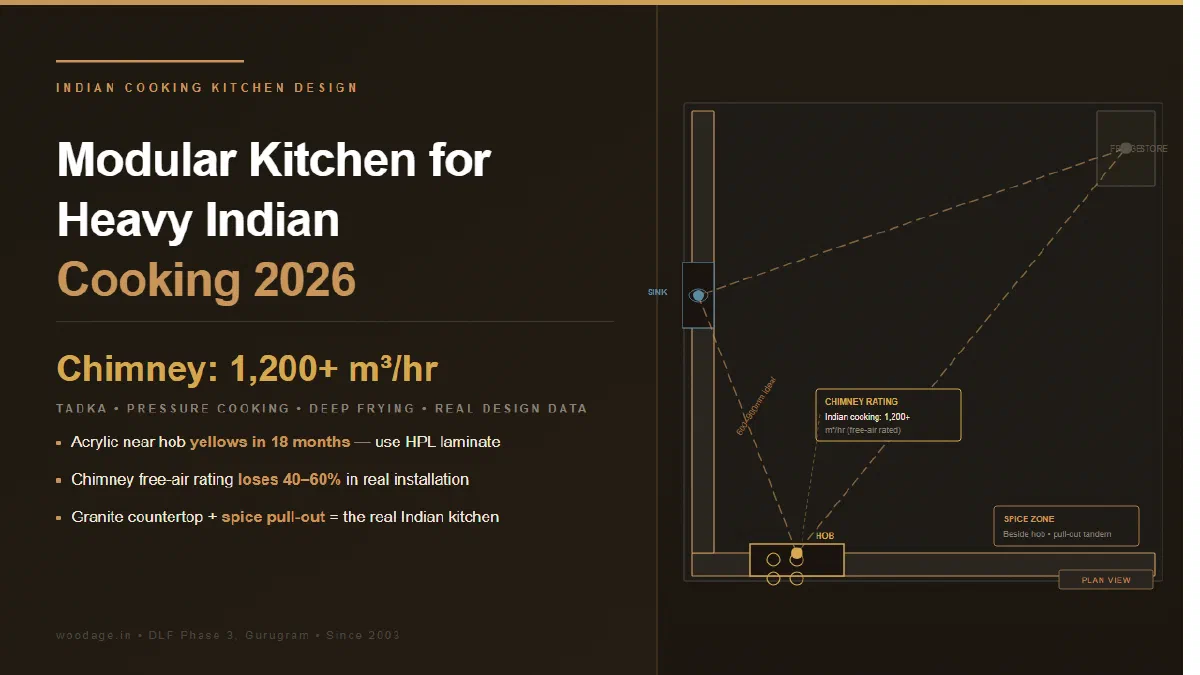
Modular Kitchen Designed for Indian Cooking 2026: Chimney CFM, Masala Storage, Hot Pan Zones and the Right Materials
Most modular kitchen advice in India is written for photogenic kitchens, not kitchens where dal tadka happens six days a week. Heavy Indian cooking produces grease, steam, smoke, spice staining and hot utensil movement in the same small zone. A light duty chimney, open shelving and delicate finishes near the hob can make the kitchen harder to clean within months of move in.
WoodAge (woodage.in) is a factory-direct modular kitchen and custom furniture manufacturer in Gurugram (Gurgaon), serving Delhi NCR since 2003.
This guide addresses what most kitchen guides skip: how to plan a modular kitchen for real Indian cooking, not aspirational cooking.
The Indian Cooking Problem That Kitchen Manufacturers Rarely Discuss
Indian cooking at home typically involves high-heat tadka where mustard seeds and whole spices are dropped into very hot oil generating immediate and intense smoke. Pressure cooking releases pressurised steam at high velocity. Deep frying in significant quantities of oil generates sustained grease-laden air. Multi-burner simultaneous cooking for complex dishes is standard. Heavy utensils including cast iron kadhai, heavy pressure cookers, and stone mortar and pestle are placed directly on countertops. Turmeric, chilli powder, and masalas stain porous or unsealed surfaces permanently.
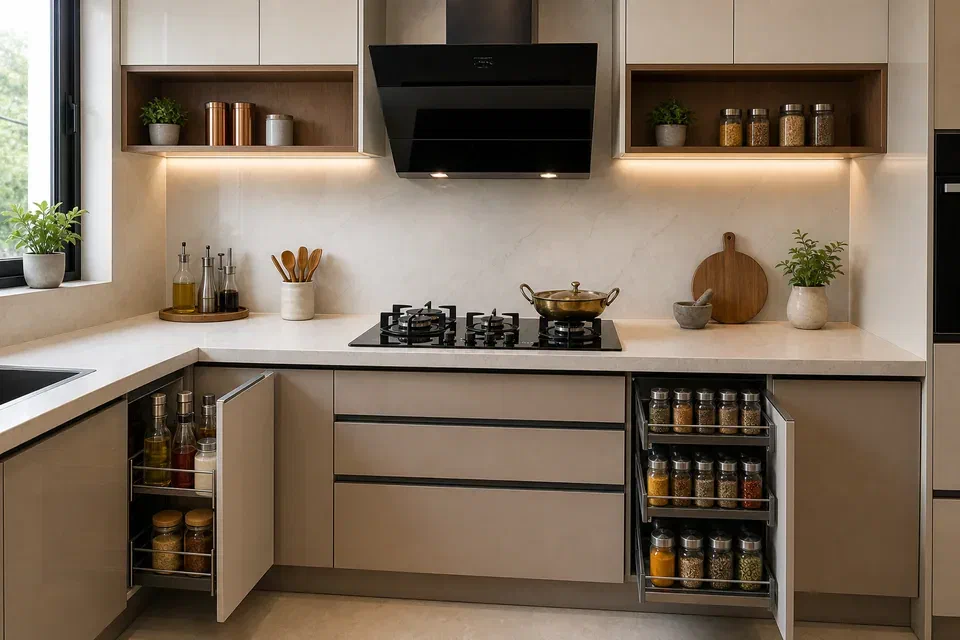
A kitchen designed for this cooking environment needs different material choices, different storage logic, and a chimney specification that most retailers undersell.
Chimney Sizing for Indian Cooking: Why 600 m3/hr Is Rarely Enough
The standard recommendation for Indian kitchens is to choose a chimney rated at 10 times the kitchen volume per hour. For a 55 sq ft kitchen with a 9-foot ceiling, kitchen volume is approximately 14 cubic metres. Recommended minimum chimney rating is 140 m3/hr.
However, this is a bare minimum for light cooking. For Indian cooking with tadka, deep frying, and pressure cooking, the recommended multiplier is 15 to 20 times the kitchen volume.
Most chimneys sold in India are rated between 600 and 1,500 m3/hr in their marketing. However, this is the theoretical free-air rating, not the actual suction at the filter. After accounting for filter resistance and duct losses, effective suction is typically 40 to 60 percent of the rated figure. A chimney marketed as 1,000 m3/hr typically delivers 400 to 600 m3/hr effective suction.
| Kitchen Size (sq ft) | Ceiling Height | Minimum Chimney Rating (m3/hr) | Recommended for Indian Cooking |
|---|---|---|---|
| 40 to 50 | 9 ft | 600 | 900 to 1,000 |
| 55 to 70 | 9 ft | 700 to 900 | 1,100 to 1,200 |
| 80 to 100 | 9 to 10 ft | 1,000 to 1,300 | 1,400 to 1,500 |
| 100 to 130 | 10 ft | 1,300 to 1,750 | 1,600 to 2,000 |
Auto-clean vs baffle filter chimneys for Indian cooking: Auto-clean chimneys use a motorised mechanism to collect grease in an oil collector bowl. For Indian cooking, auto-clean is strongly recommended. Baffle filters can collect 3 to 4 times their safe grease capacity within 30 to 45 days in a kitchen that cooks daily. Auto-clean maintenance involves emptying the oil collector bowl monthly, which takes 2 minutes.
Kitchen Layout Planning: The Hob-Sink-Prep Triangle for Indian Cooking
Hob-to-sink distance: 600 to 900mm is ideal. Close enough to move a hot vessel to the sink quickly, far enough to keep water splashes away from the cooking zone.
Prep counter adjacent to hob: Minimum 600mm of clear countertop immediately beside the hob on the non-chimney side. This is where vegetables are moved, vessels are rested, and spices are arranged during cooking. Insufficient prep space beside the hob is the most common kitchen planning mistake in Indian homes.
Dedicated masala zone below hob: The base cabinet or drawer immediately below or beside the hob is the highest-demand access point in an Indian kitchen. It should store daily spices (turmeric, chilli, coriander, cumin), cooking oil, and frequently used small utensils. A deep drawer (150 to 200mm) in this location is 4 to 5 times more efficient than a shelf cabinet.
Material Choices for Heavy Indian Cooking
Shutter Finishes Near the Hob
Acrylic shutters near the hob: Acrylic absorbs grease fumes and gradually yellows. Even with a properly functioning chimney, acrylic shutters directly above an open-flame gas hob will show yellowing within 18 to 24 months of daily Indian cooking. Use acrylic only on wall cabinets away from the hob.
Laminate (HPL) shutters near the hob: High-pressure laminate performs best in this zone. HPL does not absorb grease fumes at the same rate as acrylic, is easy to wipe clean, and maintains its colour for 10 to 15 years with normal maintenance.
PU paint near the hob: PU paint tends to yellow over 5 to 7 years near cooking zones. Best used on cabinets far from the hob.
Countertop Materials for Indian Cooking
Granite: The best performing countertop for Indian cooking. Handles hot pans without damage, does not absorb oil if properly sealed. Dark granites (Absolute Black, Steel Grey) are ideal for heavy cooking kitchens.
Quartz near the hob: Use with caution. The polymer resin in quartz cannot handle sustained direct heat from a hot cast iron vessel. The zone immediately beside the gas hob is better served by granite.
Stainless steel countertop (hob zone): Premium kitchens sometimes use a stainless steel section (600 to 800mm wide) immediately beside the hob. Cost is approximately Rs 800 to Rs 1,500 per sq ft for 16-gauge SS fabrication.
Masala and Oil Storage: Designing the Indian Pantry Zone
An Indian kitchen uses 20 to 40 spice varieties in daily cooking. Most Western kitchen design systems allocate a single drawer for spices. This is inadequate.
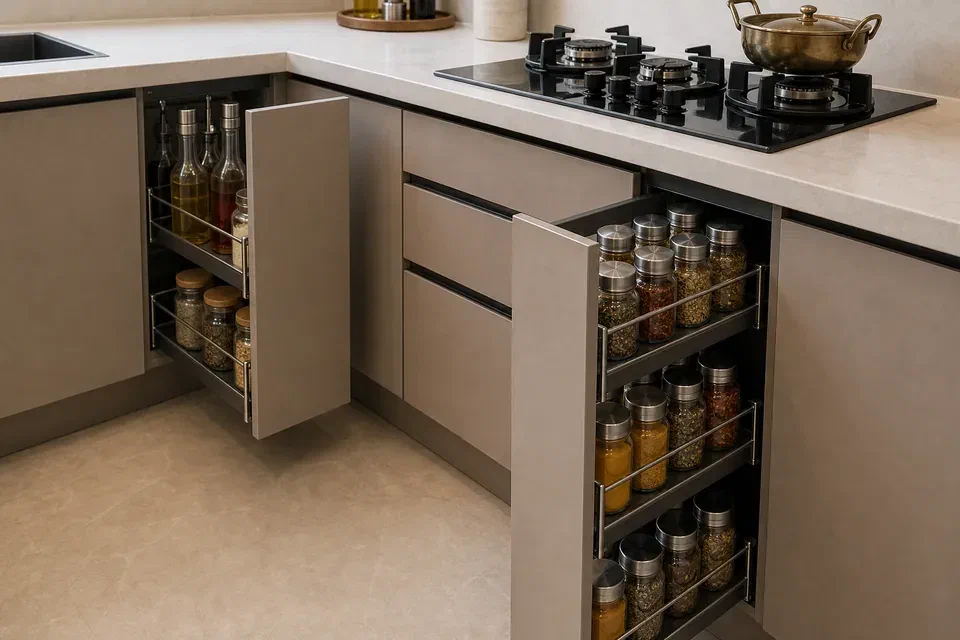
Daily spices (used every day): Turmeric, chilli powder, coriander powder, cumin, garam masala, salt should be within arm’s reach of the hob. A spice pull-out (tandem spice rack on the inside of a narrow 150mm door) is ideal. Cost: Rs 2,500 to Rs 8,000 for a good spice tandem pull-out from Hettich or Hafele.
Oil and liquid storage: Mustard oil, refined oil, ghee, and vinegar are heavy items. Store in a deep base cabinet with a pull-out basket to allow access to bottles at the back without removing the ones in front. Cost: Rs 4,000 to Rs 10,000.
Atta and bulk dal storage: A 10kg atta container weighs 10kg. A pull-out unit in a 600mm base cabinet with wheels is the correct solution. Dedicated atta storage units from Hafele and Hettich hold 20 to 25kg. Cost: Rs 6,000 to Rs 15,000.
The Dusty Kitchen Problem: Delhi NCR Dust and Open Shelving
Delhi NCR consistently ranks among the most air-pollution-affected cities in the world during October through February. Open shelving in a Delhi NCR kitchen is a dust accumulation disaster. Our recommendation is to minimise open shelving completely. Every storage unit should have a closed shutter.
If you want the appearance of open storage without the dust problem, consider glass-shuttered wall cabinets. Frosted or tinted glass allows you to see the contents while keeping dust out.
See also: For a factory-direct kitchen from the Gurugram unit, see WoodAge’s factory-made kitchens in Gurgaon.
Frequently Asked Questions
What chimney size do I need for an Indian kitchen in Gurgaon?
For a typical Gurgaon 2BHK kitchen (55 to 70 sq ft, 9 ft ceiling), a chimney rated at 1,000 to 1,200 m3/hr in free-air suction is recommended. For a 3BHK with a larger kitchen and four-burner cooking, 1,400 to 1,500 m3/hr is appropriate. Auto-clean is strongly preferred over baffle-filter chimneys for Indian cooking.
Can I use acrylic shutters in an Indian kitchen?
Yes, but position them strategically. Use acrylic on wall cabinets away from the cooking hob. Avoid acrylic directly above or beside the gas hob where grease and heat exposure will cause yellowing within 18 to 24 months of daily Indian cooking.
Which is better for an Indian kitchen countertop: granite or quartz?
Granite, if you cook heavily on a daily basis. Granite handles hot pans without damage and does not degrade near heat. Quartz is better for kitchens with lighter daily cooking where you value minimal upkeep (no periodic sealing) over heat performance.
Should I have an open or closed kitchen for Indian cooking?
A closed kitchen is strongly recommended for heavy Indian cooking. Open kitchens allow cooking fumes, grease, and spice aromas to spread into the living area. A semi-open kitchen with a glass partition or a sliding panel that can be closed during heavy cooking is the best of both worlds.
How do I prevent my white kitchen from yellowing near the hob?
Choose light grey or beige laminate rather than pure white. These shades are forgiving of light yellowing from cooking vapours. If you want white, use it on cabinets far from the hob and specify HPL laminate rather than acrylic. Clean white cabinets weekly with a mild degreaser.
What is the difference between a chimney’s free-air rating and its actual kitchen performance?
The free-air rating is measured in a laboratory with no filters, no duct, and no resistance. In a real kitchen installation with filters, ductwork, and bends, effective suction is typically 40 to 60 percent of the free-air rating. A chimney marketed as 1,000 m3/hr delivers approximately 400 to 600 m3/hr effective suction in a real Gurgaon kitchen.
What should be closest to the hob in an Indian kitchen?
Keep daily masalas, oil, ladles, tongs, a spoon rest and a heat safe prep zone within one step of the hob. This reduces cross kitchen movement while cooking and keeps hot pans away from cabinet shutters, refrigerator sides and children walking through the kitchen.
Which shutter finish is easiest to maintain near tadka and frying?
HPL laminate is usually the easiest practical finish near the hob because it wipes clean, tolerates daily degreasing better than delicate glossy finishes and can be matched with BWP plywood or HDHMR carcass specifications. Reserve acrylic, veneer or PU for zones away from direct cooking vapour.
What should I confirm before chimney ducting is cut?
Confirm the duct exit point, duct diameter, number of bends, chimney width, wall cabinet height and electrical point before cabinet manufacturing starts. If these are decided after installation, the duct may cut through storage, reduce suction or leave an exposed pipe in the kitchen.
How should a small Gurgaon 2BHK kitchen handle masala storage?
Use a narrow spice pull-out, one deep drawer for oil bottles and a small daily masala tray near the hob. Avoid open spice shelves in Delhi NCR apartments because dust and cooking grease settle quickly on exposed jars.
WoodAge designs kitchens for the way Indians actually cook, not for the way European kitchens look on Pinterest.
16 SCO, Saraswati Vihar, Chakkarpur, Gurugram 122002 Phone: +91-9910318044 | info@woodage.in | woodage.in
Related Guides From WoodAge
- Acrylic vs Laminate vs PU Paint vs Veneer: Best Kitchen Finish for Delhi NCR - The climate and cooking data behind why HPL laminate outperforms acrylic and PU paint for Delhi NCR conditions.
- Granite vs Quartz vs Sintered Stone Countertop Guide 2026 - The countertop choice near a gas hob is critical for Indian cooking.
- Modular Kitchen Accessories and Pull-Outs Guide 2026 - The specific Indian-cooking pull-outs with current prices and manufacturer options.
- 10 Hidden Costs in Modular Kitchens Nobody Tells You About - Chimney, plumbing, and electrical costs are often excluded from kitchen quotes.
- Vastu Shastra for Modular Kitchens 2026: Directions, Platform Placement, Colours and Practical Guidance for Indian Homes - Useful next reading on kitchen planning, costs, materials, or execution.
- BWP Plywood vs HDHMR vs MDF: Which Kitchen Material Lasts Longest in Delhi NCR? - Useful next reading on kitchen planning, costs, materials, or execution.
- Penthouse Kitchen Playbook for Gurgaon - Penthouse kitchens in Gurgaon premium projects (M3M Mansion, M3M Opus, TARC Ishva, DLF Camellias) need different design rules. This guide covers double-height ceilings, terrace integration, multiple kitchens, luxury appliances and bespoke material strategies.
WoodAge
16 SCO, Saraswati Vihar, Chakkarpur, Gurugram 122002
Phone: +91-9910318044
Email: info@woodage.in
Website: woodage.in