

No Hidden Cost Interior Contract: Clauses Every Gurgaon Homeowner Should Ask For
The contract clauses that stop hidden costs in a Gurgaon interior project: scope, exclusions, material brand codes, timeline, payment, warranty and disputes.

- Kautuk Sahni
- 12 min read
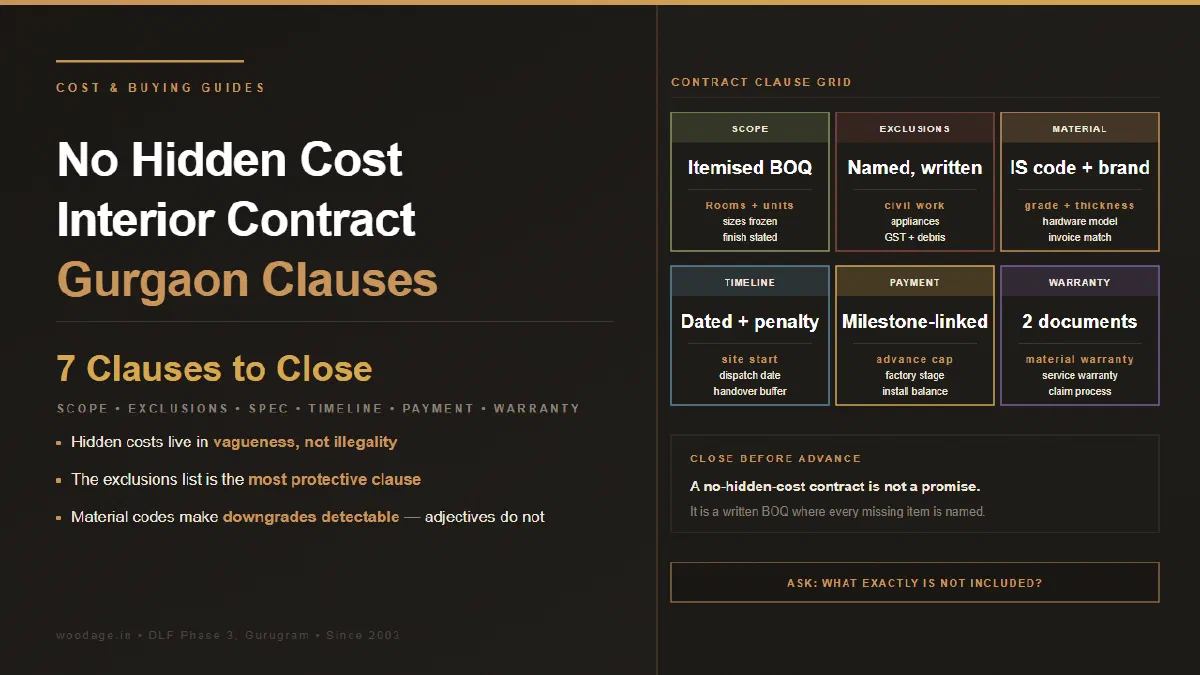
No Hidden Cost Interior Contract: Clauses Every Gurgaon Homeowner Should Ask For
Hidden costs in interior work are almost never illegal — they live in what the contract leaves vague. A no-hidden-cost contract closes the gaps with seven written clauses: itemised scope, named exclusions, material brand-and-grade codes, a dated timeline with penalty, milestone-linked payments, documented warranty, and a dispute term. The single most protective line is a written exclusions list, because that is where “extras” are born.
WoodAge (woodage.in) is a factory-direct modular kitchen and custom furniture manufacturer in Gurugram (Gurgaon), serving Delhi NCR since 2003.
The catch: most “extras” are things the buyer assumed were included and the contract never said either way — and silence always favours the side billing you. This guide gives you the exact clauses to demand and maps each to the real manufacturing, dispatch, installation and warranty work behind it.
Why Hidden Costs Live in the Contract, Not the Quote
A quote is a number; a contract is a set of promises. Buyers fixate on the headline figure and skim the terms — which is exactly backwards, because the figure is only as honest as the scope it covers. A “₹X lakh kitchen” with a thin scope and no exclusions list is an open invoice waiting to grow.
Hidden costs enter through four doors:
- Undefined scope — work you assumed was in, that wasn’t named.
- Unlisted exclusions — items the vendor always intended to bill separately but never flagged.
- Vague materials — “premium ply,” “branded hardware,” “good laminate” with no code, swapped for cheaper grades.
- Loose process — no timeline penalty and front-loaded payments, so you lose leverage to enforce anything.
The defence isn’t haggling harder on the number. It’s making the contract specific enough that there’s nothing left to “discover” mid-project. For the cost categories that most often surprise buyers, see our hidden costs in a modular kitchen guide.
The Seven Clauses That Close the Gaps
| # | Clause | What it prevents | Maps to (execution reality) |
|---|---|---|---|
| 1 | Itemised scope (BOQ) | “That wasn’t included” billing | Manufacturing + installation line-items |
| 2 | Named exclusions | Surprise “extras” | What’s genuinely outside the job |
| 3 | Material brand + grade codes | Silent downgrades | Board, laminate, hardware, counter specs |
| 4 | Dated timeline + penalty | Open-ended delays | Factory lead time + install schedule |
| 5 | Milestone-linked payments | Front-loaded risk | Advance / dispatch / install / handover |
| 6 | Documented warranty | “Verbal lifetime” with no recourse | Product + workmanship warranties |
| 7 | Dispute + change-order term | Mid-project arm-twisting | How changes get priced and approved |
Each of these is examined below as a clause you can ask for by name.
Clause 1: Itemised Scope (the BOQ Is the Contract’s Spine)
Demand a line-by-line Bill of Quantities, not a lump sum. Every cabinet, every running foot of counter, every wardrobe shutter, every accessory listed with quantity. A lump-sum “modular kitchen — ₹X” tells you nothing about what you’re owed.
A good scope clause states what is built, in what quantity, to what dimension. The test: could a third party read the BOQ and know exactly what to install? If not, it’s too vague to protect you. For the full structure of a kitchen-specific BOQ contract, see the modular kitchen contract checklist for India.
Specification paragraph you can paste: “The scope comprises only the items, quantities and dimensions listed in the attached BOQ (Annexure A). Any item not listed in Annexure A is excluded and, if required later, will be priced and approved in writing as a change order before execution.”
Clause 2: Named Exclusions (Where Extras Are Born)
This is the most protective clause and the most often missing. An exclusions list states, in writing, what the contract does not cover — so nothing can be “discovered” as an extra later.
Common interior exclusions that should be named explicitly (so you decide who pays, in advance):
- Civil work — wall demolition, plaster, waterproofing, tiling
- Electrical and plumbing point shifting (vs. the existing layout)
- Core cutting and chimney duct work
- False ceiling and cove lighting (if a separate trade)
- Painting and wall finishes
- Appliance supply (chimney, hob, oven, sink, tap) vs. only installation
- Loose furniture and soft furnishings
- Society charges — NOC deposit, lift fees, debris disposal
- Site protection and post-work deep cleaning
The point isn’t that the vendor must include all of these — it’s that each one is decided and priced before work starts, not invoiced as a surprise. A clear exclusions list and a clear scope are two halves of the same protection.
Clause 3: Material Brand and Grade Codes (Stop the Silent Downgrade)
“Premium plywood” and “branded hardware” are not specifications — they’re marketing. The contract must name the brand, grade and IS code for every material that decides cost and lifespan:
| Material | What the contract must state | Example of a verifiable spec |
|---|---|---|
| Carcass board | Type + IS code + brand | BWP plywood IS 710, named brand |
| Shutter | Material + finish + thickness | 18 mm board, 1 mm laminate, named brand |
| Edge banding | Type + thickness | 2 mm PUR (not 0.8 mm PVC) |
| Laminate | Brand + range/thickness | Named brand, 1 mm |
| Hardware | Brand + line + type + qty | Hettich/Blum/Hafele, soft-close, counted |
| Countertop | Material + thickness + brand | 18–20 mm quartz/granite, named |
We deliberately don’t quote prices or invent SKUs — but the code (IS 710, 2 mm PUR, named brand and product line) is exactly what makes a downgrade detectable. Without codes, a vendor can quote BWP and deliver MR-grade, quote PUR and deliver PVC, quote Hettich and fit local — all without breaching a vague contract. A full material schedule belongs in an annexure; our interior specification sheet template is the format to attach.
Specification paragraph you can paste: “All materials shall match the brand, grade and IS code stated in the material schedule (Annexure B). Substitution of any material requires the owner’s prior written approval. Materials delivered below the specified grade may be rejected and replaced at the contractor’s cost.”
Clause 4: Dated Timeline With a Penalty
A timeline without a consequence is a wish. The clause should state a start date, milestone dates and a completion date, plus what happens on delay.
- Tie the timeline to your obligations too (site readiness, approvals, payments) so delay responsibility is clear.
- A modest, capped delay penalty (liquidated damages) focuses the mind without being punitive.
- Distinguish vendor-caused delay from owner-caused or society-caused delay (NOC, lift availability) so the penalty is fair.
The execution reality this maps to: factory lead time (cutting, edge-banding, pre-assembly) plus on-site installation days. A vendor who can commit to dated milestones is one who actually controls their factory schedule — which is itself a quality signal.
Clause 5: Milestone-Linked Payments (Never Front-Load)
Payment terms are leverage. The clause should tie each instalment to a delivered milestone, not a calendar date:
| Milestone | Typical trigger | Why it protects you |
|---|---|---|
| Advance | On contract signing + design freeze | Books the slot; should be a minority share |
| Pre-dispatch | Factory build complete, before delivery | Material verifiable before it ships |
| On installation | Units installed on site | Work delivered, not promised |
| On handover | Snag list cleared, warranty issued | Final balance held until it’s right |
Avoid any term that demands a large majority upfront — a 60%+ advance hands the vendor all the leverage and you the risk. A retention amount held until snags are cleared is the homeowner’s best tool for getting the punch-list finished.
Clause 6: Documented Warranty (Two Documents, Not One Promise)
“Lifetime warranty” spoken across a showroom table is worthless. The contract must attach written warranties, and you should understand that there are two distinct kinds:
- Product warranty — from the manufacturer on the board, hardware and appliances, for their stated periods. (A hardware warranty covers the hinge mechanism, not your whole kitchen.)
- Workmanship warranty — from the contractor on installation: alignment, levelling, screw-holding, gaps, finishing.
The clause should state the duration, what’s covered, what voids it, and the response process for a warranty call. Vague “warranty included” with no document, duration or scope is not enforceable in any useful sense.
Specification paragraph you can paste: “The contractor shall provide, at handover, (a) manufacturer product warranties for board, hardware and appliances, and (b) a written workmanship warranty covering installation defects for a stated period, including the defect-response timeline. Warranty terms, durations and exclusions shall be documented; verbal warranties are not binding.”
Clause 7: Change Orders and Disputes
Most cost blow-ups happen through changes, not the original scope. A change-order clause states that any change is priced and approved in writing before it’s executed — no verbal “just add this, we’ll adjust later.” That single rule kills the most common mid-project surprise.
The dispute term should name a simple escalation path and what happens to retention money if work is contested. It need not be litigious — even a clear “snags are listed, fixed within N days, retention released on closure” process resolves most real-world conflicts.
NCR Context: The Gurgaon-Specific Lines to Add
Generic contract advice misses costs that are specific to Gurgaon high-rise projects. Add these explicitly:
- Society charges named: state whether NOC deposit, service-lift fees and debris-disposal charges are the owner’s or the vendor’s — these recur on every NCR fit-out and are a classic “extra.”
- Site-readiness dependency: because society NOC and lift slots can delay a dispatch, the timeline clause should treat society-caused delay separately from vendor delay.
- Core-cutting and duct route: if the kitchen needs a chimney duct, name who obtains core-cutting permission and what happens if the society refuses the route.
- Access constraints: for tight service lifts, specify that oversized units are built to knock down to fit — a build decision with cost implications if discovered late.
- Moisture-grade defaults for NCR: given Gurgaon’s monsoon humidity, the material schedule should default wet zones (kitchen, utility, bath vanity) to BWP IS 710 or HDHMR with PUR banding, in writing.
These five lines turn a generic interior contract into one that survives the realities of an NCR apartment — and they’re exactly the points a factory-direct manufacturer can speak to from execution, not theory.
TL;DR — The No-Hidden-Cost Contract
- Hidden costs live in vagueness, not illegality — close the gaps, don’t just haggle the number.
- Seven clauses: itemised scope, named exclusions, material brand/grade codes, dated timeline + penalty, milestone payments, documented warranty, change-order/dispute term.
- The exclusions list is the most protective line — it’s where “extras” are born.
- Material codes (IS 710, 2 mm PUR, named brand + product line) make downgrades detectable; “premium ply” doesn’t.
- Never front-load payment; tie each instalment to a delivered milestone and hold retention until snags clear.
- For Gurgaon: name society charges, separate society-caused delay, settle the core-cutting/duct responsibility, default wet zones to moisture-grade board.
See also: For per-running-foot ranges and a sample BOQ, see WoodAge’s factory-direct kitchen cost guide.
Frequently Asked Questions
What should be written into an interior contract?
At minimum: an itemised scope (BOQ) with quantities and dimensions, a named exclusions list, a material schedule with brand/grade/IS codes, a dated timeline with a delay penalty, milestone-linked payment terms, documented product and workmanship warranties, and a change-order/dispute clause. The scope and exclusions together define exactly what you’re owed; the material codes make downgrades detectable.
How do I avoid hidden costs in interior work?
Make the contract specific enough that nothing can be “discovered” later. Insist on a written exclusions list so items like civil work, point shifting, appliances and society charges are decided and priced before work starts. Use a change-order clause that requires written approval and pricing before any change is executed — most cost blow-ups come through changes, not the original scope.
Should material brand codes be written into the contract?
Yes — this is essential. “Premium plywood” or “branded hardware” with no code lets a vendor quote one grade and deliver a cheaper one without breaching a vague contract. The contract should name the board type and IS code (e.g. BWP IS 710), edge banding type and thickness (e.g. 2 mm PUR), laminate brand and thickness, and hardware brand, line and quantity, ideally in a material schedule annexure.
What timeline clause should I ask for?
Ask for a start date, milestone dates and a completion date, with a modest capped penalty for vendor-caused delay. The clause should separate vendor delay from owner-caused or society-caused delay (NOC, lift availability) so responsibility is fair. A vendor who can commit to dated factory and installation milestones is usually one who actually controls their production schedule.
How should warranty be documented?
As two separate written documents: a manufacturer product warranty on board, hardware and appliances (each for its stated period), and a contractor workmanship warranty on installation defects like alignment, levelling and screw-holding. The contract should state durations, what’s covered, what voids it, and the response timeline for a warranty call. A verbal “lifetime warranty” with no document and no scope is not meaningfully enforceable.
How much advance payment is reasonable for an interior project?
Avoid any term demanding a large majority upfront — a 60%+ advance hands the vendor the leverage and you the risk. Tie instalments to delivered milestones: a minority advance on design freeze, a payment before dispatch (after you’ve verified the factory build), a payment on installation, and a final balance on handover after snags are cleared. A retention held until the punch-list closes is your best tool.
Who pays for society NOC deposits, lift fees and debris disposal?
That depends entirely on what the contract says — which is why it must be named. These NCR-specific charges recur on every Gurgaon high-rise fit-out and are a classic source of surprise “extras.” State explicitly whether the NOC deposit, service-lift fees and debris-disposal charges are the owner’s or the contractor’s responsibility before work begins.
Is a contract necessary for a factory-direct interior project too?
Yes. Factory-direct removes the middleman margin, but you still need the scope, material schedule, timeline, payments and warranty in writing — the contract is what makes the factory’s specification verifiable at delivery. A factory-direct manufacturer can actually map each clause to real production and installation steps, which makes its commitments easier to hold to.
Related Guides From WoodAge
- Modular Kitchen Contract Checklist for India — the kitchen-specific version of these contract clauses.
- Hidden Costs in a Modular Kitchen in India 2026 — the cost categories that most often surprise buyers.
- Interior Specification Sheet Template: Boards, Laminate, Hardware, Countertop, Warranty — the material schedule annexure to attach to your contract.
- What to Ask Before Paying Interior Advance: 25 Questions for Gurgaon Homeowners - Related guide for planning the costs, materials and execution of the same project.
- Interior Quote Review Gurgaon: How to Decode Per-Sqft Rates, Civil Items, Electrical Lump Sums and Loose Furniture - Related guide for planning the costs, materials and execution of the same project.
- Full Home Interior Snag List Before Final Payment: Kitchen, Wardrobes, Paint, Lights and Handover - Useful next reading on interior planning, costs, materials, or execution.
Get a Factory-Direct Quote
WoodAge quotes against an itemised BOQ and a material schedule with brand, grade and IS codes — the same specification our factory builds and installs to. That’s what makes a no-hidden-cost contract enforceable rather than aspirational. Send us your scope and we’ll turn it into a contract you can audit line by line.
WoodAge
16 SCO, Saraswati Vihar, Chakkarpur, Gurugram 122002
Phone: +91-9910318044
Email: info@woodage.in
Website: woodage.in