

NRI and Remote Owner Interior Execution Checklist for Gurgaon Flats in 2026
Step-by-step checklist for NRIs and out-of-city owners fitting out a Gurgaon flat without being on site. Trusted person, video reviews, payment milestones.

- Kautuk Sahni
- 15 min read
NRI and Remote Owner Interior Execution Checklist for Gurgaon Flats in 2026
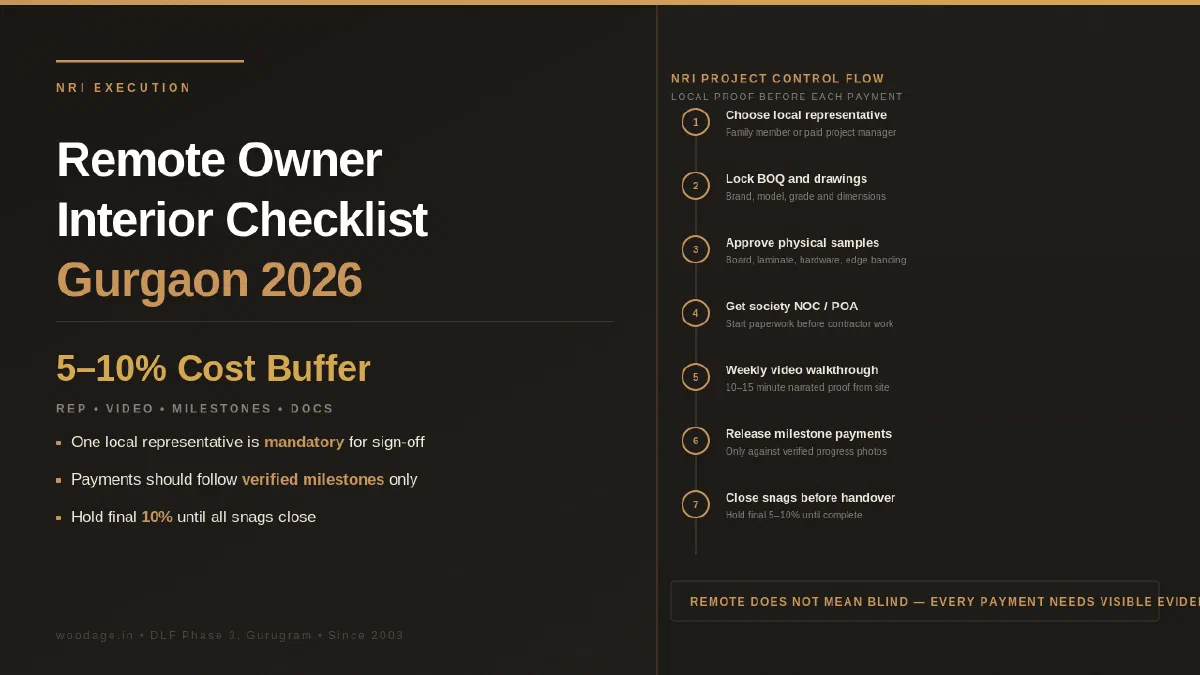
Fitting out a Gurgaon flat as an NRI or out-of-city owner is achievable with the right setup: one trusted local representative (family member or paid project manager), a contractor accountable through written scope and milestone payments, weekly video walkthroughs, and a digital documentation discipline that catches issues in week 2 rather than at handover. Done well, NRI projects in Gurgaon complete within 5 to 10 percent over the on-site baseline cost and 15 to 25 percent over the timeline. Done badly, they bleed Rs 3 lakh to Rs 8 lakh over budget and stretch by 4 to 8 months.
WoodAge (woodage.in) is a factory-direct modular kitchen and custom furniture manufacturer in Gurugram (Gurgaon), serving Delhi NCR since 2003.
This checklist is for NRIs in the Middle East, US, UK, Singapore, and Australia, plus domestic out-of-city owners in Bangalore, Mumbai, Hyderabad managing a Gurgaon investment or family flat.
The Fundamental Risk: You Cannot See What You Are Paying For
The single biggest risk in an NRI interior project is that the contractor downgrades specifications and the owner has no way to verify in real time. Examples we have observed:
- Vendor quoted BWP plywood, delivered HDHMR or particle board for non-visible cabinets
- Vendor quoted 1 mm laminate, delivered 0.7 mm cheaper laminate
- Vendor quoted Hettich hardware, delivered local Ozone or generic Chinese
- Vendor quoted Faber chimney, delivered a cheaper model from the same brand
- Vendor quoted 18 mm board, delivered 16 mm
- Vendor compromised on edge banding (PVC instead of PUR)
- Vendor added “extras” mid-project that were originally included
Each of these silent downgrades adds Rs 15,000 to Rs 80,000 to vendor margin and removes Rs 50,000 to Rs 2 lakh of value from the owner’s home. None is detectable through video alone. All require physical inspection by someone trustworthy.
The structure of an NRI project is designed to make these downgrades visible and accountable.
Step 1: Pick Your On-Ground Representative
Every NRI project needs one local person who can physically visit the site, photograph progress, sign off on milestones, and authorize payment releases. The options:
Option A: A trusted family member
When it works: A parent, sibling, or close cousin in NCR with time available and reasonable technical comfort.
When it fails: When the family member becomes overwhelmed by technical decisions, when they have soft personal ties to the contractor, or when they cannot say no to additional charges.
Compensation: Usually free, but you should fund their travel, occasional meals on-site days, and a token honorarium of Rs 25,000 to Rs 50,000 at project completion.
Option B: A paid project manager
When it works: When you have no available family member, when the project is premium tier above Rs 25 lakh, or when you need a layer of professional accountability.
Compensation: Typically 4 to 8 percent of project value, or Rs 50,000 to Rs 2 lakh flat fee. Some Gurgaon project managers offer NRI-specialised packages.
Option C: Designer-managed turnkey
When it works: When you hire an interior designer who runs the entire project including vendor selection, scope, execution, and handover. They become your local representative by default.
Compensation: Typically 15 to 25 percent over the direct manufacturing cost.
What your representative needs to do
- Visit the site at least once a week during active work
- Photograph all material delivered before installation (board stamps visible, brand markings visible)
- Sign off on each milestone before payment release
- Be the named contact for the contractor and the society RWA
- Maintain a project folder with all photos, invoices, samples
- Communicate weekly with you via WhatsApp or scheduled call
Without one of these three options, do not start the project. The temptation to “manage remotely with just video calls” is the single most expensive mistake NRI owners make in Gurgaon fit-outs.
Step 2: Choose the Right Contractor for NRI Projects
Not every interior contractor handles remote-owner projects well. Look for:
Signs of NRI-ready contractor:
- Active WhatsApp communication, with photo and video updates daily during active work
- Willingness to provide manufacturer’s bills and brand certificates for major items
- Detailed itemised quotations with brand, model, and grade specified
- Established business address (not just a Mumbai-style fly-by-night)
- References from at least 2 to 3 previous NRI clients
- GST registration, formal invoicing
- Comfortable with milestone-based payment terms
Red flags to avoid:
- Vague quotations (“modular kitchen with premium finish, Rs X lakh”)
- Demand for 60+ percent advance payment
- Unwillingness to provide brand certificates or material samples
- WhatsApp-only communication, no email or written contracts
- “Trust me, we will handle everything” attitude
For Woodage and similar factory-direct manufacturers in Gurgaon, NRI projects are common (roughly 20 to 30 percent of clientele) and the workflow is mature.
Step 3: Lock the Scope Before Starting
The scope document is the single most important risk control for an NRI project. It must include:
Detailed BOQ with brand and model
Every line item must specify:
- Material (plywood grade, IS code, brand)
- Hardware (brand, model, load rating)
- Finish (laminate brand, thickness, grade)
- Dimensions (every cabinet, drawer, shelf)
- Accessories (specific brand and model of each pullout, hinge, slide)
Example bad line: “Modular kitchen, full L-shape, mid-tier”
Example good line: “Modular kitchen base cabinet, 18 mm BWP plywood IS 710 (Century Sainik 710 or Greenply Greenpanel), 1 mm Greenlam premium laminate finish with PUR edge banding, Hettich Sensys soft-close concealed hinges, Hettich Quadro 4D 40 kg drawer slides, total 16 running feet, configuration as per drawing X.”
Drawings approved before manufacturing starts
You need three drawings minimum:
- Floor plan with each cabinet labelled showing cabinet width, depth, function, height
- Elevation drawings showing shutter configuration, accessory placement
- Cross-section drawings for any tall units, special accessories, lift mechanisms
Drawings should be signed and dated by both parties. Any change to drawings post-signature must be in writing with cost impact.
Sample approval
Physical samples of:
- Board edges (you should see the IS code stamp on a sample piece)
- Laminate finish (the exact piece going into your kitchen)
- Hardware (one drawer slide, one hinge, one lift mechanism in original packaging)
- Edge banding sample
These samples are photographed by your representative and kept on file. At delivery, materials are matched against samples.
Payment milestones tied to verifiable progress
The standard NRI-friendly payment structure:
| Milestone | Payment percentage | Trigger |
|---|---|---|
| Contract signing | 20% | Scope and drawings finalised, samples approved |
| Material received in factory | 25% | Brand certificates and bills for major items shared |
| Mid-installation | 25% | Photos showing carcass installed and inspected on site |
| Major work complete | 20% | Counter installed, all hardware in place |
| Final handover | 10% | All snags closed, handover document signed |
Avoid front-loaded payment schedules (40 to 50 percent upfront). They remove the contractor’s incentive to finish well.
Step 4: Weekly Documentation Discipline
Every week during active work, your representative captures and you review:
Daily photos during installation (5 to 10 photos per day)
- What was done that day
- Materials used that day (brand markings visible)
- Workers on site
- Any issues raised
Weekly video walkthrough (10 to 15 minutes)
Your representative records a smartphone video walking through every room, narrating:
- What is new this week
- What is left to do
- Any concerns or questions
You watch it the next morning (time-zone permitting) and respond by EOD with any feedback.
Material delivery verification
Every major delivery (kitchen carcass, countertop, appliances) is photographed at delivery:
- Brand certificate or invoice
- Boards stacked with IS code stamps visible
- Hardware boxes with brand and model
- Damaged items noted immediately
Snag tracker
A live Google Sheet or shared document with:
- Date raised
- Issue description
- Photo
- Status (open, in progress, closed)
- Expected closure date
This becomes the handover document at the end.
Step 5: Society NOC and Logistics for NRI Projects
If you are not physically present, society NOC processes need careful handling:
Power of Attorney (POA)
For most Gurgaon societies, the registered owner or a POA holder must sign the NOC application. If you cannot be in Gurgaon, your local representative needs:
- General POA registered in your name, granted to your representative, covering “interior renovation, signing NOC documents, and engaging contractors on my behalf”
- POA notarised and apostilled (for NRI owners) or simply registered with stamp duty (for domestic out-of-city owners)
- Society’s KYC accepted for the POA holder (Aadhaar, PAN, address proof)
POA registration typically takes 1 to 3 weeks. Start this 6 to 8 weeks before your planned start date.
Society deposit and refund logistics
Society deposits (Rs 25,000 to Rs 1 lakh) are paid at NOC issuance and refunded after final inspection. For NRIs:
- Deposit can be paid through NRO account or by representative on your behalf
- Refund typically issued by cheque to the named applicant
- Keep all receipts; refunds take 2 to 6 weeks after final inspection
Lift booking and material movement
In premium societies like Sobha, DLF, M3M, ATS, you need:
- Lift booking forms (often 24 to 48 hours advance)
- Daily working hour restrictions (typically 10 AM to 6 PM)
- Material delivery only through service lift
- Debris disposal scheduled separately
Your representative handles these on a rolling basis.
Step 6: Payment Workflow for NRIs
Domestic remittance
If you have an NRO account in India, payments to the contractor are straightforward NEFT or RTGS transfers. Keep all transaction proofs.
International remittance
If paying directly from your foreign bank account:
- SWIFT transfer to contractor’s GST-registered business account (not personal)
- Contractor issues GST invoice for each payment
- Document the purpose code (interior renovation services)
- Repatriation considerations apply if you later sell the flat
TDS implications
For payments to Indian residents (contractor), TDS may apply at 1 to 2 percent under section 194C of the Income Tax Act if you are filing returns in India. Consult your CA. Most NRIs delegate this to a local CA in Gurgaon or Delhi who handles the project’s tax compliance.
GST handling
All major contractors should be GST registered (18 percent applies on services and most goods). Verify GSTIN on every invoice. NRIs cannot typically claim GST credit unless they have an Indian business; this is just a cost.
Step 7: Handover Inspection (The Critical Moment)
The handover is where most NRI project issues either close successfully or escalate into multi-month disputes.
What your representative inspects on handover day
- Every drawer opens and closes smoothly with soft-close action
- Every shutter aligns flush, no gaps, no sag
- Every hinge has 3D adjustment visible (Hettich Sensys or Blum Clip Top)
- Every drawer slide is full-extension (drawer pulls all the way out)
- Edge banding is intact on every visible edge
- Laminate has no visible damage, bubbles, or peeling
- Countertop is mitred at corners (not just butted)
- Sink drains properly, tap has full flow, no leaks
- Chimney sucks effectively (test with a candle or matchstick)
- Hob ignites on all burners, gas pressure adequate
- Built-in appliances power on and function
- All electrical points work
- All lights work
- Wardrobe doors and drawers all function
Handover documents required
- Snag list closed and signed
- Brand certificates and warranty cards for major items
- Touch-up materials (laminate piece, edge banding, paint sample)
- Service contact list for all branded items
- As-built drawings showing actual installed configuration
- Material samples retained for future reference
What to do if there are unresolved snags
Hold back the final 5 to 10 percent payment until snags are closed in writing. Most reputable contractors accept this; vendors who insist on full payment “now and we will fix later” rarely actually fix anything.
Common NRI Project Failures and How to Avoid Them
Failure 1: Spec drift across weeks
What happens: Project starts with clear BOQ. By week 6, contractor has substituted 4 to 6 items with “what was available” or “the upgrade we had to make”. Each substitution adds Rs 5,000 to Rs 25,000 silently.
Prevention: Require written approval for every substitution before it happens. Photograph every material before use.
Failure 2: Scope creep dressed as helpful additions
What happens: “Sir, we suggest adding a tall pantry since you have the space” or “Madam, we recommend changing the countertop to quartz, much better”. Each addition is real value but also chargeable. Without owner discipline, scope adds Rs 1 lakh to Rs 3 lakh.
Prevention: All additions go through written change orders with cost impact. Owner approves each in writing before work proceeds.
Failure 3: Timeline drift with no consequence
What happens: Project quoted at 45 days, ends at 95 days. NRI cannot pressure on the ground. Contractor moves to other projects between sessions.
Prevention: Penalty clause in the contract (Rs 2,000 to Rs 5,000 per day delay beyond agreed timeline, after a buffer of 10 days). Milestone payments tied to specific dates, not just completion.
Failure 4: Quality compromises on hidden elements
What happens: Visible surfaces look premium, hidden elements (carcass back panels, drawer bottoms, internal hardware) are substandard.
Prevention: Inspection of unfinished cabinets in factory before installation. Open at least 30 percent of installed cabinets at handover to check internal quality.
Failure 5: Disputed extras at handover
What happens: Contractor presents a Rs 2 lakh to Rs 5 lakh extras bill at the end. Owner has no documentation that these were not in original scope.
Prevention: Maintain a single living document with all original scope plus all approved changes. No verbal additions accepted.
See also: For per-running-foot ranges and a sample BOQ, see WoodAge’s modular kitchen cost guide for Gurgaon.
Frequently Asked Questions
Is it realistic to manage a Gurgaon interior project entirely from abroad?
With the right setup yes. The required setup is one trusted on-ground representative (family or paid), an NRI-experienced contractor with WhatsApp discipline, detailed written scope with brand specifications, milestone-based payments, and weekly documentation. NRI projects typically take 15 to 25 percent longer than on-site projects and cost 5 to 10 percent more in overhead, but the result quality can match on-site projects.
How much should I budget for project management overhead as an NRI?
For a paid project manager, plan 4 to 8 percent of project value (Rs 50,000 to Rs 1.5 lakh for a typical 3BHK fit-out). If using a family member, budget Rs 25,000 to Rs 50,000 honorarium plus their direct costs (travel, meals on site days). For designer-managed turnkey, plan 15 to 25 percent over direct manufacturing cost.
What is the minimum number of site visits I should plan to make personally?
Two if possible: one at scope finalisation and sample approval (often combined with possession or visit to India anyway), one at handover. If only one visit is possible, prioritise handover. If zero visits, your representative needs full POA and clear delegation.
How do I verify the contractor is actually using the specified plywood?
Three checks: 1) Insist on Century Sainik 710, Greenply Greenpanel, or other branded marine plywood with visible IS 710 stamp and BIS standard mark. 2) Have your representative photograph the stamped edges of plywood at factory before cutting. 3) Test one delivered cabinet with the water swell test (a few drops of water on a hidden bottom edge, check 24 hours later for swelling). Plywood will not swell, particle board or MDF will.
Can I pay the contractor in instalments from my US/UK/UAE bank account?
Yes via SWIFT transfer to the contractor’s GST-registered business account. Each transfer needs purpose code (interior renovation services), and the contractor issues GST invoices. Plan for SWIFT charges (Rs 1,500 to Rs 3,500 per transfer) and 1 to 3 day clearing time. Many NRIs find it easier to fund the project from their NRO account in India to avoid repeated international transfers.
What is the typical timeline for a 3BHK NRI fit-out?
For a clean new possession 3BHK with full mid-tier interior, plan 75 to 110 days from scope finalisation to handover (versus 55 to 80 days for an on-site project). The extra time covers POA, NOC processing, weekly review cycles, and the typical 5 to 10 day delays from cross-time-zone decision making. Plan for project start 6 to 8 weeks after you finalise the contractor, allowing POA registration, society NOC, and material procurement.
Should I use a Gurgaon-based interior designer who specialises in NRI clients?
For projects above Rs 25 lakh and for owners with limited family on the ground, yes. NRI-specialised designers charge 15 to 25 percent premium but handle vendor management, society liaison, daily site supervision, and weekly reporting in formats designed for remote owners. For projects under Rs 20 lakh with a family member who can visit weekly, direct contractor engagement saves the designer premium.
How do I handle warranty issues after I move back or sell the flat?
For NRI owners who will not be in Gurgaon at warranty claim time, the local representative continues as the point of contact for the warranty period (typically 2 to 5 years). If you sell the flat, the warranty does not legally transfer to the new owner unless the contractor agrees in writing. Most Gurgaon contractors will honour reasonable warranty claims from new owners if you ask politely and pay a small inspection fee.
Related Guides From WoodAge
- Factory Dispatch and Material Receiving Checklist, the on-ground inspection guide for your representative.
- New Gurgaon Apartment Interior Planning 2026: Complete Move-In Guide for 2BHK and 3BHK - Related guide for planning the costs, materials and execution of the same project.
- Dwarka Expressway New Possession Interior Guide 2026: Sectors 88 to 113, What to Plan First and Where Not to Spend - Related guide for planning the costs, materials and execution of the same project.
- Modular Kitchen Electrical Points Plan for Gurgaon Apartments 2026: Appliance-Wise Socket, Load and Switch Layout - Useful next reading on interior planning, costs, materials, or execution.
- Livspace vs HomeLane vs Local Manufacturer in Gurgaon: An Honest 2026 Comparison for New Homeowners - Related guide for planning the costs, materials and execution of the same project.
- Best Modular Kitchen Manufacturer in Gurgaon 2026: 15-Point Checklist Before You Buy - Related guide for planning the costs, materials and execution of the same project.
WoodAge
16 SCO, Saraswati Vihar, Chakkarpur, Gurugram 122002
Phone: +91-9910318044
Email: info@woodage.in
Website: woodage.in
Last reviewed: May 2026. Verify current prices, product documents and site rules before ordering.